As 2025 comes to a close, one last article is coming out:
“Mise-en-page Between Roman Egypt and Medieval Europe: The Recette de Saint-Remi and the Layout of an Early Greek Parchment Codex (P.Ant. 1 27),” Fragmentology 8 (2025), 155-169.
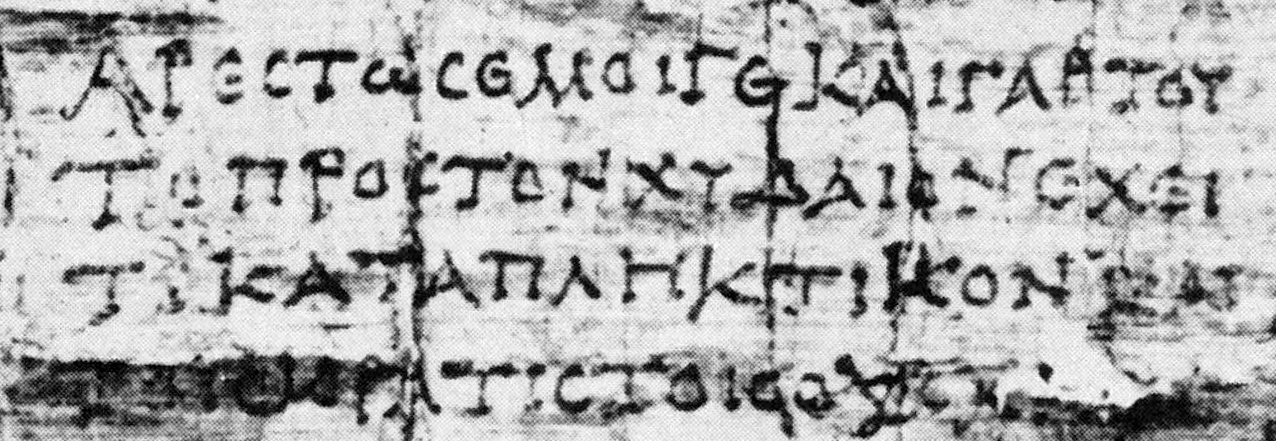
This article (available open access!) originated from a survey of the manuscripts usually regarded as the earliest non-Christian codices. There are a number of interesting things to observe in the corpus, but one item that stood out to me was P.Ant. 1 27 (TM 59621), a nicely preserved parchment folium containing a portion of Demosthenes, De corona. The original editors (C.H. Roberts and J.C Dancy) had assigned it to the third century, but it had more recently been reassigned to the second century.
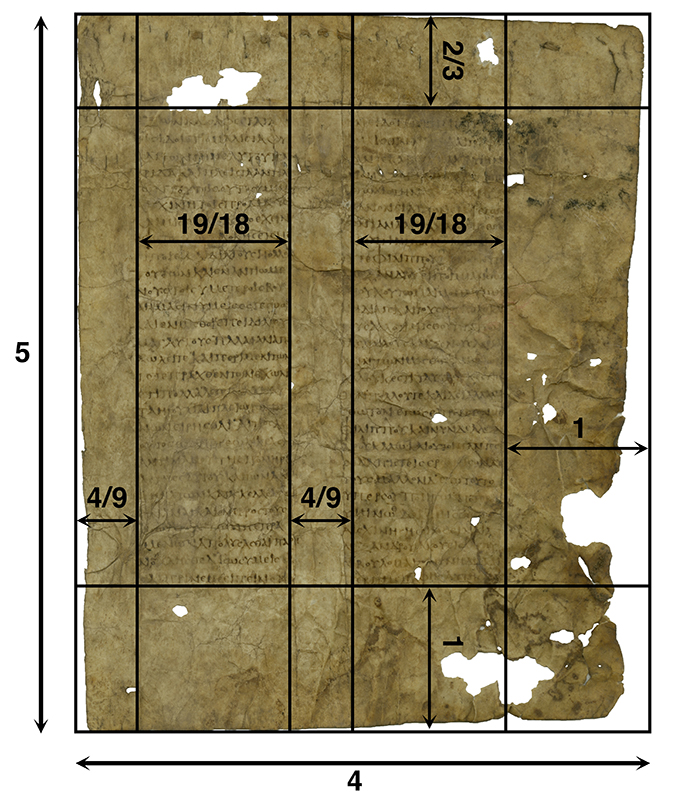
Roberts and Darcy commented upon the layout of the text in two neat columns with wide margins: “The total effect is thus that of a spacious and well-proportioned page.” In fact, the layout of this manuscript aligns shockingly well with a set of somewhat idiosyncratic instructions for laying out a page preserved in the margins of a medieval Latin manuscript (BnF Latin 11884). The manuscript dates to the late ninth century, and the marginal addition, the so-called Recette de Saint-Remi, was probably added in the tenth century.
P.Ant. 1 27 with the layout suggested in the Recette de Saint-Remi superimposed
This similarity between the layout of P.Ant. 1 27 and the recipe has some important implications: Either this recipe for laying out the page has very early roots and the technology of the parchment codex had already reached a highly developed state by the second century, or P.Ant. 1 27 has been assigned a date that is perhaps a bit too early. The article contains an investigation of the dating of this codex, which turned up some fascinating details about the archaeological context of the papyri excavated at Antinoopolis during the Egypt Exploration Fund campaign of 1913-1914. This in turn led to a series of interesting discoveries relating to the Antinoopolis papyri that I will outline in a couple other articles that will hopefully be out soon. A good new year to all!
Thinking about the letters of Augustine reminds me of one of the more interesting manuscripts I encountered this year. Among the many remarkable manuscripts in the Cairo Genizah is Cambridge University Library ADD.4320. It’s a collection of fragments of a palimpsest with an upper text containing masoretic notes on various texts from the Hebrew scriptures and a lower erased text that has been identified as a collection of Augustine’s sermons.
The hand of the Latin script is a clear uncial that has been assigned to the sixth century, making these folia some of the oldest surviving copies of Augustine’s writings.
Cairo Genizah palimpsest with sermons of Augustine, detail of lower Latin text; Cambridge University Library Add. MS. 4320a; image source: University of Cambridge Digital Library
The bookmaker who reused the parchment from the codex of Augustine’s sermons seems to have just cut the bifolia in two down the middle, rotated the resulting folia 90 degrees, and folded them in half to make the new quires.
An open-access article by Hugh Houghton from 2019 provides a fresh treatment of the fragments and supplies the relevant bibliography. Houghton also poses a couple very interesting questions:
“How did a luxury codex of Augustine’s writings come to be reused some three or four centuries later for writing Hebrew masoretic lists before being deposited in the genizah in Cairo? Might still more pages come to light from the same document?”
The codex of Augustine’s sermons is one of several unambiguously “Christian” books that were found in reuse among the genizah fragments (that is to say, the content of the books was Christian, even if the last owners or users of the books did not identify as Christian). These include folia containing a lectionary with gospel readings, folia containing Acts and 1 Peter, and a leaf of Origen’s Hexapla.
It’s not hard to imagine that any serious scholar of the Hebrew Bible in medieval Cairo (Jewish, Christian, Muslim, or “other”) would be happy to have a copy of the Hexapla for consultation. But the exact reasons for someone in the Jewish community having a copy of Acts and the Catholic epistles in Greek or a collection of Augustine’s sermons in Latin is less easy to discern. It’s a reminder of how much we still don’t know about the Jews of medieval Egypt despite the wealth of evidence provided by the Genizah finds.
When I teach about ancient letter writing, one of the things I emphasize is the precariousness of sending letters any great distance in the Roman world. Without an organized postal service, the delivery of letters could be quite haphazard. I just came across a very nice illustration of that point that had escaped my notice until now. It occurs in one of Augustine’s letters to Jerome written in the year 403 (Augustine, Letter 71, Jerome, Letter 104):
“And so, since I already sent two letters, but afterward received none from you, I chose to send the same letters again in the belief that they have not arrived. Even if they did arrive and your letters rather were perhaps unable to reach me, send once again those letters that you already sent if you perhaps kept copies. If not, dictate again something for me to read, provided that you do not, nonetheless, delay to answer this letter because it has already been a long time that I am waiting for it.”1
Most of this letter is dedicated to a fascinating discussion of Jerome’s text-critical activities and their contemporary reception, but this side note about the sending and receiving of letters raises some interesting questions about “original copies,” duplicate copies of letters sent to others, and the possibility of having to dictate an entire letter again.
“Quia ergo duas iam epistulas misi, nullam autem tuam post ea recepi, easdem ipsas rursus mittere volui credens eas non pervenisse. Quod si et pervenerunt ac fortasse tuae potius ad me pervenire minime potuerunt, ea ipsa scripta quae iam misisti iterum mitte, si forte servata sunt; sin minus, rursus dicta quod legam, dum tamen his respondere ne graveris, quod iam diu est ut exspecto!” K.D. Daur, Sancti Aurelii Augustini: Epistulae LVI-C (Brepols, 2005), p. 36; English translation by Roland Teske, The Works of St. Augustine: A Translation for the 21st Century: Letters 1-99 (New City Press, 2001), p. 266. ↩︎
When I think of the Biblical Majuscule, what usually comes to mind is the script of the famous Greek Bible, Codex Sinaiticus, which is usually assigned to the fourth century (though the early fifth is not out of the question). But as Guglielmo Cavallo demonstrated in his classic 1967 study, Ricerche sulla maiouscola biblica, examples of this script persist until the very end of the eighth century and perhaps beyond. I recently had occasion to look into a very late example of the Biblical Majuscule, and I find myself a little confused.
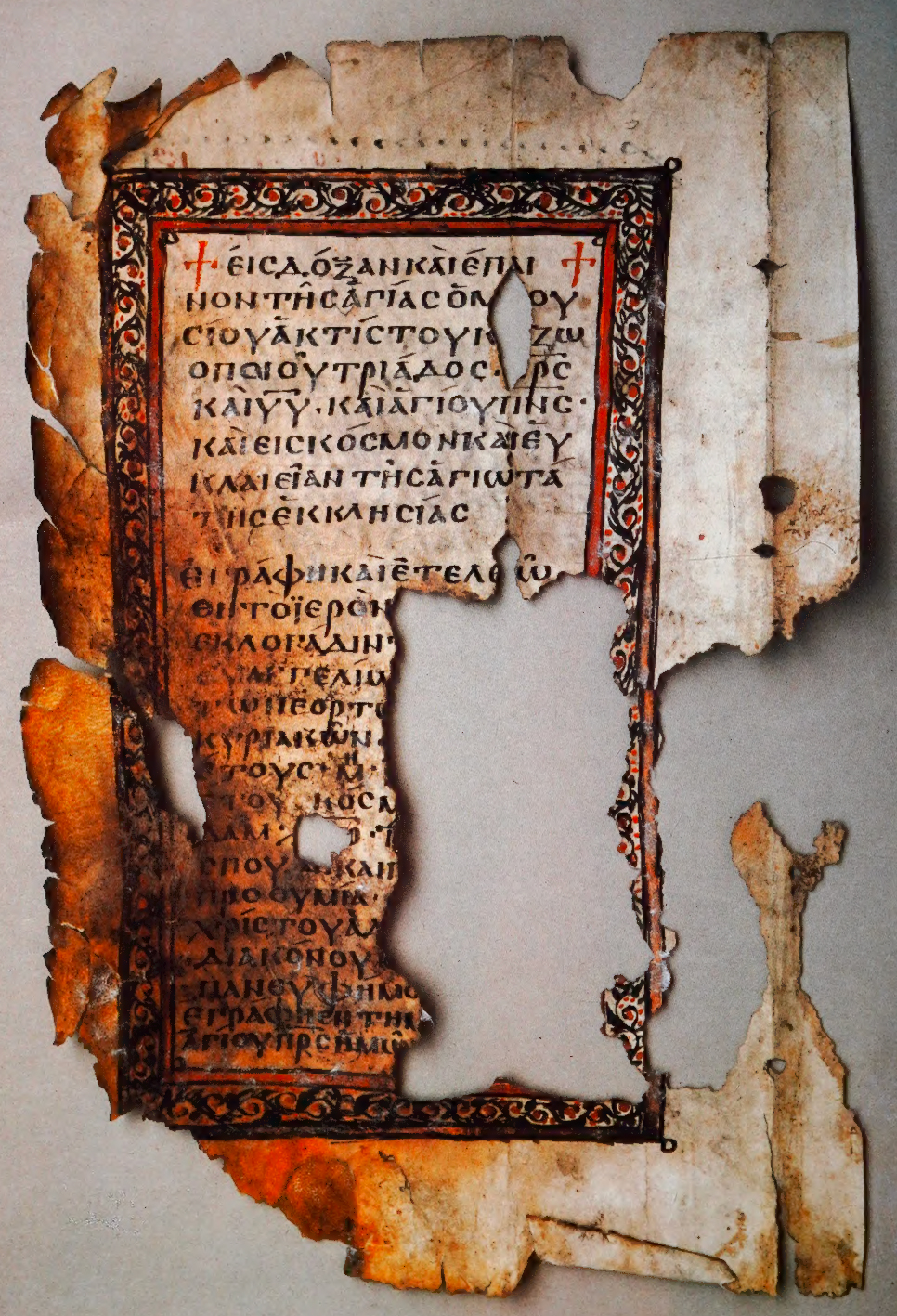
It involves one of the “new finds” from St. Catherine’s Monastery in the Sinai, Sin. ΝΕ gr. ΜΓ 012, a fragmentary parchment bifolium that is usually said to be securely dated to 861/862 CE. The bifolium belongs to Sin. gr. 210, a gospel lectionary (ℓ844 in the INTF numeration). The bulk of Sin. gr. 210 was reported as missing in 1983, but it was photographed in Kenneth W. Clark’s microfilming project in 1949. The date given for the manuscript in the microfilm is eighth century, which seems sensible given the script of the codex (a sloping pointed majuscule). The challenge is that the date given in the colophon preserved in Sin. ΝΕ gr. ΜΓ 012 is said to be 861/862 CE, which would place the codex (and its scripts) squarely in the ninth century rather than the eighth. This manuscript would then be (to the best of my knowledge) the latest precisely dated example of the Biblical Majuscule (at present, I think the generally accepted latest securely dated example is Vat. gr. 1666, a codex containing the Dialogues of Gregory the Great with a colophon dating to 800 CE).
Here is an image of the page in question from Sin. ΝΕ gr. ΜΓ 012:
Sin. ΝΕ gr. ΜΓ 012; image source: D. Harlfinger et al., Specimina Sinaitica (Berlin, 1983), figure 1
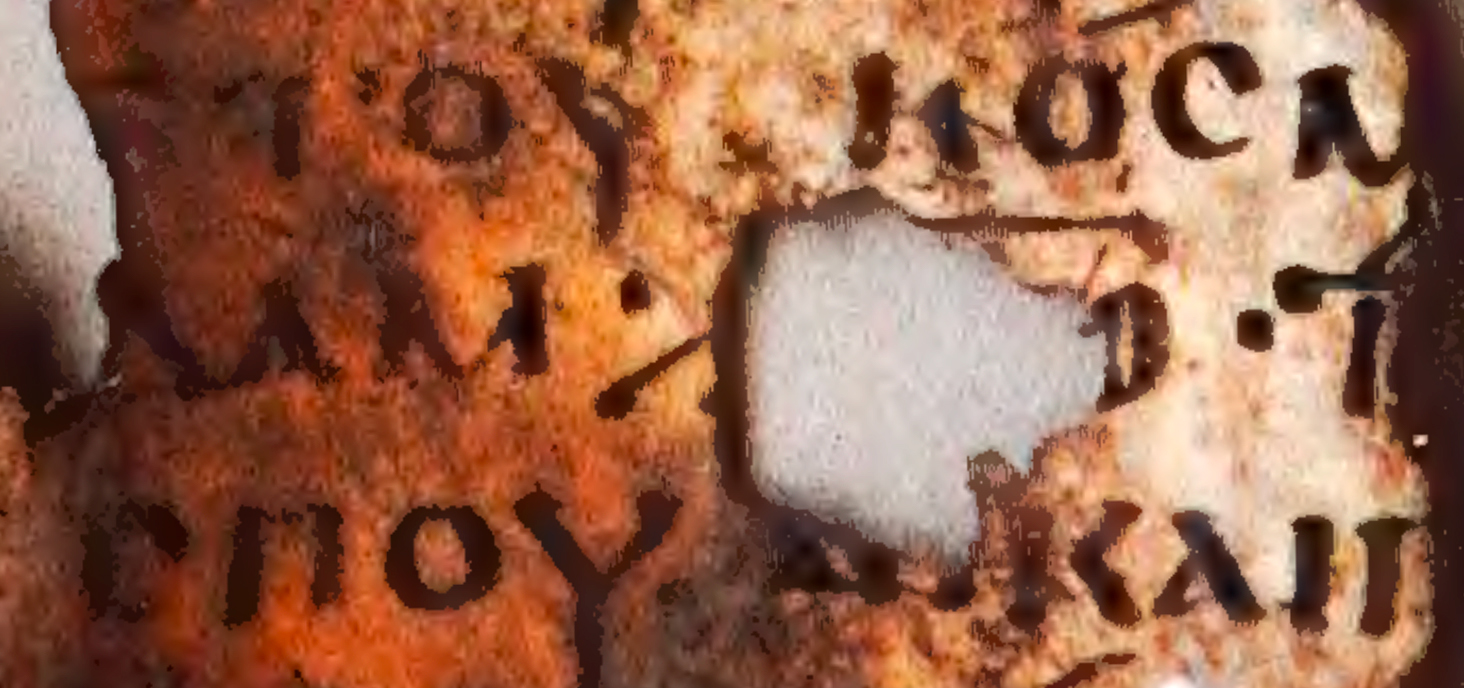
But note that the date is partly (actually mostly) obscured by a hole. Here is an image:
Detail of dating formula in Sin. ΝΕ gr. ΜΓ 012; image source: D. Harlfinger et al., Specimina Sinaitica (Berlin, 1983), figure 1
The editors read the dating formula as:
έτους κόσμ[ου ἀπὸ ἀ]δὰμ/[ϛτ]ο / ·
The date is thus restored to /ϛτο, world year 6370. Based on the assumption that the world was created in September of 5509 BCE, the equation would be 6370–5509 = 861 CE (or maybe 862, since we can’t read the month in the colophon). I can see and accept the omicron (70) for the decade digit, and the millennium digit logically must be a digamma (6000), but the crucial number, the century digit, is completely missing due to the hole in the manuscript. I’m not sure if there is anything else about this codex that would determine that the letter/number to be supplied in the lacuna must be tau rather than sigma, which would give us a date of 761 (or 762) CE.
One issue that may be problematic for restoring a sigma is that 761/762 would be, as far as I know, the earliest example of a precisely dated Greek colophon. At present, I believe the earliest example is again, Vat. gr. 1666, which is dated to April 6308 = 800 CE). So the Sinai codex would either be the earliest precisely dated Greek colophon or the latest example of the Biblical Majuscule, depending on whether we restore a sigma or a tau. Either way, an important milestone.
So, the manuscript is securely dated, in a sense (either 761/762 or 861/862 CE). The INTF Liste describes the date as “861/62?” I wonder if this is the reason for the question mark.
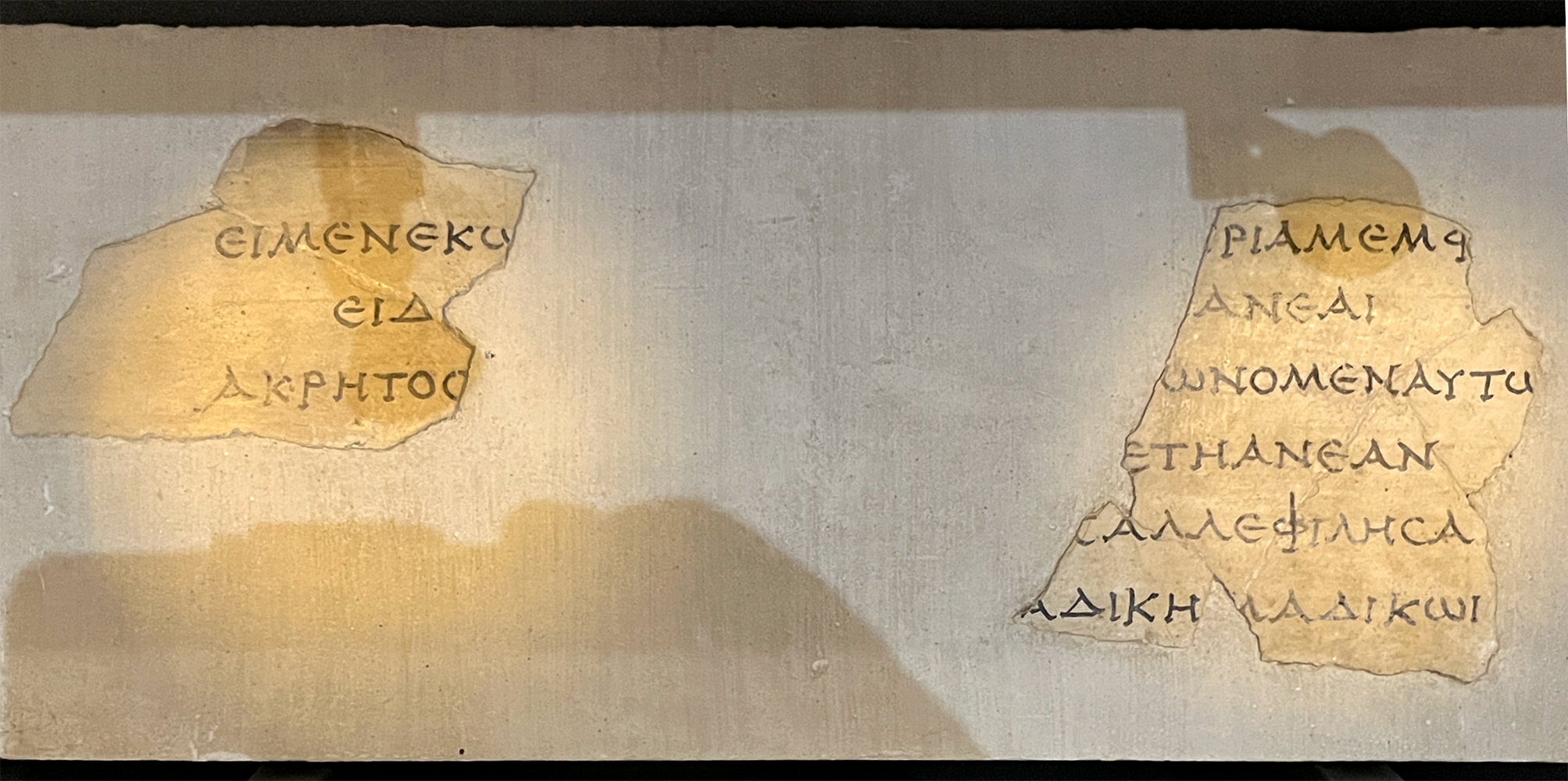
At the Capitoline Museum in Rome, there are a series of rooms dedicated to finds from the various garden areas uncovered in the area of the Esquiline hill in the late nineteenth century. Tucked away in a corner of one of these rooms are some bits of painted fresco with Greek writing in a very nicely executed script. The fragments were found in situ on the exterior of the so-called Auditorium of Maecenas in 1874 (the actual function of this building is open to debate). The mounting and lighting of the fragments in the museum are a little less than ideal, so please excuse the shadows, reflections, and the general quality of the image:
Lines of Callimachus on plaster; Capitoline Museums A.C. inv. 32363; image: Brent Nongbri 2025
The pieces are mounted in a way that indicates how much text is missing in between the two large chunks. We know the amount of missing text within tolerable limits because the lines are known to be an epigram attributed to Callimachus. A drawing was published in 1875 and an edition appeared in 1878.
And in fact there is a new edition of the epigrams of Callimachus, fresh off the presses (October 2025) by Susan Α. Stephens and Benjamin Acosta-Hughes. Here is their full text of the epigram:
If of my free will, Archinus, I had brought a revel, blame me a thousand times, but if I have come against my will, permit my rashness. Unmixed wine and love compelled me, of which the one dragged me, the other would not allow me to let my insolence go. When I came, I did not shout out who I was and whose son, but I kissed the doorpost. If this is wrong-doing, I do wrong.1
Stephens and Acosta-Hughes provide an excellent and thorough line-by-line commentary, as they do for all the epigrams (just one quibble: In connection to these plaster fragments, they write that “the inscription no longer exists,” but here it is! The didactic material at the museum gives no indication that these pieces are facsimiles).
The script is quite interesting. It was applied with a brush but shows an attempt to mimic the effects of the use of a stylus for serifs, occasionally giving some vertical lines ends that look like arrows (e.g. tau as ↧).
Detail, lines of Callimachus on plaster; Capitoline Museums A.C. inv. 32363; image: Brent Nongbri 2025
The script is similar to that found in some surviving papyri. It features letters of a basically square modulus, with only the phi really breaking bilinearity. The alpha is often written in three clear strokes, the epsilon often shows a little bit of space between the curve and the central stroke, and the phi has a somewhat compressed loop and prominent foot. The hand reminds me of some Herculaneum papyri, such as P.Herc. 1507:
P.Herc. 1507; image source: G. Cavallo, Libri scritture scribi a Ercolano (Cronache Ercolanesi supp., 1983), plate LIII
It also brings to mind certain Jewish manuscripts, such as P.Fouad inv. 266:
P.Fouad inv. 266; image source: Z. aly and L. Koenen, Three Rolls of the Early Septuagint (Habelt, 1980), plate 18
Both of these manuscripts have been assigned to the first century BCE, and it seems plausible that our lines of Callimachus could have been written in the same period (i.e., during the first or second phase of the building’s use), although a later date cannot be ruled out.
And where, exactly, were these lines displayed? The excavators give us a description:
“Some passages of a Greek epigram, which, with a brush dipped in black, had been written on the white plaster of the external wall of the semicircle, near the middle of its curve. The point where these verses could be read is about two-thirds of the height of the wall; so high that, in the present state of the excavation, one would have to get up on a ladder; but when the building was in its original condition, that is to say, sunken the ground up to more than half its height, it was possible to write comfortably in that spot, standing in front of the wall. The part of the plaster on which the epigram had been written, although torn into pieces and lacunose, was detached, by the care of this Commission, and is preserved among its collections of antiquities.”2
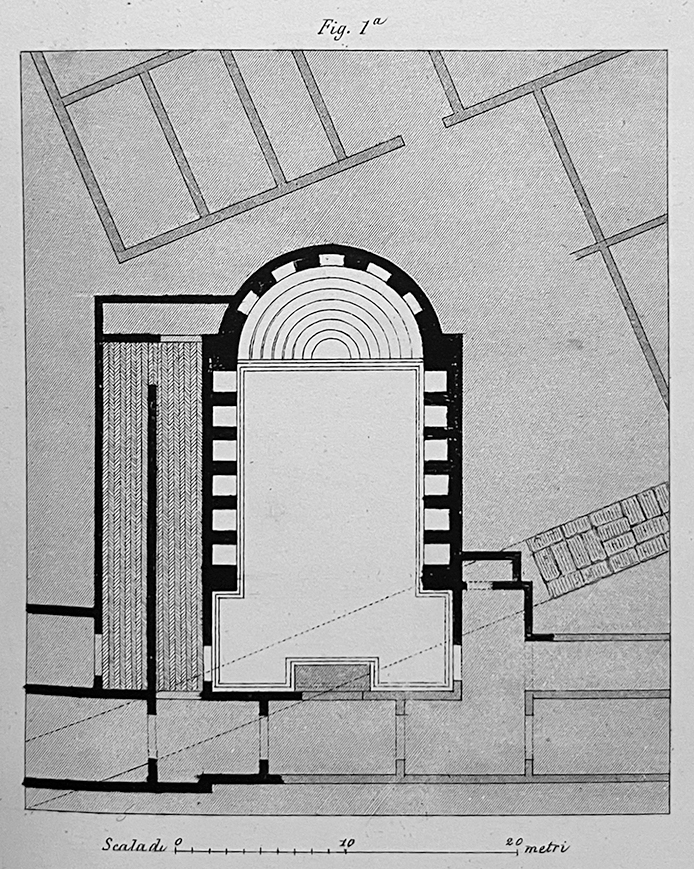
The top plan and reconstructed profile drawing offered by the excavators give a reasonably good idea of the position of the verses “on the external wall of the semicircle.” Notice the hypothesized ground level shown at the right side of the profile drawing.
Top plan of the “Auditorium of Maecenas”; image source: Vespignani and Visconti (1874), Tav. XI
Reconstructed profile of the “Auditorium of Maecenas”; image source: Vespignani and Visconti (1874), Tav. XI
It’s nice to learn of the existence of these fragments, and it’s wonderful to be able to recover their context, at least to a certain extent.
Susan A. Stephens, Benjamin Acosta-Hughes, Callimachus: The Epigrams (De Gruyter, 2025), 271. ↩︎
V. Vespignani and C.L. Visconti, “Antica sala da recitazioni, ovvero auditorio, scoperto fra le ruine degli orti mecenaziani sull’ Esquilino,” Bullettino della Commissione Archeologica Comunale di Roma (1874) at 162: “Alcuni brani di un greco epigramma, il quale col pennello intriso di nero era stato scritto sull’ intonaco bianco del muro esterno dell’ emiciclo, quasi nel mezzo della sua curvatura. Il punto in che leggevansi questi versi corrisponde a circa due terzi dell’ altezza del muro; talchè, nello stato attuale del disterro, sarebbe necessario ascendervi con una scala: ma quando l’ edifizio era nelle sue condizioni primitive, cioè a dire, internato nel suolo per più della metà di sua altezza, poteasi comodamente scrivere in quel sito, stando in piedi avanti la parete. La parte dell’ intonaco in cui l’ epigramma era stato vergato, sebbene ridotta in brani e mancante, venne distaccata, per cura di questa Commisione, e si conserva fra le suo raccolte di antichità.” ↩︎
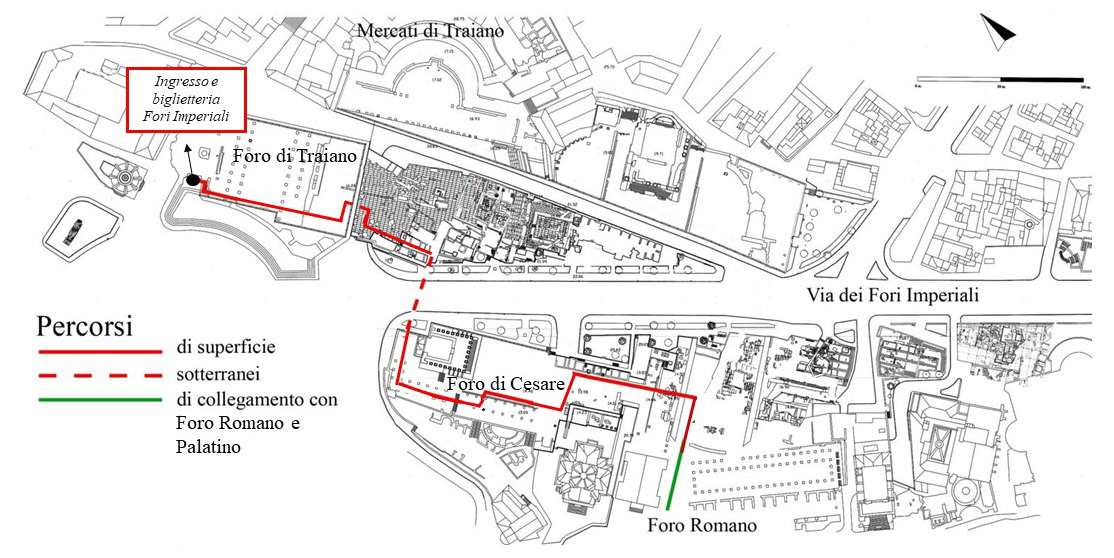
For the first time since it opened, I took the walk on the new pathway through the imperial fora in Rome. From the Roman Forum you can go past the curia (where, at the moment, a portion of the Magna Mater exhibition is on display) and on a raised path through the Forum of Nerva and the Forum of Caesar, under the Via dei Fori Imperiali and into the Forum of Trajan. The perspective from well below street level was fascinating, but it was a lot to take in.
Certainly a highlight for me was the Forum of Nerva. The poet Martial locates book sellers in exactly this area, and provides names for a couple of them (translations courtesy of Shackleton Bailey):
“Look for Secundus, freedman of lettered Lucensis, behind Peace’s entrance and Pallas’ Forum” (libertum docti Lucensis quaere Secundum limina post Pacis Palladiumque forum, 1.2)
“No doubt you often go down to Argiletum. Opposite Caesar’s Forum there’s a shop (contra Caesaris est forum taberna) with its doorposts completely covered by advertisements, so that you can read the entire list of poets at a glance. Look for me there. Ask for Atrectus (that being the name of the shop’s proprietor), and he will hand you from the first or second pigeonhole a Martial, shaved with pumice and smart with purple, for five denarii” (1.117)
With these passages in mind, it was striking to see the “You are here” didactic sign:
Of course, the didactic material doesn’t tell you exactly which ground level you’re standing on, but it was still very helpful to be able to get a sense of the space at this lower level, and I hope the accessible areas expand to include the Temple of Peace. But even as it is now, it’s definitely worth a second visit.
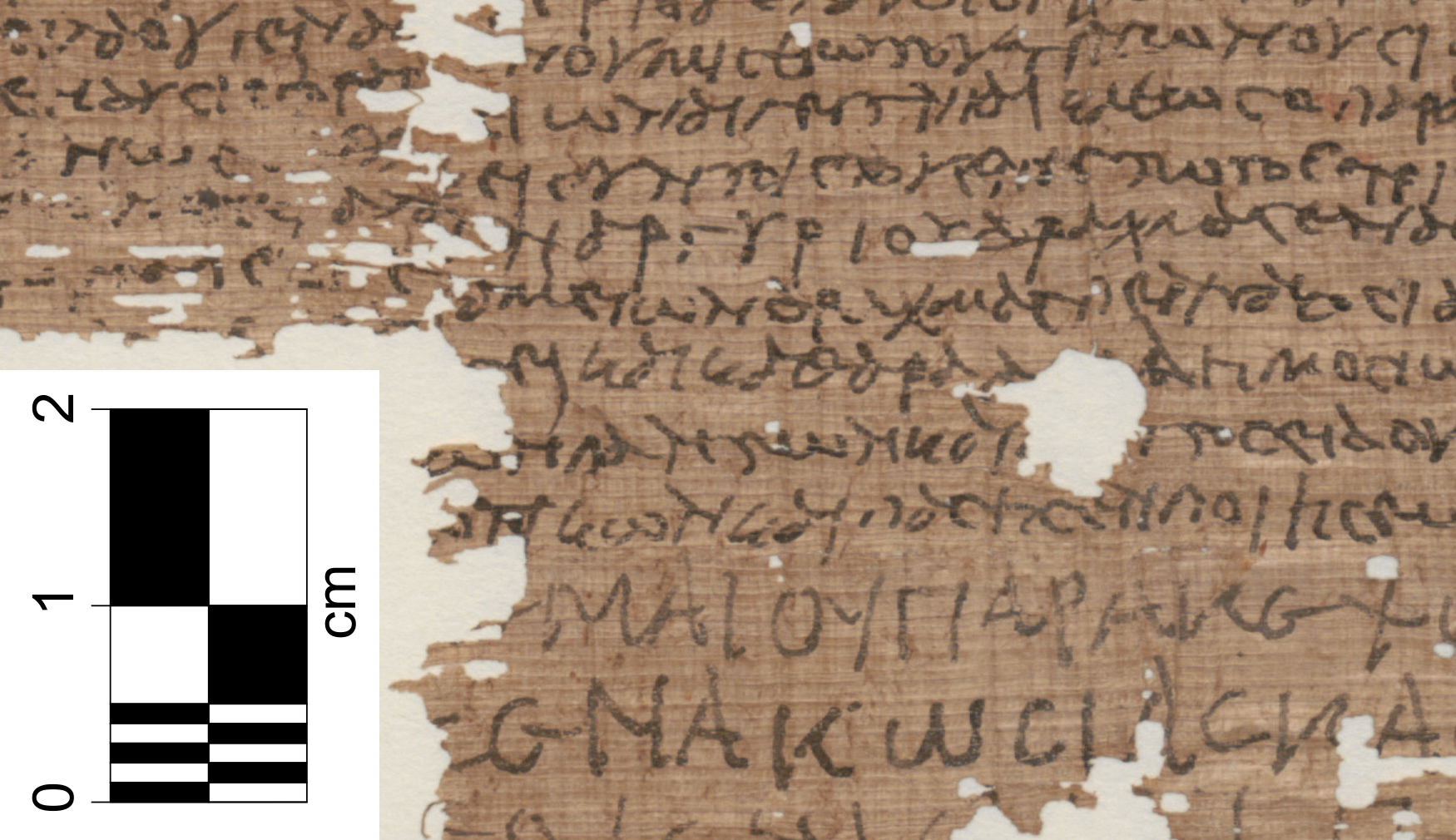
I have written before about 7Q5, a small fragment of papyrus found in Cave 7Q at Qumran. It contains an unidentified text in Greek. It became (in)famous in the early 1970s when José O’Callaghan (1922-2001) argued that it preserved a bit of the Gospel According to Mark (Mark 6:52-53). Crucial to this identification was the reading of line 2. The original editors had read the Greek letters tau, omega, iota, and alpha, ⲧⲱⲓ ⲁ̣. O’Callaghan saw instead tau, omega, and the remains of a very oddly shaped Greek letter nu, ⲧⲱⲛ.
I say “oddly shaped” because construing the existing traces of ink in line 2 as a nu would result in a letter substantially different from the clear letter nu that occurs in line 4 of 7Q5.
Undisputed nu in line 4 of 7Q5 (left) and hypothetical forms of a would-be nu in line 2 of 7Q5 (center and right); original image source: Leon Levy Dead Sea Scrolls Digital Library (photographer: Najib Anton Albina)
For this and other reasons, O’Callaghan’s argument did not prove persuasive to most scholars.1 His argument has, however, lived on among some enthusiastic supporters.
In an another post, I noted that those in favor of the identification of 7Q5 as Mark often invoke names of authorities who have at one time or another agreed with O’Callaghan. Figuring out what these authoritative voices actually said, however, is often challenging, as the advocates almost never cite arguments but instead just list names. So, over the last year, I have been tracking down some of these references. In my earlier post, I looked into what the papyrologist Orsolina Montevecchi (1911-2009) had to say about 7Q5. It turned out that she added nothing substantial to the discussion and in fact obscured matters by ignoring the key point (O’Callaghan’s readings of certain letters are not really possible given the ink on the page). In this post, I will examine the contribution of another authority whose name frequently comes up in these discussions.
Carsten Thiede (1952-2004), perhaps the most vocal promoter of O’Callaghan’s interpretation of 7Q5, frequently brought up the name of Herbert Hunger in support of O’Callaghan: “A classical papyrologist like Herbert Hunger, with no vested ‘theological’ interest either for or against the proposed New Testament passage, accepted the nu without the slightest hesitation.”2 This is interesting. Hunger was a scholar with a formidable reputation–What did he actually say in connection to 7Q5?
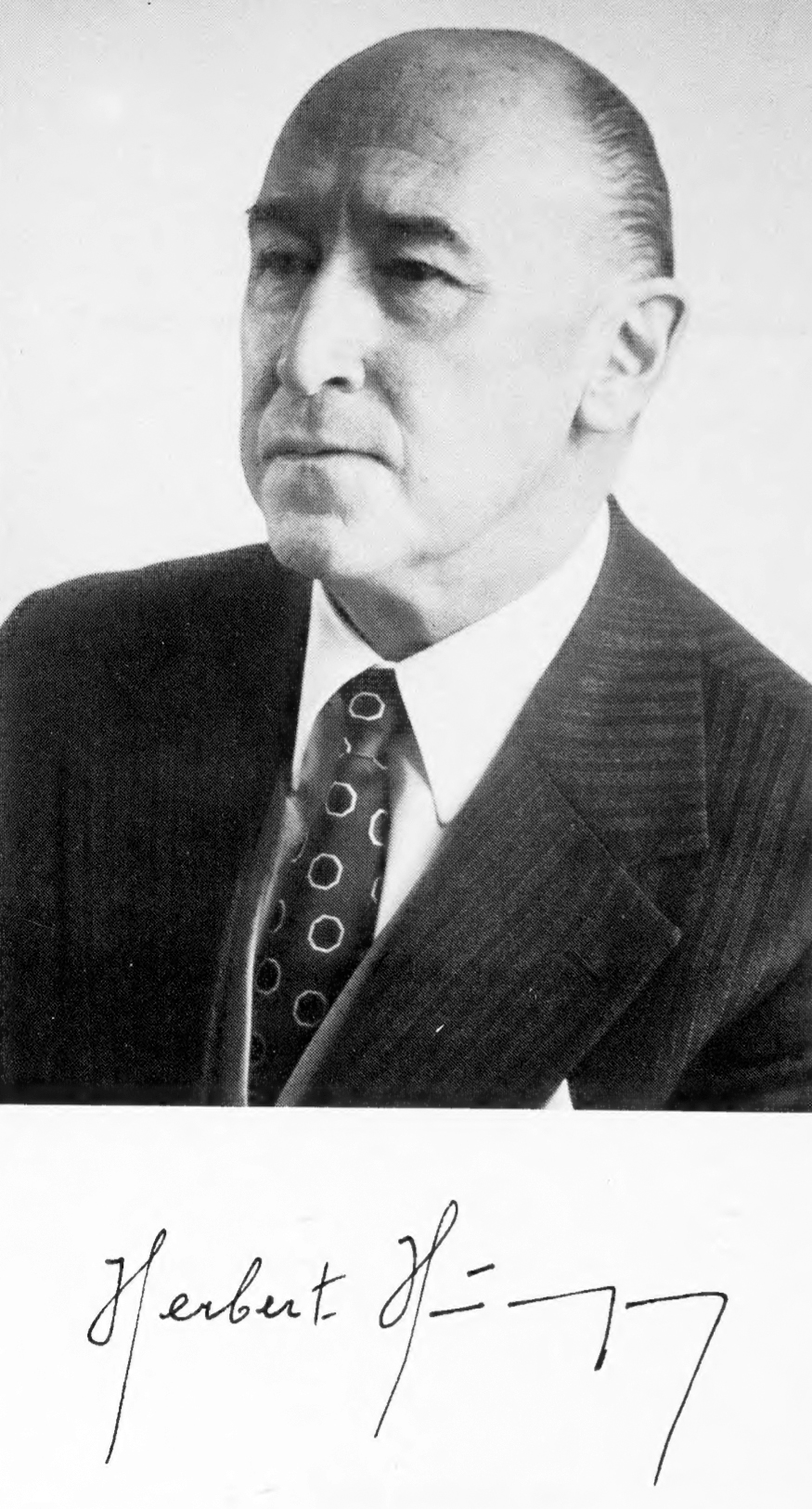
Herbert Hunger (1914-2000) is primarily remembered as a Byzantinist, but early in his career, he also had responsibility for the large collection of papyri in the Austrian National Library for a period of six years (1956 to 1962). During this stretch of time, he produced a booklet on the Vienna collection as well as editions of several Vienna papyri (17 pieces by my count, but I may be missing some).3 And in 1961, he published a short article on P.Bodmer 2 that attempted to redate that manuscript of John’s gospel from the early third century to the first half of the second century, an effort that received a mixed reception.4
Portrait of Herbert Hunger; image source: W. Hörandner et al. (eds.), ΒΥΖΑΝΤΙΟΣ: Festschrift für Herbert Hunger zum 70. Geburtstag (Vienna, 1984), iv.
In 1962, Hunger was appointed as Ordinariat für Byzantinistik at the University of Vienna and left behind the papyrus collection. Hunger held this position in Byzantine Studies for over twenty years. During that period, he was a prolific scholar, initiated many long-term research projects, and became widely known and respected in the world of Byzantine Studies. He was honored with multiple Festschriften by his colleagues and received several honorary degrees.
In a book published in 1992 (seven years after his retirement from the chair in Byzantine Studies in 1985), Hunger reclaimed the title of “papyrologist” and authored a chapter in support of Carsten Thiede’s identification of 7Q5 as a copy of Mark. The title of his contribution was “7Q5: Markus 6,52-53 – oder? Die Meinung des Papyrologen.”5
Unlike Montevecchi, Hunger did make a new argument in support of Thiede’s (and O’Callaghan’s) contested readings of letters in 7Q5. Hunger began his chapter by criticizing the appearance of the script of 7Q5, describing it as “below average” (unterdurchschnittlich) and even going so far as to call it the product of a βραδέως γράφων, a “slow writer,” that is, a person just (barely) capable of writing their own name and a short statement on a document.6
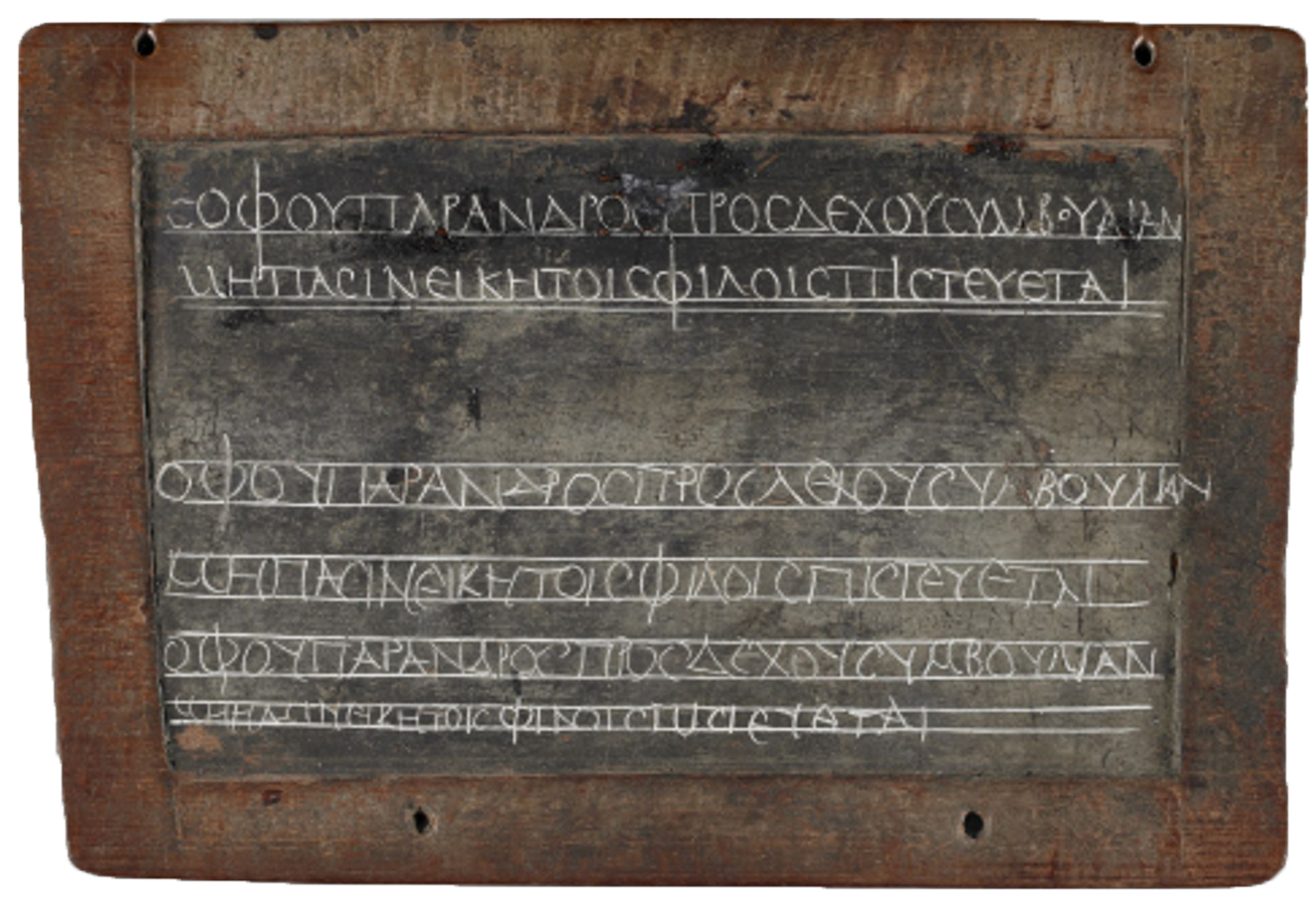
Hunger then offered comparisons between the letters in 7Q5 and the letters in two other pieces that have examples of less-than-competent writing: the student hand in the famous wax tablet at the British Library (Add. MS. 34186) and the signator’s hand in P.Vindob. inv. G 02001.
In connection with the wax tablet, Hunger saw similarities between the sigma, eta, and nu of the student hand and the hand of 7Q5.
Wax tablet with a teacher’s example (top) and a student’s copy (bottom), British Library, Add. MS. 34186; image source: The British Library
in P.Vindob. inv. G 02001, Hunger pointed to the alpha and omega as being similar those letters in 7Q5.
In these comparisons, Hunger also focused especially on forms of the letter nu, arguing that the scribe of 7Q5 was not an experienced writer and may thus have written the same letter in very different and even non-standard ways.
Up to this point the argument is comprehensible. I disagree with Hunger’s assessment (there is nothing about the script of 7Q5 that suggests the writer was incompetent), but thus far, Hunger’s argument is at least intelligible.
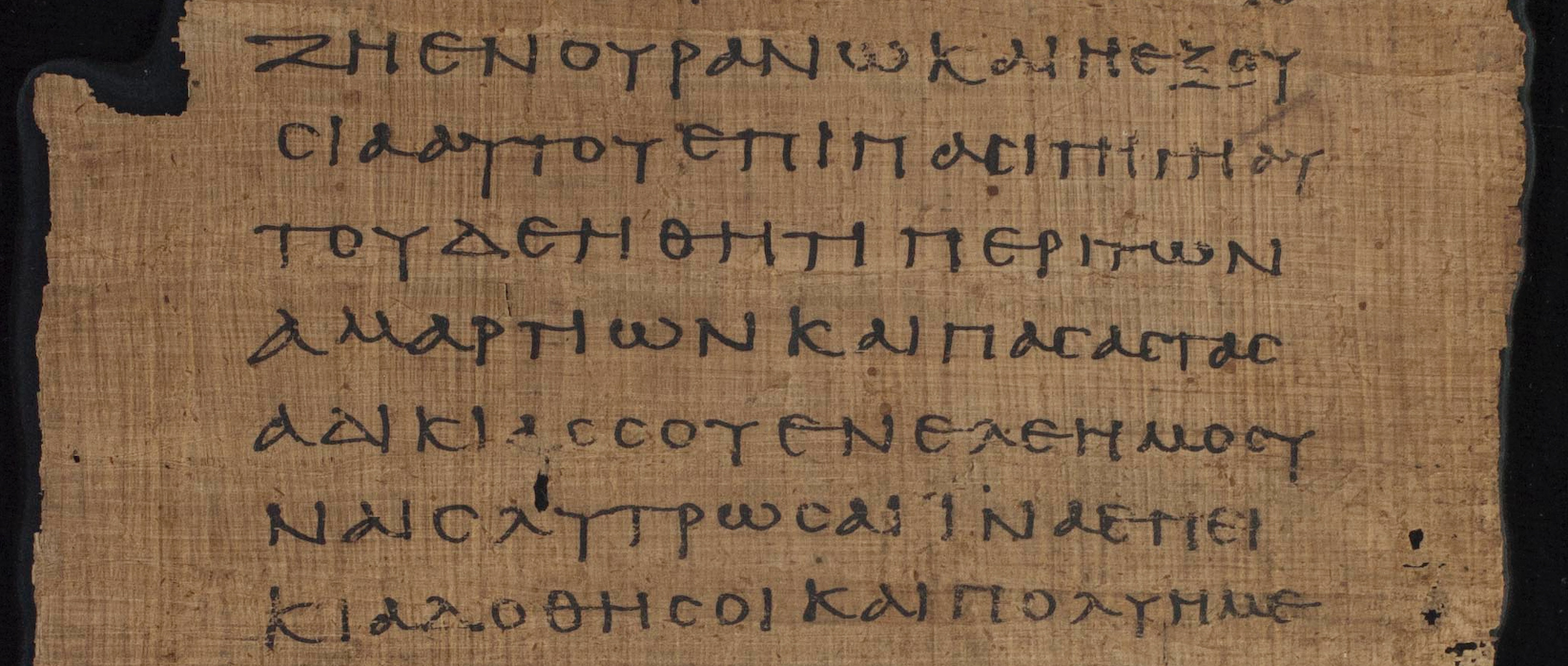
But then Hunger very abruptly and without comment begins a hunt through palaeographic handbooks and the Vienna papyrus collection in search of forms of the letter nu that might somehow fit with the visible bits of ink in line 2 of 7Q5. That is to say, rather than continuing the argument about incompetent writers, Hunger turns to alleged parallels from perfectly competent writers, which makes no sense in terms of his larger argument. To make matters worse, his suggested parallels do not really resemble the oddly shaped nu that O’Callaghan’s proposal demands. I offer just one of Hunger’s examples drawn from Seider’s palaeogrgaphic handbook, Seider II, plate 45 (that is, the Chester Beatty Ezekiel-Daniel-Esther codex):
Hunger claimed the nu in the Beatty papyrus showed the same “diagonal oscillation” (diagonale Schwingung) of the supposed nu in line 2 of 7Q5. But there is no real similarity; the nu in the Beatty papyrus is formed in a perfectly normal manner. It will not be helpful to work through any more comparisons because Hunger’s approach involves piling up irrelevant palaeographic comparanda in order to give the impression of having a solid argument. In fact, it is all a house of cards (incidentally, this is also the approach that Hunger took in his article on P.Bodmer 2).
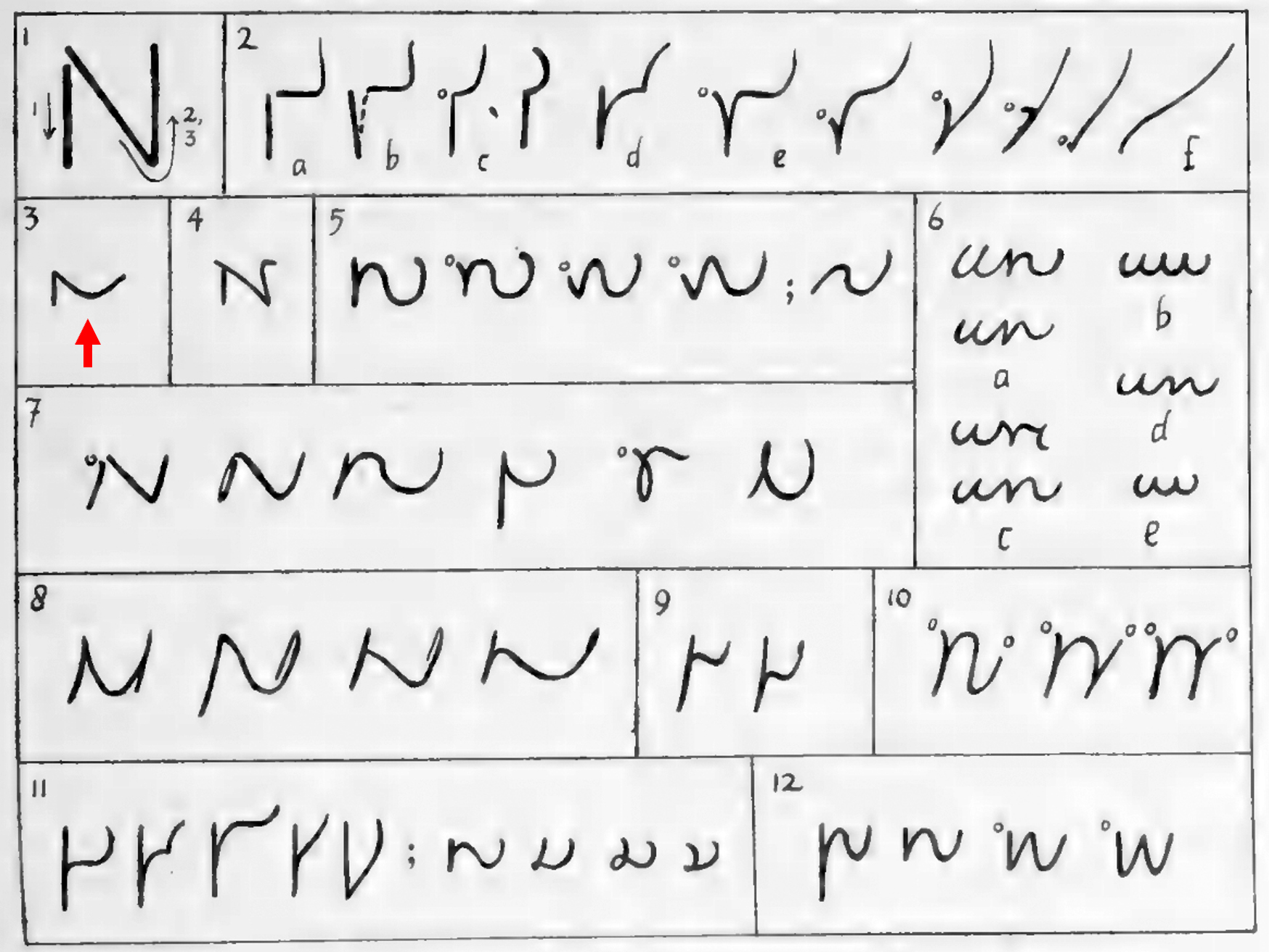
To confuse matters further, Hunger turned to an article by J.P. Gumbert, “Structure and Forms of the Letter ν in Greek Documentary Papyri: Α Palaeographical Study,” Papyrologica Lugduno-Batava 14 (1965), 1-9. From Gumbert’s chart of documentary forms (which, to be completely clear, tracks forms produced by competent writersof documentary texts–that is the whole point of his study). Hunger suggested that the (supposedly incompetent) writer of a literary text in 7Q5 was trying to produce a very particular documentary form of nu, marked with a red arrow in the Gumbert’s chart below:
With this alleged parallel, Hunger believed he had clinched his argument:
“The Urform to which the disputed nu in line 2 can be traced is found in Gumbert (Fig. 17). Once one has thought this through properly, one will not be offended by the remains of the letter that still exist today [in 7Q5], but will confidently interpret them as nu.”7
It is a baffling argument. According to this scenario, someone that could hardly write their own name or keep to a straight line would have managed to copy out (at least) two full sentences from the Gospel According to Mark in a literary script complete with serifs and sense spaces, but also with an intention to write the letter nu on the model of an obsolete documentary form (but only sometimes!).
Hunger followed up his defense of Thiede with a pretty shocking statement: “If someone rejects a meaningful decipherment and identification of a text, they should feel obligated to offer an alternative.”8 So, Hunger’s position is effectively that a manifestly incorrect identification is better than having the humility to admit the evidence is insufficient to make a confident identification. This is simply bad scholarship.
Finally, Hunger ended his chapter with an argument that is theological rather than palaeographic: If people disagree that 7Q5 is a copy of Mark, it can only be because “their hearts have been hardened” (Mark 6:52).
Whether or not one agrees with Thiede’s characterization of Hunger as “a classical papyrologist” with “no vested theological interests,” Hunger’s papyrological arguments on display in this chapter are poorly formed and completely unconvincing. Hunger’s argument is internally inconsistent, and neither of the two inconsistent parts of the argument is convincing on its own. Nothing about the script of 7Q5 indicates that it was the product of a βραδέως γράφων; the few extant letters have the appearance of being written by someone comfortable with copying literary Greek. At the same time, the alleged palaeographic parallels that Hunger presents with competent hands are not really relevant to the script of 7Q5.
So, when it comes to the readings of 7Q5, appeals to the authority of Herbert Hunger, just like the appeals Montevecchi, carry no weight.
See, for example, E.J. Epp and L.W. Hurtado, “Qumran Greek Fragments 7Q3-7Q19” in The Dead Sea Scrolls: Hebrew, Aramaic, and Greek Texts with English Translations, vol. 5B (Westminster John Knox, 2024): “The chief problem was O’Callaghan’s need to assume or propose a number of highly unlikely or quite impossible readings, such as ν in line 2, when it is clearly ι-adscript.” ( ↩︎
Carsten Peter Thiede, The Earliest Gospel Manuscript? The Qumran Papyrus 7Q5 and its Significance for New Testament Studies (Pater Noster Press, 1992), 35. ↩︎
The booklet was H. Hunger, Die Papyrussammlung der Österreichischen Nationalbibliothek. Katalog der ständigen Ausstellung (Biblos-Schriften 35; Vienna: Österreichische Nationalbibliothek), 1962 (37 pages and 16 plates). The editions of papyri that I have been able to identify are the following: H. Hunger, “Ein neues Septuaginta-Fragment in der Österreichischen Nationalbibliothek,” Anzeiger der Österreichische Akademie der Wissenschaften, philosophisch-historische Klasse 93 (1956) 188-199. H. Hunger, “Die Logistie – ein liturgisches Amt. (Pap. Graec. Vindob. 19799/19800),” Chronique d’Egypte 32 (1957) 273-283. H. Hunger, “Zwei unbekannte neutestamentliche Papyrusfragmente der Österreichischen Nationalbibliothek,” Biblos 8 (1959) 7-12 [updated in H. Hunger, “Ergänzungen zu zwei neutestamentlichen Papyrusfragmenten der Österreichischen Nationalbibliothek,” Biblos 19 (1970) 71-75]. H. Hunger, “Zwei Papyri aus dem byzantinischen Ägypten (Pap. Graec. Vindob. 16887 und 4),” Jahrbuch der Österreichischen Byzantinistik 9 (1960) 21-30. H. Hunger, “Eine frühe byzantinische Dialysis-Urkunde in Wien (Pap. Graec. Vindob. 16),” Jahrbuch der Österreichischen Byzantinistik 10 (1961) 1-8. H. Hunger and A. Fackelmann, “Grundsteuerliste aus Arsinoe in einem Papyruskodex des 7. Jahrhunderts. Ein neuartiger Restaurierungsversuch an Pap. Graec. Vindob. 39739,” Forschungen und Fortschritte 35 (1961) 23-28. H. Hunger, “Pseudo-Platonica in einer Ausgabe des 4. Jahrhunderts. Ein neues Fragment in der Papyrussammlung der Österreichischen Nationalbibliothek (G 39846),” Wiener Studien 74 (1961) 40-42 H. Hunger, “Ein Wiener Papyrus zur Ernennung der Priester im römischen Ägypten (Pap. Graec. Vindob. 19793),” Acta Antiqua Academiae Scientarum Hungaricae 10 (1962) 151-156. H. Hunger Herbert and E. Pöhlmann, “Neue griechische Musikfragmente aus ptolemäischer Zeit in der Papyrussammlung der Österreichischen Nationalbibliothek (G 29.825 a-f),” Wiener Studien 75 (1962) 51-78. H. Hunger, “Papyrus-Nachlese zu Homer (Unbekannte Fragmente aus der Papyrussammlung der Österreichischen Nationalbibliothek.),” Wiener Studien 76 (1963) pp. 159-162. ↩︎
H. Hunger, “Zur Datierung des Papyrus Bodmer II (P66),” Anzeiger der Österreichischen Akademie der Wissenschaften, philosophisch-historische Klasse 97 (1961) 12-23. Although Hunger’s article was cited with some frequency, the dated documentary parallels that Hunger proposed for the script of P.Bodmer 2 were described by Eric G. Turner as “not cogent.” For the assessment and Turner’s alternative analysis of P.Bodmer 2, see E.G. Turner, Greek Manuscripts of the Ancient World (Oxford, 1971), 108. ↩︎
The chapter was the published version of a paper given at a symposium on 7Q5 held at the Katholische Universität Eichstätt in 1991: B. Mayer (ed.), Christen und Christliches in Qumran? (Regensburg: Pustet, 1992). ↩︎
“Die “Urform”, auf die das in Zeile 2 vorliegende umstrittene Ny zurückgeht, findet sich auch bei Gumbert (Abb. 17). Wenn man das einmal richtig überlegt hat, wird man auch an den heute noch vorhandenen Resten des Buchstabens keinen Anstoß nehmen, sondern sie getrost als Ny deuten” (Hunger, “7Q5: Markus 6,52-53 – oder?” 37). ↩︎
“Wer eine sinnvolle Entzifferung eines Textes und dessen Identifizierung ablehnt, sollte sich verpflichtet fühlen, eine Alternative anzubieten” (“7Q5: Markus 6,52-53 – oder?” 39). In point of fact, many alternative identifications have been proposed, though none has proven fully convincing. ↩︎
I’ve removed all the content I had on academia.edu. Much of what was on my page there is available here on the publications page and the book review page. For copies of other publications, just email me.
I’ve been contemplating this for a while, but it was the disturbing auto-generated AI podcasts combined with absurd changes made a couple weeks ago to the privacy policy that finally made me decide to remove the material. The company apparently walked back some of the language in the privacy policy a few days after the policy was issued, but it seems only a matter of time before the same kinds of things happen again. I understand that academia.edu is a for-profit company that needs to make money, but this stuff just feels somehow wrong.
I’m genuinely sad about this. Over the years I discovered a lot of interesting research on academia.edu that I would probably not have otherwise encountered. Also, if the stats provided by the site are accurate and meaningful, a decent number of people found my work there. And when I was unemployed and without academic affiliation, academia.edu was one of the few means I had to kind of stay connected to the world of research.
But this points to larger issues about the dissemination and availability of research in academic journals: Is the academia.edu model really any more exploitative than traditional academic publishers for whom we write and (peer review) at no cost, just so that they then can sell our scholarship back to universities at prices that are often outrageous? I don’t know. I’m trying to publish more in open-access venues, but that whole system has its own sets of problems. There are of course the predatory open access publishers, but even the traditional journals associated with the “big” presses have open access policies that are pretty shocking. For instance, I recently had an article accepted for publication in a venerable journal. To make the article open access, the publisher asks for a fee of $3,550 USD. But someone working at a wealthier institution that has a deal with the press could publish open access in the very same journal at no personal cost. So, the articles of authors at wealthy universities are freely available, while my article sits behind a paywall (it would cost an individual about $30 USD to access the article through the publisher website). I will of course make the “Author Accepted Manuscript” available and provide copies of articles to those who contact me, but these seem like inadequate solutions to a larger problem.
I honestly don’t know what is best solutions are, but I’m convinced that it’s time for me to move on from academia.edu.
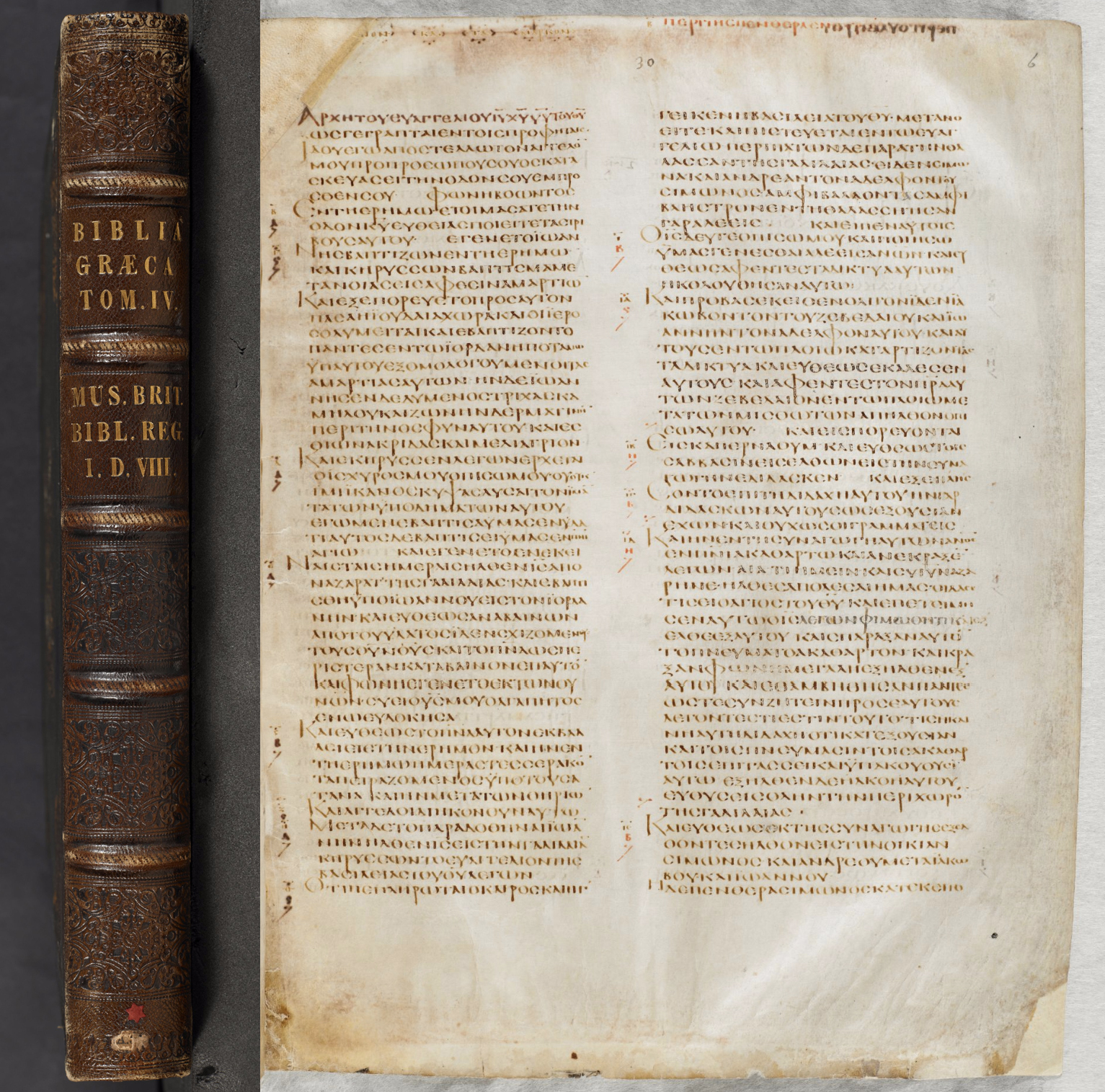
Recent scholarship on the codex has generally rejected the possibility that the manuscript was produced in Egypt (Constantinople is the most frequently named alternative; Ephesus has also been suggested). Now Monier’s article brings together several arguments that undercut the case for Constantinople and offer support for an Egyptian provenance for the codex. Among other things, the article:
provides both an improved transcription and a richer contextualization of the Arabic endowment statement in the codex. The result is that there is no longer any reason to believe that Codex Alexandrinus came to Egypt with a group of books from Constantinople in the early fourteenth century, which has been the usual assumption since T.C. Skeat’s 1955 article on the provenance of Alexandrinus.
points out that marginal liturgical notes in Arabic can be explained only in light of the Coptic paschal lectionary.
highlights neglected Egyptian evidence for lists of New Testament books that match the curious contents and order of the New Testament books in Codex Alexandrinus (which includes 1-2 Clement and places Hebrews between 2 Thessalonians and 1 Timothy).
There is much more in the article itself (including a thorough discussion of the enigmatic reference to “the handwriting of Thecla the Martyr,” as well as a new approach to the context of the foliation of the codex). This is a fascinating read, and I have no doubt that this will be a landmark study that reorients the discussion of the early history of Codex Alexandrinus.
Codex Alexandrinus (British Library, Royal MS 1 D. viii)
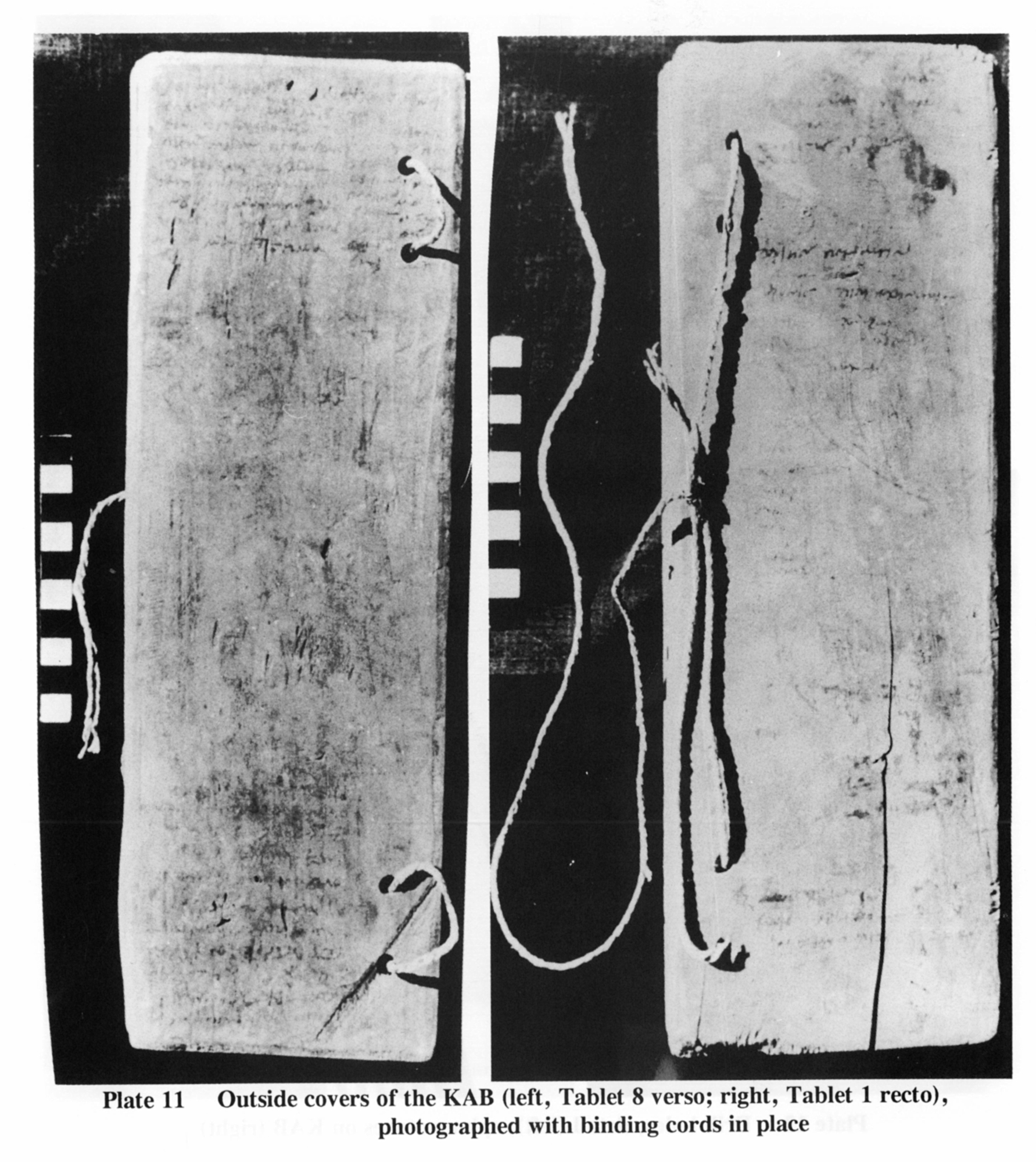
For a long time, I assumed that sets of wooden tablets from the Roman era were bound in a fairly simple way, with a cord looped straight through the holes as we see in this set of tablets from Kellis that were found with the cord in place:
Kellis Account Book with binding cord in place; image source: R.S. Bagnall, The Kellis Agricultural Account Book (Oxbow, 1997), plate 11.
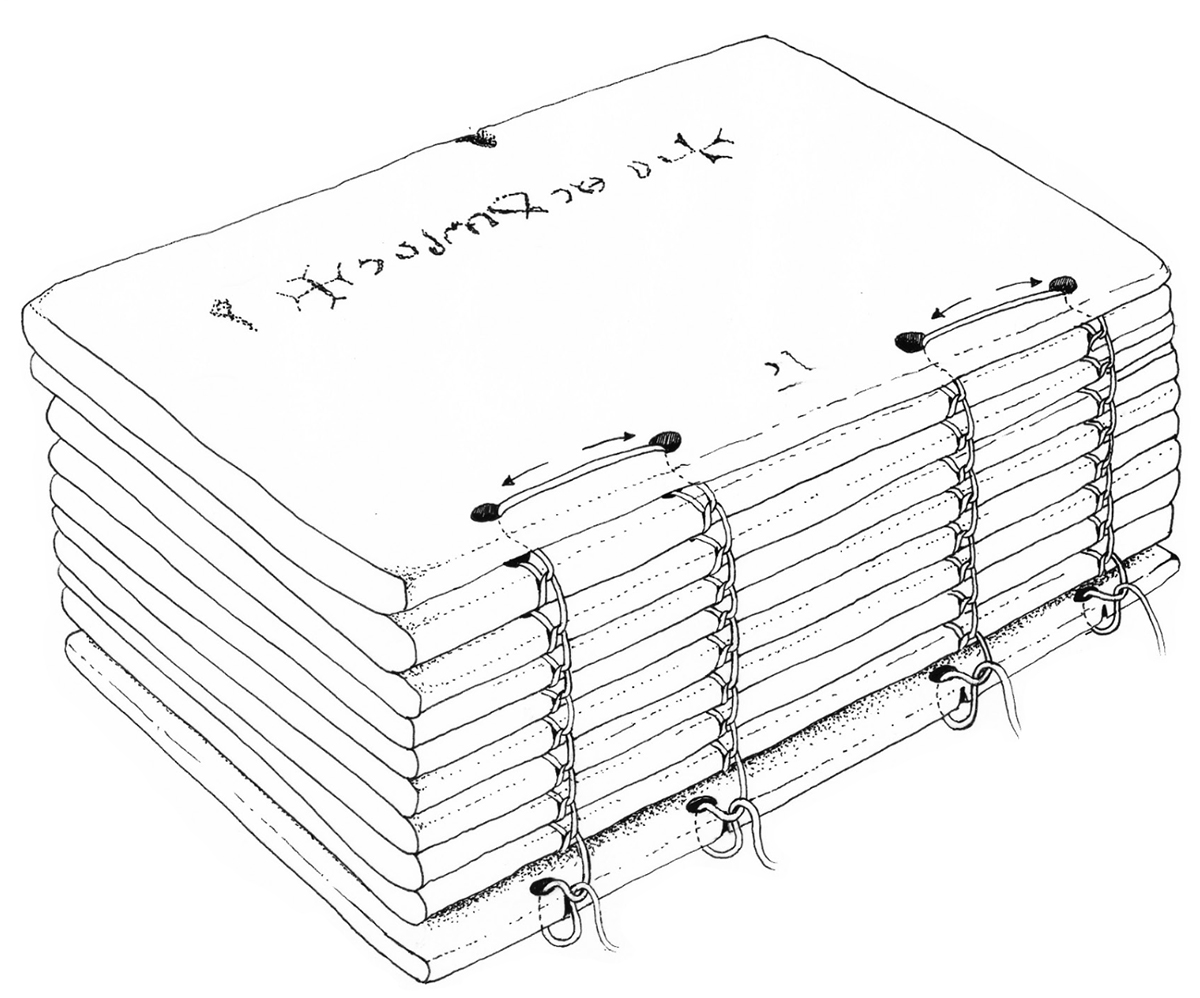
The method results in a slightly clunky but effective method for holding the tablets together and allowing one to turn the “pages.” It had not occurred to me that tablets would be bound in other ways until I saw the remarkable exhibition and catalog from 2018 produced by Georgios Boudalis, “The Codex and Crafts in Late Antiquity.” One of the many interesting and innovative suggestions in that book is that the sewing of wooden tablets may have been more elaborate, with the binding cords wrapping around the outside of the individual tablets along the spine in a manner partly analogous to the way that a loop-stitch (or link-stitch) holds together the gatherings of a multi-quire parchment or papyrus codex. Boudalis illustrated this hypothesis with one of his excellent diagrams:
Boudalis’s reconstruction of possible method for sewing tablets together; image source: G. Boudalis, The Codex and Crafts in Late Antiquity (New York, 2018), p. 29, fig. 15
When I reviewed his book, I brought up these imaginative reconstructions and expressed some cautious enthusiasm:
“Boudalis’s reconstructions are rightly and openly signaled as hypothetical. And they are entirely plausible, but they are not (yet!) capable of being confirmed from existing archaeological remains.”
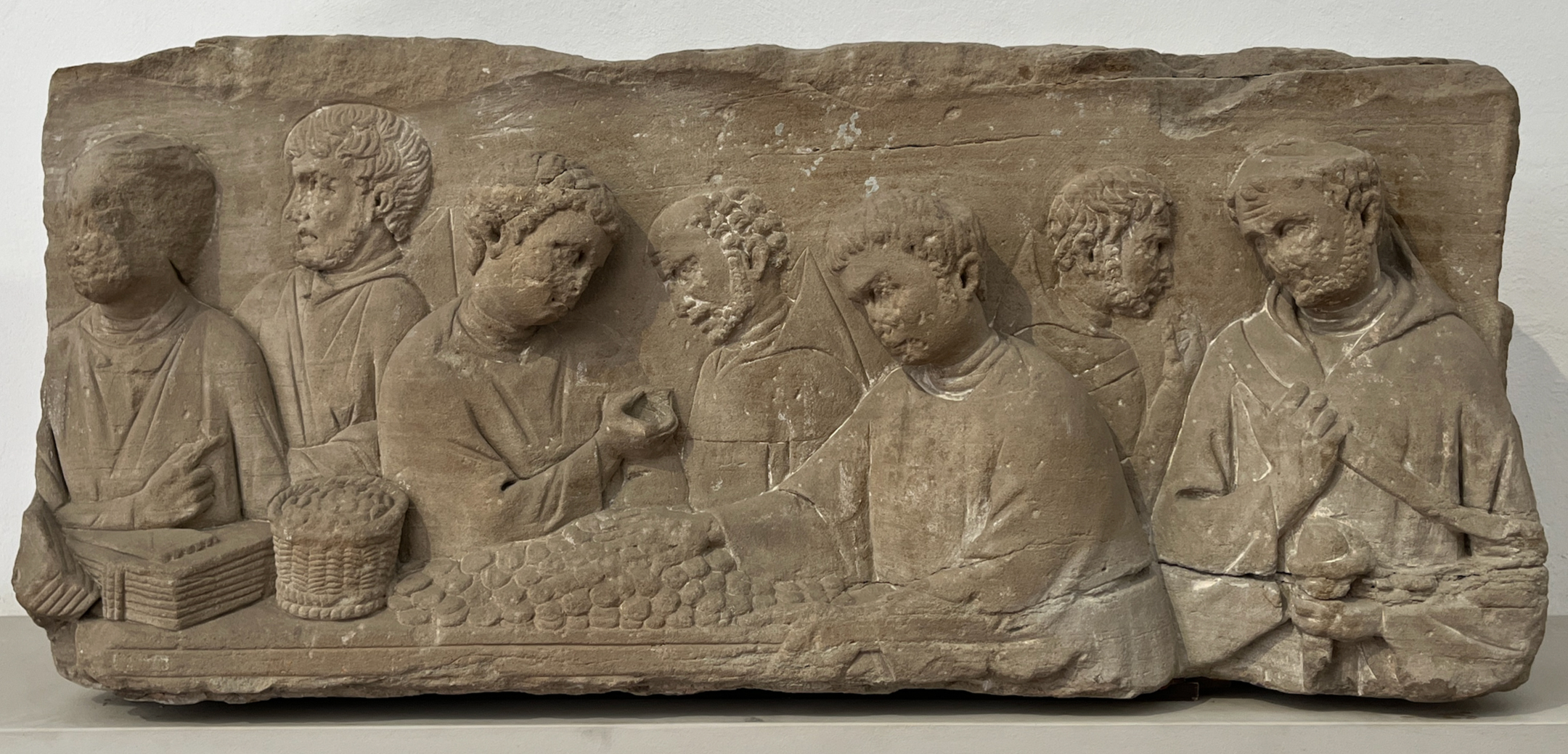
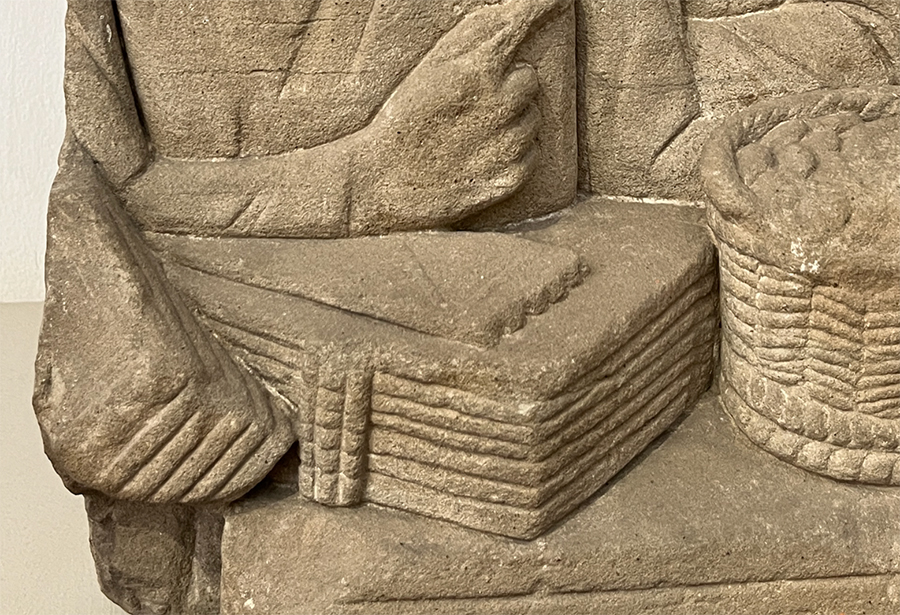
Now I have seen a relief that seems to show a set of tablets bound in a way very similar to what Boudalis proposed. It is a funerary relief in the Rheinische Landesmuseum in Trier. Many of the funerary monuments on display here show sets of tablets as part of “Kontorszene,” office scenes.1 This particular item (inv. 303) is a relief on sandstone showing seven people in a such a financial scene.
Relief showing men with money and a set of tablets (left); Rheinische Landesmuseum Trier inv. 303; image Brent Nongbri 2025
The figure at far left has a set of tablets that appear to be sitting spine-side-out, and it looks like the person who carved the relief has attempted to represent the stitching of the tablets:
Detail of bound tablets showing sewing(?) on the spine; Rheinische Landesmuseum Trier inv. 303; image Brent Nongbri 2025
The series of small knobs that correspond to each of the individual tablets seem to me to be an attempt to show stitching in the medium of carved stone. If this is correct, it would confirm Boudalis’s hypothesis that some sets of tablets were bound with this more elaborate type of stitching that is related to the sewing of multi-quire codices. I have not noted this detail in other reliefs, but I haven’t really been on the lookout for this kind of thing. If anyone knows of other examples, I would be grateful to learn of them.










 Variant Readings