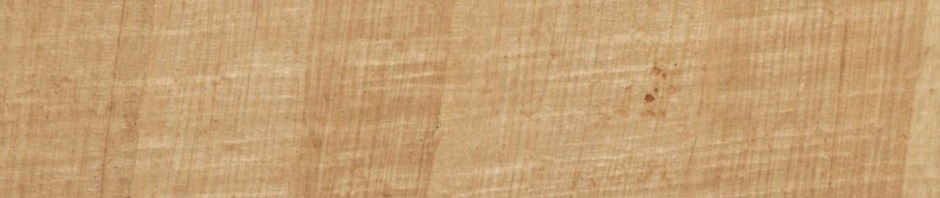
A few months ago, I observed that two stalks of papyrus from the same plant could produce quite different colored sheets of papyrus. I’ve also noticed that the same stalk of papyrus can produce strips that, although they look the same when freshly cut, have different colors when dry. I wondered whether this color difference might relate to the area of the stalk from which the strips come (the top end or the root end).
I figured this was easy enough to test using a stalk from one of the papyrus plants I grew from seeds earlier this year. The stalks on my plants are quite skinny, but I’m still able to make small sheets from them. So, I cut the stalk into sections and then made strips from them. When freshly cut and shorn of its green husk, the whole stalk has a translucent grey-ish white color. But after a few minutes in the air, the portion nearer the root began to turn a reddish color. This effect diminished as you moved up the stalk toward the top, where a lighter yellow color developed.
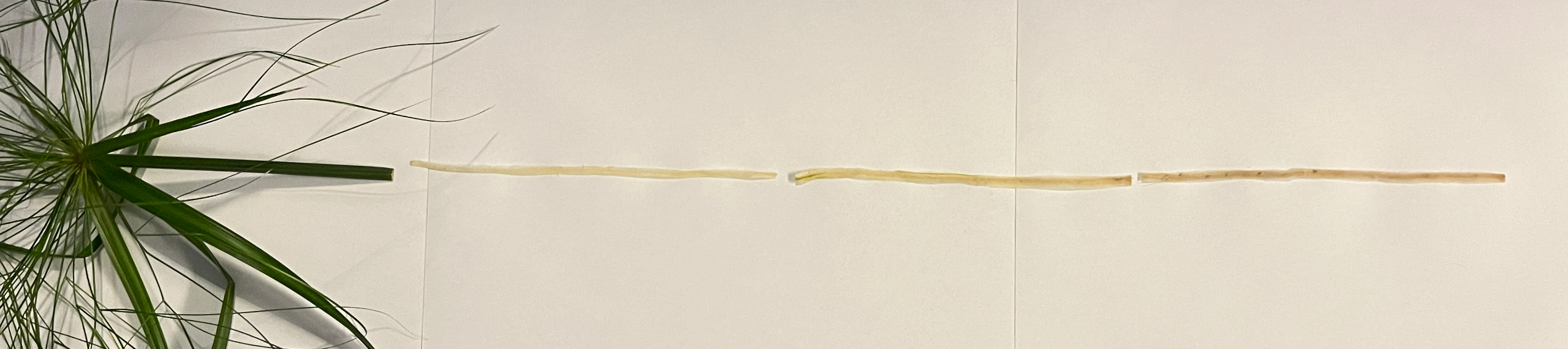
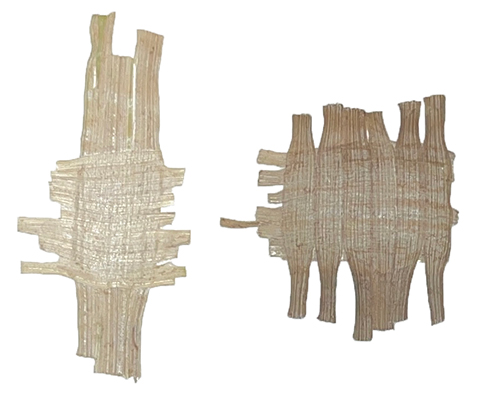
This pattern of coloration became more pronounced as the strips dried. The reddish area at the bottom dried to a fairly dark brown color after 24 hours. Strips from the upper part dried to a much lighter color. The image below shows small sheets made from middle strips on the left and lower strips on the right (the upper-most strips are simply too narrow to use effectively). The color difference is fairly stark:
I tried this on three stalks from the same root cluster and had similar results. I also observed a slightly less pronounced version of this phenomenon on strips cut from larger stalks from the local botanical garden.
In general, the upper portions produce strips of a much lighter color, but the strips become very thin due to the narrowing of the stalk near the top. At the lower portion of the stalk, the strips are broad, but the color of the papyrus becomes quite dark when exposed to air. For the purpose of making usable papyrus sheets, it’s really the portion of the stalk in the middle–where the breadth is decent and the color is still light–that is the best part.
This observation potentially sheds some light on a passage in Pliny’s famous description of the manufacture of papyrus (Natural History, book 13). Pliny writes the following (according to the text and translation in Lewis, Papyrus in Classical Antiquity):
Praeparatur ex eo charta diviso acu in praetenues sed quam latissimas philyras; principatus medio, atque inde scissurae ordine.
Paper is made from the papyrus plant by separating it with a needle point into very thin strips as broad as possible. The choice quality comes from the centre, and thence in the order of slicing.
As Lewis notes, there are several puzzles in this short passage, but for now I’m interested in the phrase principatus medio. Lewis understands medio as the center, or core portion, of the pith. But if my observations about the color differences of the pith up and down the stalk are right, then it seems like medium could equally refer to the middle part of the length of the stalk, between top and the root, where the strips are lighter color but still relatively wide. And in fact, already in 1976, Adam Bülow-Jacobsen argued for this interpretation of medio on other grounds:
“I am convinced that medium must be taken quite plainly to mean the part of the plant which is mid-way between the top and the root, and there is good physical reason to understand it thus: All fibers in a papyrus stem run all the way from bottom to top and a cross-section at the top and at the bottom of the same stem will reveal the same number of vascular bundles in both, although the diameter of the stem is much smaller at the top than at the bottom. In terms of strips cut along the fibers this means that a strip from near the bottom of the plant will seem to contain fewer and thicker fibers, which will stand out like wires once the pith between them has been hammered out flat and dried. A strip from near the top of the plant will have great concentration of fibers with little pith between them and will be too narrow for convenience.”1
Bülow-Jacobsen notes that other experimenters came to different conclusions, but the argument from the differences in color in the different levels of the stalk would seem to support his analysis and exegesis of Pliny’s text.
- Adam Bülow-Jacobsen, “principatus medio: Pliny, N.H. XIII, 72 sqq.,” Zeitschrift für Papyrologie und Epigraphik 20 (1976) 113-116. ↩︎


 Variant Readings
Love your dedication to the science, Brent. I also grew & made papyrus (when much younger!). Not as elegant a product as yours, but a lot of fun. Given the density of the pith at the different sections of the stalk, how does this affect the absorption of the ink? One can assume that different grades of papyrus could be purchased by writers, to be used for different purposes (labels, manuscripts, etc.). So the same hand might present as ‘looking different’ on different pieces of papyri.
Interesting ideas you have presented in this post -Happy New Year!
Thanks! I have not yet tried writing on the papyrus that I made myself. My colleague Ariadne Marketou has produced some different kinds of inks, so we will probably give it a try in the coming year (see Ariadne’s work here: https://earlyhistoryofthecodex.com/2023/01/23/imaging-behind-glass-2-3/ and here https://earlyhistoryofthecodex.com/2023/01/23/imaging-behind-glass-3-3/).
Do your observations allow you to rank papyrus sheets by cost?
We don’t really know much about the costs of the different grades of papyrus, but the typical unit of purchase seems to have been the roll rather than the single sheet: https://brentnongbri.com/2023/01/28/buying-papyrus-in-roman-antiquity/
When I purchased some papyrus sheets in Cairo a couple decades ago, the manufacturer said that soaking the papyrus sheets in water was a critical part of the process. He said that more precious papyrus was soaked for 14 days and became darker, while cheaper grade papyrus was soaked for 7 days. Have you come across anything like that? That would seem to be another factor in the color of the sheets.
Thanks for the observation. For this experiment, I didn’t soak the strips (Pliny doesn’t mention soaking the strips, but he does say that the papyrus sheets should be made “on a board moistened with water from the Nile: the muddy liquid serves as the bonding force”; I don’t think any modern experiments have confirmed this). If you’re working with a lot of strips simultaneously, you pretty much have to put them in water, or they will dry out fairly quickly. But from what I’ve seen, leaving strips in water for more than a day or so makes them a bit slimy and harder to work with. They also seem to stick less effectively when pressed together. The papyrus that is now produced in Egypt is often soaked in an alkaline solution and then bleached to produce a yellow color. One video I’ve seen (here: https://www.youtube.com/watch?v=SBdVhvo2UUM&t=100s) describes the alkaline soaking process as “fermentation,” but I’m not sure this is accurate.
Thank you, Brent. Very helpful.