
I only recently learned of the death, about a year ago now, of Stuart G. Hall (1928-2023). It sent me back to an article that we wrote together. In 2015, I stumbled across grainy black and white photographs of what up until then had been a “lost” leaf of a papyrus codex containing the beginning of the Peri pascha of Melito of Sardis. The leaf was part of the “Bodmer Composite Codex,” and I was (and am) very interested in the construction of this book. I thought it best to publish the piece, but not being an expert in Melito, I contacted Stuart, who was 87 at the time. He jumped at the chance to revisit his earlier work on Melito, and the two of us published an article on the piece.1
The best available images of the codex can be found on the Bodmer Lab website. For the sake of clarity in the following discussion, I post images of the front and back of the “lost” leaf below.
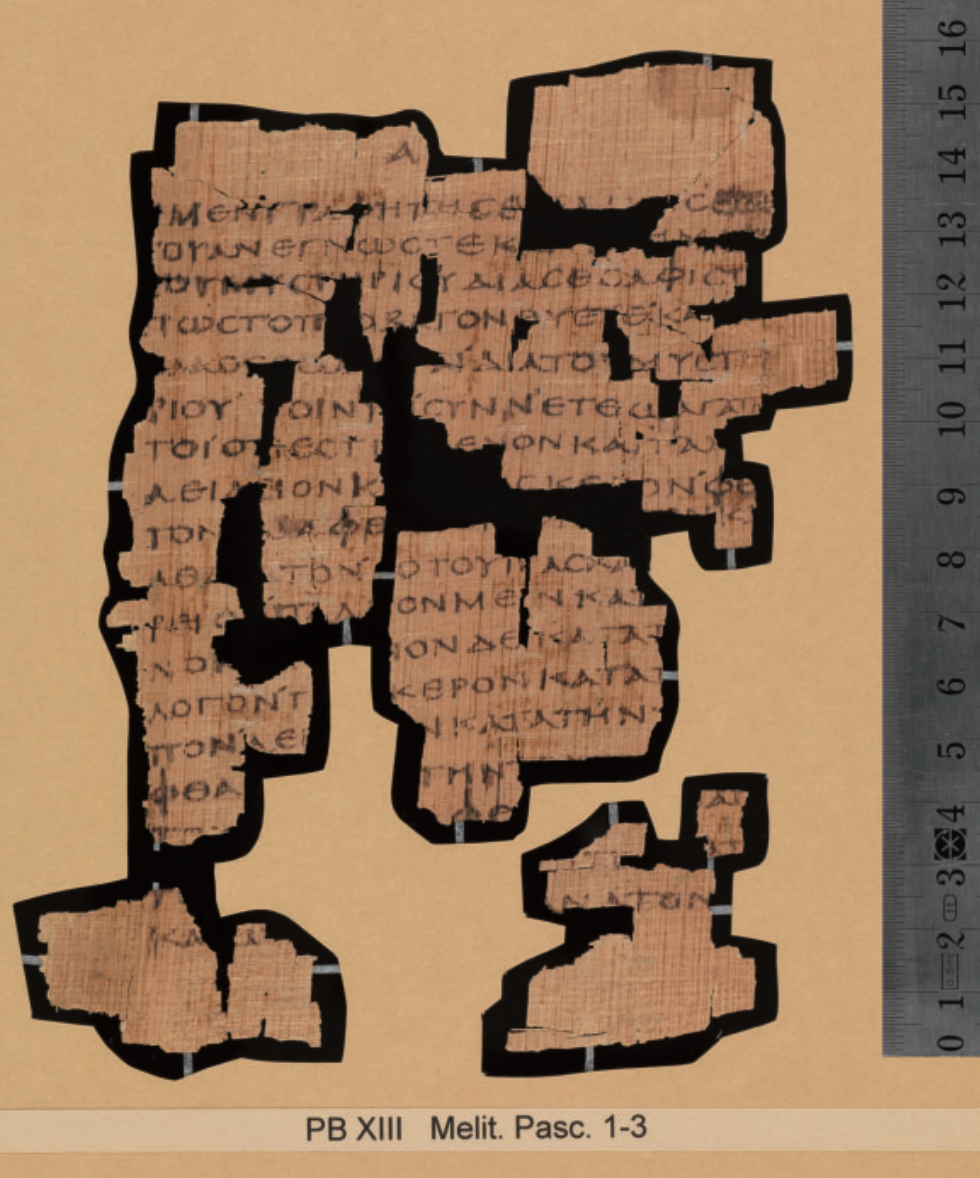

I was responsible for the codicological section of that article, and in revisiting it, I see that I made a substantial mistake. I take the opportunity now to correct it. Below is a diagram of the quire in question and my summary of the problem in the article:
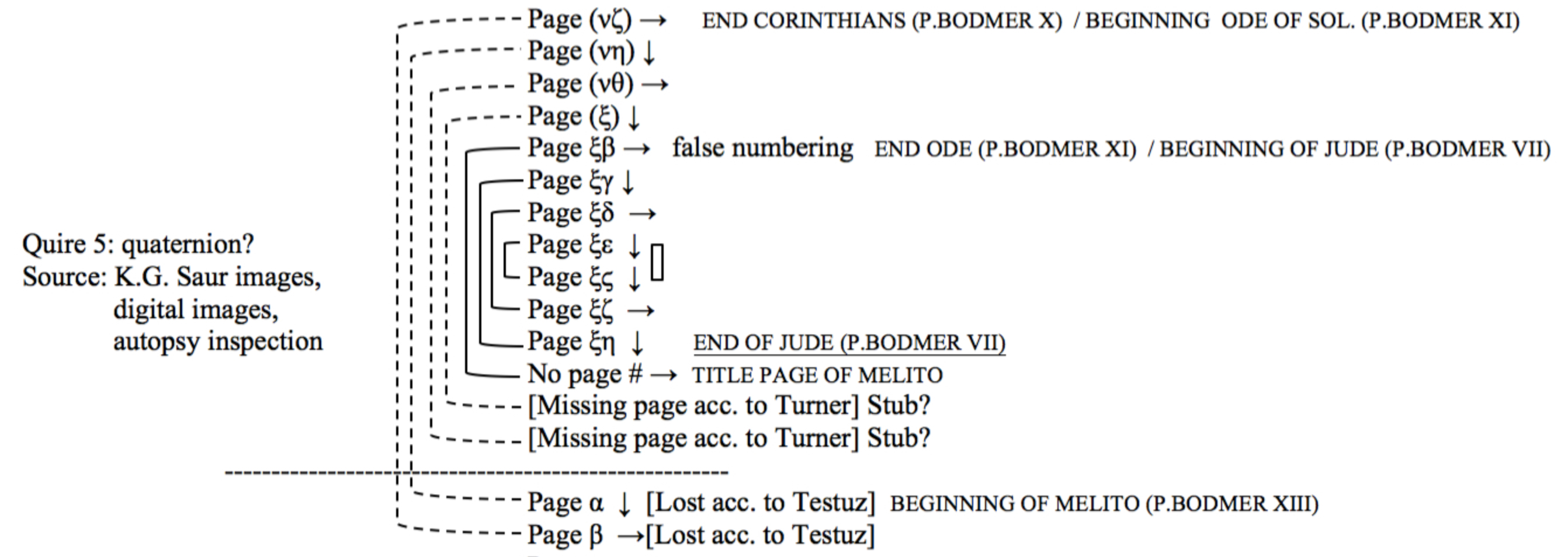
Page ⲅ (3) of Melito begins a new quire, a complete quaternion, which is followed by another complete quaternion. Thus, the first leaf of the text of Melito (pages ⲁ and ⲃ) cannot belong in a quire with the leaves that follow it. By tracing continuity of papyrus fibres across leaves, it can be shown that leaf ⲝⲇ/ⲝⲉ and leaf ⲝϛ/ⲝⲍ form a bifolium. Since the ‘inside’ of this bifolium contains consecutive pages (ⲝⲉ and ⲝϛ), it can be presumed to be the centre of a quire. Continuous fibres also show that leaf ⲝⲃ/ⲝⲅ and the leaf consisting of page ⲝⲏ and the unnumbered title page of Melito also form a bifolium. Thus, we are almost certainly dealing with a quaternion. The question is: how does the first leaf of the text of Melito fit in? Because of damage to its edges, it is not clear whether it forms a bifolium with the first or second leaf of the quire. Also adding to the difficulty is the fact that we have a total of only seven leaves (14 pages). Thus, as Turner noted in 1977, if this quire is a normal quaternion, an additional leaf (two pages) must be missing. Turner speculated that the ‘two pages could have been left empty or held a short Psalm’. 2Yet, given that the structure of the two central sheets of the quire is clear, there are only two possible positions for the missing leaf. It would need to have been located either between the title page of Melito and the first page of the text or between the first and second leaves of the text of Melito (i.e. between pages ⲃ and ⲅ of Melito). Neither option is appealing.
Given that state of affairs, I proposed that perhaps instead of an additional leaf, we may have had just a stub in one of those two positions, as illustrated in this graphic:

The problem is this: When I subsequently gained access to better images of most of the rest of this codex, I recognized that the bifolia of this codex were cut from the roll not according to how wide the bifolia should be but rather according to how tall they should be, as illustrated below:
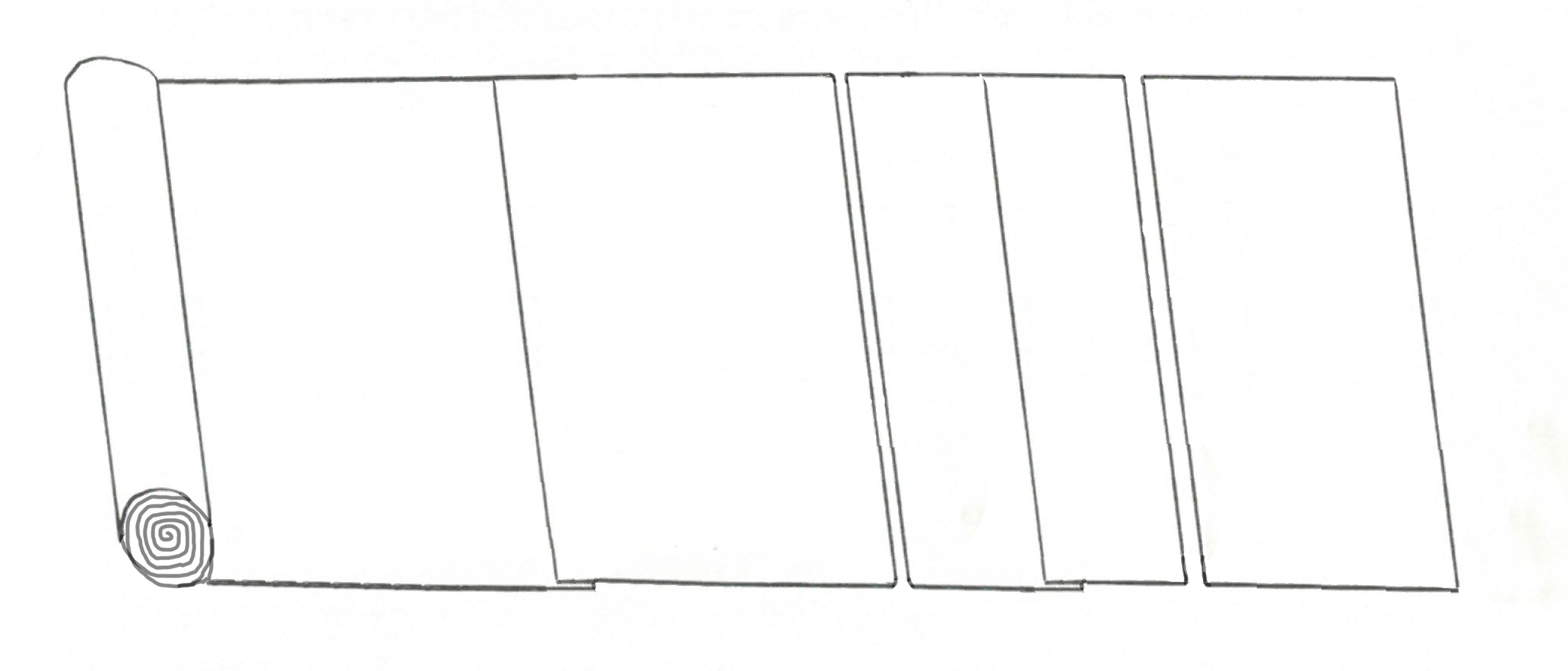
The give-away is the presence of horizontal rather than vertical kolleseis (sheet joins) that run across the full length of the bifolium. All the bifolia for this codex seem to have been cut in this way. Bifolia cut in this way will all have an equal length (the height of the roll). There will be no stubs. As a result, my suggestion that perhaps quire 5 contained a stub rather than a full sheet is simply not possible. To have stubs in a square-format codex of about the height of the Composite Codex (about 15.5 cm), you would need to be cutting the bifolia to the desired width rather than height. You probably need to have either a roll that was not very tall or a more standard roll that was cut both vertically and horizontally as illustrated below:
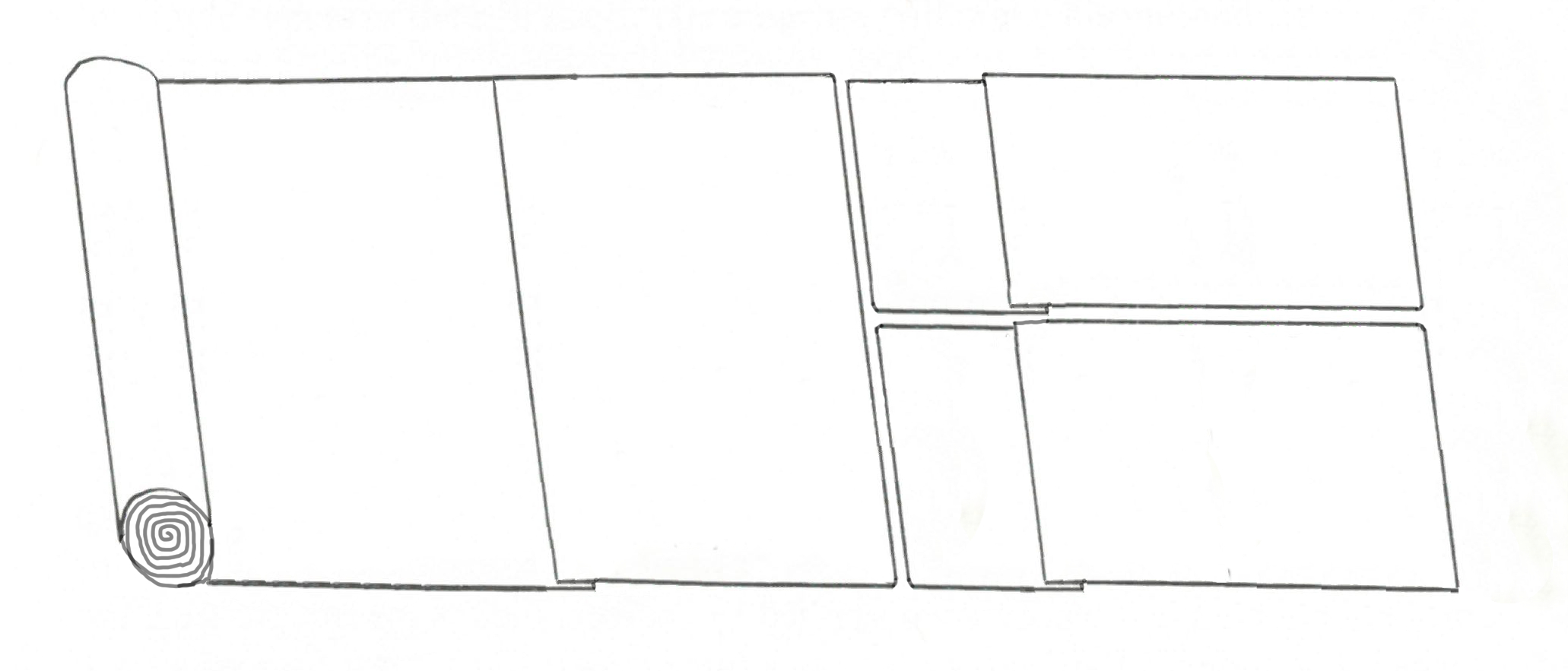
In such a case, we would see vertical kolleseis, but I have not spotted any of these in the Composite Codex.3 This means that we are again faced with the problem of explaining the quire construction. It seems that a folium intervened either between the title page of Melito and the first page of the text or between pages 2 and 3. Neither of these locations really makes sense in terms of the contents of the codex.
So what is the solution? I’m not sure. There seems to be some imprinting of the text of page ⲁ of Melito on the title page, so those two folia were probably pressed against each other at some stage, but a blank folium between pages 2 and 3 of Melito seems very odd. As I said, it’s a bit of a mystery. Suggestions welcome.
- For Hall’s earlier work, see Stuart George Hall, Melito of Sardis: On Pascha and Fragments (Oxford: Clarendon Press, 1979), reprinted with corrections 2013. For the changes to the 1979 edition, see Stuart George Hall, “Melito Peri Pascha: Corrections and Revisions,” Journal of Theological Studies 64 (2013) 105-10. For the edition of the extra Bodmer leaf, see Brent Nongbri and Stuart G. Hall, “Melito’s Peri pascha 1-5 as Recovered from a ‘Lost’ Leaf of Papyrus Bodmer XIII,” Journal of Theological Studies 68 (2017), 576-592. The edition of the text of the papyrus in that article was much improved by the suggestions of Ben Henry. ↩︎
- Eric G. Turner, The Typology of the Early Codex (University of Pennsylvania Press, 1977), 80. ↩︎
- I thought I had identified vertical kolleseis on several folia, like this one, but I am now convinced these are simply creases (the bottom of the folium in the link above seems to make this clear). ↩︎


 Variant Readings