
In my last post I unpacked the story of what seems to be the earliest published photograph of the alleged finders of the first Dead Sea Scrolls:

This picture was taken in 1951 by Richmond Brown, and published (I think) for the first time in this 1953 Picture Post article. This picture is part of the photo archive of the École biblique et archéologique française de Jérusalem. The Picture Post simply calls the men in the picture “two shepherds.” In the photographic catalog of the École biblique, one of the men is identified as the person who is said to have first discovered the cave, Muhammad ed Dhib:
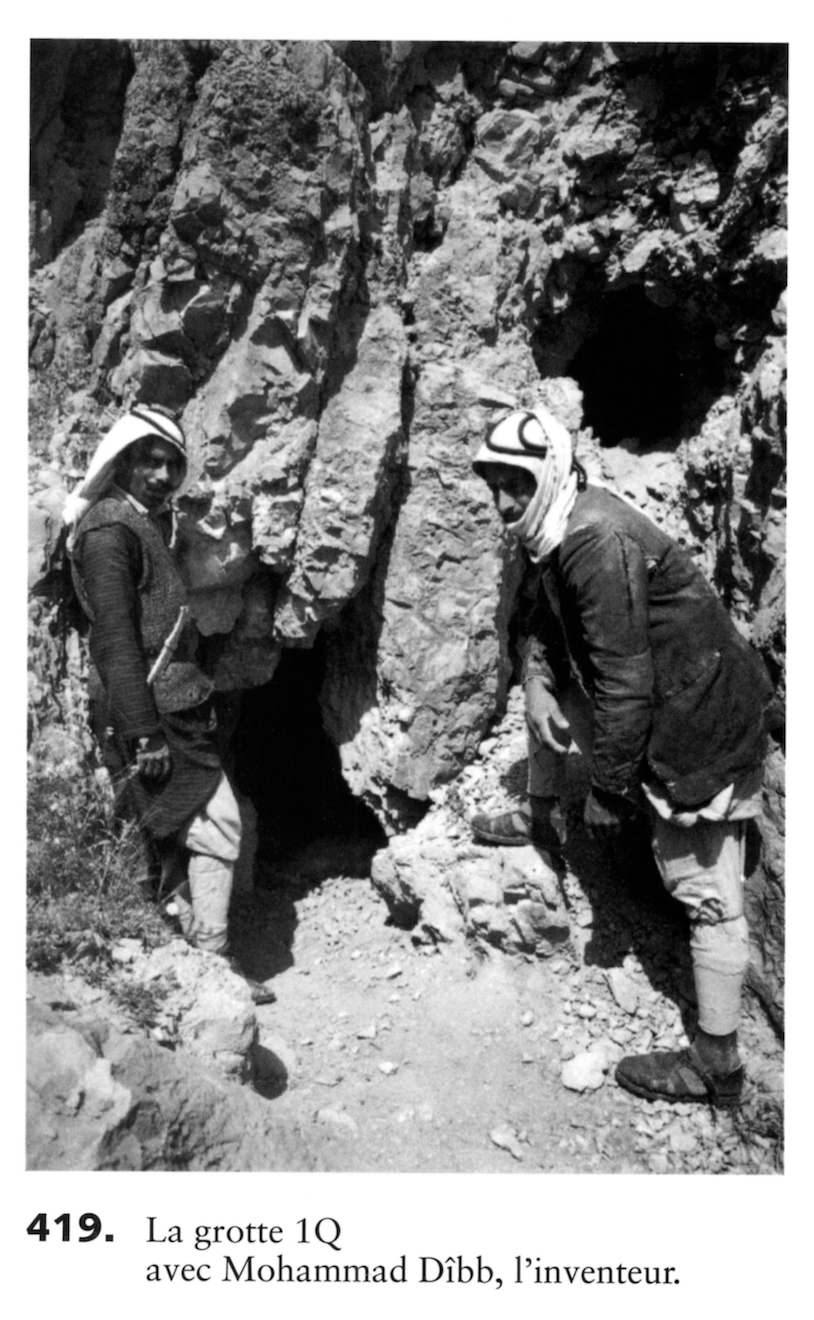
But from this caption, it’s not clear which person is Muhammed ed Dhib. Another version of this image appears in an exhibition catalog produced by Southwestern Baptist Theological Seminary. It offers a more detailed caption:
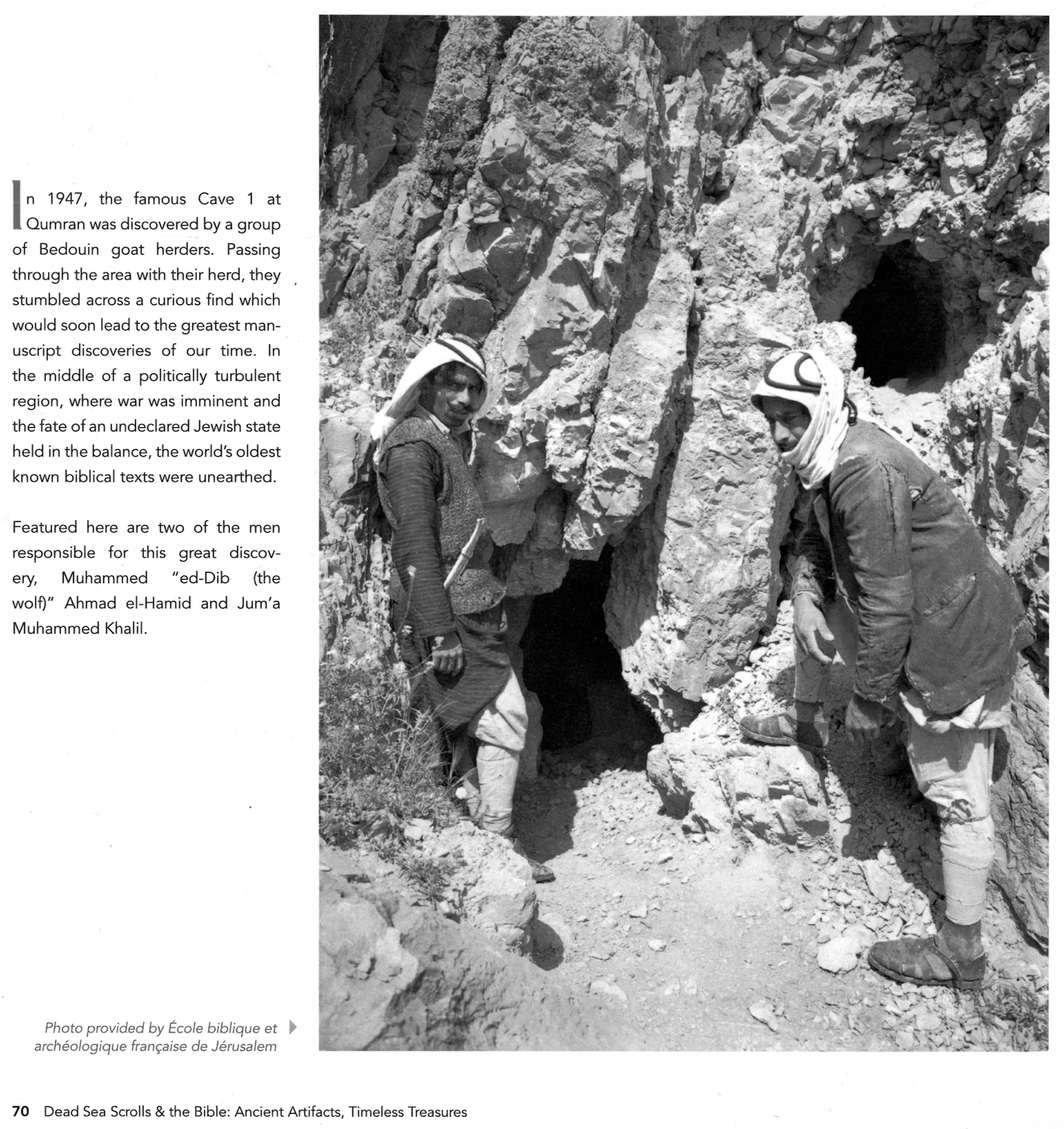
Alongside the photo is the description, “Featured here are two of the men responsible for this great discovery, Muhammed ‘ed-Dib (the wolf)’ Ahmad el-Hamid and Jum’a Muhammed Khalil.” Another name is added, but it’s not clear which person is which. I do not know where the anonymous author found this extra information, and I cannot confirm or disconfirm its accuracy.
But we can compare this image to other images. A second photo was published a couple years after the Picture Post article. This picture is in Millar Burrows, The Dead Sea Scrolls (New York Viking Press, 1955):
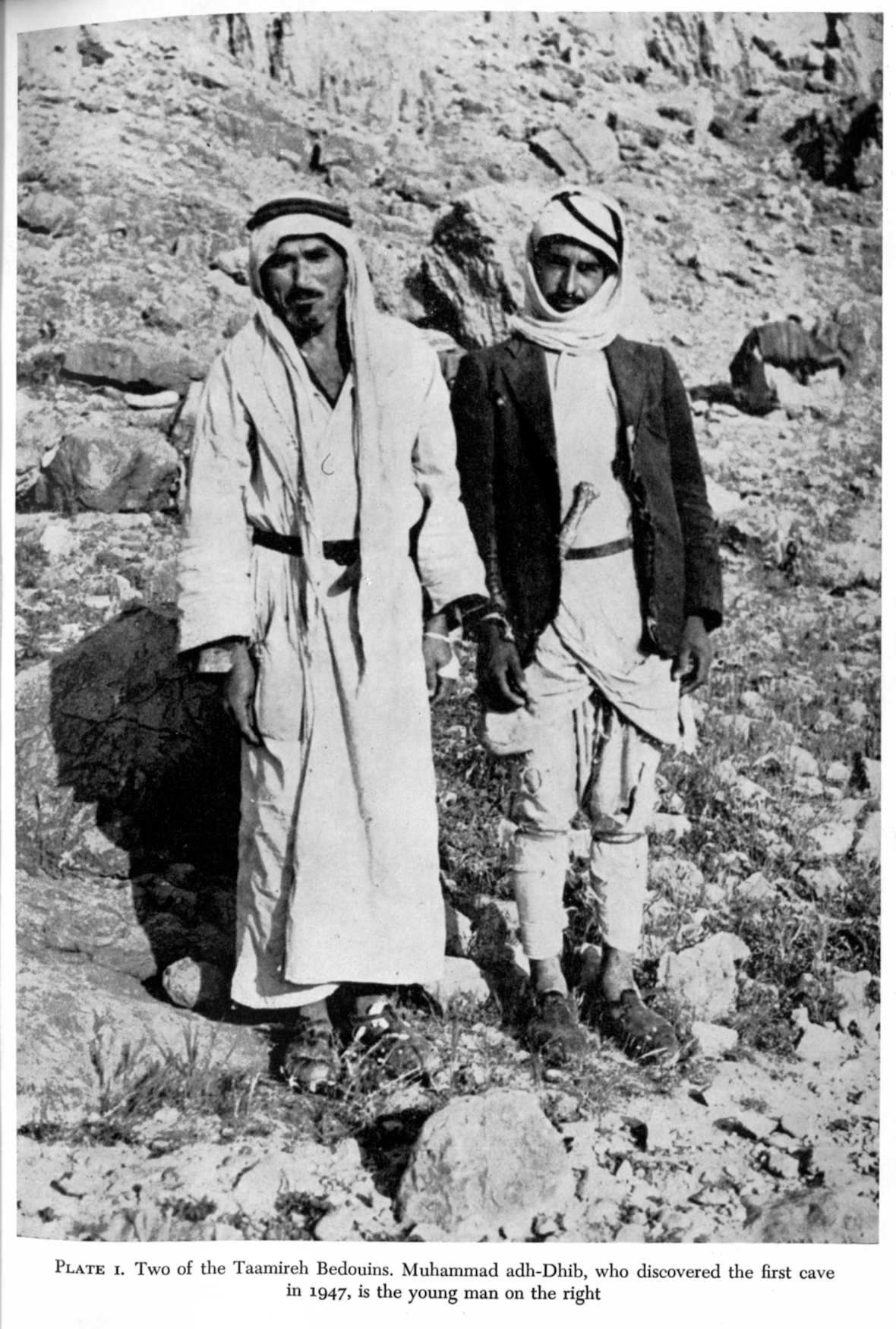
Permission to reproduce the photo is credited to William L. Reed, director of the American School of Oriental Research in Jerusalem. As far as I can see, there is no information about the date when this picture was taken. Reed was a participant in the expedition to locate manuscript caves in 1952, so that is a likely timeframe for this photograph. The man on the right in this image is identified as Muhammad ed Dhib, and he appears to be the same man as the man on the right in the École biblique image (based on the clothing), but the man on the left seems to me to be a different person from the one on the left in the École biblique image.
Perhaps the most frequently reproduced photo of the alleged discoverer(s) is the one below, here as it appears in Weston Fields, The Dead Sea Scrolls: A Full History (2009):
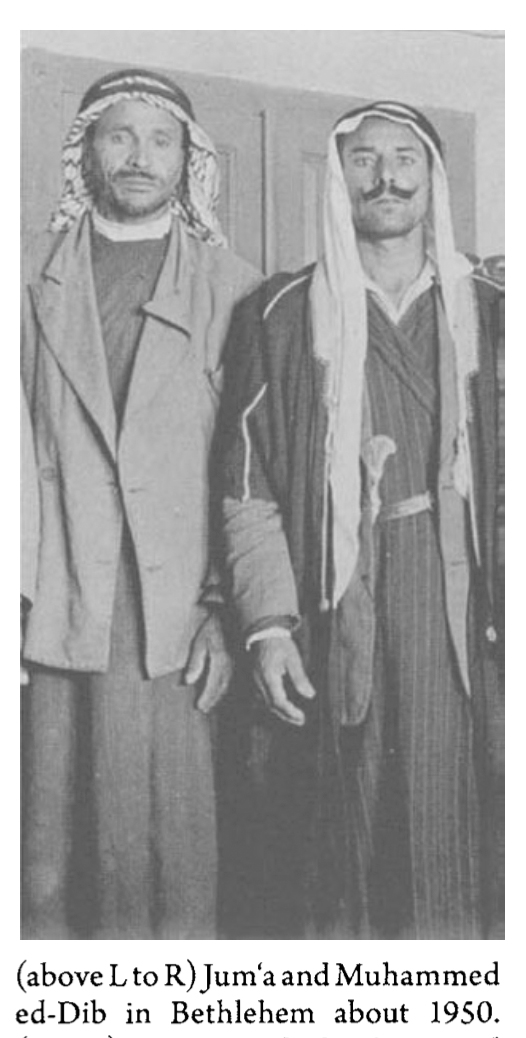
The date given in Fields (“about 1950”), seems to be incorrect. To the best of my knowledge, the earliest form of the photo was published by John Trever in The Untold Story of Qumran (1965):

So, the caption dates the photograph not to 1950 but to 1962. And in this cropping, we see that the picture also included the two men who had conducted an interview with these Bedouin. Trever credits the photo as “courtesy Anton Kiraz.” This makes me wonder if this date is also not quite right. For Trever seems to have received this photograph in a letter from Kiraz that was sent 10 December 1961. The letter contains what seems to be a description of this picture:
“Enclosed you will find a photo of the Bedouins Muhammad ed Deeb and Jum’a when they came to my home for the tape recording. The man beside me is Jum’a Muham[m]ad and the other one standing near Mr. Docmac is Muham[m]ad ed Deeb. The photo was taken on the roof of my home after lunch. You also find enclosed an approximate bill of the expenses.”1
I’m fairly sure I recognize Anton Kiraz on the far left. So, the figures in the picture are identified as (left to right): Anton Kiraz, Jum’a Muhammad, Muhammad ed Dhib, and Judeh Docmac (the headmaster of the Lutheran School in Bethlehem, who helped with the interview).
The results of this interview and other interviews with these men form the backbone of Trever’s account of the discovery of the first scrolls. Yet, as Trever notes, the stories they told in 1961 and 1962 “seemed irreconcilable at several points with the first accounts given in 1949 and 1952. The earlier accounts had also been based on direct contacts with the same Bedouins and had the advantage of being nearer the actual events.”2
But comparing the École biblique photo and the Reed photo on the one hand with Trever’s photo on the other, I’m not sure it’s absolutely clear that these are in fact “the same Bedouins.”
I’m not aware of other early photos of the people said to be involved in the discovery of the Cave 1Q scrolls, but I would be happy to be informed if anyone knows of any.


 Variant Readings
Though I don’t have Trever’s The Untold Story at Hand, his later The Dead Sea Scrolls: A Personal Account is considerably longer and corrected.
Mor to the point, though it has some errors, Weston Fields’ DSS: A Full History, vol. one is probably reliable about the following on page 534, col. 2, note 59, in which Fields was duly impressed while together in a sherut:
“….I had carried along Burrow’s book containing a photograph of “Muhammad ed-Dib [sic, slightly-different spelling than in Burrows’ caption] and another Bedouin standing together near what looks like Cave 1 in the background. With no warning to Abu Daoud, who was sitting in front of me, I thrust the photograph in front of him. Without even a second’s hesitation, his face lit up, he pointed at the person identified as “ed-Dib,” and then pointed at himself, and excited [sic], and repeatedly said it was he. He then identified the other as “Jum’a,” his “cousin.” Abu Daoud was illiterate, even in Arabic, so he couldn’t have read the English caption….”
Thanks–yes, I wanted to keep the focus on the photos so I didn’t mention the idea that Fields advanced about Abu Daoud. The methods that Fields used aren’t exactly up to the standards of academic anthropology (but, of course, neither were the methods of Trever and Kiraz, who paid their informants to tell them a story). But I think you’re right to bring this element into the conversation.
Another nice photo of Muhammed edh-Dhib appears in Lapp and Lapp volume of Wadi Ed-Daliyeh, plate 102 (final page of the volume), presumably taken in 1963-4 during the excevation of the caves.
Thanks, Asaf! I was not aware of this photo!
Pingback: Another Photo of Muhammad ed-Dhib | Variant Readings
Pingback: Gerald Lankester Harding’s Qumran Cave 1Q Excavation Photos | Variant Readings
Pingback: The Lying Pen of Scribes Project: An Appreciation | Variant Readings