In an earlier post, I mentioned that the museum at Ostia Antica has recently reopened after a long period of closure (I can’t recall now how many years it has been closed). I had a chance to visit last week, and the renovations are very impressive.
The first upgrade, which was especially noticeable on a hot August day, is air conditioning. So the museum is a nice break from the heat if you are visiting Ostia in the summer.
Many of the pieces on display are the same ones that were present before the renovations, but the presentation and the didactics are much improved.
The view from the entrance is dominated by a bold presentation of the remains of the inscription from the city gate (the Porta Romana).
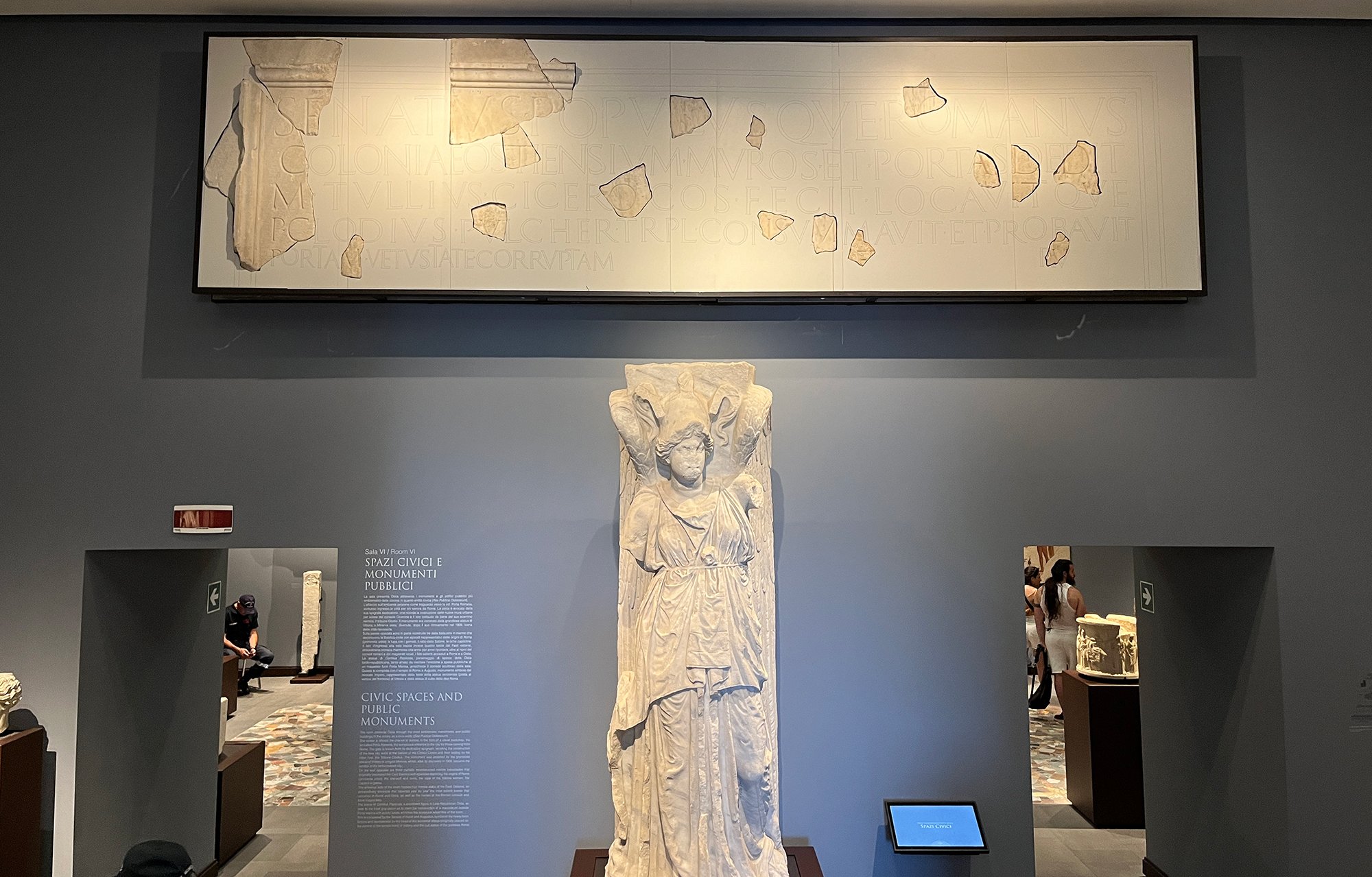
As the image shows, the inscription is highly fragmentary. The supplied text into which the fragments are fitted is based on the reconstruction of Fausto Zevi, who supplies the name “Cicero” as the authority behind the construction of the city walls of Ostia. The use of Zevi’s reconstruction in the display is somewhat unfortunate because its speculative elements are impossible to verify, as Mary Jane Cuyler has argued.
This room (Civic Spaces) contains some of Ostia’s “greatest hits,” including the Winged Victory from the city gate, the statue dedicated by Gaius Cartilius Poplicola at the temple of Hercules (off to the right, out of the picture, neatly placed in front of a wall with an image of Poplicola’s funerary monument), and the remains of the Fasti Ostienses (also not in the picture), which provide lists of local magistrates and important events from 49 BCE to 175 CE.
The rooms are arranged in different ways. Some are chronological (The Republican Age), but most are thematic (e.g., Imperial Power, Religions and Cults, Funerary Contexts, etc.). The pieces selected for exhibition are on the whole excellent, although I did not see anything from the synagogue at Ostia, which was a little disappointing, since the building has yielded some fascinating finds.
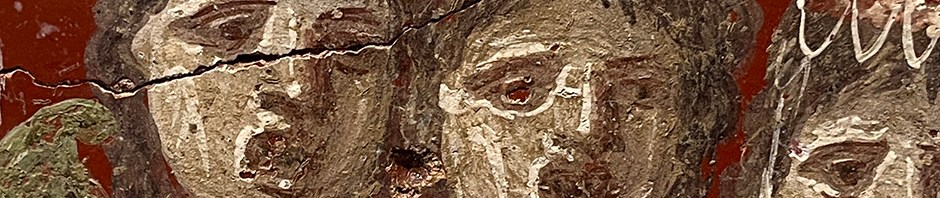
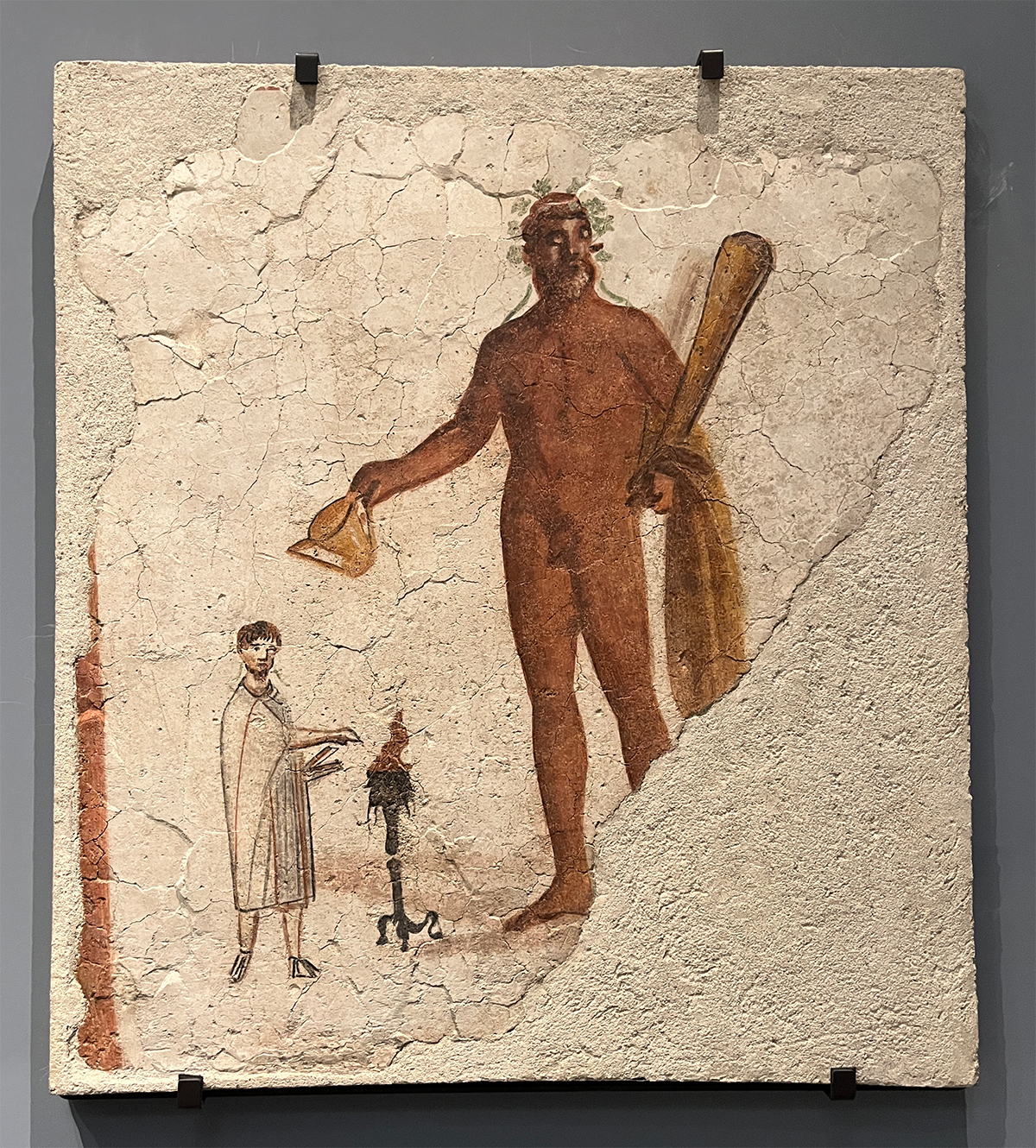
One thing that stood out across several rooms was the quantity and quality of wall paintings. I tend to associate well preserved frescos with sites other than Ostia, but there are some fine examples on display at the museum with lots of detail and vibrant color preserved (although I don’t know how much conservation/restoration has taken place). A couple examples are below.
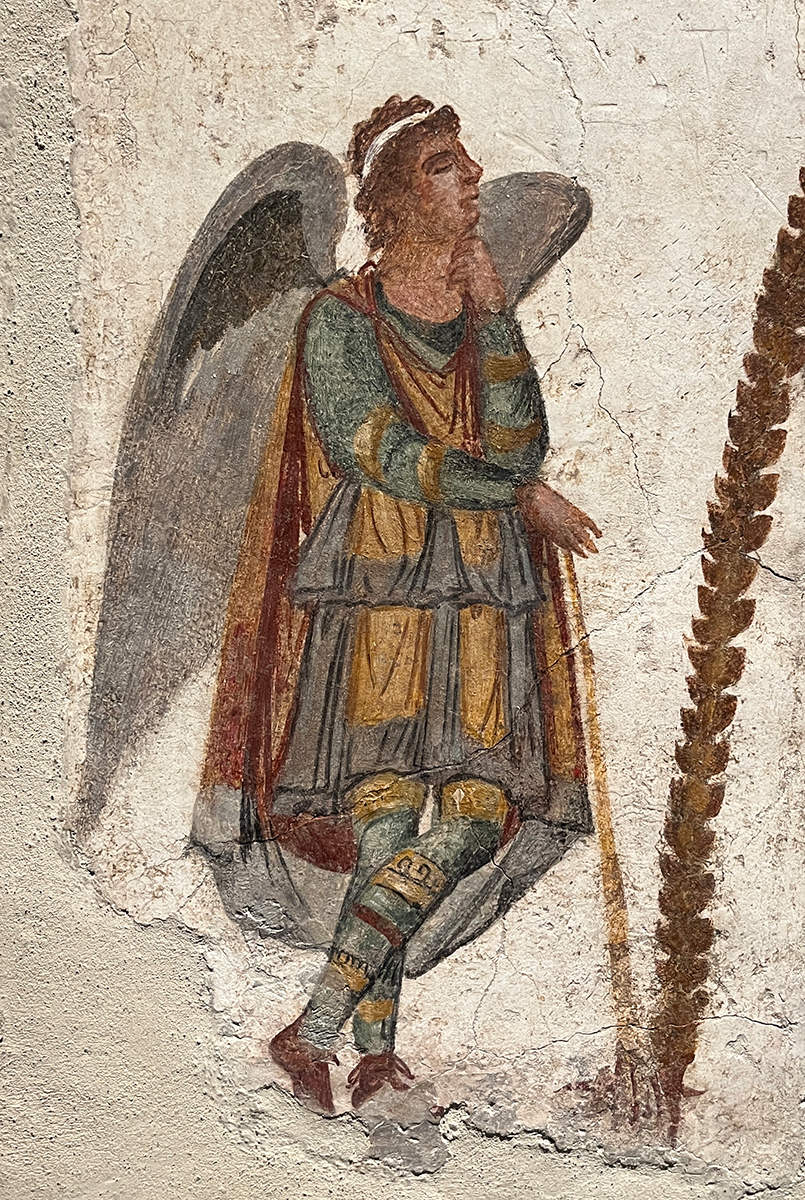
The label in the museum display describes this figure as Thanatos, but given the pretty obviously sleepy facial expression, I might opt for Hypnos. But who knows? Homer said they were twins (Iliad 16.672, διδυμάοσιν).
Another striking example is a fresco showing a man who appears to be sprinkling incense on a fire in front of a larger-than-life Hercules:
I was probably most impressed with the material from Isola Sacra. The exhibits show many interesting pieces, including the terracotta plaques that displayed various professions and were posted on the outsides of tombs:

There is also a very nice display of the material from the tomb of Julia Procula, who seems to have come from a family of physicians. The tomb contained a large statue of Julia Procula, as well as inscriptions and other sculpture. The image below shows a bust of Hippocrates atop an inscribed pillar (notice the last line of the inscription in the background: ἀρχιατρός).
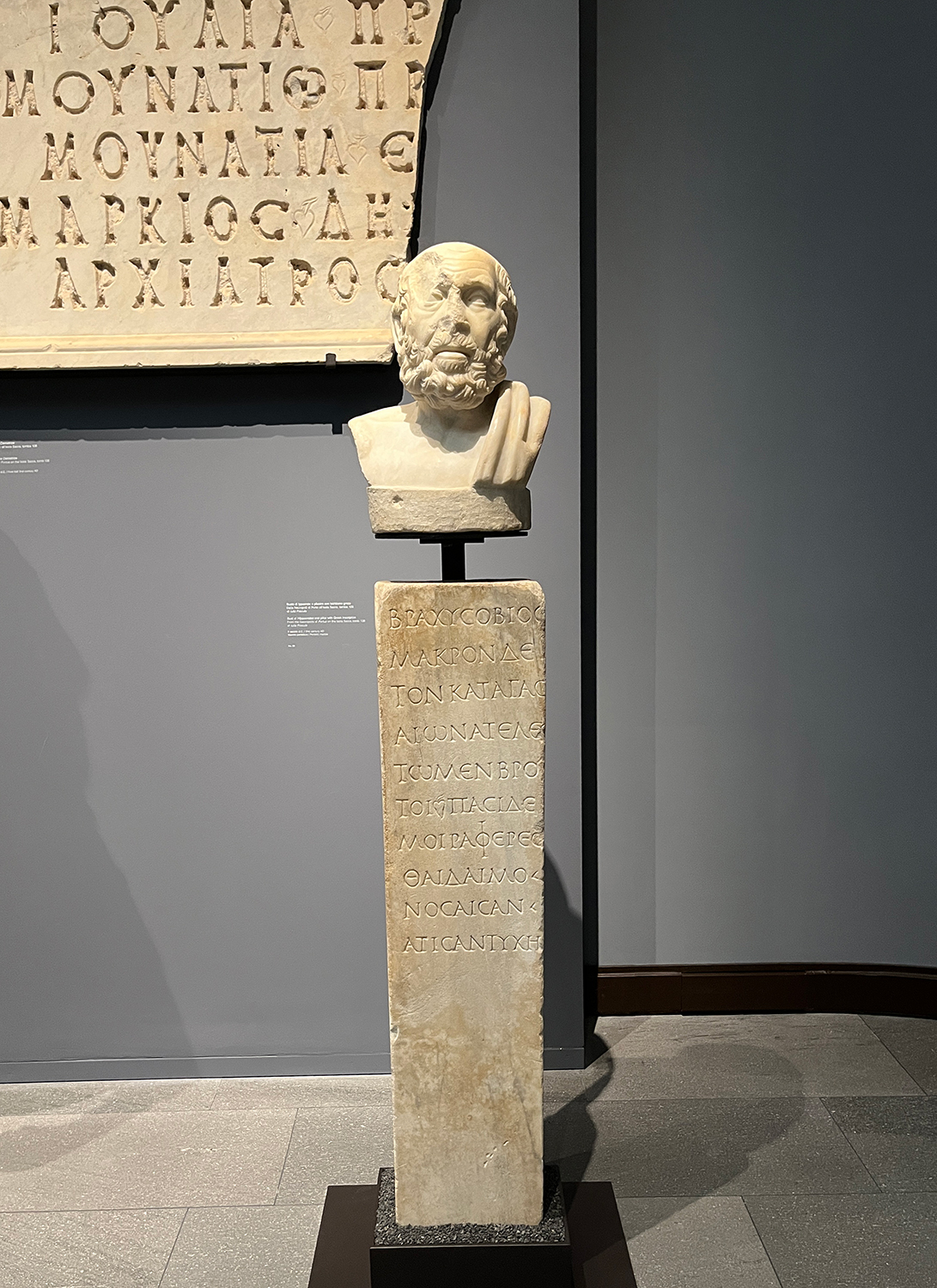
The pillar contains some lines in Greek:
βραχὺς ὁ βίος, μακρὸν δὲ τὸν κατὰ γᾶς αἰῶνα τελετῶμεν βροτοί· ❦
πᾶσι δὲ μοῖρα φέρεσθαι δαίμονος αἶσαν, ἅ τις ἂν τύχῃ.
roughly translated:
“Life is short, but we mortals lie dead underground for a long time.
It’s the fate of all to endure god’s dispensation whenever it overtakes us.”
The opening words recall the first of the aphorisms attributed to Hippocrates: Ὁ βίος βραχύς, ἡ δὲ τέχνη μακρή… (“Life is short, the craft is long…”).
Also in the Isola Sacra room is the so-called Sarcophagus of the Muses, which will get its own post in due course.
I could go on; there are many fascinating artifacts on display. It’s always worthwhile to visit Ostia if you’re in Rome, and the new museum is just one more thing to look forward to when you come.
There is also a newly produced guide to the museum for sale in the bookstore. It’s quite small, but it has color photos and reproduces a good portion of the didactic materials in the museum (in Italian and English).


 Variant Readings
Pingback: More on the mikveh at Ostia and Other Jewish Materials | Variant Readings
Pingback: The Sarcophagus of the Muses from Isola Sacra: Manuscripts and Readers | Variant Readings