I’ve been thinking a lot lately about miniaturization in the ancient Roman world, especially as it applies to books. For instance, according to Pliny the Elder, “Cicero records that a parchment copy of Homer’s poem The Iliad was enclosed in a nutshell” (Natural History 7.85).
While nothing quite like that survives from the Roman era, it’s still worth noting that Pliny was interested enough in the idea to repeat the story. There are, however, some surprising instances of Roman artifacts with writing so small that it is challenging to read with the naked eye. Some of the so-called Tabulae Iliacae fall into this category. These thin slabs are inscribed with text and images related to the Iliad and other mythological or historical themes. The writing in the inscriptions is sometimes incredibly small. There are a number of fascinating things about these artifacts, but at the moment I’m most interested in the tiny writing.
There is a very nice example in the Capitoline Museums. It has been away on traveling exhibitions recently, but when I visited a couple weeks ago, it was back in its case. The plaque illustrates the Iliad and events at Troy after the end of the Iliad. The small size and the reflection of the glass case make photographs a bit tricky, but these pictures give a sense of the piece.
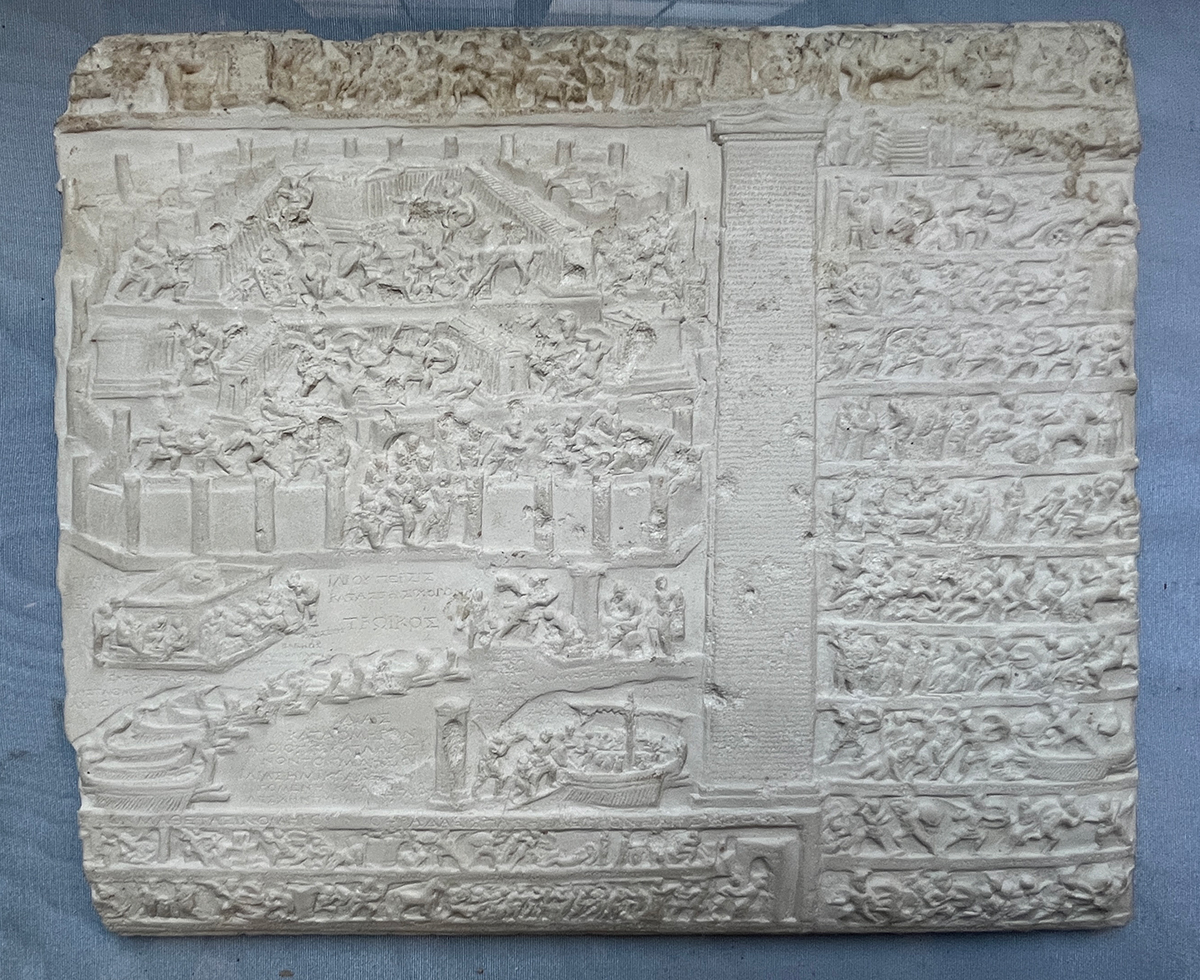
Capitoline Museums, inv. MC0316; image source: Brent Nongbri 2024
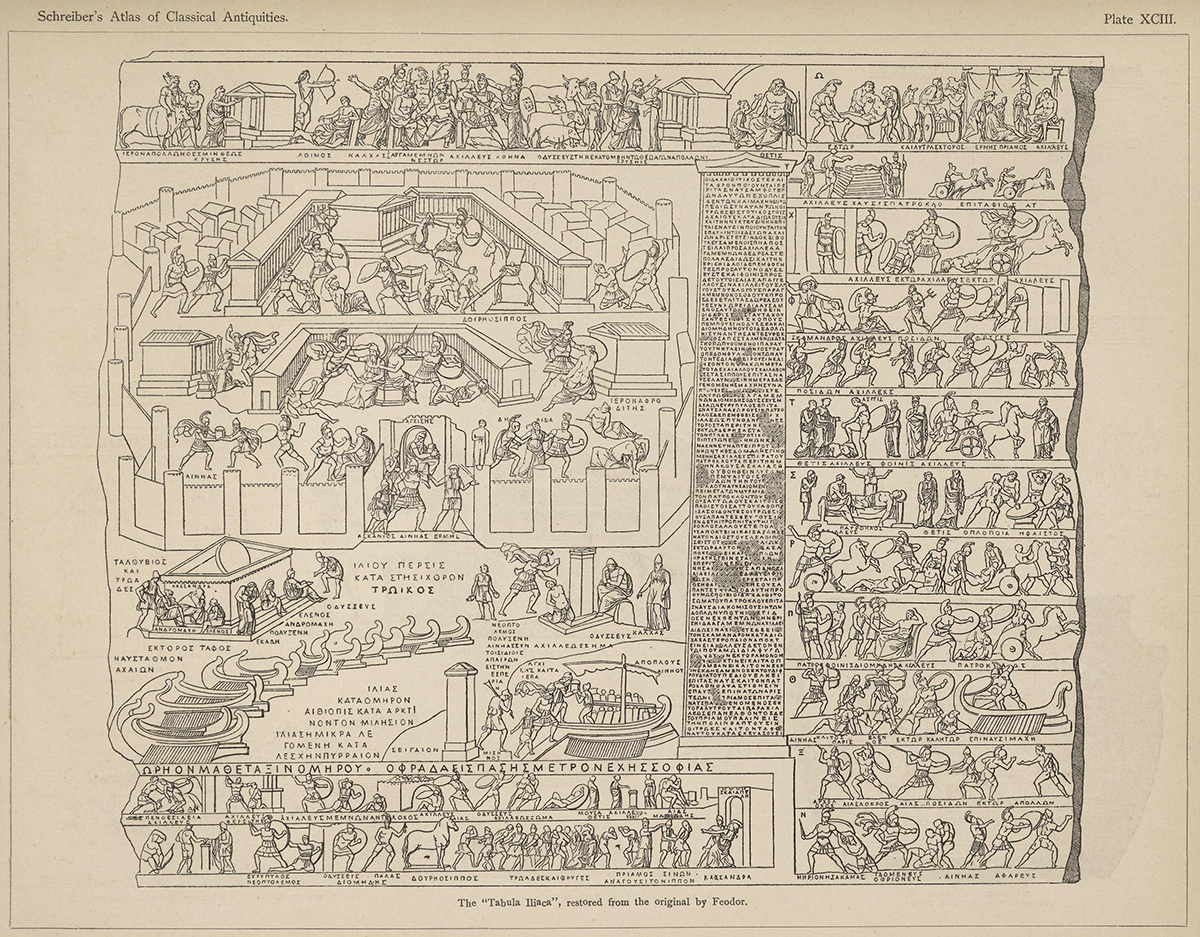
There is greater detail in a drawing made in the late nineteenth century:
The calcite plaque is quite thin and the reliefs (necessarily!) quite shallow. The thickness of the plaque is usually given as 1.5 cm:
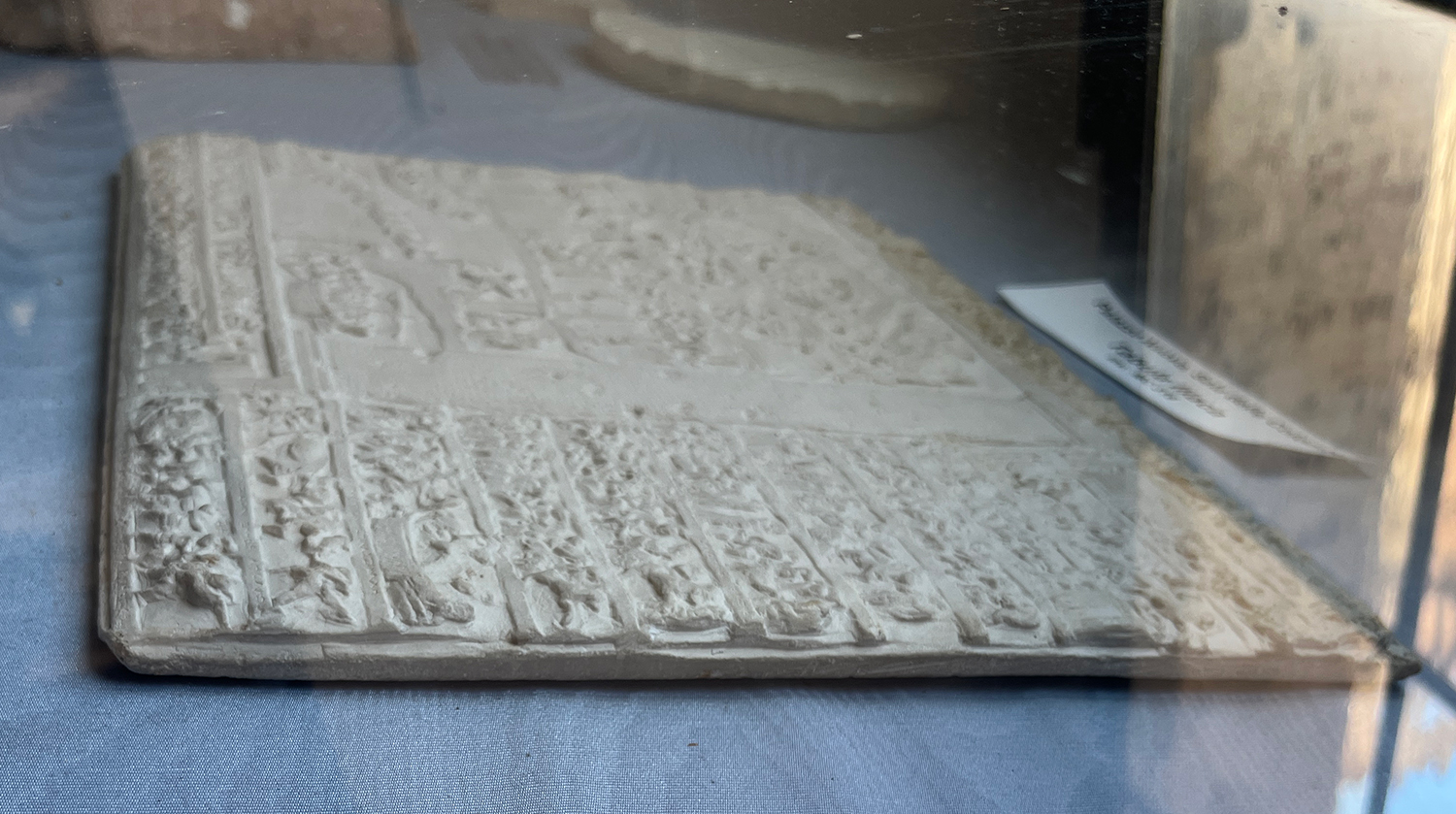
The Capitoline Tabula Iliaca, profile view
Capitoline Museums, inv. MC0316; image source: Brent Nongbri 2024
This particular example is said to have been found in the seventeenth century to the southeast of Rome along the Via Appia just past the area where the Ciampino Airport is today. It is thought to have been produced in Rome in the first century CE. The most remarkable thing to me is the prose summary of the Iliad that occupies the pilaster on the right. Because the plaque is in a case, it was not possible to get an image with a scale, but the dimensions of the surviving portion of the tablet are usually given as 29 or 28 cm wide and 25 cm high.
If that’s the case, then when we digitally add a scale, we can get a better idea of just how small the lettering is.

The Capitoline Tabula Iliaca with a scale added digitally
Capitoline Museums, inv. MC0316; image source: Brent Nongbri 2024
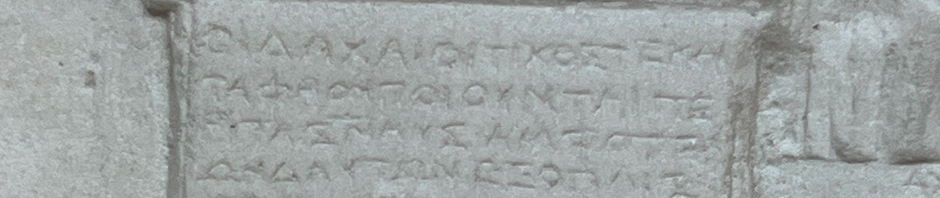
If we set a scale next to the inscription on the pilaster, we can see that there are about 6 lines for each centimeter. Most letters are about 1 millimeter high.
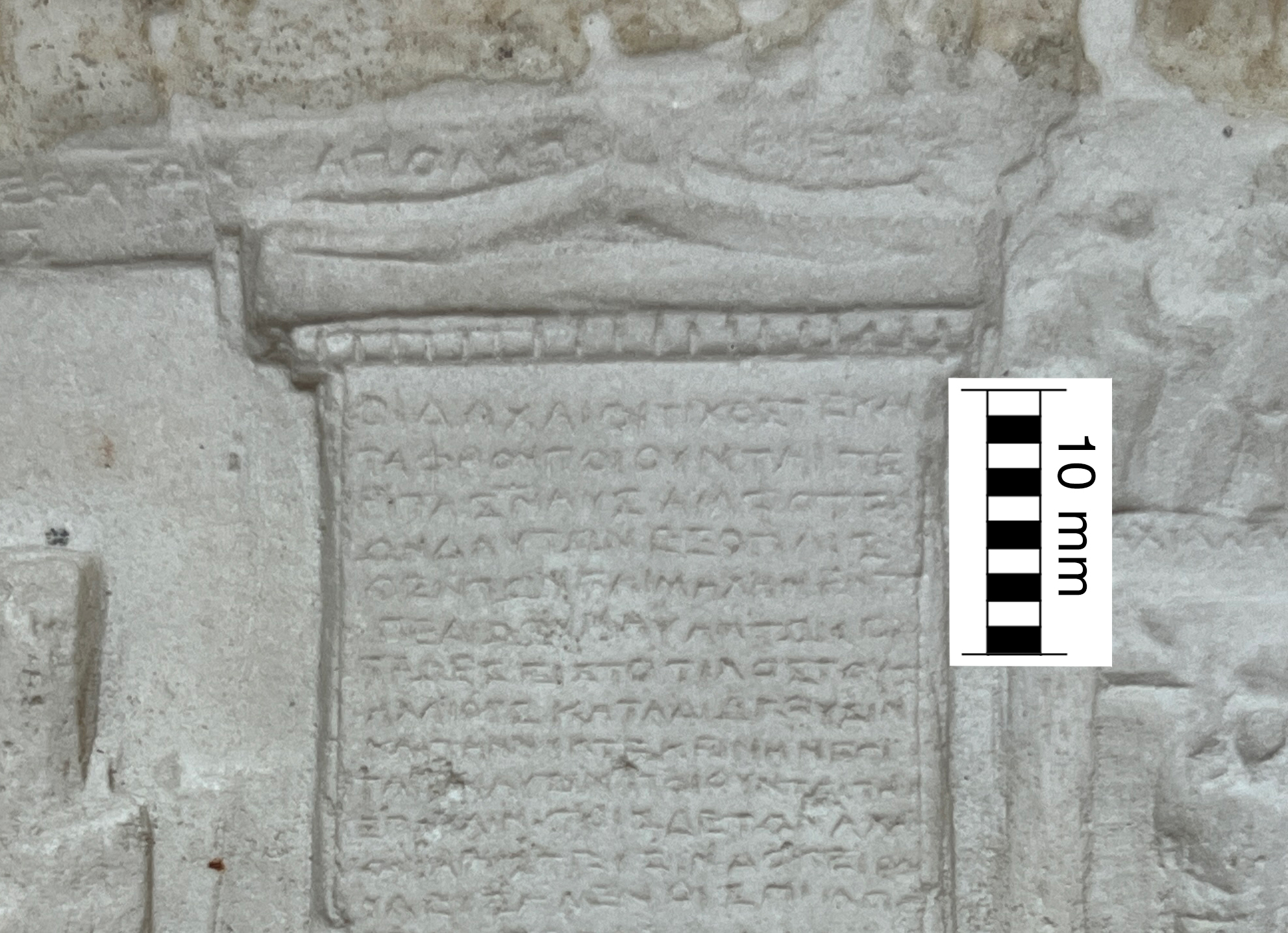
The Capitoline Tabula Iliaca, detail of pilaster with scale added digitally
Capitoline Museums, inv. MC0316; image source: Brent Nongbri 2024
It’s quite amazing that legible writing, cut into stone, could be produced at this size (this is roughly the size of the writing we find in the miniature parchment Manichean codex in Cologne).
The text in the pilaster picks up in Book 7 (there was almost certainly another pilaster on the left side of the plaque that contained a summary of the earlier books). The summary is pretty dry. Here are the first few lines from the picture above (for the whole Greek text, see the edition of IG XIV 1284 at PHI):
οἱ δ’ Ἀχαιοὶ τῖχός τε καὶ
τάφρον ποιοῦνται πε-
ρὶ τὰς ναῦς. ἀμφοτέρ-
ων δ’ αὐτῶν ἐξοπλισ-
θέντων καὶ μάχην ἐν τῷ
πεδίῳ συναψάντων οἱ
Τρῶες εἰς τὸ τῖχος τοὺς
Ἀχαιοὺς καταδιώκουσιν
καὶ τὴν νύκτ’ ἐκείνην ἐπὶ
ταῖς ναυσὶν ποιοῦνται τὴν
ἔπαυλιν. …
So, who would use an object like this and in what kind of setting? The tabulae have sometimes been understood as educational aids (Nicholas Horsfall has argued that this and other similar plaques served as a means of “elementary adult education” for the nouveau riche: “Above all, the Tabulae belong chez Trimalchio.”)1 But given the difficulty of actually reading the writing, an educational purpose seems unlikely. Use as a conversation piece seems a bit more plausible.
Two recent books have provided good treatments of the larger group of artifacts to which the Capitoline example belongs:
- Michael Squire, The Iliad in a Nutshell: Visualizing Epic on the Tabulae Iliacae (Oxford University Press, 2011)
- David Petrain, Homer in Stone: The Tabulae Iliace in their Roman Context (Cambridge University Press, 2014)
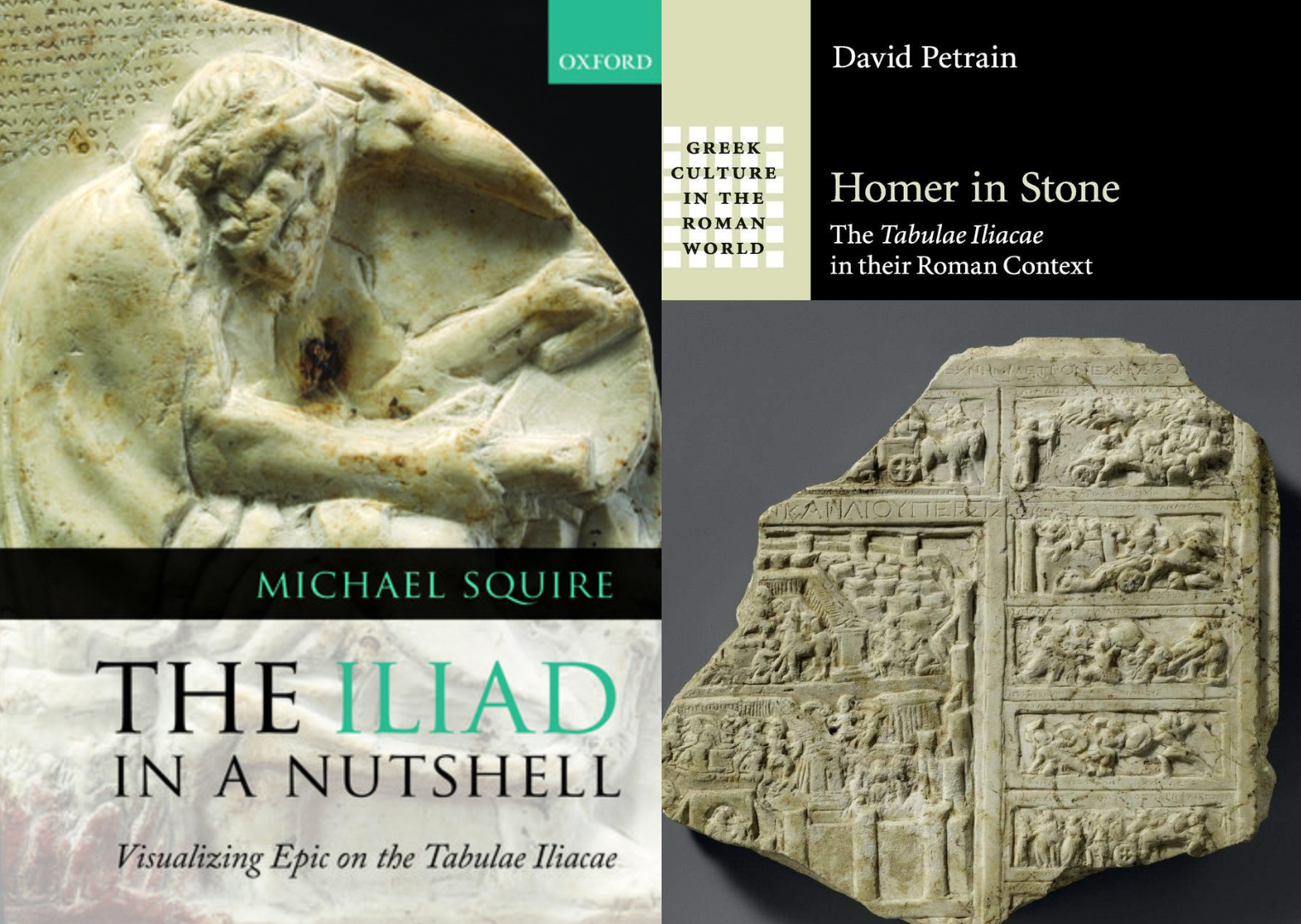
The archived museum record for the Capitoline Tabula Iliaca is here. This very useful online catalog seems to have disappeared from the web and been replaced by a page where one can purchase a (backwards) photograph of the plaque. Unfortunate.
- Nicholas Horsfall, “Stesichorus at Bovillae?” Journal of Hellenic Studies 99 (1979) 26-48. ↩︎


 Variant Readings