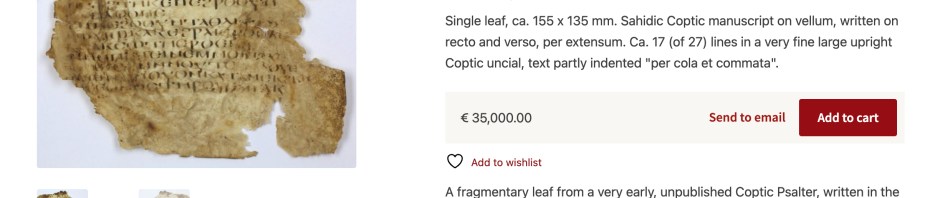
Thanks to Alexander Schick for the tip: Earlier this year, Christie’s offered on auction several pieces from the collection of Martin Schøyen. Among the pieces sold was the so-called Crosby-Schøyen codex. Still no word on who bought the book or where it now resides. Now it looks like other pieces are for sale through an online rare book dealer:

Included are parchment folia from Coptic Psalters. All three have the same slightly odd statement of provenance:
“In the collection of Maurice Nahman (1868-1948), French collector-dealer, and Head Cashier at the Crédit Foncier d’Egypte in Cairo, who used this position to establish himself as the foremost antiquity dealer of Cairo in the 1920s and 1930s. A sale of part of his collection was held by Christie’s, London, on 2 March 1937. After his death his son kept the business going until 1953, and then the remaining stock was offered at Hotel Drouot, Paris, on 26-27 February and 5 June 1953, with the remainder apparently passing to Erik von Scherling.”
It’s not clear from this statement whether these particular pieces are being claimed as part of the 1937 sale, the 1953 sales, or as a part of Nahman’s collection that “apparently passed” to Erik von Scherling. Or whether they are just being assigned in general terms to “the collection of Maurice Nahman.” A somewhat frustratingly vague statement.


 Variant Readings
I would guess that the association with the White Monastery is presumed and that the provenance is reconstructed thereupon. Although I think that this provenance could be correct, a group of Coptic parchments seems to have dispersed in the late 1980s, which resembled the known White Monastery pieces more than for instance the papyri from the Dishna Papers.
Yes, I agree that the statement is plausible; it’s just really vague. Also, it’s odd in the case of Ms. 114 that only one leaf appears to be for sale, as the collection website describes the manuscript as “a substantial part of a Coptic Psalter” and the image at the collection site shows two folia.
Ah, I see the fuller story of the provenance of this leaf is given at the Christie’s page for the bound portion of the manuscript: https://www.christies.com.cn/en/lot/lot-6483580