
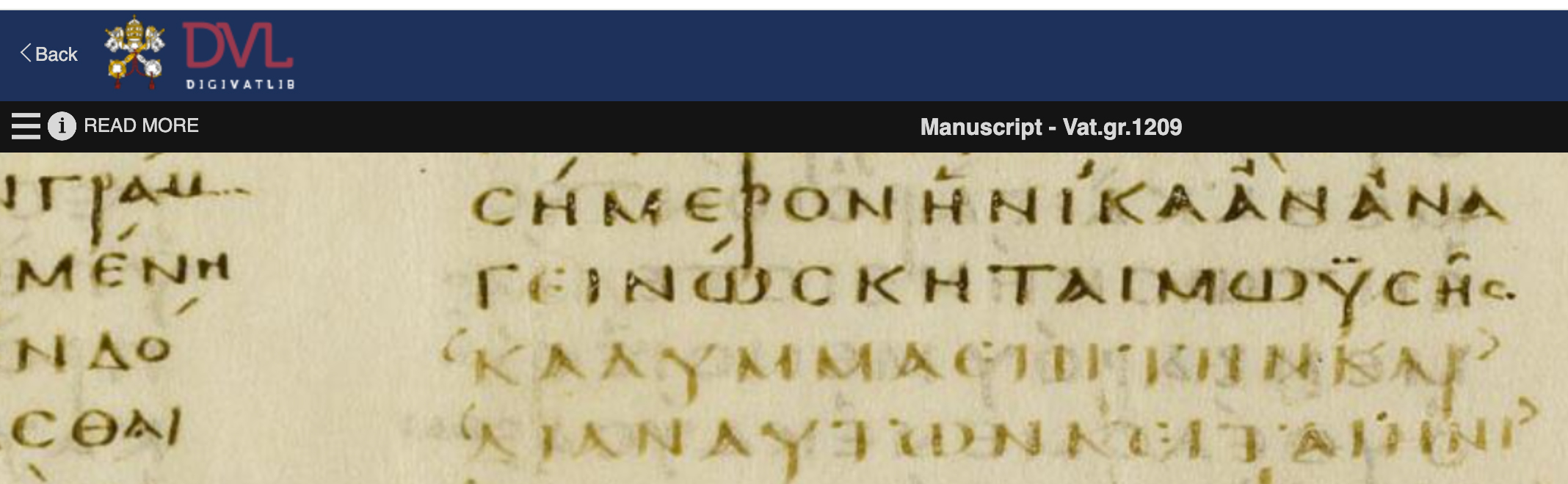
2024 has been a good year for the study of Codex Vaticanus. Peter Head at the Evangelical Textual Criticism blog just posted a notice of an important new study of the inks in the codex:
- Nehemia Gordon, Patrick Andrist, Oliver Hahn, Pavlos D. Vasileiadis, Nelson Calvillo, and Ira Rabin, “Did the Original Scribes Write the Distigmai in Codex Vaticanus B of the Bible (Vat. gr. 1209)?” Vatican Library Review 3 (2024) 125-156
The article is available open access here.
It seems that the marginal distigmai (double dots), which have occasionally been described as fourth-century indicators of textual variation, are written in inks that were made from a very pure form of vitriol, which points to a much later date (sixteenth century). Thus, the distigmai were neither part of the original production of the codex nor the work of an early user of the codex.
Earlier this year, the Arbeiten zur neutestamentlichen Textforschung series published a fascinating study on the early critical academic reception of Codex Vaticanus, detailing how it came to have such a prominent place in the textual criticism of the New Testament:
- An-Ting Yi, From Erasmus to Maius: The History of Codex Vaticanus in New Testament Textual Scholarship (Berlin: De Gruyter, 2024)
The book is available open access here.
These 2024 studies follow on the heels of two other important studies of Codex Vaticanus, a doctoral thesis at Cambridge and a recent volume of Studi e testi:
- Jesse Grenz, The Scribes and Correctors of Codex Vaticanus: A Study on the Codicology, Paleography, and Text of B(03) (Ph.D. dissertation, University of Cambridge, 2021)
- Pietro Versace, I marginalia del Codex Vaticanus (Vatican City: Biblioteca Apostolica Vaticana, 2018)
And all of this is in addition to the nicely illustrated resources related to the codex on the Vatican Library’s excellent palaeography site.
It’s exciting to see how much we still have to learn from this fascinating manuscript.


 Variant Readings