I am fascinated by the Wikipedia entry for 7Q5, which seems to continuously bounce back and forth between being useful and informative to being goofy and borderline incoherent. 7Q5 is a tiny fragment of papyrus found in Cave 7Q at Qumran that contains an unidentified text in Greek. As I noted in an earlier post, it was a mistaken reading of a printed edition (not the manuscript itself) that led the Spanish scholar José O’Callaghan to conclude that fragment contained a portion of the Gospel According to Mark in the 1970s. This created a sensation because it is generally accepted that the manuscripts in the caves at Qumran predate the sack of Qumran in the late 60s CE. O’Callaghan’s error was pointed out immediately, but instead of admitting the slip, he doubled down, and his mistaken identification of 7Q5 has had a persistent afterlife.
The arguments against O’Callaghan’s proposal are compelling.1 Most importantly, O’Callaghan’s reconstruction both depended upon impossible or highly suspect readings of several letters and necessitated that one out of the mere nine undisputed letters on the papyrus must be a scribal error.
After a flurry of articles in the 1970s demonstrating the problems with O’Callaghan’s thesis, it largely (and justifiably) fell out of view, only to be revived in the 1990s by Carsten Peter Thiede (1952-2004).
In my earlier post on 7Q5, I pointed out that what was once a reasonably informative article on Wikipedia had become a confused collection of misinformation. The article was then cleaned up but has again become a jumble of decent scholarship and nonsense. One of the recent changes to the entry is a series of appeals to authority, especially that of Orsolina Montevecchi (1911-2009), an Italian papyrologist who endorsed O’Callaghan’s identification of 7Q5 as a fragment of Mark. However, these appeals to authority tend to be by way of hearsay. For instance, many appeals to authority come by way of Thiede. In a book co-authored with the journalist Matthew D’Ancona, Thiede presented Montevecchi’s view as decisive:
“In 1994 the last word on this particular identification seemed to have been uttered by one of the great papyrologists of our time, Orsolina Montevecchi, Honorary President of the International Papyrologists’ Association. She summarized the results of her analysis in a single, unequivocal sentence: ‘I do not think that there can be any doubt about the identification of 7Q5.'”2
This confident assertion made me wonder: What was Montevecchi’s actual reasoning? As far as I have been able to tell, in her massive bibliography, Montevecchi mentions 7Q5 just twice (I would be happy to be corrected if anyone knows of additional references) [[Update 24 May 2025: The count is up to three; see in the comments below]].
The first reference appears in her introductory textbook, La papirologia (1973). The preface to this book is dated May 1972. That is to say, a little more than one month after the first appearance of José O’Callaghan’s first publication on 7Q5 in the first issue of the 1972 volume of Biblica (which carried a print date in March of 1972). That is to say, this statement was composed before any of the rebuttals to O’Callaghan had had been published. At the conclusion of a list of the New Testament papyri that had been published to date, we find a single sentence:
“Furthermore, in the papyrus fragments 7Q5, 7Q6 (frag.1), and 7Q8, palaeographically datable to 50 BCE – 50 CE, have been recognized respectively, Mark 6:52-53 and 4:28 and James 1:23-24 (O’Callagahan, J. in Biblica 53 [1972], 91-100) [“Inoltre nei frammenti papiracei 7Q5, 7Q6, 1, 7Q8, paleograficamente datibili c. 50a-50p, sono stati riconosciuti rispettivamente Mc. 6, 52-53 e 4, 28 Iac. 1, 23-24 (O’Callaghan, J. in «Biblica» 53 1972, pp. 91-100).”]
As far as I know, that is all Montevecchi ever said about this papyrus in an academic publication. The other reference that comes up frequently is an interview conducted for the Catholic periodical 30 Giorni in 1994.
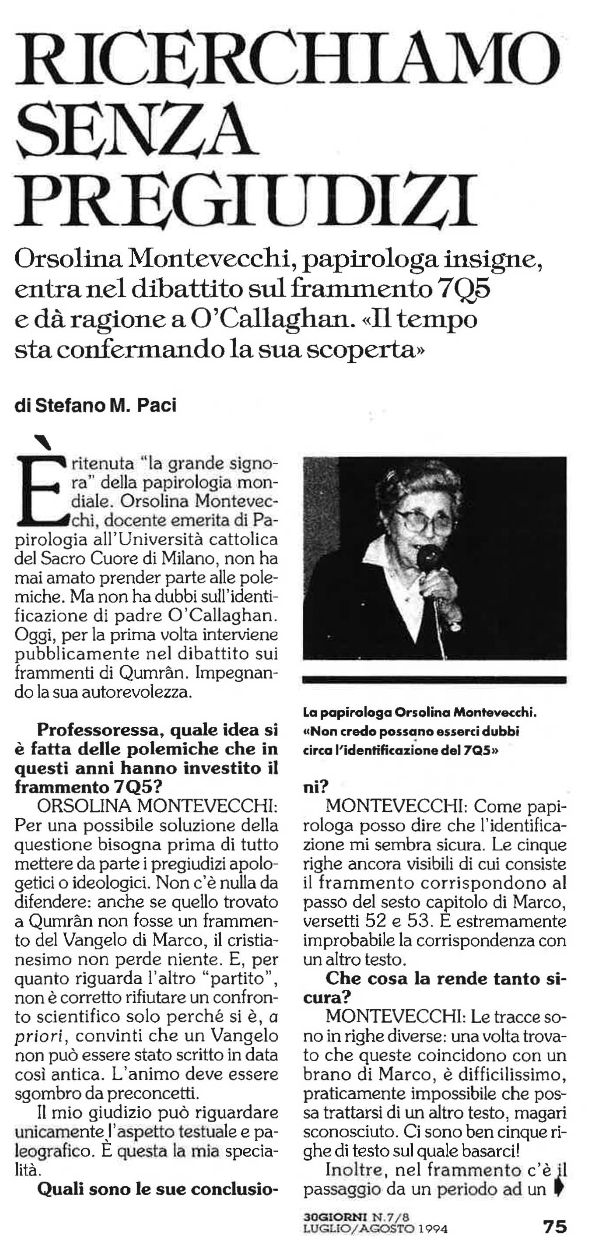
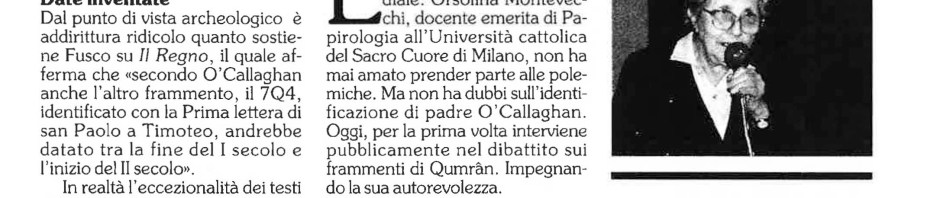
This article, which is the source of Thiede’s quotation endorsing the identification 7Q5, actually has an extended interview with Montevecchi, in which she outlines her reasoning for accepting the identification. It’s fascinating to see what she actually says.
Interviewer: Many excellent palaeographers do not agree with this identification.
Montevecchi: There are some difficulties because three words are missing from the text (epi tēn gēn = “to the land”) compared to the passage in Mark. We read in the gospel text handed down to us: “Having crossed the lake to the land.” But that “to the land” is superfluous. When one crosses a lake, one obviously goes to the other side. In fact, even though these palaeographers seem to ignore it, it’s quite common in the oldest texts of the Bible on papyrus to find the omission of some element not necessary for the understanding of the text. It is as if such words were added later, by way of explanation. Another source of opposition is the fact that there is an exchange of consonants, a tau (t) instead of a delta (d). But this is also a frequent error. Because texts were dictated, the writer transmitted errors of pronunciation. These are the only two objections, which are taken as an excuse to invalidate the identification of this papyrus, since they are the only variations from the text as it was handed down.3
Regardless of how good a papyrologist Montevecchi may have been or how important she may have been to the field, this is simply a very bad argument. Montevecchi neglects even to mention the most compelling counterargument to the identification–the fact that several of O’Callaghan’s readings of letters are wrong, doubtful, or impossible to verify. It is that fact, combined with the need to consider one of only nine undisputed letters as an error, combined with the need to posit the existence of the existence of an otherwise unattested textual variant (διαπερασαντες ηλθον εις γεννησαρετ in Mark 6:53), which makes the identification extremely doubtful if not impossible. Montevecchi was either not fully informed about the scholarly debate around the fragment, or she simply decided to try to defend O’Callaghan’s position by mischaracterizing the opposing arguments and ignoring the most damaging evidence against O’Callaghan’s identification. In the matter of 7Q5, the appeal to Montevecchi’s authority actually adds nothing of substance to the discussion.
- The most informed and thorough rebuttals to O’Callaghan (and later Thiede) include the following (in chronological order):
Maurice Baillet, “Les manuscrits de la Grotte 7 de Qumrân et le Nouveau Testament.” Biblica 53.4 (1972) 508-516.
C.H. Roberts, “On Some Presumed Papyrus Fragments of the New Testament from Qumran,” Journal of Theological Studies, n.s. 23 (1972) 446-447.
Gordon D. Fee, “Some Dissenting Notes on 7Q5 = Mark 6:52-53,” Journal of Biblical Literature 92 (1973) 109-112.
Stuart R. Pickering and Rosalie R.E. Cook, Has a Fragment of the Gospel of Mark Been Found at Qumran? (Sydney: Macquarie University Ancient History Documentary Research Centre, 1989).
Robert H. Gundry, “No nu in Line 2 of 7Q5: A Final Disidentification of 7Q5 with Mark 6:52-53,” Journal of Biblical Literature 118 (1999) 698-707. ↩︎ - Carsten Peter Thiede and Matthew D’Ancona, The Jesus Papyrus (Weidenfeld and Nicolson, 1996), 56. ↩︎
- “È stata fatta qualche difficoltà perché nel testo mancano tre parole (epi ten ghen = verso terra) rispetto al brano dì Marco. «Avendo attraversato il lago verso terra”, si legge nel testo del Vangelo tramandatoci. Ma quel «verso terra» è superfluo: attraversando un lago, si va ovviamente dall’altra parte. In realtà, anche se questi paleografi sembrano ignorarlo, è abbastanza frequente nei testi più antichi della Bibbia su papiro, trovare l’omissione di qualche elemento non necessario per la comprensione del testo. È come se quelle parole fossero state aggiunte dopo, a mo’ di spiegazione. Un’altra fonte di opposizione è il fatto che c’è uno scambio di consonanti: una tau (t) invece di una delta (d). Ma anche questo è un errore frequente. Poiché i testi venivano dettati, chi scriveva riportava gli errori di pronuncia. Ci sono molti altri casi, nei papiri biblici di scambio di tau con delta. Queste sono le due sole obiezioni che sono prese a pretesto per invalidare l’identificazione di questo papiro, poiché sono le sole varianti rispetto al testo tramandato.” ↩︎


 Variant Readings
Yet another very thorough bit of detective work!
https://nl.m.wikipedia.org/wiki/7Q5
The Dutch version, a refreshing piece of soberness. The little fragment should say Καὶ διαπεράσαντες, in toto?
No wonder the appeal to authority is made 😉
Also, apparently, discussion, bibliography and edition in “Qumran Greek Fragments 7Q3-7Q19” by Elden Jay Epp and Larry W. Hurtado, pages 1-33 in The Dead Sea Scrolls… Volume 5B…, ed. J. H. Charlesworth et al. (Westminster John Knox Press, 2024).
Thanks for that reference, Stephen. I just took a look at that chapter, which I had not seen before. It has an excellent overview of scholarship and a very even-handed and up-to-date discussion of the whole matter.
In a 1994 book review she simply says that 7Q5 should be added to the list of NT Mss. See Review of Il testo del Nuovo Testamento. Introduzione alla critica testuale, Aegyptus, 74(1/2), 206–207.
Many thanks–I was not aware of this review.
Hi Brent, most of your sources are from non papyrologists like Cook, Pickering and Gundry who are in error. They also appeal to a “phantom” authority by saying most scholars disagree that 7Q5 is Mark. Not a single peer reviewed survey or even book of papyrologists on record states this. Most papyrologists agree that 7Q5 is Mark 6. People like Ochallaghan, Thiede, S Daris, Hunger, Montevecchi etc. The Book Christen und Christliches of Q. Symposium confirms this. Furthermore the objections have been answered/many show a lack of understanding of the field of papyrology such as missing letters, variants, small # of letters which is part of the field. NU was 3rd party verified twice
Hi Anton, thanks for reading. I would agree that the sources cited in my note, aside from C.H. Roberts, were not professional papyrologists (though it should be pointed out that both Pickering and Cook earned PhDs on the basis of papyrological theses). Nevertheless, I would stand by the claim that the sources I cite are in fact the most informed and thorough rebuttals to O’Callaghan and Thiede (and I note in passing your characterization of Thiede as a papyrologist is open to question). The Dead Sea Scrolls sit at an interesting intersection of different areas of expertise. Yes, papyrology is one such area. At the same time, however, scrolls scholars formed their own kind of specialist area in the second half of the twentieth century (meaning they developed their own academic journals, book series, etc.). When it was proposed that some scroll fragments like 7Q5 may be Christian, still another area of experts became relevant: textual critics of the New Testament and scholars of early Christianity, people who specialize in the text of early Christian literature. So, the arguments of people like Baillet, Fee, and Gundry should not just be swept aside because they are not papyrologists. Their expertise is relevant, and their arguments should be examined, as should the arguments of papyrologists. That is what I do in this post—track down and examine what Montevecchi actually argued, and it turned out that her argument was poor; she ignored the main issue—O’Callaghan’s highly questionable readings of several letters.
Thanks for the reply. No disrespect was meant to scholars who aren’t papyrologists but I meant to merely point out that they made assertions in analysis and conclusions that there aren’t papyrologist on record that support it. As early as 1970s David Estrada records in a book papyrologists on record who support 7Q5 as Mark 6. The book is entitled something like First New Testament. Interdisciplinary approaches can be helpful. Your intention of having an engaging discussion with even dissenting views is encouraging. In the Jewish Talmud, Shabbat 116 A describes a Christian Canon, gospels as part of it and then Rabban Gamliel 2 cites Matthew. Non Jewish Christians had possession of these texts
Not having David Estrada Herrero’s 1972 Eternity articles nor his 1978 book at hand, if useful, from an old email:
“The passage about saving scrolls from a fire that may be about Ebionim and
Notsrim is in bavli Shabbat 116 a-b. A related text is Tosefta Shabbat 13, 5.
According to my dissertation (pages 92-94) here are some scholars who suggested
this idea:
S.M.N. (=? Michael Sachs), “Ueber zwei im Talmud vorkommende christliche
Sekten,” Litteratureblatt des Orients 6 (1845) col. 1-5.
Michael Sachs, Beitrage zur Sprach und Altertumsforschung I (Berlin: Verlag von
Veit, 1852, 59f.
Leopold Loew, “Be Abidan ube Nisraphi,” Hehaluz 2 (1953) 100-101.
I.M. Jost, Geschichte des Judenthums II (Leipzig, 1858) 40 n.1 (with
typographical error).
Manuel Joel, Blicke in die Religionsgeschichte II (Amsterdam 1973 reprint of
1883 ed) 91-4.
Jacob Lauterbach, Rabbinic Essays (Cincinnati: Hebrew Union College Press,
1951) 570.”
Hi Stephen, thanks for the reply. In the last section of Shabbat 116A it specifically says the Christian writings and then the Gospels (evangelion which is literally the gospel) as Rabbi Meir retorts. Secondly in Shabbat 116B the Judge refers to a new law and the Rabban 2 says light your light shine as a lamp which is a quote from Matthew’s Gospel. I had a typo on last post- I meant to say non Christian Jews had copies of Christian texts as this Talmud section proves. Christian texts among Dead Sea scrolls is fine
Anton, the Cave 7 Qumran manuscripts were written centuries before that Talmud passage. The Talmud passage does nothing to show any Christian content in Cave 7.
[A typo on Leopold Loew article above: 1853, not 1953.]
The first non-Christian known to mention Jesus was Josephus, in about the year 94,
discussed here:
https://ntweblog.blogspot.com/2025/06/what-exactly-did-josephus-write-about.html
The point of mentioning Shabbat 116 was to show that Non Christian Jews possessed Christian texts in the first century ce. Rabbi Gamaliel 2 and others lived part of their lives in the first century CE. Futhermore, the codification of the Talmud teachings existed centuries before being written. Matthew 15 and Mark 7 are examples where the Talmud Mishnah is referred to explicitly. Also Pilate and Tiberius wrote of Jesus as part of official Roman correspondence in the 30s CE as non Christians. The texts are no longer extant but multiple sources attest to the reference they both made. Thallus wrote of Jesus in 52 CE and Phelgon about 70 CE and Mara Bar Sapien about 73CE wrote of Jesus as non Christians decades before Josephus did.
Stephen and Anton: Probably best to continue this discussion on Stephen’s post, where it’s more exactly on point: https://ntweblog.blogspot.com/2025/06/what-exactly-did-josephus-write-about.html
Dear Brent Nongbri: Thanks so much for your summary piece on the
conflicting palaeographical reports on 7Q5; they are very useful. I am
not a palaeographer, I’m a book historian,so I face a different
question, not answered in any sources I have been able to consult. Are
there any signs of formatting in 7Q5, however faint or feeble?? This
is not a joke question; palaeographers often pay no attention to format;
I always consult Larry Hurtado’s handlists for his view of whether a ms.
shows any signs of coming from a roll, a codex, in an amulet, etc., or
shows specific signs of codex format: central gutter, writing on both
recto and verso, piercing holes for links or sewing. From the pictures I
have seen of 7Q5 I can’t detect any of these, and of course I will never
get to see the fragment in question, but since you have written about
7Q5 (and not only because you share my view of the delirious Wikipedia
article on the object in question) I thought I would ask. By the way, if
you want to see a really delirious argument in Wikipedia, try the “Talk”
section on P52; it’s a stunner, or was when I last looked at it a few
months ago (I fear it has been archived now). Thanks so much for
“Variant Readings” — I wouldn’t miss it! Yours, Germaine Warkentin
Thanks for the comment! All of the 7Q fragments are now glued to rice paper, so a proper examination of the back sides is not possible. But no lettering is visible on the back sides of the fragments when they are set on a light table. Some of the 7Q fragments show spacing between words, but otherwise, there is no appreciable formatting visible on any of the pieces.
Pingback: 7Q5 and Appeals to Authority, Part 2: Herbert Hunger | Variant Readings