
An important new study of the Dead Sea Scrolls has just been published (open access!) in the journal PLOS One:
In some ways, the article buries the lede. The The AI experiments mentioned in the title are interesting, but the most important material is certainly the new radiocarbon analysis of some 30 manuscripts. The actual radiocarbon data is absent from the article itself but is presented as one portion of a lengthy (95 page) appendix that is available here.
This is a very exciting study. The team carried out multiple analyses for each manuscript, so we can have a good degree of confidence in the results. There is also a detailed description of the cleaning and analysis procedures, which is a very welcome development that will be helpful in planning future AMS tests on parchment manuscripts. This is also (to the best of my knowledge) the first published report of direct CO2 analysis of parchment (which allows analysis of very small samples), so this is very exciting!
Of the 30 manuscripts tested, valid results were obtained for 26. The results were something of a surprise. In 17 of these 26 cases, there is at least some overlap between the palaeographic dates assigned by the editors of the Discoveries in the Judaean Desert series and the radiocarbon results, but in 9 cases (a third of the samples), there was no overlap at all. In most cases, the radiocarbon ranges are earlier than the proposed palaeographic dates. So, these results create some potential problems for the typology of Jewish scripts that is associated with Frank Moore Cross. Part of the problem is that Cross’s typology works with unrealistically narrow ranges, sometimes assigning scripts to intervals as small as 30 years (less than the working life of some scribes known from Egyptian data). If the palaeographic dates were expanded to a more sensible one-century range, there would be more overlap between the palaeographic dates and the radiocarbon results.
In terms of the individual results, the one that is really eye-catching is the analysis of 4Q114, a manuscript with portions of the book of Daniel:
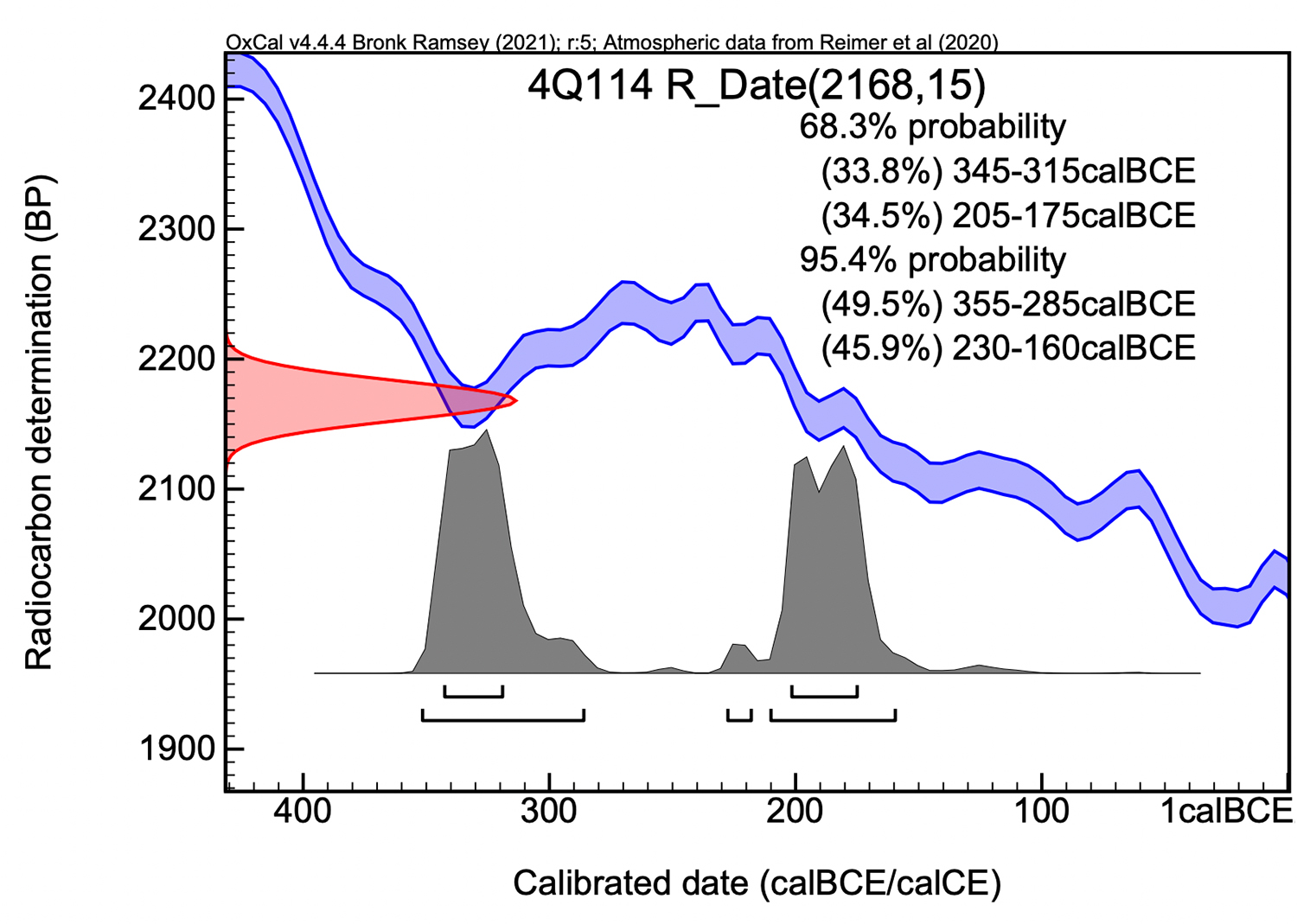
As the authors write:
“Sample 4Q114 is one of the most significant findings of the 14C results. The manuscript
preserves Daniel 8–11, which scholars date on literary-historical grounds to the 160s BCE. The accepted 2𝜎 calibrated range for 4Q114, 230–160 BCE, overlaps withe the period in which the final part of the biblical book of Daniel was presumably authored.”
This is quite interesting. Anyway, these are just my first impressions. There is a lot of useful data here that will take some time to digest.


 Variant Readings
C14 might provide some reasonable results due to the dry cave environment of these scrolls.
Their findings regarding 1QIsaa were also quite interesting, placing the supposed two hands that composed the scroll within the same time period.
In December I sent the following to Popovic’s cowriter Maruf Dhali as response to an earlier pre-publication version of the paper, with some enclosures. I have not checked if there are substantial differences in the latest version.
—-
Dear Maruf, Always good to meet you!
I promised some responses to the paper:
This is an important paper, but it needs reworking, primarily a discussion of the uncertainties connected to C14-dating of samples from the Levant with reference to the needed literature from the last ten years. I enclose an article by Hugo Lundhaug (2020) that discusses this nicely, as well as a chapter (+ notes) from Stephen Shoemaker’s Creating the Quran (2022), which in detail surveys and discusses this issue. Shoemaker’s book is open access, so you should easily be able to find his long bibliography (needed to navigate his notes).
I accept your findings of overlap in time between late-Hasmonean and early-Herodian scripts—-a very important result.
The nine samples providing a C14 date older than common paleographic dates, with 4Q114 Daniel c as a shining example, makes me suspect that your C14 dates in general are too early due to the uncertainties of calibrating C14 dates in the Levant. 230–160 for 4Q114 remains impossible.
(4Q114 is not the autograph)
Then: I did not note that you state clearly in the paper what you told me: that there is a high uncertainty connected to dates around 200BC, stretching out to 300 BC and 100 BC. This point should be expressed more clearly.
I enclose a chapter from our Schøyen volume, where Ira Rabin demonstrates that the high-quality parchment of 1QIsa a and 1QS were processed in the same Judean workshop from the same recipe, which likely means that these two scolls should be dated to the same time.
Good luck (with reworking?)!
Torleif
Thanks, Torleif. The nuances discussed by Hugo Lundhaug are correct with reference to materials calibrated with IntCal 13, but the results reported for this batch of DSS have been calibrated with IntCal 20, which is said to account (at least in part) for the offset discussed by Lundhaug (see Reimer et al. 2020). And Shoemaker’s objections aren’t really applicable in this case. He objects to the combination of dates from artifacts presumed to be from the same archaeological context, but this is a standard practice among archaeologists and is accepted science. And in the present case of this batch of DSS, the only combination of dates are from samples taken from the self same artifact, so Shoemaker’s argument is not really relevant.
I am no specialist when it comes to C14. Shoemaker notes the highly conflicting dates given to different sheets of Sanaa1, clearly the oldest manuscript of the Quran, by different labs: 578–669, 338–535, 565–656, 575–655 (IntCal 20), 406–543 (IntCal 20), 441–636 (IntCal 20), 599–655 (IntCal 20). With the Quran finalized around 705 CE, Shoemaker notes that we have a serious problem here, at least for mss from the Middle East in early medieval times.
This study by Popovic yields the calibrated date 230–160 BCE for 4QDaniel c, a Daniel ms that cannot be the autograph. With the book of Daniel finalized not earlier than the late 160s, I remain skeptical at least to the nine cases where C14 provides dates earlier than the paleographical dates given to these mss.
Do some of these earlier date ranges contradict some of the dates for some TaNaK books proposed by, e.g., Russell Gmirkin and other advocates for Hellenistic dates?
Hello again, Torleif. The data from Shoemaker does not help your case, I think. Your list of dates includes the same results calibrated in different ways. The uncalibrated ages reported for these samples are:
1423 ± 23 BP
1437 ± 33 BP
1515 ± 25 BP
There is a fourth sample from folio 13, but I am not sure what the uncalibrated age is (the data given in Shoemaker must be incorrect; his notes b and c on p. 75 report very different calendar dates for the exact same uncalibrated age). Whatever the age of the fourth sample may be, Shoemaker’s point is that there is considerable distance between the measurements (1515-1423=92). The distances between the measurements reported for 4Q114 are much smaller:
2182 ± 24
2158 ± 20
2168 ± 15
This is a fairly narrow range (2182-2158=24). So the comparative data from the Sanaa folio show just how good the data for 4Q114 actually appears to be. But, the radiocarbon ages reported in Popović et al. are already averaged. It would be nice to see the individual measurements for each of the runs. I do not find this data in the article or the appendices.
Good analysis. This shows the importance of using objective data. Ezekiel writing 588BCE quotes Daniel 4:9 in Ezekiel 28:3. Furthermore, he applies the passage of a prideful pagan king brought down by YHWH in Daniel 4 (which references Daniel 2) to ruler of Tyre in Ezekiel. Many other external/objectives proofs show Daniel was actually written in 6th century BCE. Critical scholars don’t like to accept this since it shows Daniel contains prophecy which proves God is source due to human limitation on foreknowledge. But eventually the evidence will show truth. Daniel was written by 530BCE