
The seven-book composition by the historian Josephus describing the sacking of Jerusalem goes by different names in the Greek manuscript copies:
- Περὶ ἁλώσεως
- Ἰουδαϊκὴ ἱστορία περὶ ἁλώσεως
- Ἰουδαϊκὸς πόλεμος πρὸς Ῥωμαίους
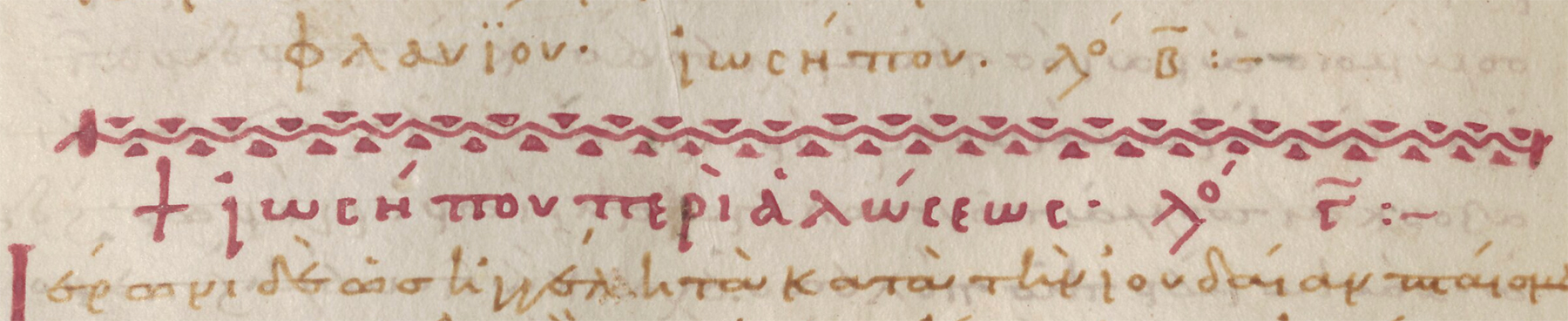
In the Latin tradition, these books were known to Jerome as captituitas Iudaicae (Comm. in Isaiam 17), but the appear under the title De bello iudaico in the manuscripts (when they are not sequentially numbered as a continuation of the Antiquitates)


English editions settled on The Jewish War (or the The Judean War in the ongoing Brill edition).
Images (of varying quality) of several of the important Greek manuscripts of this work are available online.
The oldest manuscript by far is a fragmentary leaf of a papyrus codex usually said to have been produced in the third century, Vienna, Austrian National Library G 29810 Pap (MPER N.S. 3 36):

The medieval manuscripts are of course more numerous and in a much better state of preservation. The major ones I see online are as follows:
- Florence, BML Plut. 69.17, 12th century (online at BML Digital Library); Pinakes entry
- Florence, BML Plut. 69.19, 11th century (online at BML Digital Library); Pinakes entry
- Milan, Biblioteca Ambrosiana D50 sup., 11th century (online at Biblioteca Pinacoteca Accademia Ambrosiana); Pinakes entry
- Munich, Bayerische Staatsbibliothek, Cod.graec., 639, 11th century (online at BSB); Pinakes entry
- Paris, BnF Grec 1425, 11th century (online at Gallica); Pinakes entry
- Rome, Vatican Library, Pal. gr. 284, 11th century (online at DigiVatLib); Pinakes entry
- Rome, Vatican Library, Urb. gr. 84, 11th century (online at DigiVatLib); Pinakes entry
- Rome, Vatican Library, Vat. gr. 148, 10th or 11th century (online at DigiVatLib); Pinakes entry
There are of course many other more recent or more fragmentary (or not-yet-digitized) manuscripts, which are all listed here.


 Variant Readings
The new book by T. C. Schmidt, Josephus and Jesus: New Evidence for the One Called Christ, like any other book, can of course be reviewed and criticized.
Its Appendix 5, “The Great Sanhedrin and Its Records of the Trial of Jesus,” speculates that Josephus *might* have had a written transcript of that court proceedings. The suggestion is quite unlikely, in my view. Such a record, if it existed,
would probably not have survived the war. Much of Jerusalem burned, including the “public archives,” as Josephus reported, in War 2.427 [17.6]. In his Life Josephus tells that Titus allowed him to keep only some sacred books
(maybe after the victory parade in Rome?).
So that Appendix, as I read it, is of poor quality. Though, after all, it is an Appendix, and not the main text.
On the other hand, the main text does well demonstrate that the TF is mostly quite similar to the writing of Josephus overall. Moreso than some (such as John Meier and Ken Olson) may possibly have thought. Predictably knee-jerk responses (such as by Joseph Wallack and Neil Godfrey) clarify little. More insightful reviews (such as by Daniel R. Schwartz, who has affirmed a mention of Jesus by Josephus that was later altered, scheduled for SBL, among others) I gratefully await.
Top