For a long time, I assumed that sets of wooden tablets from the Roman era were bound in a fairly simple way, with a cord looped straight through the holes as we see in this set of tablets from Kellis that were found with the cord in place:
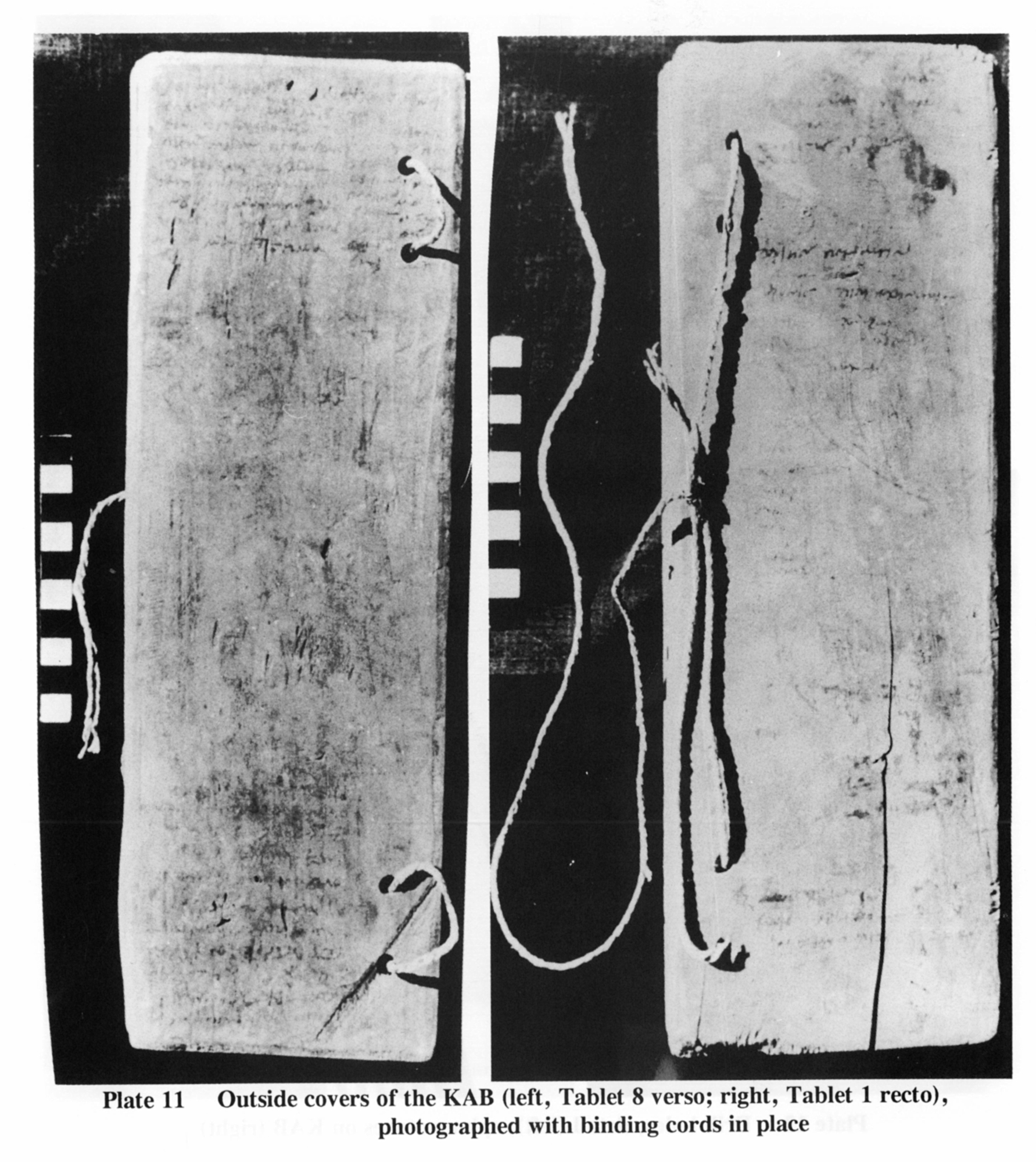
The method results in a slightly clunky but effective method for holding the tablets together and allowing one to turn the “pages.” It had not occurred to me that tablets would be bound in other ways until I saw the remarkable exhibition and catalog from 2018 produced by Georgios Boudalis, “The Codex and Crafts in Late Antiquity.” One of the many interesting and innovative suggestions in that book is that the sewing of wooden tablets may have been more elaborate, with the binding cords wrapping around the outside of the individual tablets along the spine in a manner partly analogous to the way that a loop-stitch (or link-stitch) holds together the gatherings of a multi-quire parchment or papyrus codex. Boudalis illustrated this hypothesis with one of his excellent diagrams:
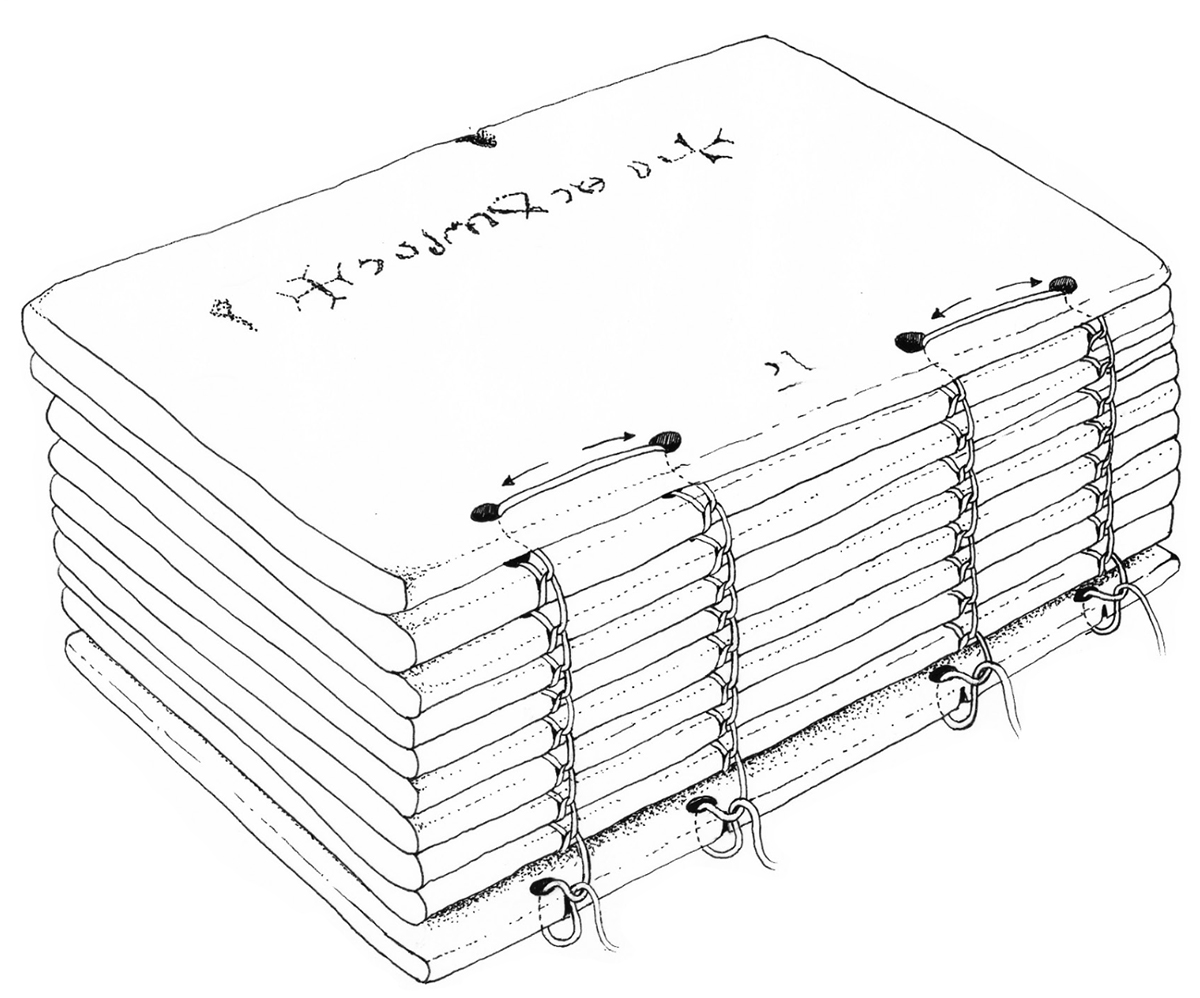
Boudalis’s reconstruction of possible method for sewing tablets together; image source: G. Boudalis, The Codex and Crafts in Late Antiquity (New York, 2018), p. 29, fig. 15
When I reviewed his book, I brought up these imaginative reconstructions and expressed some cautious enthusiasm:
“Boudalis’s reconstructions are rightly and openly signaled as hypothetical. And they are entirely plausible, but they are not (yet!) capable of being confirmed from existing archaeological remains.”
Now I have seen a relief that seems to show a set of tablets bound in a way very similar to what Boudalis proposed. It is a funerary relief in the Rheinische Landesmuseum in Trier. Many of the funerary monuments on display here show sets of tablets as part of “Kontorszene,” office scenes.1 This particular item (inv. 303) is a relief on sandstone showing seven people in a such a financial scene.
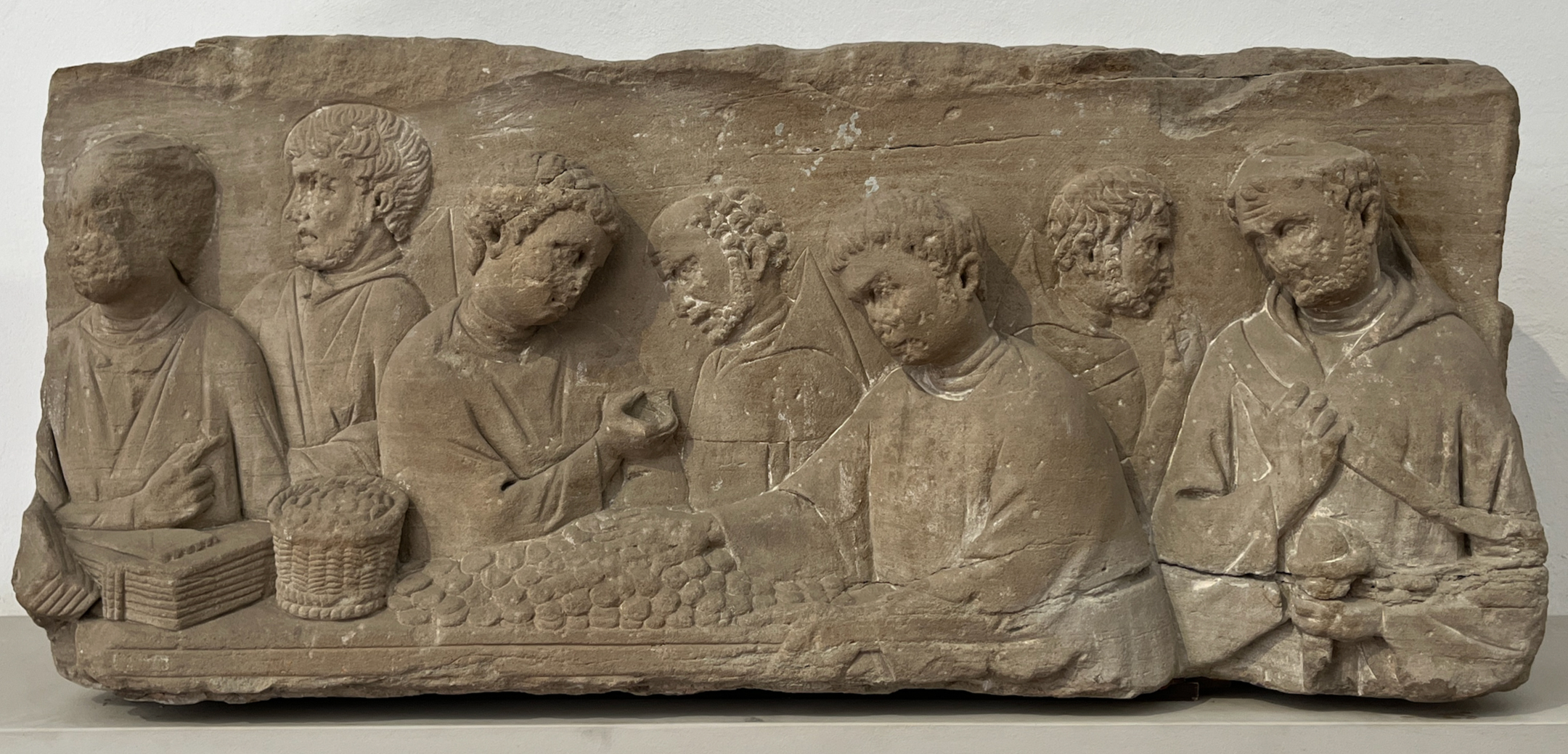
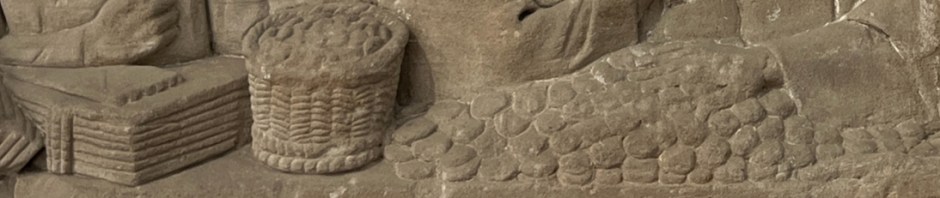
The figure at far left has a set of tablets that appear to be sitting spine-side-out, and it looks like the person who carved the relief has attempted to represent the stitching of the tablets:
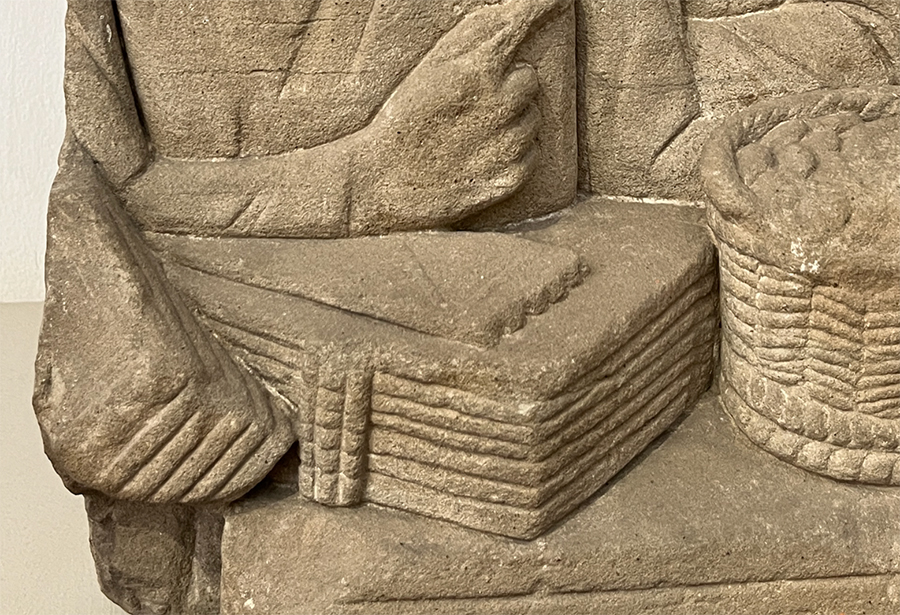
Detail of bound tablets showing sewing(?) on the spine; Rheinische Landesmuseum Trier inv. 303; image Brent Nongbri 2025
The series of small knobs that correspond to each of the individual tablets seem to me to be an attempt to show stitching in the medium of carved stone. If this is correct, it would confirm Boudalis’s hypothesis that some sets of tablets were bound with this more elaborate type of stitching that is related to the sewing of multi-quire codices. I have not noted this detail in other reliefs, but I haven’t really been on the lookout for this kind of thing. If anyone knows of other examples, I would be grateful to learn of them.
- These reliefs are the subject of a chapter by Anja Klöckner and Michaela Stark, “Bildsprache und Semantik der sog. Kontorszenen auf den Grabmonumenten der Civitas Treverorum,” in Sabine Lefebvre (ed.), Iconographie du quotidien dans l’art provincial romain: modèles régionaux (Dijon: ARTEHIS Éditions, 2017). Thanks to Michele Cammarosano for drawing it to my attention. ↩︎


 Variant Readings
Thank you Brent! This is truly an important addition to our meager evidence. I cannot relate exactly the presumed sewing with a technique already known, but the accuracy with which for example the basket next to the tablets is represented maybe allows us to safely assume that the presumed sewing of the tablets is also accurate, even if we cannot, for the moment, fully understand it.