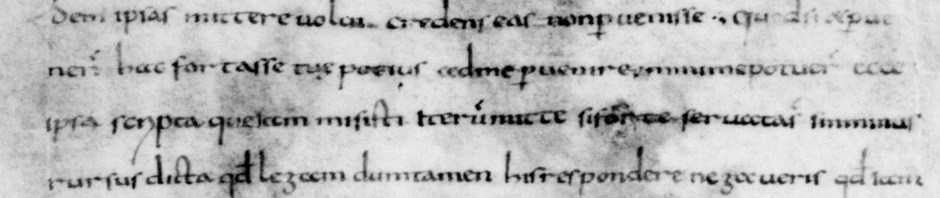
When I teach about ancient letter writing, one of the things I emphasize is the precariousness of sending letters any great distance in the Roman world. Without an organized postal service, the delivery of letters could be quite haphazard. I just came across a very nice illustration of that point that had escaped my notice until now. It occurs in one of Augustine’s letters to Jerome written in the year 403 (Augustine, Letter 71, Jerome, Letter 104):
“And so, since I already sent two letters, but afterward received none from you, I chose to send the same letters again in the belief that they have not arrived. Even if they did arrive and your letters rather were perhaps unable to reach me, send once again those letters that you already sent if you perhaps kept copies. If not, dictate again something for me to read, provided that you do not, nonetheless, delay to answer this letter because it has already been a long time that I am waiting for it.”1
Most of this letter is dedicated to a fascinating discussion of Jerome’s text-critical activities and their contemporary reception, but this side note about the sending and receiving of letters raises some interesting questions about “original copies,” duplicate copies of letters sent to others, and the possibility of having to dictate an entire letter again.

- “Quia ergo duas iam epistulas misi, nullam autem tuam post ea recepi, easdem ipsas rursus mittere volui credens eas non pervenisse. Quod si et pervenerunt ac fortasse tuae potius ad me pervenire minime potuerunt, ea ipsa scripta quae iam misisti iterum mitte, si forte servata sunt; sin minus, rursus dicta quod legam, dum tamen his respondere ne graveris, quod iam diu est ut exspecto!” K.D. Daur, Sancti Aurelii Augustini: Epistulae LVI-C (Brepols, 2005), p. 36; English translation by Roland Teske, The Works of St. Augustine: A Translation for the 21st Century: Letters 1-99 (New City Press, 2001), p. 266. ↩︎


 Variant Readings
Gallica rarely has folio numbers and navigating can be cumbersome; the direct link to 192v is https://gallica.bnf.fr/ark:/12148/btv1b10038578q/f195.item.zoom
The transcription is inaccurate; I’ve added the correct letters between asterisks, inserted a missing one between plus signs, and there’s even a superfluous one that I’ve caught between dashes:
Quia ergo duas iam epist*o*las misi, nullam autem tuam post ea rec*i*pi, easdem ipsas rursus mittere volui credens eas non pervenisse. Quod si et pervenerunt +h+ac fortasse tuae potius ad me pervenire minime potuerunt, ea ipsa scripta quae iam misisti iterum mitte, si forte servata sunt; sin minus, rursus dicta quod legam, dum tamen his respondere ne graveris, quod iam diu est ut ex-s-pecto!
Martijn Linssen
Thanks, Martijn. The Latin text here is not a transcript of the Paris manuscript; it’s Daur’s critical text. So it’s not surprising that there are some differences.
Brent, I vaguely recall (I am not doing any searching here, relying only on memory) that letters between Jerome & Augustine often went through Rome, and were copied and read by interested parties there before the recipient(s) saw them — blurring the line between private and public … Does this ring a bell with you?
Paul Needham
Scheide Librarian Emeritus
Thanks, Paul. Yes, one of the earlier letters that Augustine sent to Jerome was circulated at Rome before the extra copy that Augustine mentions finally reached him several years later. Jerome mentions this in his reply (letter of Augustine 72, here again in Teske’s translation): “You send me frequent letters, and you often push me to respond to a certain letter of yours, copies of which, as I have already written before, came into my hands without your signature through Sysinnius, the deacon. You indicate that you first sent the letter by Brother Profuturus and secondly through some other person, and that Profuturus was held back from the journey and was made a bishop and died soon thereafter, while the other man, whose name you do not mention, feared the dangers of the sea and changed his plans to set sail. Since that is so, I cannot sufficiently express my amazement at how this letter is said to be in the hands of many at Rome and in Italy and has not come to me alone to whom it was sent, especially since the same brother, Sysinnius, said that he found it among your other treatises, not in Africa, not in your home, but on an island of the Adriatic, nearly five years ago.”
Pingback: Archaeology 2025-12-21 – Ingram Braun
Pingback: Augustine in the Cairo Genizah | Variant Readings