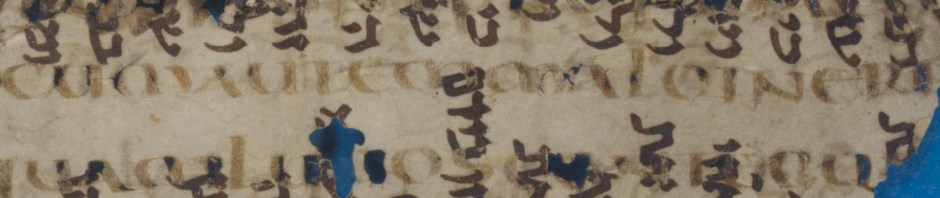
Thinking about the letters of Augustine reminds me of one of the more interesting manuscripts I encountered this year. Among the many remarkable manuscripts in the Cairo Genizah is Cambridge University Library ADD.4320. It’s a collection of fragments of a palimpsest with an upper text containing masoretic notes on various texts from the Hebrew scriptures and a lower erased text that has been identified as a collection of Augustine’s sermons.

The hand of the Latin script is a clear uncial that has been assigned to the sixth century, making these folia some of the oldest surviving copies of Augustine’s writings.

The bookmaker who reused the parchment from the codex of Augustine’s sermons seems to have just cut the bifolia in two down the middle, rotated the resulting folia 90 degrees, and folded them in half to make the new quires.
An open-access article by Hugh Houghton from 2019 provides a fresh treatment of the fragments and supplies the relevant bibliography. Houghton also poses a couple very interesting questions:
“How did a luxury codex of Augustine’s writings come to be reused some three or four centuries later for writing Hebrew masoretic lists before being deposited in the genizah in Cairo? Might still more pages come to light from the same document?”
The codex of Augustine’s sermons is one of several unambiguously “Christian” books that were found in reuse among the genizah fragments (that is to say, the content of the books was Christian, even if the last owners or users of the books did not identify as Christian). These include folia containing a lectionary with gospel readings, folia containing Acts and 1 Peter, and a leaf of Origen’s Hexapla.
It’s not hard to imagine that any serious scholar of the Hebrew Bible in medieval Cairo (Jewish, Christian, Muslim, or “other”) would be happy to have a copy of the Hexapla for consultation. But the exact reasons for someone in the Jewish community having a copy of Acts and the Catholic epistles in Greek or a collection of Augustine’s sermons in Latin is less easy to discern. It’s a reminder of how much we still don’t know about the Jews of medieval Egypt despite the wealth of evidence provided by the Genizah finds.


 Variant Readings
Of course, I have no reliable answer to the question raised here. But merely note that Augustine and Arius and perhaps the Jewish ms owner and the genizah were all North African.
According to Epiphanius, Panarion 30, the nasi in Tiberias owned a Hebrew gospel version. If so, the Cairo case might be a similar instance of interest for purposes of polemic.