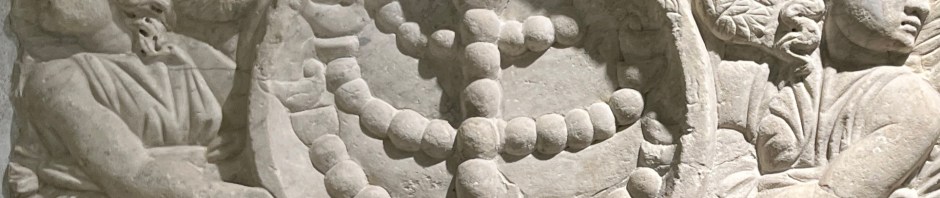
Another very interesting item in the epigraphic collection at the Baths of Diocletian in Rome is a portion of a sarcophagus that contains a nice depiction of a menorah. It is typically assigned to the third or fourth century CE, and it is often used as an illustration in books.
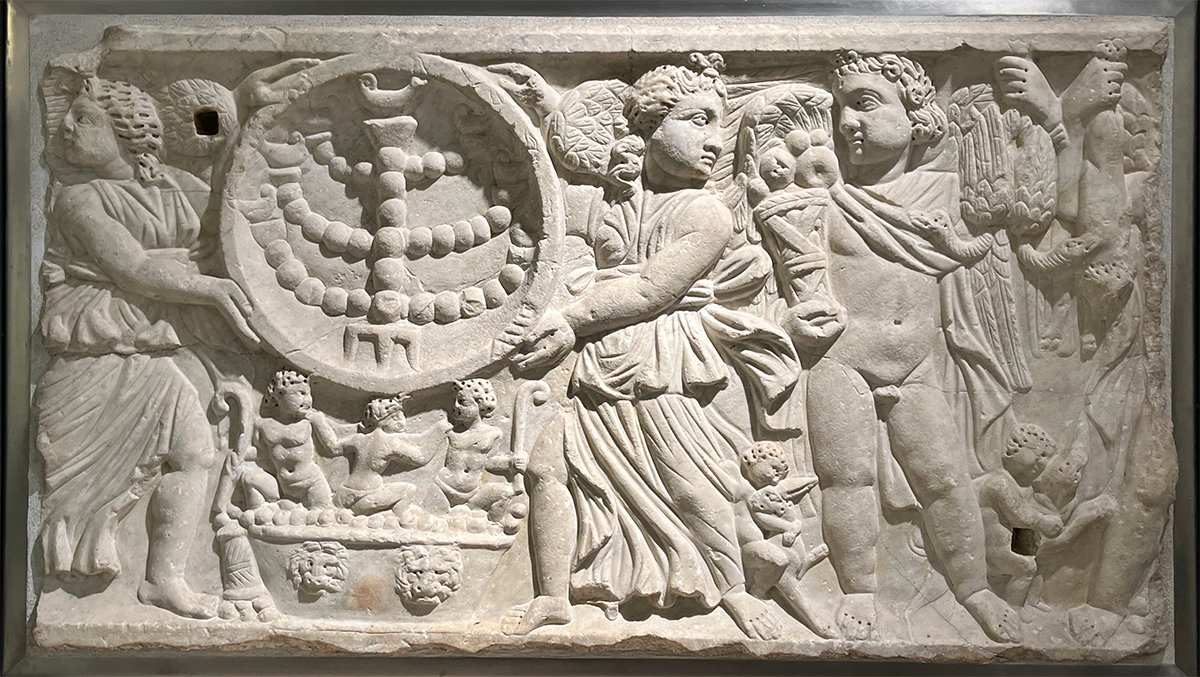
The slab is positioned in a spot that is not on the main walking path in the museum and is easily missed. It is also positioned near a wall, which is a shame, because the back of the slab is also inscribed and is somewhat difficult to see in its current position:
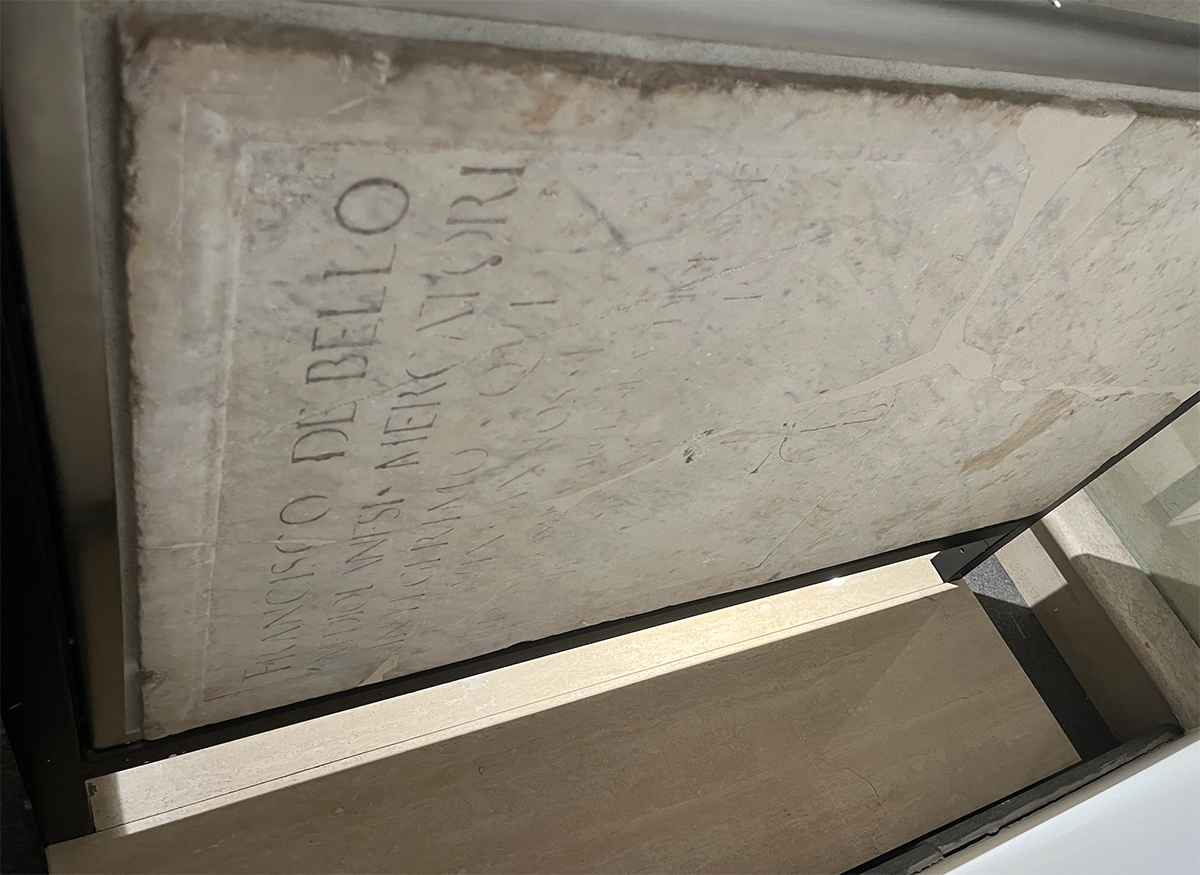
It is clear enough that this is a floor panel from a church, and googling the legible part of the inscription turns up Vincenzo Forcella’s 1874 edition of the inscriptions from the church of San Lorenzo in Damaso in Rome, among which is this one:
FRANCISCO DE BELLO
MEDIOLANESI MERCATORI
INTEGERRIMO QVI
VlXlT ANNOS L.
IO. ANDREAS DE MARCHESIIS MEDIOLANĒ
B. M. P.
The inscription, dedicated by one Milanese to another, is said to date to the 16th century, and the source is listed as “Dal Galletti (Cod. Vat. 7911, c. 17, n. 76),” that is a volume of clippings from the records of Pierluigi Galletti (1722-1790), who recorded many church inscriptions. Happily, this manuscript has been digitized by the Vatican Library.
De Bello’s inscription is also mentioned in a 1729 publication on San Lorenzo in Damaso by Giovanni Battista Bovio. If Bovio and Galletti saw Francisco de Bello’s slab in situ in the church in the eighteenth century, then it would have probably been removed during one of the substantial nineteenth-century interventions in the church. The slab was known to be a part of the Kircher collection at least as early as 1879, when it appeared in the guide to the museum written by Ettore de Ruggiero (1839-1926), and it was probably in the Kircheriano as early as 1866, when it was mentioned by Raffaele Garrucci (1812-1885). It passed into the Terme collection when the Kirchner collection was dispersed in 1915.
I’m not aware of other cases of Christian reuse of Jewish funerary art in exactly this way. I would be grateful to learn of more examples.


 Variant Readings
Though not funerary art, a marble chancel screen in the area 9 Pella (Jordan) west church may contain Jewish symbols more typical of a synagogue. On one side in the center within a wreath is a phoenix bird surrounded by four images. Depending on which description one reads, these are a menorah, a lulav, a citron, and a shofar, or, interpreted differently (a variant reading), a chalice, a Nilotic plant, a cuttle-fish, and a sea shell.