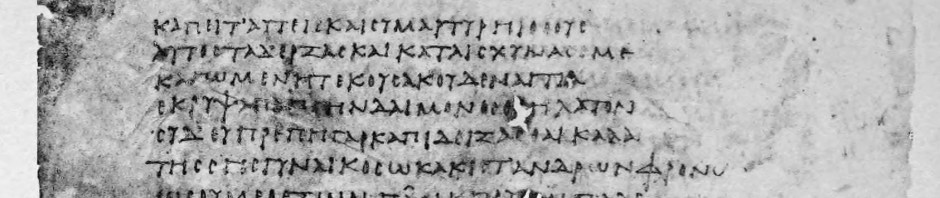
One of the reference points that used to come up very frequently in discussions of the earliest codices was a manuscript of Euripides–the Berlin Cretans, an isolated parchment folium that was published in 1907 as BKT V.2 XVII (P.Berol. inv. 13217).
The original editors, Wilhelm Schubart and Ulrich von Wilamowitz-Moellendorff, assigned the script of the leaf to the first century CE, instantly making it the earliest surviving codex. The difficulty, however, was that they presented no securely dated parallel to make their dating convincing.
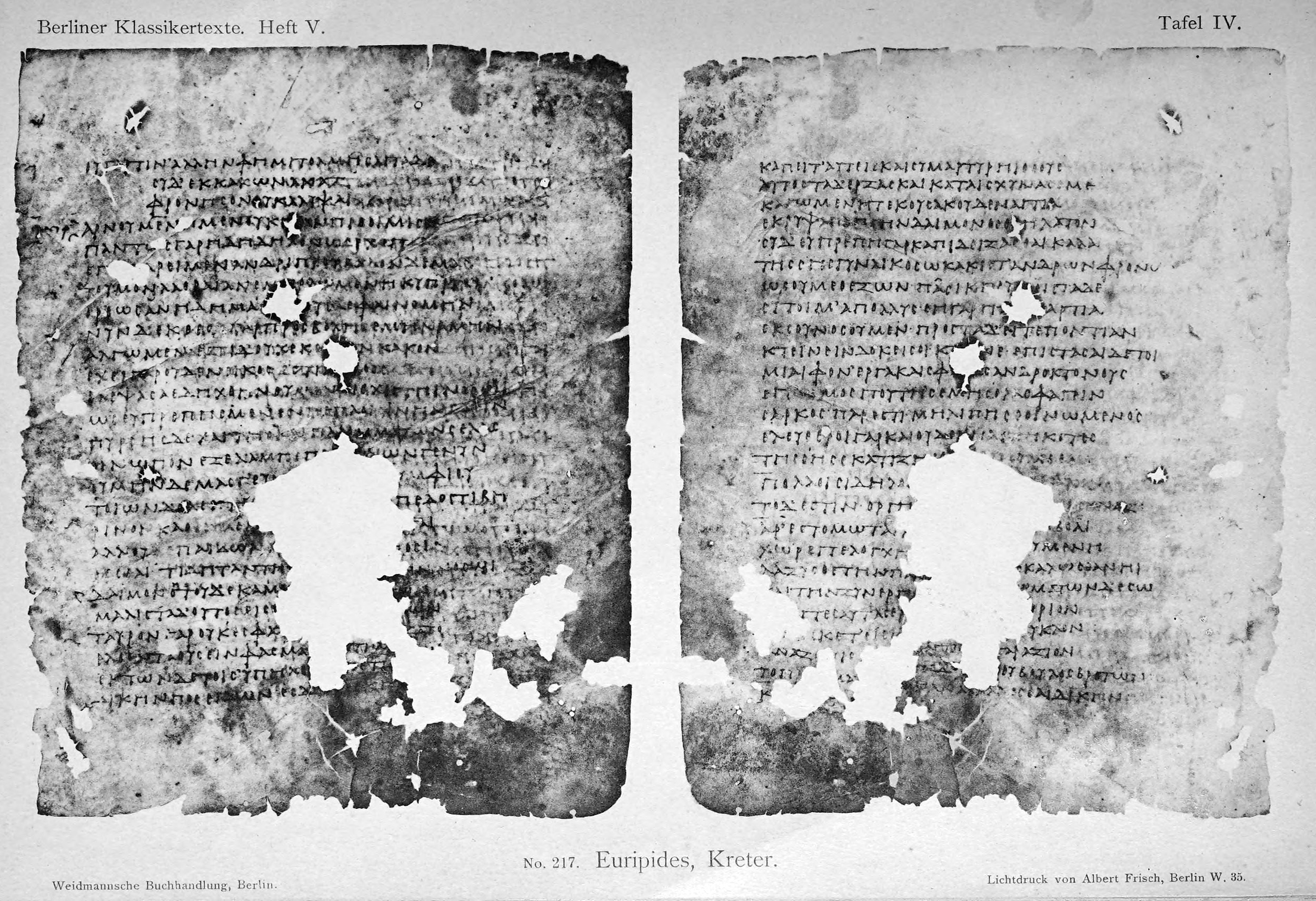
In his classic book The Typology of the Early Codex (1977), Eric Turner devoted an appendix to trying to establish a more well-grounded date for this manuscript. Turner classified the script as a sloping variety of his “formal mixed” type and opted for a significantly later date in “the latter half of c. ii A.D. (c. A.D. 150-200).” Guglielmo Cavallo also weighed in on the question in 1985, expressing a preference for a date squarely in the third century (“La nascita del codice,” p. 120).
Absent in any of this discussion was the provenance of the folium. The original editors of the Cretans leaf did not, in 1907, mention anything about its origins. A lack of interest in such questions was not uncommon in those days. But in 1974, when Herwig Maehler published a large group of papyri in Berlin excavated under the direction of Otto Rubensohn at Hermopolis in the early twentieth century, he pointed out that Rubensohn’s notes contained short descriptions of the manuscript finds from the site.1 On 27 January 1905, several interesting finds are mentioned, including 40 complete documents and a parchment leaf from an octavo book.2 Maehler then made reference to a short 1905 article by Ludwig Borchardt, in which he reported briefly on the 1905 season at Hermopolis:
“Work for the Prussian Papyrus Expedition initially took place in Ashmunein [ancient Hermopolis], specifically in the eastern part of the town. Here, a large number—about 150 pieces—of complete business documents from the third and fourth centuries and a number—about 20 fragments—of literary works were found. Among the latter were several larger pieces from a codex of Homer dating from the 4th or 5th century and a parchment sheet containing 56 verses from Euripides’ Cretans.”3
As Maehler recognized, the parchment leaf found with the group of documents on the 27th of January must be the Berlin Cretans, which has 26 lines on each page, for a total of 52 verses. So, this parchment folium actually does have an archaeological context. It was found in the same location–on the same day–as a documentary archive. The easiest explanation is that the literary piece was thrown out at the same time as the archive.
What is more, subsequent study of the 40 complete documents revealed that they were in fact the archive of Flavius Taurinos containing items dating from 426 to 513 CE. That is to say, this parchment leaf was found in some kind of proximity to documents discarded in the sixth century. It is possible that this folium was a survival from a codex produced centuries earlier and saved with this collection. This was in fact what Maehler proposed in a later article:
“Given the circumstances of its discovery, it seems highly likely to me that [the Berlin Cretans] was part of these family archives. The style of the handwriting suggests a date towards the end of the second or, I believe, the beginning of the third century. The folio is damaged in the center but intact in its external dimensions. No other fragment of this parchment codex has been found; it therefore seems likely to me that it is an isolated folium, torn from the codex and preserved for a long time, perhaps because its owner realized its rarity, if other copies of this drama were now impossible to find.”4
This is a reasonable explanation, but I do think there are other possibilities. As I noted, nobody has yet presented any truly compelling securely dated comparanda for the script of the Berlin Cretans. The three the pieces that Turner thought were the best parallels for the script were all undated:
- P.Ant. 1 26 (TM 62997), a parchment roll(!) of Xenophon assigned to the third century
- P.Ant. 1 27 (TM 59621), a parchment folium of Demosthenes, typically assigned to the second or third century
- PSI 14 1383 (TM 60112), a parchment folium of Hesiod, typically assigned to the third century
It is perhaps notable that two of these three (P.Ant. 1 26 and P.Ant. 1 27) were both found in a trash mound at Antinoopolis that has a terminus post quem for deposition in the sixth century, a point discussed in the article linked here. And the third item, PSI 14 1383, has since been reassigned by Cavallo to “the early decades of the fourth century.”5 I wonder if it might be the case that all these items–the Berlin Cretans, P.Ant. 1 26 and 27, and PSI 14 1383–might be products of the fourth century that had a useful life of a couple centuries before being consigned to the trash heaps?
As Maehler mentioned, the Berlin Cretans was among the manuscripts that disappeared from Berlin after World War II. It has since reemerged in Warsaw (National Museum inv. 200600), a little bit worse for wear, with portions missing. Nevertheless, there is still plenty of marginal space for radiocarbon analysis that could shed some light on the question of dating this manuscript.
- BGU XII (Maehler, Papyri aus Hermupolis). ↩︎
- BGU XII, p. xvi: “am 27. 1. 1905 schließlich folgt der größte Fund ‘an unlitterar. Papyri … 40 vollständige Urkunden …Pergamentblatt aus einem Oktavbuch’.” ↩︎
- L. Borchardt, “Die diesjährigen deutschen Ausgrabungen in Ägypten,” Klio 5 (1905) 410-412, at 410: “Für das preußische Papyrus-Unternehmen wurde zuerst in Eschmunejn gearbeitet und zwar im Ostkôm daselbst. Hier wurde eine größere Anzahl–etwa 150 Stück–vollständiger Geschäftspapiere aus dem dritten und vierten Jahrhundert und eine Anzahl–etwa 20 Fragmente–literarischer Stücke gefunden. Unter letzteren waren mehrere größere Stücke einer Buchausgabe des Homer aus dem 4. oder 5. Jahrhundert und ein Pergamentblatt mit 56 Versen aus den Κρῆτες des Euripides.” ↩︎
- H. Maehler, “Élites urbaines et production littéraire en Égypte romaine et byzantine,” Gaia: Revue interdisciplinaire sur la Grèce Archaïque 3 (1998) 81-95, at 86: “Il me paraît très probable, en raison des circonstances de la découverte, qu’il faisait partie de ces archives familiales. Le caractère de l’écriture fait penser à une date vers la fin du IIe ou plutôt, je crois, au début du IIIe siècle. Le feuillet est endommagé au centre mais intact dans les dimensions extérieures. Aucun autre fragment de ce codex de parchemin n’a été trouvé; il me semble donc probable qu’il est un feuillet isolé, arraché du codex et conservé longtemps, peut-être parce que son possesseur se rendit compte de sa rareté, si d’autres exemplaires de ce drame étaient désormais introuvables.” ↩︎
- Guglielmo Cavallo, La scrittura greca e latina dei papiri: Una introduzione (Fabrizio Serra, 2008), 109: “Un altro frammento di codice membranaceo in stile severo, PSI XIV 1383, contenente il Catalogo delle donne esiodeo, va assegnato piuttosto ai primi decenni del IV secolo.” ↩︎


 Variant Readings