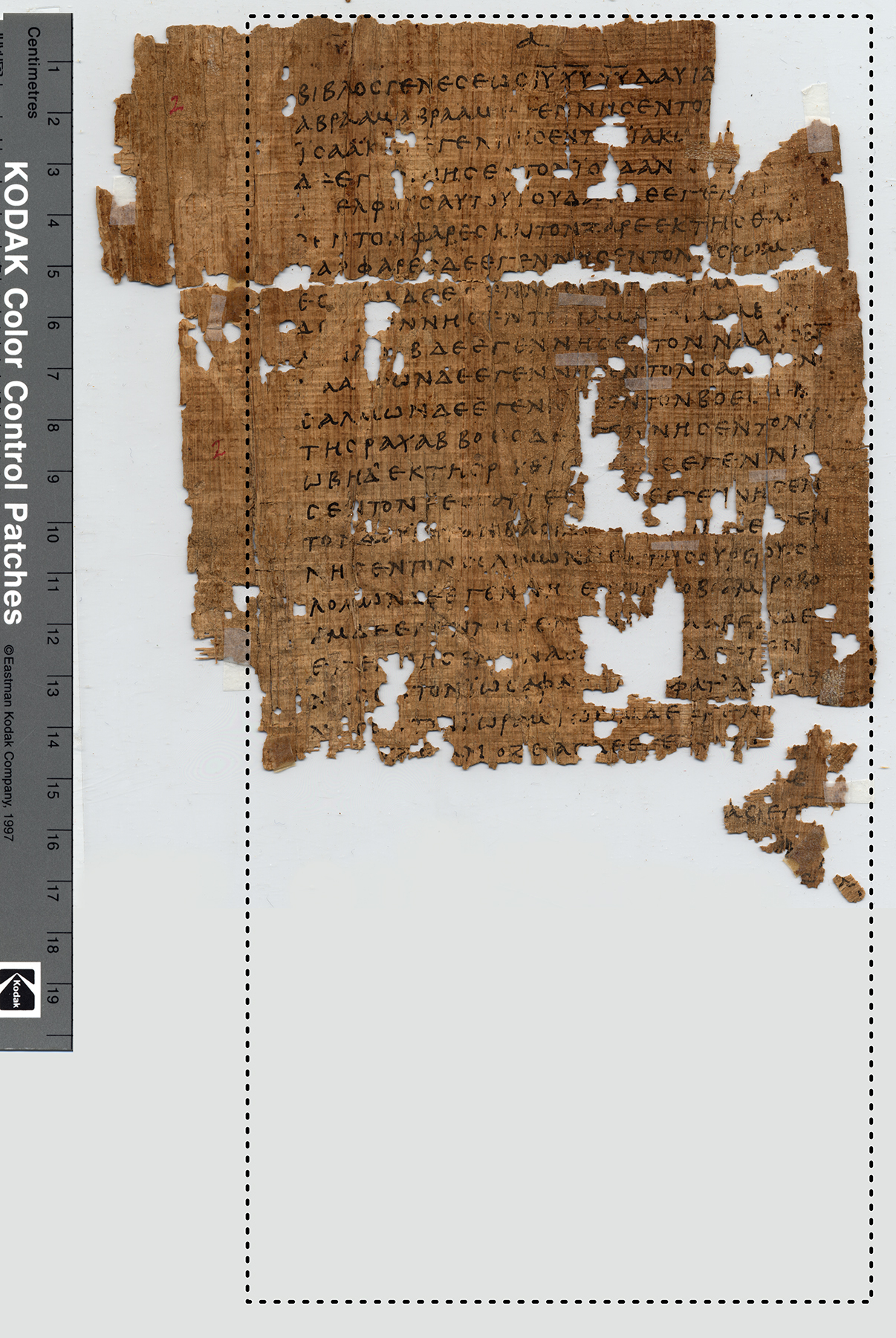
Volumes 9 and 10 of The Bulletin of the Bezan Club

Thanks to C.R. van Tilburg and Jean Putnams for sending scans of issues 10 and 11 of The Bulletin of the Bezan Club. Thanks also to John Muccigrosso for improving the quality of some of the pdf files.

These files now make the set complete. Thank you to everyone who contributed to making this resource available!

Posted in New Testament, Textual criticism | Tagged , | Leave a comment

Volume 12 of The Bulletin of the Bezan Club

Thanks to Jean Putmans for tracking down a copy of volume 12 of The Bulletin of the Bezan Club. This, as far as I know, was the last issue of the Bulletin. The issue contains several comments that indicate another volume was expected (“Our next issue…” etc.), but it seems that it never appeared. I had assumed that events in Germany in 1938 had led to the dissolution of the Club. But I recently saw that Alessandro Falcetta, the biographer of Rendel Harris, has made an intriguing alternative suggestion:


“The twelfth issue of the bulletin was published in 1937. The secretary of the club, Plooij, had died in 1935 and had been replaced by Johannes de Zwaan of Leyden, a former student of Rendel’s at Woodbrooke. Several other members had also died, including Mingana, and obituary notices had almost become a fixed feature of the bulletin. Rendel had turned eighty-five and for the first time there was no contribution from him. He was no longer a driving force behind the club. Now, it was de Zwaan’s job to carry on the bulletin, but, though he had plans for a new issue, he never came to publish it. Probably, the reason was that the bulletin had to give way to a new enterprise. In 1937, during a conference in Edinburgh, de Zwaan met [with] Herbert G. Wood,… George Boobyer and other scholars. There he proposed to them the idea of forming a New Testament society. The following year, a number of scholars met at Carey Hall…and formalized the foundation of the Societas Novi Testamenti Studiorum (SNTS), of which de Zwaan was elected first president. The SNTS is today the most important association of its kind. One wonders whether de Zwaan had in mind the Bezan Club when he outlined his project in Edinburgh.”1


This seems like a plausible scenario.2

A second feature of volume 12 that stood out is a curious coincidence. The issue contains three articles by none other than Robert Eisler (1882-1949), whom I mentioned in a recent post in connection to his (baseless) identification of a marble bust in Copenhagen as a portrait of the Jewish historian Josephus. In the Bulletin, Eisler has written a (sort of?) obituary for Arthur C. Clark (1859-1937), Corpus Christi Professor of Latin at Oxford from 1913-1934, an article on Paul and the “pillars” in Galatians, and an article on Acts 19:14. This seems to be Eisler’s first appearance in the Bulletin (he is not listed on the first page among the members of the Club).

A third interesting aspect of this volume is the last article: “The textual relations of Codex Bezae in Matthew by Miss Ad. H.A. Bakker.” This would be Adolphine Henriette Annette Bakker (1907-1984), author of A Study of Codex Evang. Bobbiensis (1933). She is listed among the members of the Club on the first page of this issue along with “Mrs. Sylva New-Lake,” i.e. Silva Tipple New Lake (1898-1983). So, it seems that by at least as early as 1937, the Club had admitted women as members.

The other issues of the journal can be found here.

  1. Alessandro Falcetta, The Daily Discoveries of a Bible Scholar and Manuscript Hunter: A Biography of James Rendel Harris (T&T Clark, 2018), 455. ↩︎
  2. On the early history of the SNTS, see this page and its link to an article by G.H. Boobyer. ↩︎
Posted in J. Rendel Harris, Josephus | Tagged , , , , , , | 1 Comment

Manuscripts of The Jewish War by Josephus

The seven-book composition by the historian Josephus describing the sacking of Jerusalem goes by different names in the Greek manuscript copies:

  • Περὶ ἁλώσεως
  • Ἰουδαϊκὴ ἱστορία περὶ ἁλώσεως
  • Ἰουδαϊκὸς πόλεμος πρὸς Ῥωμαίους
Josephus, Jewish War, beginning of Book 3 in BSB Cod.graec. 639 fol. 125v

In the Latin tradition, these books were known to Jerome as captituitas Iudaicae (Comm. in Isaiam 17), but the appear under the title De bello iudaico in the manuscripts (when they are not sequentially numbered as a continuation of the Antiquitates)

Jerome, Commentary on Isaiah 17; Bodleian Library MS. Laud Misc. 455, fol. 252r
Beginning of Book 1 of Josephus, De bello Iudaico in St. Gallen, Stiftsbibliothek, Cod. Sang. 627, fol. 3r

English editions settled on The Jewish War (or the The Judean War in the ongoing Brill edition).

Images (of varying quality) of several of the important Greek manuscripts of this work are available online.

The oldest manuscript by far is a fragmentary leaf of a papyrus codex usually said to have been produced in the third century, Vienna, Austrian National Library G 29810 Pap (MPER N.S. 3 36):

Fragment of a folium from a papyrus codex of Josephus’s Jewish War (MPER n.s. 3 36); image source: Vienna, National Library of Austria

The medieval manuscripts are of course more numerous and in a much better state of preservation. The major ones I see online are as follows:

There are of course many other more recent or more fragmentary (or not-yet-digitized) manuscripts, which are all listed here.

Josephus writing The Jewish War for Vespasian; Landesbibliothek Fulda 100 C 1, fol. 1v
Posted in Josephus, Judaism | Tagged , , , | 1 Comment

A New Project on Gospel Harmonies

I’m very happy to report that my colleague Dr. Mina Monier has been awarded funding from the Research Council of Norway for a four-year project examining gospel harmonies, texts that weave together the narratives of the four canonical gospels. The project, Unconventional Gospels, will focus on the understudied gospel harmonies of eastern Christian churches.

A copy of the Arabic Diatessaron (Cairo, Coptic Patriarchate, Ms. 67)

Monier is the founder and head of the MF Lab for Manuscript Studies and Digital Research (MF L-MaSDR). He has already been doing some exciting work on the Arabic Diatessaron over the last couple years:

We are very much looking forward to the commencement of this new project!

Posted in Uncategorized | Tagged , , , | 1 Comment

New Radiocarbon Analysis of the Dead Sea Scrolls

An important new study of the Dead Sea Scrolls has just been published (open access!) in the journal PLOS One:

Mladen Popović et al., “Dating ancient manuscripts using radiocarbon and AI-based writing style analysis,” PLOS One 2025.

In some ways, the article buries the lede. The The AI experiments mentioned in the title are interesting, but the most important material is certainly the new radiocarbon analysis of some 30 manuscripts. The actual radiocarbon data is absent from the article itself but is presented as one portion of a lengthy (95 page) appendix that is available here.

This is a very exciting study. The team carried out multiple analyses for each manuscript, so we can have a good degree of confidence in the results. There is also a detailed description of the cleaning and analysis procedures, which is a very welcome development that will be helpful in planning future AMS tests on parchment manuscripts. This is also (to the best of my knowledge) the first published report of direct CO2 analysis of parchment (which allows analysis of very small samples), so this is very exciting!

Of the 30 manuscripts tested, valid results were obtained for 26. The results were something of a surprise. In 17 of these 26 cases, there is at least some overlap between the palaeographic dates assigned by the editors of the Discoveries in the Judaean Desert series and the radiocarbon results, but in 9 cases (a third of the samples), there was no overlap at all. In most cases, the radiocarbon ranges are earlier than the proposed palaeographic dates. So, these results create some potential problems for the typology of Jewish scripts that is associated with Frank Moore Cross. Part of the problem is that Cross’s typology works with unrealistically narrow ranges, sometimes assigning scripts to intervals as small as 30 years (less than the working life of some scribes known from Egyptian data). If the palaeographic dates were expanded to a more sensible one-century range, there would be more overlap between the palaeographic dates and the radiocarbon results.

In terms of the individual results, the one that is really eye-catching is the analysis of 4Q114, a manuscript with portions of the book of Daniel:

As the authors write:

“Sample 4Q114 is one of the most significant findings of the 14C results. The manuscript
preserves Daniel 8–11, which scholars date on literary-historical grounds to the 160s BCE. The accepted 2𝜎 calibrated range for 4Q114, 230–160 BCE, overlaps withe the period in which the final part of the biblical book of Daniel was presumably authored.”

This is quite interesting. Anyway, these are just my first impressions. There is a lot of useful data here that will take some time to digest.

Posted in Dead Sea Scrolls, Frank Moore Cross, Palaeography, Radiocarbon analysis | Tagged , , , , , | 8 Comments

The Sarcophagus of the Muses from Isola Sacra: Manuscripts and Readers

I’ve written before about the reopening of the museum at Ostia Antica in 2024. One of my favorite displays there involves material from what is now known as Tomb E 200 from Isola Sacra–an interesting sarcophagus with equally interesting contents.

This sarcophagus was uncovered in 2008 on private property north of the excavated archaeological park at Isola Sacra. The Guardia di Finanza thwarted would-be looters, and the sarcophagus was excavated with its contents intact.

The Sarcophagus of the Muses from Isola Sacra in situ in 2008; image source: Bondioli et al. 2018

The sarcophagus found inside a damaged structure and was set on its rear side with its front facing upward. The body inside the sarcophagus has been identified as that of a five or six year-old child. Among the materials inside were two gold rings, one of which is inscribed with Greek letters spelling out μυστικ on a foot-shaped bezel.

Inscribed gold ring from sarcophagus in Tomb E 200 at Isola Sacra; image: Brent Nongbri 2025

Inside the sarcophagus near the remains of the child’s head was a corroded bronze coin datable to the late first or early second century CE (a coin in the mouth for Charon?). There was also a bent iron nail, a type of artifact often found in Roman burials.

Both the sarcophagus and its lid are elaborately decorated with imagery relevant to the topic of manuscripts and readers. Although some imagery associated with reading is common on Roman sarcophagus reliefs (for instance, a bust of the deceased holding a closed papyrus roll), the density of the imagery on this particular sarcophagus is notable.

Sarcophagus of the Muses from Isola Sacra; image: Brent Nongbri 2025

The central figure in the main relief on the front is Athena, who is flanked by the nine muses and Apollo. But it was the imagery on the short ends of the sarcophagus and the lid that really caught my eye.

The two short ends of the sarcophagus are especially rich. On one side, a seated figure on the left holds an open papyrus roll in one hand and reaches out to receive what looks like another papyrus roll from the outstretched hand of the seated figure on the right, who holds a closed papyrus roll in his other hand. In the center of the scene between the two figures is a case for holding papyrus rolls (a capsa or scrinium).

Left end of the Sarcophagus of the Muses from Isola Sacra; image Brent Nongbri 2025

On the opposite side, two standing figures each hold papyrus rolls in their left hands, while the figure on the left lifts the top off a capsa to reveal bundles of papyrus rolls.

Right end of the Sarcophagus of the Muses from Isola Sacra; image Brent Nongbri 2025

Most interesting to me is the lid. Between the two theatrical masks on the corners of the lid are two scenes, each with a pair of reclining men. The two men on the left sit on either side of what looks like an open papyrus roll in a holding stand of some kind.

Left side of the lid of the Sarcophagus of the Muses from Isola Sacra; image Brent Nongbri 2025

Similar devices are sometimes shown standing atop a pedestal, as on the well known tombstone of Abeita in the British Museum. Here it sits on a low table or box, perhaps another capsa. The figure on the right holds what looks like a closed papyrus roll in his right hand (an early publication, Germoni 2009, identified the object as a writing instrument, but I am not so sure).

On the right side of the lid, a parallel pair of men recline. Between them are two objects.

Right side of the lid of the Sarcophagus of the Muses from Isola Sacra; image Brent Nongbri 2025

The lower object between the two figures seems to have a latch, which is characteristic of capsae. The upper object has a dangling strap also characteristic of some depictions of capsae.

This is a fascinating artifact, with its attention to detail and clear interest in the imagery of reading and learning. I wonder: What is the story behind the burial of a child in a sarcophagus with this kind of iconography? What is the significance of the inscribed ring?

And one last small detail that just delighted me about this piece: Look at Athena’s little owl at the bottom of the sarcophagus. It’s perfect:

Athena’s owl on the Sarcophagus of the Muses from Isola Sacra; image: Brent Nongbri 2025

Sources:

Bondioli, Luca, et al. 2018. “L’infante e il sarcofago delle Muse dall’Isola Sacra,” in Ricerche su Ostia e il suo territorio, edited by Mireille Cébeillac-Gervasoni, Nicolas Laubry, and Fausto Zevi. Rome: Publications de l’École française de Rome. https://doi.org/10.4000/books.efr.3712.

Germoni, Paola. 2009. “Fiumicino-Isola Sacra: Vecchi e nuovi rinvenimenti.” Bulletino della Commissione Archeologica Comunale di Roma 110: 398-404.

Posted in Archaeological context, desks, Ostia | Tagged , , , , , , | 1 Comment

The Bulletin of the Bezan Club

[[Update 5 June 2025: I managed to find two additional issues (8 and 9) and a copy of issue 6 that has all of its pages. So, now we lack only issues 10-12.]]

[[Update 26 June 2025: Thanks to Jean Putmans for obtaining a copy of issue 12! So, now only issues 10 and 11 remain to be found.]]

[[Update July 1 2025: Thanks to C.R. van Tilburg and Jean Putnams for sending scans of issues 10 and 11 and to John Muccigrosso for improving the quality of some of the files. The set is complete!]]

The Bulletin of the Bezan Club was a privately circulated journal that, to the best of my knowledge, consisted of 12 issues printed between 1925 and 1937. It was dedicated to studies about the problems of the so-called “Western Text” of the New Testament, but it contains many interesting articles on topics from palaeography to the complexities of the Diatessaron and other gospel harmonies. The issues that I have read offer a fascinating snapshot of one corner of New Testament textual criticism in the years between the two world wars.

The membership of the club, which never exceeded about two dozen names, includes many of the philological luminaries of the early twentieth century. To pick just a few:

  • J. Rendel Harris (1852-1941)
  • Kirsopp Lake (1872-1946)
  • Hans Lietzmann (1875-1942)
  • Elias Avery Lowe (1879-1969)
  • Daniel Plooij (1877-1935)
  • Theodor Zahn (1838-1933)

Rendel Harris introduced the club in this way in the first issue in 1925:


The Bezan Club has been formed by a group of scholars European and American, with the object of applying a combined effort to the elucidation of the mystery of what is called the Western Text of the New Testament; and since this Text has one of its most striking representatives in the Codex Bezae, the name of that manuscript has been made into a short appellation for the Club and its objects. This does not mean that the Codex Bezae and the Western Text are to be treated as nearly equivalent, but it does mean that no solution of the problem of the Western Text is possible, which will not at the same time elucidate the origin of the MS., which is its principal, and often its only Greek representative. It has long been recognised that the geographical term Western was a misnomer; that the evidence for such a Text was as much Eastern as Western, and that it would conduce to clarity of ideas, if the term were abandoned. But as this cannot be done without dislocating a mass of references and allusions, it may be sufficient to reiterate a well-known caution to beginners, and say “Western Text, or whatever that may mean.”


Many years ago, I needed to consult some of these discussions, but I could not locate any copies of the journal. I eventually wrote to Eldon Epp, asking if he knew where I might find copies. Some weeks later, much to my surprise, I received a package in the mail (in Sydney, Australia) containing neatly stapled xerox copies of issues 1-7 as well as a cumulative index (I came to learn that this kind of thoughtfulness and generosity is characteristic of Eldon). Eldon had collected and copied these over the years (some of these appear to have been E.A. Lowe’s personal copies).

These xerox copies travelled back to the US, spent some time in one of many boxes stacked in a garage, and eventually came to Norway with me. I recently needed to consult them again. As they still seem difficult to find online, I thought I should scan the hard copies in my possession. And so, with Eldon’s blessing, I have digitized these issues and posted them below. I am not aware of any copyright concerns, but if there are objections, please let me know.

I believe that there were 12 issues in total (1925-1937). If anyone has copies of the other issues, I would love to have them to post here to complete the set. [Update: As noted above, the set is now complete.]

Posted in Codex Bezae, J. Rendel Harris, New Testament, Palaeography, Textual criticism | Tagged , , , , , , | 17 Comments

7Q5 and Appeals to Authority, Part 1: Orsolina Montevecchi

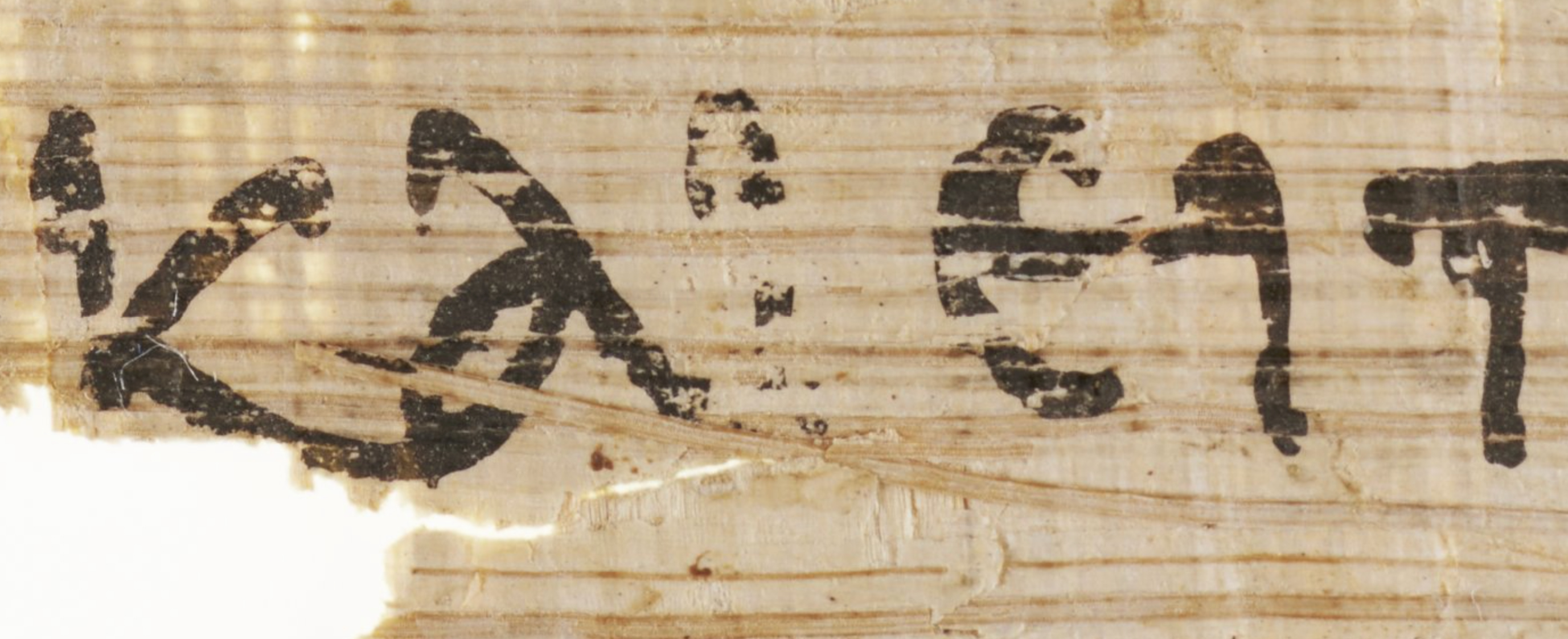
I am fascinated by the Wikipedia entry for 7Q5, which seems to continuously bounce back and forth between being useful and informative to being goofy and borderline incoherent. 7Q5 is a tiny fragment of papyrus found in Cave 7Q at Qumran that contains an unidentified text in Greek. As I noted in an earlier post, it was a mistaken reading of a printed edition (not the manuscript itself) that led the Spanish scholar José O’Callaghan to conclude that fragment contained a portion of the Gospel According to Mark in the 1970s. This created a sensation because it is generally accepted that the manuscripts in the caves at Qumran predate the sack of Qumran in the late 60s CE. O’Callaghan’s error was pointed out immediately, but instead of admitting the slip, he doubled down, and his mistaken identification of 7Q5 has had a persistent afterlife.

The arguments against O’Callaghan’s proposal are compelling.1 Most importantly, O’Callaghan’s reconstruction both depended upon impossible or highly suspect readings of several letters and necessitated that one out of the mere nine undisputed letters on the papyrus must be a scribal error.

After a flurry of articles in the 1970s demonstrating the problems with O’Callaghan’s thesis, it largely (and justifiably) fell out of view, only to be revived in the 1990s by Carsten Peter Thiede (1952-2004).

In my earlier post on 7Q5, I pointed out that what was once a reasonably informative article on Wikipedia had become a confused collection of misinformation. The article was then cleaned up but has again become a jumble of decent scholarship and nonsense. One of the recent changes to the entry is a series of appeals to authority, especially that of Orsolina Montevecchi (1911-2009), an Italian papyrologist who endorsed O’Callaghan’s identification of 7Q5 as a fragment of Mark. However, these appeals to authority tend to be by way of hearsay. For instance, many appeals to authority come by way of Thiede. In a book co-authored with the journalist Matthew D’Ancona, Thiede presented Montevecchi’s view as decisive:

“In 1994 the last word on this particular identification seemed to have been uttered by one of the great papyrologists of our time, Orsolina Montevecchi, Honorary President of the International Papyrologists’ Association. She summarized the results of her analysis in a single, unequivocal sentence: ‘I do not think that there can be any doubt about the identification of 7Q5.'”2

This confident assertion made me wonder: What was Montevecchi’s actual reasoning? As far as I have been able to tell, in her massive bibliography, Montevecchi mentions 7Q5 just twice (I would be happy to be corrected if anyone knows of additional references) [[Update 24 May 2025: The count is up to three; see in the comments below]].

The first reference appears in her introductory textbook, La papirologia (1973). The preface to this book is dated May 1972. That is to say, a little more than one month after the first appearance of José O’Callaghan’s first publication on 7Q5 in the first issue of the 1972 volume of Biblica (which carried a print date in March of 1972). That is to say, this statement was composed before any of the rebuttals to O’Callaghan had had been published. At the conclusion of a list of the New Testament papyri that had been published to date, we find a single sentence:

“Furthermore, in the papyrus fragments 7Q5, 7Q6 (frag.1), and 7Q8, palaeographically datable to 50 BCE – 50 CE, have been recognized respectively, Mark 6:52-53 and 4:28 and James 1:23-24 (O’Callagahan, J. in Biblica 53 [1972], 91-100) [“Inoltre nei frammenti papiracei 7Q5, 7Q6, 1, 7Q8, paleograficamente datibili c. 50a-50p, sono stati riconosciuti rispettivamente Mc. 6, 52-53 e 4, 28 Iac. 1, 23-24 (O’Callaghan, J. in «Biblica» 53 1972, pp. 91-100).”]

As far as I know, that is all Montevecchi ever said about this papyrus in an academic publication. The other reference that comes up frequently is an interview conducted for the Catholic periodical 30 Giorni in 1994.

This article, which is the source of Thiede’s quotation endorsing the identification 7Q5, actually has an extended interview with Montevecchi, in which she outlines her reasoning for accepting the identification. It’s fascinating to see what she actually says.


Interviewer: Many excellent palaeographers do not agree with this identification.

Montevecchi: There are some difficulties because three words are missing from the text (epi tēn gēn = “to the land”) compared to the passage in Mark. We read in the gospel text handed down to us: “Having crossed the lake to the land.” But that “to the land” is superfluous. When one crosses a lake, one obviously goes to the other side. In fact, even though these palaeographers seem to ignore it, it’s quite common in the oldest texts of the Bible on papyrus to find the omission of some element not necessary for the understanding of the text. It is as if such words were added later, by way of explanation. Another source of opposition is the fact that there is an exchange of consonants, a tau (t) instead of a delta (d). But this is also a frequent error. Because texts were dictated, the writer transmitted errors of pronunciation. These are the only two objections, which are taken as an excuse to invalidate the identification of this papyrus, since they are the only variations from the text as it was handed down.3


Regardless of how good a papyrologist Montevecchi may have been or how important she may have been to the field, this is simply a very bad argument. Montevecchi neglects even to mention the most compelling counterargument to the identification–the fact that several of O’Callaghan’s readings of letters are wrong, doubtful, or impossible to verify. It is that fact, combined with the need to consider one of only nine undisputed letters as an error, combined with the need to posit the existence of the existence of an otherwise unattested textual variant (διαπερασαντες ηλθον εις γεννησαρετ in Mark 6:53), which makes the identification extremely doubtful if not impossible. Montevecchi was either not fully informed about the scholarly debate around the fragment, or she simply decided to try to defend O’Callaghan’s position by mischaracterizing the opposing arguments and ignoring the most damaging evidence against O’Callaghan’s identification. In the matter of 7Q5, the appeal to Montevecchi’s authority actually adds nothing of substance to the discussion.

  1. The most informed and thorough rebuttals to O’Callaghan (and later Thiede) include the following (in chronological order):
    Maurice Baillet, “Les manuscrits de la Grotte 7 de Qumrân et le Nouveau Testament.” Biblica 53.4 (1972) 508-516.
    C.H. Roberts, “On Some Presumed Papyrus Fragments of the New Testament from Qumran,” Journal of Theological Studies, n.s. 23 (1972) 446-447.
    Gordon D. Fee, “Some Dissenting Notes on 7Q5 = Mark 6:52-53,” Journal of Biblical Literature 92 (1973) 109-112.
    Stuart R. Pickering and Rosalie R.E. Cook, Has a Fragment of the Gospel of Mark Been Found at Qumran? (Sydney: Macquarie University Ancient History Documentary Research Centre, 1989).
    Robert H. Gundry, “No nu in Line 2 of 7Q5: A Final Disidentification of 7Q5 with Mark 6:52-53,” Journal of Biblical Literature 118 (1999) 698-707. ↩︎
  2. Carsten Peter Thiede and Matthew D’Ancona, The Jesus Papyrus (Weidenfeld and Nicolson, 1996), 56. ↩︎
  3. “È stata fatta qualche difficoltà perché nel testo mancano tre parole (epi ten ghen = verso terra) rispetto al brano dì Marco. «Avendo attraversato il lago verso terra”, si legge nel testo del Vangelo tramandatoci. Ma quel «verso terra» è superfluo: attraversando un lago, si va ovviamente dall’altra parte. In realtà, anche se questi paleografi sembrano ignorarlo, è abbastanza frequente nei testi più antichi della Bibbia su papiro, trovare l’omissione di qualche elemento non necessario per la comprensione del testo. È come se quelle parole fossero state aggiunte dopo, a mo’ di spiegazione. Un’altra fonte di opposizione è il fatto che c’è uno scambio di consonanti: una tau (t) invece di una delta (d). Ma anche questo è un errore frequente. Poiché i testi venivano dettati, chi scriveva riportava gli errori di pronuncia. Ci sono molti altri casi, nei papiri biblici di scambio di tau con delta. Queste sono le due sole obiezioni che sono prese a pretesto per invalidare l’identificazione di questo papiro, poiché sono le sole varianti rispetto al testo tramandato.” ↩︎
Posted in 7Q5, Dead Sea Scrolls, Orsolina Montevecchi | Tagged , , , , , , | 16 Comments

Pumice, Parchment, and Papyrus

In the latest issue of the Bulletin of the American Society of Papyrologists (2024, just out–table of contents here), I have an article on the use of pumice on papyrus (AAM here). Here is the abstract:


Papyrological handbooks published in the second half of the twentieth century suggest that pumice was used in antiquity to smooth the surface of papyrus in preparation for writing. Experimentation with modern papyrus and pumice calls this claim into question. The ancient literary references to pumice and papyrus, when they are properly understood, demonstrate that when pumice was used on papyrus rolls in antiquity, it was not used for the purpose of smoothing the writing surface. Pumice was instead used to smooth the frontes, the top and the bottom of the closed papyrus roll. This fact that was quite well established at the end of the nineteenth century, but it seems to have been largely forgotten over the course of the second half of the twentieth century.


People used pumice (Greek κίσηρις, Latin pumex) for many purposes in antiquity, including the preparation of parchment writing surfaces. Several ancient and medieval discussions of the production of parchment mention the use of pumice at different stages in the process. I’ve previously noted one of these, a few leaves preserved in a papyrus codex of the sixth or seventh century that contain instructions in Coptic for preparing parchment.

What interests me in this article are references to the use of pumice not on parchment, but on papyrus. Several Latin poets refer to the use of pumice on papyrus (all the references are collected in the article). Modern handbooks on papyrology sometimes claim that pumice was used to prepare the surface of papyrus for writing (thus Italo Gallo, Greek and Latin Papyrology, p. 7: “[the papyrus sheet] was then allowed to dry, and was finally polished with a pumice stone, an ebony tool, or a shell”). But doing a bit of experimentation with modern papyrus shows that if you rub even very fine pumice on papyrus, it tears the fibers, resulting in worse conditions for writing (smooth objects like bone or shell flatten the fibers and do create a better writing surface).

Homemade modern papyrus before rubbing with pumice (left) and after rubbing with pumice (right); image source: Brent Nongbri

In fact, the ancient references to the use of pumice on papyrus never say it was used to smooth the writing surface. Rather, it was used on the frontes, the top and bottom of the closed scroll. The pumice would grind off any stray fibers that protruded from the ends of the rolled up cylinder. This seems to have been one of the last stages of the manufacture of a bookroll, one that took place after the papyrus was already inscribed, in some cases even at the shops where books were sold.

The form of pumice used for this task seems to have been a hemispherical block that could be held in the palm of the hand (such a stone was found as part of what seems to be a writing kit in the so-called Tomb of the Scribe in the Vatican). This is very similar to hemispherical pumice stones found at Pompeii, often in bronze holders.

Pumice stone in bronze casing from Pompeii, inv. 7150; image source: Paul Roberts, Life and Death in Pompeii and Herculaneum (The British Museum Press, 2013), p. 132, fig. 142

When the context of these Pompeian hemispherical pumice stones is known, it is most frequently as part of cosmetics kits. This is interesting in light of the personification and sexualization of bookrolls that we sometimes find in Latin poets. The hemisphere of pumice offers us a case of a single tool that could be used on both the human body (for removal of hair and smoothing of skin) and the book (for tidying the frontes).

I enjoyed researching and writing this piece. It led me down several fascinating rabbit holes that I hope to talk about here in the near future.

Posted in Archaeological context, Book Trade in Antiquity, Voluminology | Tagged , , , , , | Leave a comment

The So-called Bust of Josephus

I recently had occasion to spend some time revisiting the works of the Jewish historian Josephus, which was a real pleasure. When working on Josephus, I occasionally come across the “bust of Josephus” that so often serves as an illustration of the historian, as it does on the Norwegian Wikipedia page for Josephus (albeit with an ambivalent caption):

image source: no.wikipedia.org

Eusebius mentions that there was a statue of Josephus in Rome (Eccl. Hist. 3.9.2), but there is no indication that this bust has anything to do with that statue. So, how and when did this bust become “Josephus”?

It turns out that there is an excellent chapter in a recent book that tells the fascinating story of this bust:

René Bloch, “Testa incognita: The History of the Pseudo-Josephus Bust in Copenhagen,” in R. Brody et al. (eds.), “A Vision of the Days”: Studies in Early Jewish History and Historiography in Honor of Daniel R. Schwartz (Leiden: Brill, 2023), 419-442.

The bust, which is now in the Ny Carlsberg Glyptotek in Copenhagen, was first identified as “Josephus” by Robert Eisler (1882-1949) in an article written in 1930. This point had already been noted by Steven Fine in 2013, but Bloch takes a deep dive into both the history of the bust itself and into Eisler’s interesting background. The identification was made on the flimsiest of grounds (Eisler believed the bust had a “Jewish-looking face”), and it is remarkable that the claim was ever given any credence.

But Bloch’s chapter is an engaging read full of wonderful detective work. I highly recommend it.

Some of it has been incorporated into the German Wikipedia article connected to this bust.

Posted in Josephus, Judaism, Sculpture | 7 Comments