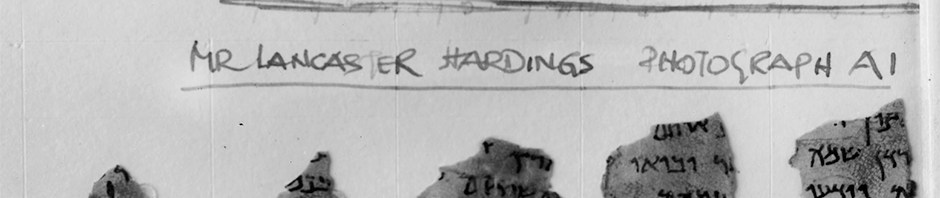
I think a copy of Gerald Lankester Harding’s photographs of the Cave 1Q manuscripts as they were being excavated in 1949 may be at the École biblique in Jerusalem.
The back story: When I was writing an article on the Cave 1Q scrolls a few years ago, I ran into a problem that I just could not solve. Nearly all the evidence I surveyed suggested that there was no sure connection between any of the rolls that Muhammad ed Dhib is said to have found and the cave now known as 1Q. Nearly all the evidence. The one indicator that pointed in another direction was a claim from John Trever. Here is how I put it in the article:
“Trever makes a curiously specific claim regarding one fragment of this text: ‘A small piece of 1QSb (Col. II) also was sifted from the debris’ during the excavation of Cave 1. I can find no corroboration of Trever’s statement, but if it were correct, this fragment would constitute a material connection between Cave 1 and the three scrolls associated with Muhammad ed-Dhib. Thus, it would be very useful to see if Trever’s statement can be somehow confirmed or disconfirmed.”
I added the following long footnote that invoked Harding’s photos as a possible path forward:
“In theory, Trever’s claim could be either confirmed or disconfirmed by reference to photographs taken by Harding at the time of the excavation itself in 1949. As Harding wrote in DJD I: ‘Inscribed fragments were mounted between glass each day as they were found, and photographed on the spot for safe record’ (Gerald Lankester Harding, ‘Introductory: The Discovery, the Excavation, Minor Finds,’ in Barthélemy and Milik, Qumran Cave I, 3–7, at 7). While a very small group of these photographs seems to have been published (see the bibliography in Barthélemy and Milik, Qumran Cave I, 43), I have been unable to locate the original copies of this set of excavation photographs. The Jordanian Department of Antiquities did not respond to my queries concerning these photographs. Stephen Reed reports that the John C. Trever Collection of photographs includes some of Harding’s images (see Stephen A. Reed, Marilyn J. Lundberg, and Michael B. Phelps, The Dead Sea Scrolls Catalogue: Documents, Photographs, and Museum Inventory Numbers [RBS 32; Atlanta: Scholars Press, 1994] 451–52). According to the descriptions Reed provides, the Harding photos in the Trever collection seem to contain a mix of excavated and purchased materials, so these may not be the excavation photos that Harding mentioned. I contacted James Trever, the son of John Trever, in July 2020 to try to obtain copies of this material, but he was unable to locate these photographs or negatives. Among the PAM photographs, at least one sequence seems to derive from Harding (PAM 40.433–40.552). Although the date given for the photographs is April 1953, these images appear to be photographs of earlier photographs by Harding (PAM 40.508 is actually labeled “MR LANCASTER HARDINGS (sic) PHOTOGRAPH A1”). Again, these contain a mix of excavated and purchased materials, and none of them seems to match the published photographs mentioned in DJD I, 43. The recovery of Harding’s excavation photographs is a desideratum.”
The early photos of the Dead Sea Scrolls present a number of challenges. Even guides by good scholars can be misleading or just wrong (here’s a case from Tov and Pfann, Companion Volume to the Dead Sea Scrolls Microfiche Edition, 2nd rev. ed; Leiden: Brill, 1995).
The Harding photos said to be a part of Trever’s collection continue to escape me. Trevor’s photos are now at the University of Chicago, and I have been assured that copies of Harding’s photos are not among them.
But, while digging around for photographs of Muhammed ed Dhib over the last couple weeks, I came across a piece of evidence that I somehow missed while conducting my search for copies of Harding’s Cave 1Q excavation photos: It may be the case that the École biblique in Jerusalem holds copies of these pictures. In the first volume of the Qumran excavation report, the following note accompanies one of the photographic sources (Lot 8, on p. 404):
“Date et circonstances. M. Lankester Harding, alors directeur des Antiquités de Jordanie, a représenté pendant les campagnes de fouilles à Qumrân, le service des Antiquités qui patronnait les travaux. Bon photographe, il a pris une centaine de clichés de synthèse, en général de bonne qualité.
Dépôt. Les archives photographiques de Lankester Harding ont été déposées aux archives photographiques du service des Antiquités de Jordanie. Les négatifs ont été rangés dans des classeurs à couverture grise et les contacts dans des classeurs à couverture rouge. Une copie de toute la série avait été donnée par l’auteur à l’École biblique, où les clichés ont été intégrés aux albums de la photothèque. Toute une série de documents concernant les manuscrits et les circonstances de leur découverte a été réalisée par Lankester Harding. Les documents ont été déposés aux archives photographiques du service des Antiquités de Jordanie où leur numéro d’inventaire est précédé dans les registres de la lettre A. Puisqu’ils ne concernent pas les travaux de chantier, nous ne les avons pas intégrés à notre liste; cependant, nous en donnons ici la liste, à titre indicatif A 1 393-1 492 (objets trouvés avec les manuscrits), A 1 493-1 500 et 1 536-1537 (manuscrits enveloppés dans des toiles de lin), A 1 538-1 539, A 1 652-1 672, A 2 069-2 077, A 2 341-2 353 (objets trouvés avec les manuscrits).”1
The 95 photos from the Harding collection that are individually described in this volume are almost all from the 1950s excavation, with just 12 from the 1949 campaign. But it sounds like there is a reasonably good chance that copies of the daily manuscript photos from the 1949 excavations might be found at the École biblique photo archive. Let us hope so.

- Jean-Baptiste Humbert and Alain Chambon, Fouilles de Khirbet Qumrân et de Aïn Feshkha I: Album de photographies (Göttingen: Vandenhoeck & Ruprecht, 1994), 404. ↩︎


 Variant Readings
Possibly relevant: what the Donceels have. Also Strugnell’s report.
Thanks–I have not had a look at the Donceel volume. By “Strugnell’s report,” do you mean his chapter in Tov and Pfann?
Reportedly–others know more–the Donceels gathered data about Qumran. Whether including Harding 1Q photos, I don’t know.
In 1989 Strugnell suggested ASOR fund their research.
It may be that some photo prints sent to de Vaux were in a small format.
An interim report (1989?) by Robert and Pauline Donceel mentioned gathering much graphic information on Qumran at the Ecole Biblique. “The problem of the photographs was worse, as they had to be traced down not only in the collections of the Ecole but also in the different institutions….The prints of their photos, sent to Father de Vaux, were frequently in a very small format.”