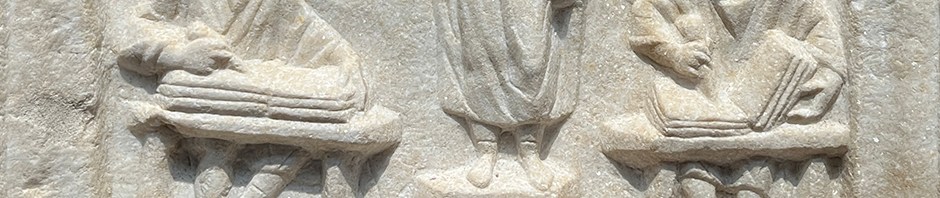
The museum at the archaeological park at Ostia Antica has reopened after many years of closure for renovations. The results are quite impressive, and I hope to have a chance to post some reflections about the museum itself soon, but I thought I would highlight a piece that has interested me for some time and which I was quite excited to see in person. It is a relatively small marble relief that is roughly square (51 cm wide, 49 cm high):

Ostia Antiquarium, inv. 130; image source: Brent Nongbri, 2024
The relief was reportedly found at the Aula della Are in 1938. Its date of production is not clear. It is typically assigned to the late fourth century (as it is described in the current museum didactic material). Eric Turner, however, described it in the following way: “The date is not earlier than late ii A.D., and may be iv-v A.D.”1
What is being depicted in the relief is also open to debate. There have been a number of different suggestions: A lecture at a philosophical school, a Christian speaker whose words are being recorded by scribes, a courtroom or other scene with stenographers (shorthand writers), or an auction. The function of the relief is also unknown. Guido Calza suggested that it was the shop sign of a professional copyist. No interpretation commands wide assent.
Among all these unknowns, one thing that is clear is that the two figures in the lower left and the lower right corners are seated at tables or desks, and they are writing in what look like large sets of bound wooden tablets (although parchment or papyrus codices are also possible interpretations).

Ostia Antiquarium, inv. 130, detail showing a writer at work while seated at a table or desk; image source: Brent Nongbri, 2024
This piece is thus generally acknowledged as one of the earliest depictions of writers at work at desks. It is commonly believed that writers did not regularly use desks, tables, or stands before this period. Theodor Birt’s statement is typical: “In antiquity, people did not write on desks.”2 I am skeptical of this view for a variety of reasons, but it is the consensus.
The classic treatment of the question is Bruce Metzger, “When Did Scribes Begin to Use Desks?”3 At the time Metzger raised the issue (the late 1950s), the common knolwedge was that writers did not use desks until rather late in the medieval period. Metzger gathered data (including this relief) to show that the use of desks by writers in the premodern Mediterranean went back as least as early as the fourth century, and his broader conclusion is surely correct: “In seeking to discover when it was that scribes began to use a writing desk, one must not imagine that the habits of all scribes changed suddenly. The transition from the custom of writing on one’s lap to the custom of using a desk or table must have taken place gradually.”
It is good to be able to have a close look at this interesting relief, which is an important piece of evidence in connection to this question.
- Eric G. Turner, Greek Manuscripts of the Ancient World, 2nd rev. ed. (London: Institute of Classical Studies, 1987), p. 6, note 17. The exact archaeological context in which the relief was found does not appear to have been discussed in print in any detail. ↩︎
- Theodor Birt, Die Buchrolle in der Kunst (Leipzig: Teubner, 1907), p. 209: “Im Altertum schrieb man nicht auf Pulten.” ↩︎
- I cite from the chapter published in Bruce M. Metzger, Historical and Literary Studies: Pagan, Jewish, and Christian (Leiden: Brill, 1968), 123-137, but Metzger notes that the chapter is drawn from material originally published in different outlets in the late 1950s. ↩︎


 Variant Readings
I am also interested to see how clearly they are writing in a codex. Versus a scroll. Doesn’t that give evidence for the use of the codex as well?
Yes, it depends on whether those are in fact (papyrus or parchment) codices or bound sets of wooden (or wooden waxed) tablets.
It looks adversarial. Two groups of partisans agitatedly gesticulating, though whether angry at the other group, or upset amongst themselves, or some agitated at the speaker is, um, debatable. The two scribes wary of one another.
By the way, what is depicted in the upper left?
Good question about the upper left. I’m not sure what that is.
Pingback: A Relief from Portus showing a Writer at a Desk | Variant Readings
When I was trying to guess what was represented in the upper left, one of my–unsatisfactory–guesses was a ship.
But now I have a different opinion, which may be more plausible if there is a crack from the mid left side, across the leftmost figure’s eyes and to the point of the missing piece, near the central speaker’s head.
I now hypothesize that the carving was not completed, the upper left unfinished, perhaps because the stone broke before completion, not after.
Is the carving in the upper left perhaps part of a curtain? It almost looks like there’s a curtain rod projecting out from under the “folds” into the missing section.
Yes, I wondered about that possibility (a curtain with a fringe at bottom visible in places).
If I may say so, it seems too heavy and outsized to be a curtain–at least not a finished carving of such.
Pingback: The Newly Reopened Museum at Ostia Antica | Variant Readings
Pingback: A Mosaic from Thabraca with a Writer at a Desk | Variant Readings
Pingback: The So-called Scriptorium at Bu Njem | Variant Readings