
When I was writing God’s Library, I did a good bit of reading on the Shroud of Turin. I used it as an example for which radiocarbon dating was ideally suited, namely a situation in which the date of an object is disputed by a matter of centuries. In the case of the Shroud, samples analyzed at three different labs agreed in determining that the Shroud was a product of the thirteenth or fourteenth century and not the first century.1
But I had to wade through quite a few publications of widely varying quality to find reliable information about the Shroud. Toward the end of my research I was lucky to be directed to Andrea Nicolotti’s Sindone: Storia e leggende di una reliquia controversa (Turin, 2015). This book is the most comprehensive overview of the historical sources and scientific work on the Shroud of Turin, and it has since been translated into English as The Shroud of Turin: The History and Legends of the World’s Most Famous Relic (Baylor University Press, 2020). I highly recommend it as a starting point for people interested in the Shroud.

A more recent book that takes a deeper dive into what we might call the early reception history of the Shroud is Andrew R. Casper, An Artful Relic: The Shroud of Turin in Baroque Italy (Penn State University Press, 2021).
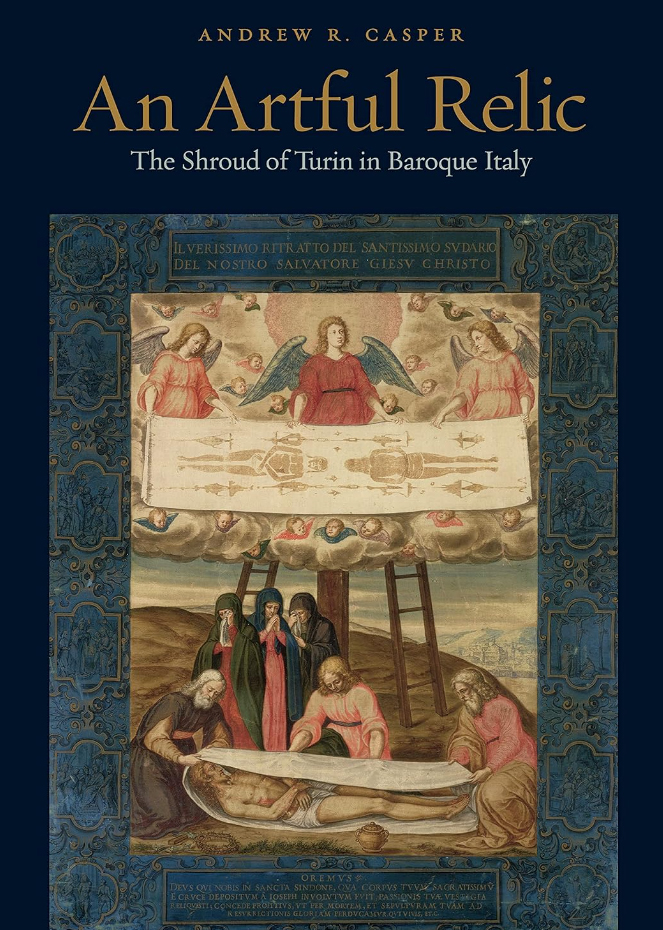
Casper’s book focuses on the way in which people understood the Shroud in the sixteenth and seventeenth centuries (chiefly as “as an artful relic crafted by God…a divine painting attributed to God’s artistry”).
These two books provide rich and helpful discussions of the Shroud.
- See P.E. Damon, D.J. Donahue, B.H. Gore et al., “Radiocarbon Dating of the Shroud of Turin,” Nature 337 (1989) 611–615 and H.E. Gove, “Dating the Turin Shroud—An Assessment,” Radiocarbon 32 (1990) 87–92. ↩︎


 Variant Readings
Carbon dating was important; so was analysis of the “blood” on the shroud. It turned out to be a pigment, red ochre. Walter C. McCrone of the McCrone Research Institute was the one who determined that.
The carbon dating is controversial, to say the least, and most recent testing has shown the shroud to be more accurately dated to the fist century. Of course the easier and most sure fire way to prove the shroud a forgery or fake or manufactured is to simply reproduce it. Still has not been done even by modern methods, much less medieval ones.
Thanks for your comment. To the best of my knowledge, the challenges to the radiocarbon results have not been compelling to most experts, and the method used to argue for a first-century date for the shroud in a recent publication (“Wide-Angle X-ray Scattering”), is not, as far as I know, a widely accepted method for dating textiles.
What about the argument that the carbon dating was done on the edge of the shroud, where repair or additions may have been placed?
According to the original reporting of the radiocarbon analysis, the sample was taken in the presence of two experts on textiles and “came from a single site on the main body of the shroud away from any patches or charred areas” (P.E. Damon et al., “Radiocarbon Dating of the Shroud of Turin,” Nature 337, 16 February 1989). So, unless the textile specialists were both wrong, it seems like the sample was part of the original shroud. A similar argument actually came up quite soon after the testing, and here is the response of Harry Gove, one of the pioneers of AMS technology: “Another argument has been made…that the part of the shroud from which the sample was cut had possibly become worn and threadbare from countless handlings and had been subjected to medieval textile restoration. If so, the restoration would have to have been done with such incredible virtuosity as to render it microscopically indistinguishable from the real thing. Even modern so-called invisible weaving can readily be detected under a microscope, so this possibility seems unlikely. It seems very convincing that what was measured in the laboratories was genuine cloth from the shroud after it had been subjected to rigorous cleaning procedures” (H. E. Gove, “Dating the Turin Shroud—An Assessment,” Radiocarbon 32 [1990], 87-92).