Among codices that supposedly date to the Roman and late antique eras, there is a small set of “books” made of lead. Some of these made their first appearance in the last couple decades (the so-called Jordanian lead codices) and were clearly demonstrated to be modern forgeries.
But there were earlier artifacts that have sometimes been called lead codices. One of them is on display in Rome at the Epigraphic Museum of the Museo Nazionale at the Baths of Diocletian. The label at the museum describes this object in the following way:
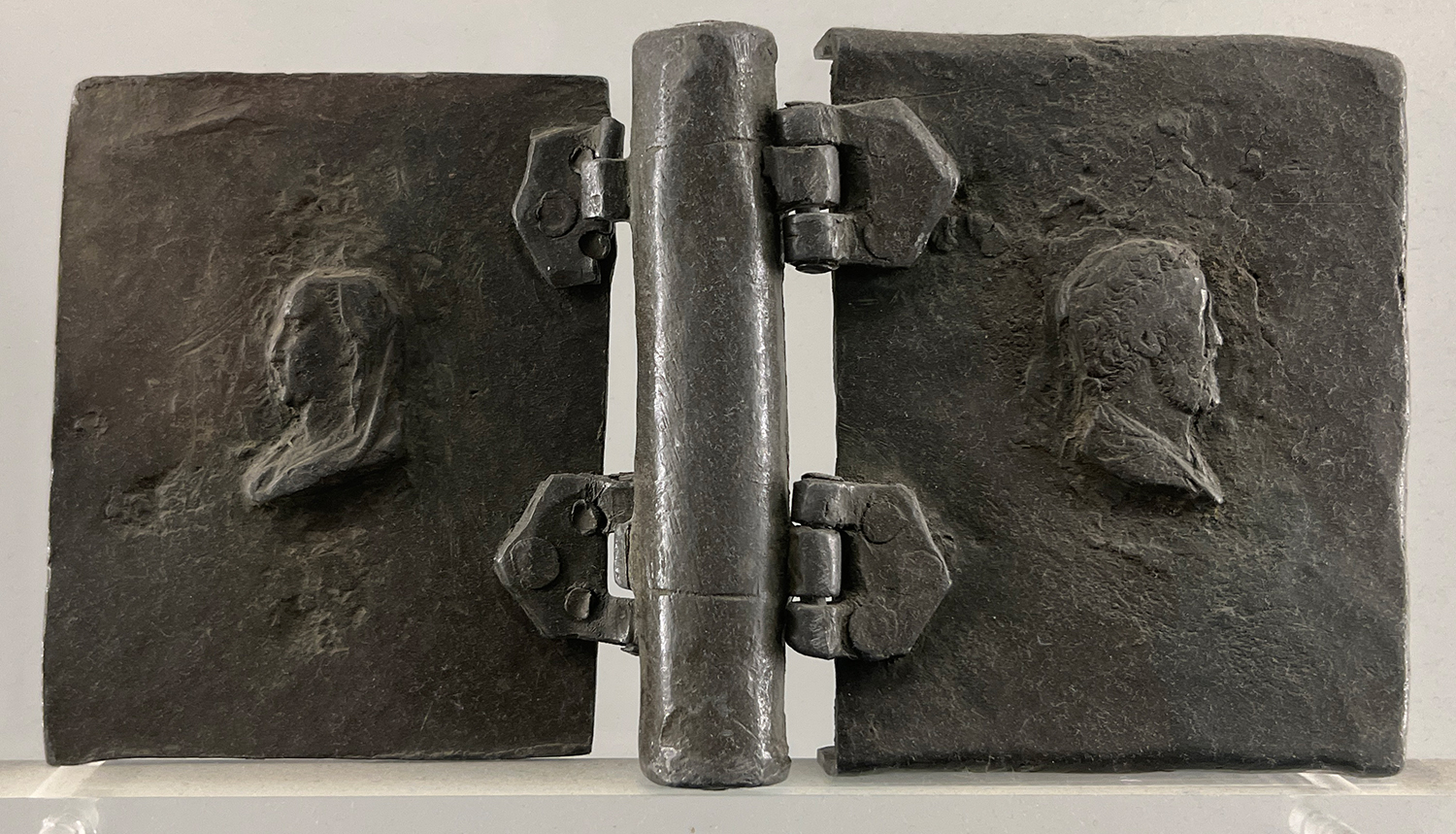
“‘Basilidian’ book: The small lead book was for magical and religious use and is formed of seven pages with a cover on whose faces are a male and a female portrait. On the pages, incised on both sides, objects, animals and human figures, are depicted, followed by a line and five rows of Greek characters with the value of magic symbols, charakteres. The term ‘Basilidian’ refers to Basilides, the founder of a philosophical school at Alexandria in the 2nd century AD. Unknown provenance, 4th-5th century AD”
The “unknown provenance” should of course give us pause. And it turns out there is a strange story to tell. But first, a brief description of the object (a quite thorough description of the sheets can be found in a 2012 catalog entry by Gabriella Bevilacqua1).
The cover, which is hinged, is displayed apart from the folia. It has the profile of a male head on the front cover and that of a female head on the back cover.:
The seven individual folia are displayed against a mirror, so that both sides of each leaf can be seen:

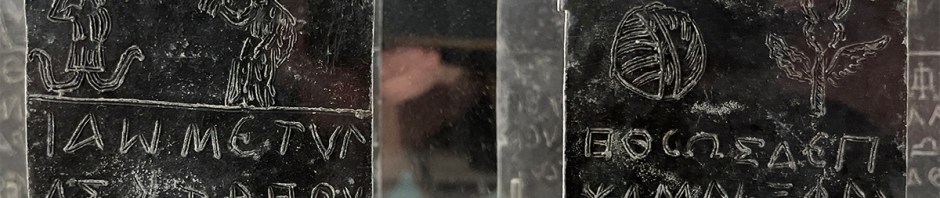
Each sheet displays images at the top of the sheet with mostly gibberish text occupying the lower portion:
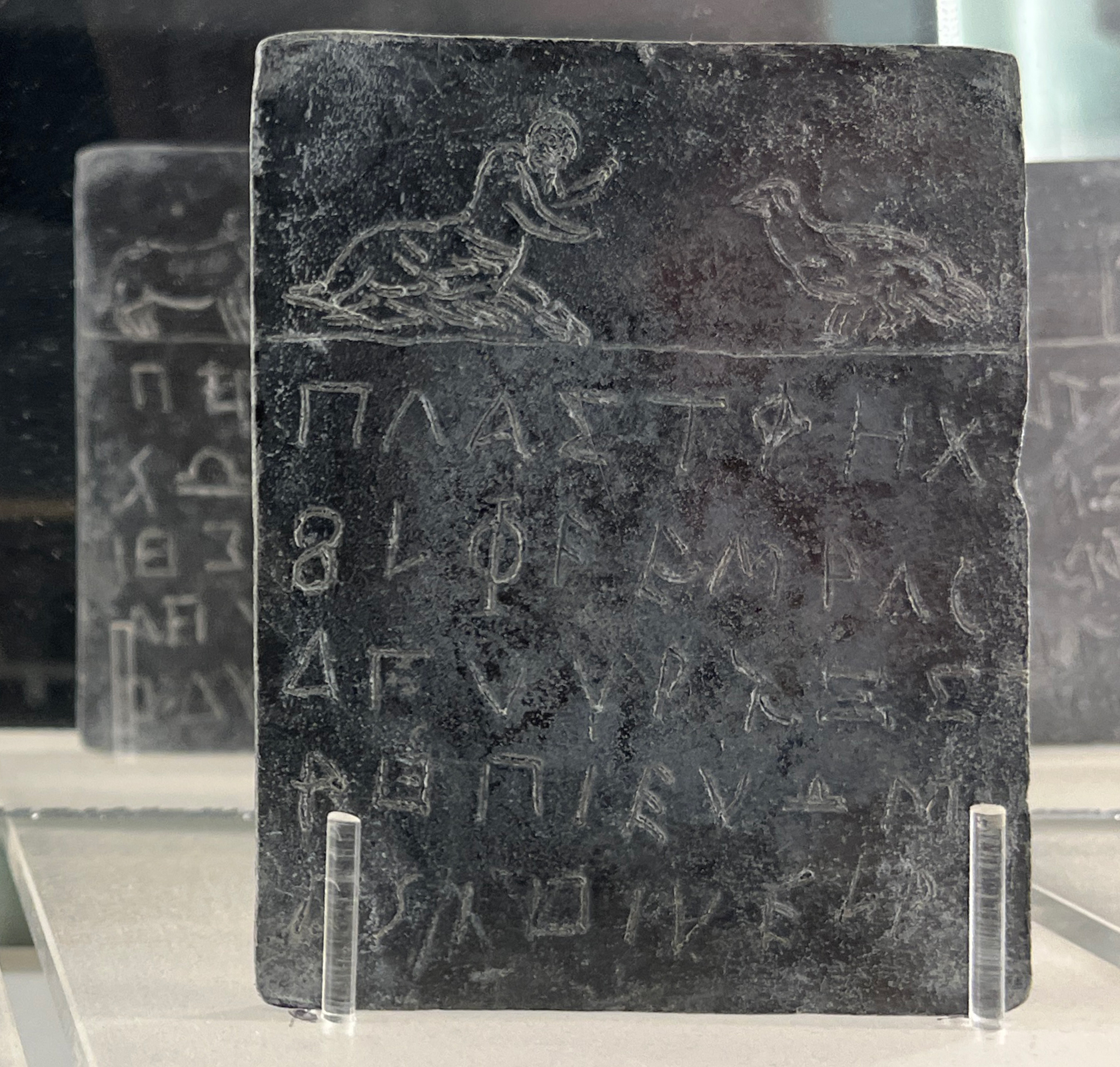
Drawings of all the sheets were published in a short pamphlet by Jacques Matter in 1852.2 Another set of drawings, including a detailed rendering of the cover and the hinge apparatus appeared in the1878 catalog of Ettore de Ruggiero.3 The images are reproduced below (after the front and back covers, each vertical pair with a Roman numeral shows the front and back of a sheet):

Strings of letters that don’t form words are common in ancient magical contexts, but the text on these leaves is strange for a couple reasons. It not only combines letters seemingly from multiple different alphabets, it also combines different forms of letters from within alphabets. For instance, it uses both a “capital” omega, Ω, and something like a script omega, (see the W in what looks like ⲓⲁⲱ on sheet V). Similarly, the writing shows both a branched sigma, Σ, and what appears to be a lunate sigma, C. There also appear to be some Arabic numerals tossed in (for instance, the numeral 8 seems to appear on several pages).
It seems that the covers were each hinged to a vertical pipe with a rod to which the seven sheets were originally affixed with tabs wrapped around the rod (a couple of the plates seem to show small stubs where the tabs snapped off the hinge mechanism).
And now the provenance story: This item (currently inventory number 65036) comes from the Museo Kircheriano, the sprawling collection of antiquities most closely associated with Athanasius Kircher (1602-1680), but the earliest documentation of this exact item seems to be the 1837 catalog of Giuseppe Brunati. There, Brunati notes that a similar item was in the Kircheriano in the eighteenth century, but that the present lead book was a different object. As he wrote, “The suspicion arises that somebody, having taken away the genuinely ancient booklet, has fraudulently substituted another.”4
This earlier lead book was documented in the catalog of Filippo Buonanni in 1709.5 Interestingly, he described the artifact both as a “book” (liber) and as a “box” or “case” (theca) that “contained seven lead plates” (septem laminae…plumbeae includunture). These sheets are said to have images and nonsense text drawn from different alphabets, but the accompanying illustration confirms that these are distinct from the lead artifact currently on display in the Epigraphic Museum:

The cover at first glance looks similar to what we have seen, but the hinge mechanism and its attachment to the cover are both different. And again, the layout of the sheets is similar (images in the upper portion, nonsense text in the lower portion), but none of the seven current sheets match the images or text of this drawing. Note also that the sheet in the upper lefthand corner of the plate clearly looks as if it is sitting in a box with sides extending from the bottom, the top, and the side opposite the hinge.
Buonnani claimed that this book had come from “an ancient sarcophagus” that also contained the ashes of the deceased, but he offered no further details (Fuit hic plumbeus liber repertus in antiquo Sarcophago, in quo cineres demortui fuerant inclusi). The current location of this artifact is unknown (or at least unknown to me).
After Buonnani published this object in 1709, Bernard de Montfaucon in 1719 published another similar artifact that he said he had purchased during his trip to Rome in 1699.6 This piece is described as having six lead sheets between two lead covers, though only four of the lead sheets were said to have text. The illustration provided by Montfaucon again shows the similarities in terms of layout, imagery, and writing but also the differences in the details when compared to the lead codex in the museum.
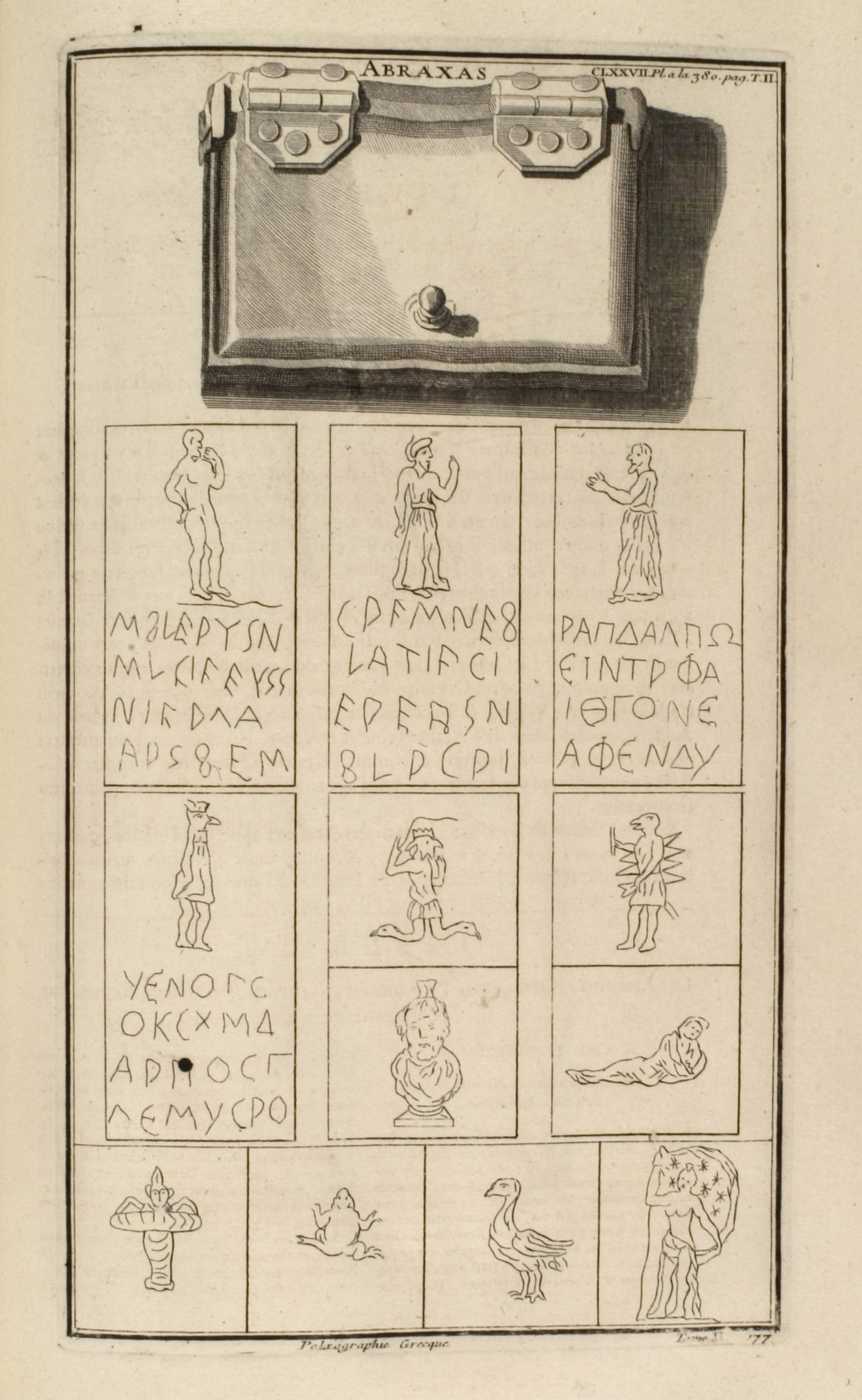
It was Montfaucon who gave this small genre its commonly used name (“Basilidian books”), because of the iconography, which includes an Abraxas figure (a human torso and arms with a bird head and two serpents in place of legs), which he associated with the “gnostic” teacher Basilides. Montfaucon said that he gave this lead book to Cardinal de Bouillon (1643-1715). I am not aware of its current location.
We thus seem to have evidence for two lead codices in Rome in the very late 17th and early 18th centuries (both now lost), and for a third that shows up in the early 19th century. To the best of my knowledge, there are no other such objects that have been published. Iconography for hinged book-like objects in pre-Roman contexts is attested, and ivory diptychs with different forms of hinges are well known from Roman late antiquity.7 But these lead codices seem very dubious to me, especially the one now on display in the Epigraphic Museum–the thickness of the lead, the look of the script, and most of all its sudden appearance in a museum in place of an entirely different artifact! When Brunati first mentioned this “new” lead book in 1837, his evaluation did not inspire much confidence: “Utinam vero authenticus sit.” I suspect his hesitations were justified. Barring the discovery of a similar kind of artifact in a secure archaeological context, it is probably best to regard this object as a production of 17th or 18th century.8
- Gabriella Bevilacqua, “IX, 41. Libro ‘Basilidiano’,” in Rosanna Friggeri et al. (eds.), Terme di Diocleziano: La collezione epigrafica (Milan, 2012), pp. 596-599. ↩︎
- Jacques Matter, Une excursion gnostique en Italie (Paris, 1852), plates 3-9. ↩︎
- Ettore de Ruggiero, Catalogo del Museo Kircheriano (Rome, 1878), pp. 1.63-64): “199: Libello basllldlano di piombo (al. c. 10, lar. c. 9). La copertura del libro ha sul diritto, in rilievo, un busto di donna velata, sul rovescio quello d’un uomo barbato. Dentro erano, per mezzo di cerniera, riunite sette sottili tavolette di piombo della medesima grandezza, che ora sono sciolte, ciascuna delle quali contiene, ai due lati, incise due figure simboliche nella parte sùperiore, e una leggenda nel rimanente. Una strana mescolanza di lettere greche, italiche e latine non ne rende possibile alcuna decifrazione; il carattere gnostico dell’ insieme è però indubitato. Il Bonanni menziona (mus. Kirch. p. 180), pubblicandone un saggio (tav. LX), un analogo monumento, che pare sia stato ai suoi tempi trovato in Roma, ed era conservato nel Museo. Esso però era affatto diverso dal nostro, come pure dall’altro acquistato in Roma dal Montfaucon nel 1699 e donato da lui al cardinale de Bauillon (palaeoar. graeca p. 181; cf. antiq. expliq. 2, 2, pl. 177). È ignoto come e quando sia scomparso il primo del Museo, sostituendovisi quest’altro. Il Brunati, (p. 122) per altro, già notò nel 1838 questa sostituzione, manifestando qualche dubbio sulla sua autenticità, e concludendo che tutti e tre i sudetti libelli possano pervenire da una medesima origine.” These images were reprinted in H. Leclercq’s entry for “Basilidiens” in the Dictionnaire d’archéologie chrétienne et de liturgie (Paris, 1910), vol. 2, part 1, cols. 514-525. ↩︎
- Brunati, Musei Kircheriani inscriptiones ethnicae et christianae (Milan, 1837), pp. 122-124: “Tantum suspicio oritur, quod quidam, abrepto sincero veteri libello, alium fraudolenter substituerit.” ↩︎
- Buonanni, Musaeum Kircherianum (Rome, 1709), p. 180: “LIBER PLUMBEUS, Thecam plumbeam expressimus in Tabula LX. in formam libri compactam, in qua septem laminae etiam plumbeae includuntur, in quarum singulis plures characteres incisi fuerunt verriculo, & quidem non unius idiomatis, sed variorum linguarum; sunt enim aliqui ex graeco Alphabetico selecti, alqui verò ex haebraico, multi ex antiqo Etruscorum, varii ex latino. Horum Characterum combinationes verba intelligibilia efformat, quae nec Graecus, nec haebraici, neque latini sermonis licet peritissimus intelligere nunquam potuit. Singulis etiam laminis adjecta sunt aliqua symbola at ex nullo eorum deduci potest, quid Artifex mente conceperit, quod indicaret. Quamobrem in genere Talismanorum enumerandum esse judico, in quibus Antiquorum superstitio id exprimebat, quod erronea mente conceperat, putabatque optimum esse remedium, vel ad amla avertenda, vel ad daemones fugandos, aut tutissimam viam ad bonorum. Fuit hic plumbeus liber repertus in antiquo Sarcophago, in quo cineres demortui fuerant inclusi. Constat autem ex pluribus monumentis, ab Aethnicis praecipuè Aegyptiis non rarò in sepulchris aliqua deposita fuisse, quae ad placandos Manes, vel ad Daemones fugandos utilia esse opinabantur. Ex Cornelio Tacito Annal. lib. 2. habemus, cum refert Mortem Germanici veneno intersecti, ‘Carmina, & devotiones, & nomen Germanici, plumbeis tabulis insculptum, semiusti eineres ac able obliti, aliaque maleficia, & animas Numinibus infernis sacrari.’ Ubi notat Ludovicus Dorleans in suis novis cogitationibus, Antiquos plumbeis laminis usos esse, ne facilè illa nomina delerentur.” ↩︎
- Montfaucon, L’antiquité expliquée et représentée en figures, vol. 2.2 (Paris, 1719), plate 177 and page 378: “Il me reste à parler d’un petit livre tout de plomb, que j’achetai à Rome en 1699, & dont je fis present à M. le Cardinal de Bouillon: il eft de la même grandeur qu’il est ci-après représenté dans la planche; non seulement les deux plaques qui font la couverture , mais aussi tous les feuillets au nombre de six, la baguete inserée dans les anneaux qui tiennent aux feuillets, la charnière & ses clous; enfin tout sans exception est de plomb. Les douze pages que sont les deux côtez de chaque feuillet, ont autant de figures des Gnostiques: audessous de ces figures, il y a des inscriptions, partie Hetrusques & partie Greques , mais aux quatre premières pages seulement; toutes ces inscriptions sont également inintelligibles.” ↩︎
- On hinged Hittite tablets, see Michele Cammarosano, “Writing on Wood in Hittite Anatolia,” in Marilina Betrò et al. (eds), The Ancient World Revisited: Material Dimensions of Written Artefacts (De Gruyter, 2024), 165-205. For an example of a hinged late antique diptych, see the Boethius Diptych. ↩︎
- The first catalog of the Kircher collection appeared in 1678: Georgius de Sepibus, Romani collegii Societatus Jesu Musaeum celeberrimum (Amsterdam, 1678). It has a section on books in foreign languages, but that includes nothing that matches well with the lead books. In the index of objects, the only leaden item is a chunk of pure lead (p. 41). Perhaps this is an indication that the lead codex described by Buonanni in 1709 entered the collection after 1678. ↩︎


 Variant Readings
Correct — a group of bad forgeries from a common source, probably a single enterprising individual. As you say, the workmanship isn’t ancient: Text, letters, drawings, thick “sheets,” and silly binding methods all point to relatively recent production. Even ancient “imitations,” which are rare, have more convincing writing. The writing on these lead pages isn’t ancient. I have seen a different group of fakes of single “magic” gold lamellae (sheets) with very bad writing, all very similar and self-imitative, produced by a single individual over a period of about forty years (or more). Who knows how many collectors and museums have purchased these fakes over the years? I myself was the owner (temporarily) of one of these gold tablets in the 1980s before returning it (with full refund) to the London antiquities dealer from whom I bought it. I have seen and studied at least 12-15 of these since, all created in the same manner by the same person with no good ancient analogies.
These may have been inspired, in part, by the earlier-faked lead books of Sacromonte.
Brent, thanks for the link. But you might want to replace it with this 2017 link which is the first of four posts in which I give my comprehensive, fully informed, evaluation of the Jordanian lead codices. (Spoiler: I still think they are not ancient artifacts.) https://paleojudaica.blogspot.com/2017/08/the-jordanian-lead-codices-1-materials.html
Thanks–I updated that link.
Thanks. Perhaps of interest: https://paleojudaica.blogspot.com/2025/01/some-basilidian-lead-codices.html