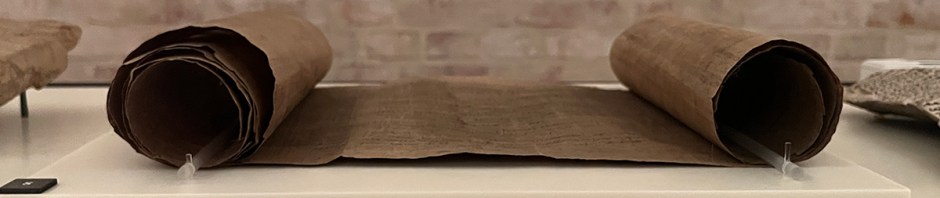
Some of the real workhorses of both my teaching and public presentations over the years have been a group of papyrus rolls in Berlin. They are a set of Greek documentary rolls from the second half of the second century CE that were bought in 1912 in an excellent state of preservation.
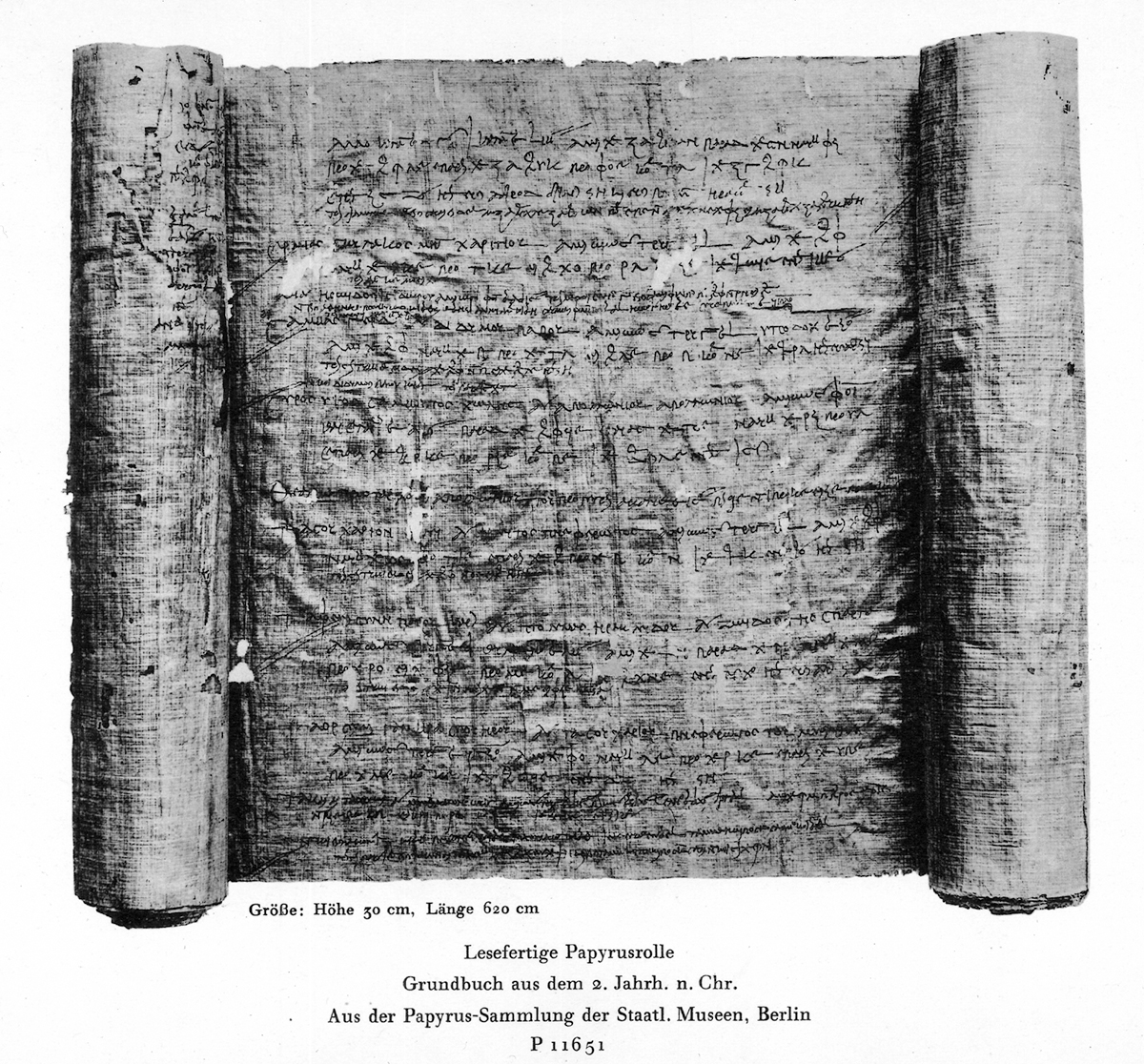
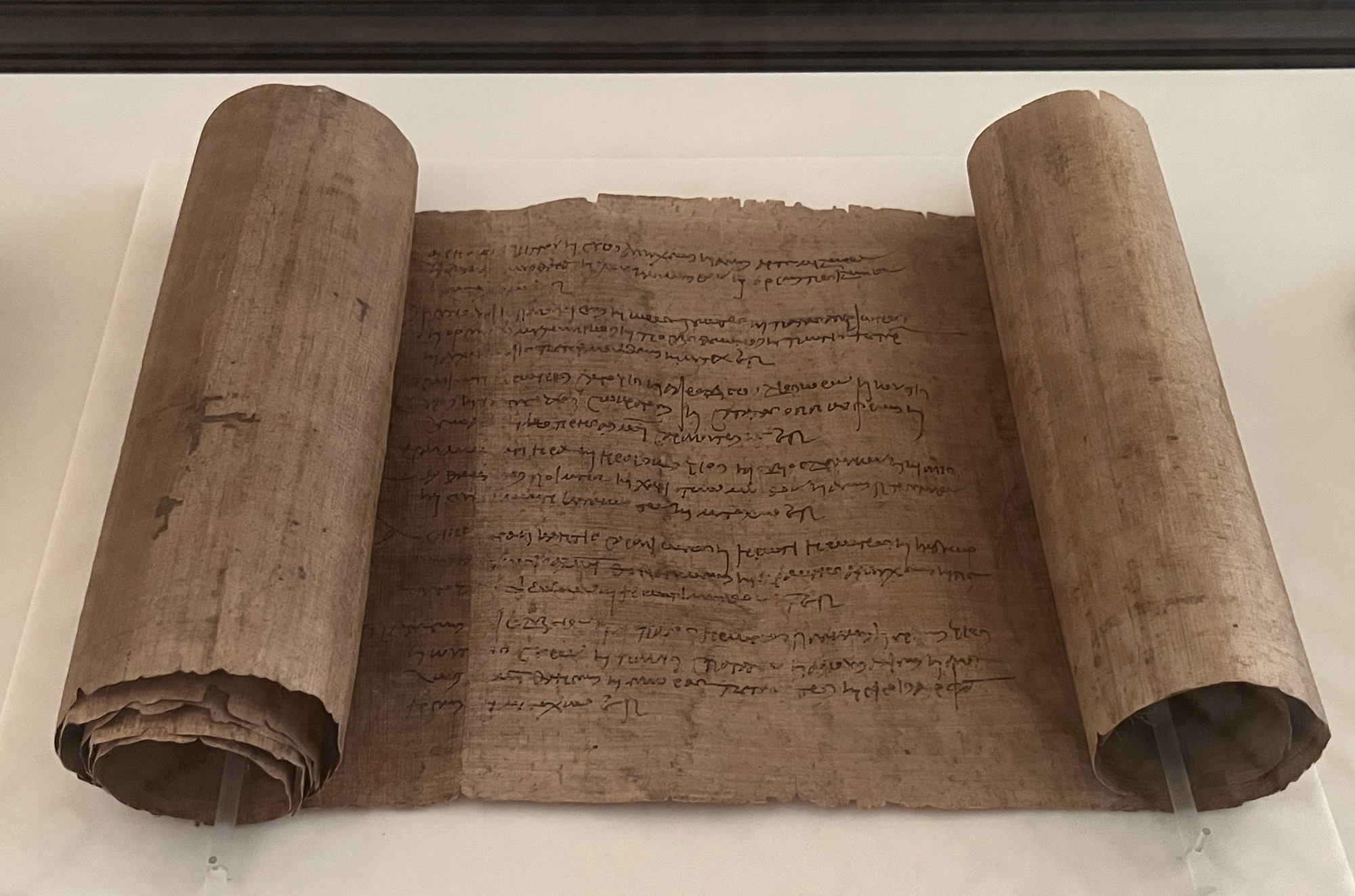
I use images of these manuscripts to provide illustrations of the papyrus roll as a three-dimensional object and also to show the differences between literary rolls, with their (usually) narrow columns and neat scripts, and these everyday documents with their broad columns and cursive writing.
For many years, I used an image of the roll that was found in the wonderful old journal, Jahrbuch der Einbandkunst (an image that also appears in lower resolution in the second edition of Schubart’s Das Buch, p. 53, fig. 14–so the photo must have been taken before 1921).
More recently I’ve used color images from the public display of one of the rolls in the Ägyptisches Museum in Berlin:
I’ve often thought that these rolls have held up remarkably well for being 2000-year old artifacts. But of course, nobody looks that good at that age without having a little work done.
Today I stumbled across a very interesting article that describes the process of conserving these rolls–“die Methode der doppelseitigen Chiffonierung,” double-sided application of a fine silk to hold the roll together, a practice championed by Rolf Ibscher (1906-1967), book conservator and son of the famous conservator, Hugo Ibscher (1874-1943) The roll described in the article is P.Berol. inv. 11651 (the one in the black and white image above), and the same process was applied to 11642, the roll in the color image above. The process has several steps.
First the roll was cut into pieces to make it more manageable, and damaged areas were repaired with Japanese paper in order to “eliminate the distracting gaps” in the papyrus. Then these papyrus and paper portions were dampened and flattened. A strip of plastic film was laid out and coated with rice starch (there is no mention of moistening the starch, but I imagine it must have been a thin paste). Then the silk mesh was placed on the rice starch to absorb it and be stretched to the proper level of tension. The plastic film was then used as a kind of applicator to press the silk and starch on to the dampened papyrus pieces. Once the silk was firmly attached to the papyrus, the plastic film was peeled away.
The process was then repeated on the other side of the papyrus sheets. All the parts were pressed for 24 hours until the all the material was dry. And then the gap-free, newly flexible roll was ready to go.
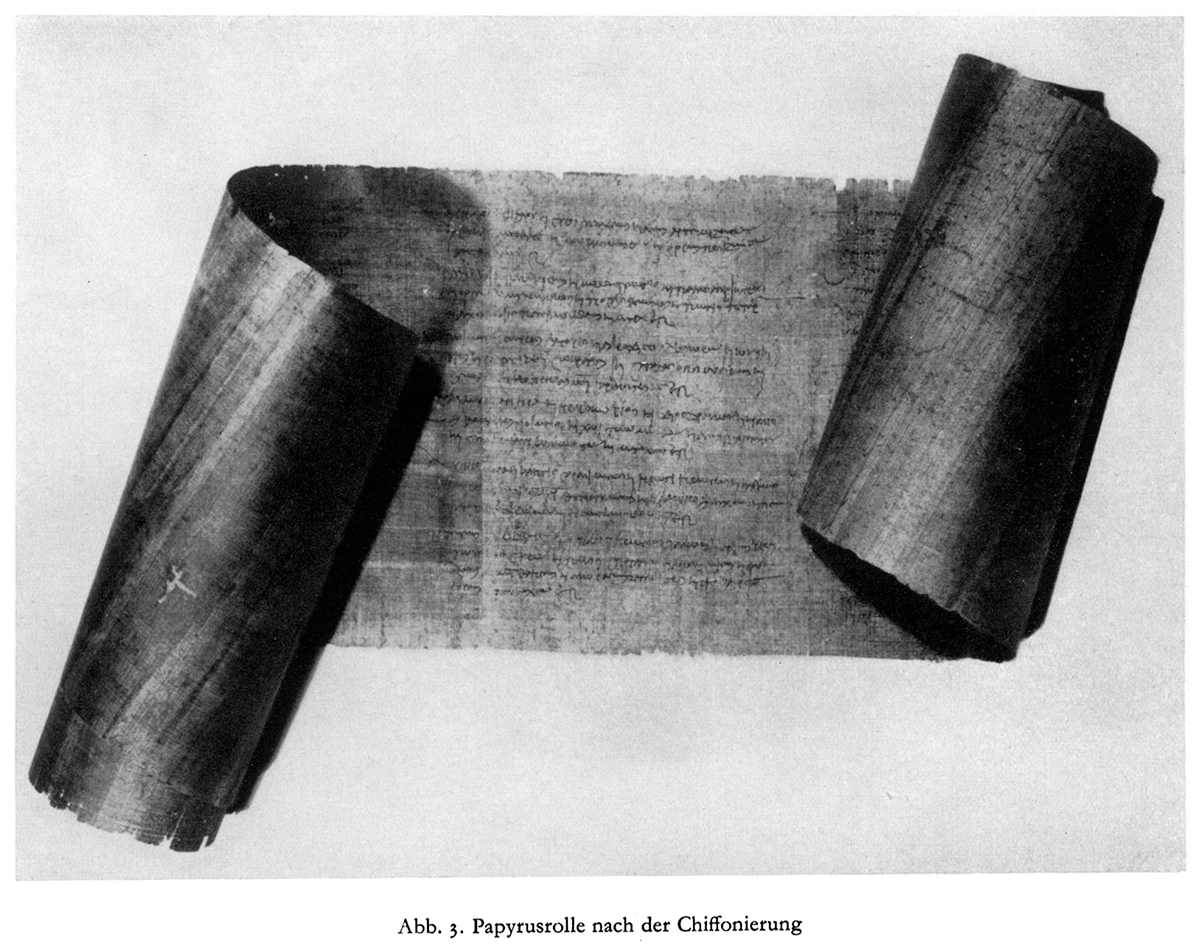
While the papyrus may now be gap-free, there are a few gaps in the narrative. There is no discussion of how the cut up pieces of papyrus were reattached to one another. Nor is there any discussion of the degree to which the silk obscures physical features of the rolls like kolleseis (the ancient joins between sheets). But on the whole, it’s very nice to have this documentation of the conservation process. There are definite benefits to cutting rolls and mounting them between glass plates to make them easily (and safely) readable–see the fine images of P.Berol. inv. 11656, another papyrus roll purchased in 1912 that has been flattened. Yet, I can’t help feeling that it’s nice to have a few examples conserved in ways like this that help us to appreciate the three-dimensionality of these artifacts. But of course I may be biased here because I am not a specialist in the texts preserved on these rolls and will likely never need to consult them to check readings. I am not thrilled that a similar procedure was carried out on the bifolia of an important papyrus codex in a way that has rendered close study of the papyrus surface difficult, if not impossible. But these kinds of decisions always have benefits and drawbacks. And as I said, it’s very good to have even this little bit of documentation of a papyrus conservation process from the middle of the twentieth century.
Source: Wolfgang Müller, Rolf Ibscher and Otto Werner Luke, “Zur Chiffonierung der Papyrusrolle P. 11651,” Forschungen und Berichte 6 (1964) 97-101.


