Palimpsests among the Tura Codices

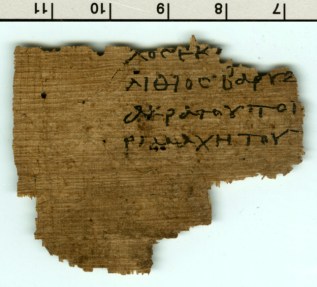
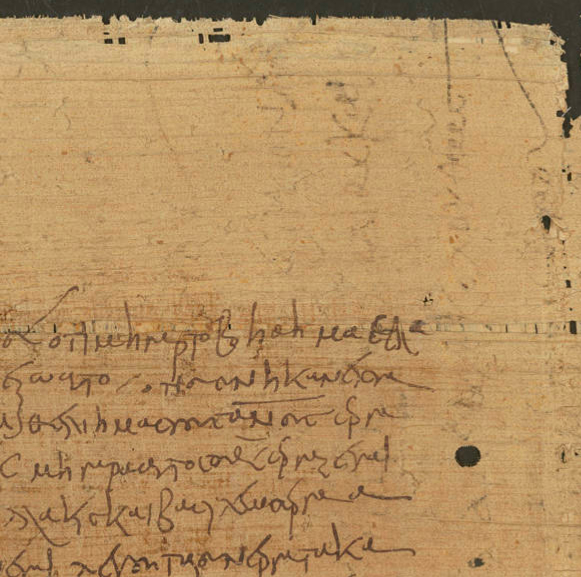
A question concerning papyrus (rather than parchment) palimpsests came up recently in the comments over on Bart Ehrman’s blog. I thought I would post here a good example of a papyrus palimpsest, namely the papyrus codex containing the commentary on the Psalms by Didymus the Blind. This codex was discovered in Tura, Egypt in 1941 (I discussed the discovery of the books here and linked to some actual black and white archival film of the site of the discovery in 1941 here). Whoever constructed the codex containing the commentary on the Psalms used recycled papyrus. The papyrus was first used for a document. At some later point, the document was rotated 90 degrees and cut into sheets. The ink that was originally on the papyrus had been washed off, but whoever cleaned the papyrus did a kind of spotty job. Here is an image of one of the leaves of this codex kept at BYU. The horizontal writing is Didymus’s commentary, but in the background you can see traces of the earlier writing (which is oriented perpendicularly to the writing of the commentary). Can you see the Greek letters nu (N) and kappa (K) in the upper margin?

Didymus Palimpsest

Tura Codex V, Commentary on the Psalms by Didymus the Blind; image source: BYU Library Digital Collections

Posted in Codices, Palimpsests, Tura Papyri | Leave a comment

A Working List of Funerary Sculpture Attributed to Oxyrhynchus

Liverpool World Museum 1970 160

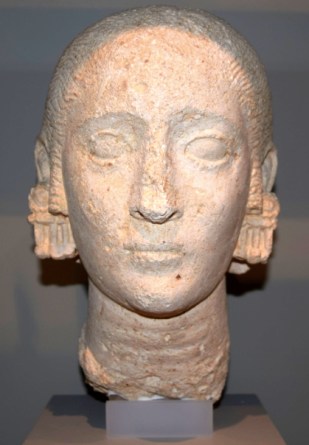
Limestone head of a woman, attributed to Oxyrhynchus; World Museum, Liverpool, 1970.160

As I have been looking into a set of sculptures attributed Oxyrhynchus (in previous posts here and here), some patterns have emerged in terms of acquisition. It seems that the best thing to do is to make a list of pieces that have been attributed to Oxyrhynchus (modern Bahnasa and its environs). This will not include all sculpture attributed to Oxyrhynchus–just the limestone pieces of adults or children in framed niches (or which appear to have been removed from framed niches). So, I’ll use this post to create a running inventory of such pieces, adding (when possible) dates of acquisition, the dealers from whom the pieces were purchased, and the precise stated provenance. Entries in bold have a secure archaeological provenance. A map below shows the locations. Items without a hyperlink are illustrated below the list. Additions and corrections are welcome.

Last updated 18 May 2018 (with thanks to Kathy Zurek-Doule of the Brooklyn Museum). Continue reading

Posted in Antiquities Market, Find Stories, Oxyrhynchus Sculpture, William Matthew Flinders Petrie | 2 Comments

A Bit More on Sculpture Attributed to Oxyrhynchus

In an earlier post, I discussed a set of limestone sculptures usually described as funerary reliefs found at Oxyrhynchus. One of the pieces was a portrait of a woman acquired by the Boston Museum of Fine Arts in 1972. I noted that she resembles a more fragmentary piece in the Brooklyn Museum. A bit more searching has turned up some of the other examples of this type of sculpture. Continue reading

Posted in Antiquities Market, Oxyrhynchus Sculpture | 1 Comment

Faces from Oxyrhynchus?

Earlier this year I had the pleasure of visiting the University of Edinburgh. In addition to chatting with a fascinating group of graduate students, I was able to squeeze in a quick trip to the National Museum of Scotland. While there, I encountered a life-size limestone statue: Continue reading

Posted in Antiquities Market, British Museum, Fakes and Forgeries, Oxyrhynchus Sculpture, William Matthew Flinders Petrie | 4 Comments

The Barcelona-Montserrat Greek-Latin Codex: Another “Bodmer” Codex with Mixed Contents

In addition to the so-called Bodmer composite codex (LDAB 2565, which I described in some detail here), the same ancient collection seems to have included another papyrus codex with equally (if not more) diverse contents. The Barcelona-Montserrat “miscellaneous” codex (LDAB 552) is composed of a single papyrus quire originally consisting of at least 28 sheets (= 56 leaves = 112 pages). It contains a fascinating mix of classical and Christian material in Greek and Latin. Continue reading

Posted in Barcelona-Montserrat Greek-Latin Codex, Bodmer Papyri, Codices, Robinson Papyri | 9 Comments

Justin Martyr and the Gospel(s)

Over on his blog, Larry Hurtado has responded to my last post on textual transmission, and I fear we may be talking past each other. Just to try to clarify the actual points of our disagreement:

Hurtado writes: “Nongbri seems to doubt that we can view the term [apomnemoneumata] as referring to the familiar NT Gospels.”

No, this oversimplifies and blurs the matter under discussion. What I wrote was this: Continue reading

Posted in Justin Martyr, Textual criticism | 6 Comments

Guest post: Mike Holmes and Matthew Larsen on Finished and Unfinished Ancient Texts

My recent invocation of Matthew Larsen’s article has generated a good bit of discussion both on and off the blog. In one of these exchanges, Mike Holmes raised some good questions about the article and agreed to let me post them. I invited Matthew Larsen to respond, and I’ve posted his response below Mike’s observations. Thanks to both Mike and Matthew for sharing their thoughts.

Here is Mike’s query: Continue reading

Posted in Textual criticism | 6 Comments

Early Christian Textual Transmission, Part 3

In my first posting prompted by Larry Hurtado’s reflections on textual transmission, I brought up a recent article by Matthew Larsen, “Accidental Publication, Unfinished Texts and the Traditional Goals of New Testament Textual Criticism.” In a response (here), Hurtado has offered a critical reading of Larsen’s article. Continue reading

Posted in Justin Martyr, Textual criticism | 6 Comments

Early Christian Textual Transmission, Part 2

POxy 57 3890

P.Oxy. 57.3890, title from a papyrus roll containing Book 2 of Thucydides’ History; image source: POxy Oxyrhynchus Online

I posted yesterday some initial thoughts about questions of textual fluidity and stability in early Christian manuscripts generated in conversation with a post by Larry Hurtado. Larry has responded in a lengthy post here. I’ll take up some his points in a later post. For now, I want to follow through on my original line of thought: Is there non-Christian (in this case, classical) material that we can look at for the sake of comparing how other literature was published and transmitted in Greek and Roman antiquity? Continue reading

Posted in Textual criticism | 4 Comments

Early Christian Textual Transmission, Part 1

Recently on his blog Larry Hurtado has been reflecting on issues of textual stability and fluidity of early Christian manuscripts. It’s an interesting question to ponder, but as Larry notes, assertions in either direction are tricky because just about everyone agrees that when it comes to the documents of the New Testament, we simply don’t have manuscripts from the very earliest period of transmission. Continue reading

Posted in Textual criticism | 13 Comments