Pumice, Parchment, and Papyrus

In the latest issue of the Bulletin of the American Society of Papyrologists (2024, just out–table of contents here), I have an article on the use of pumice on papyrus (AAM here). Here is the abstract:


Papyrological handbooks published in the second half of the twentieth century suggest that pumice was used in antiquity to smooth the surface of papyrus in preparation for writing. Experimentation with modern papyrus and pumice calls this claim into question. The ancient literary references to pumice and papyrus, when they are properly understood, demonstrate that when pumice was used on papyrus rolls in antiquity, it was not used for the purpose of smoothing the writing surface. Pumice was instead used to smooth the frontes, the top and the bottom of the closed papyrus roll. This fact that was quite well established at the end of the nineteenth century, but it seems to have been largely forgotten over the course of the second half of the twentieth century.


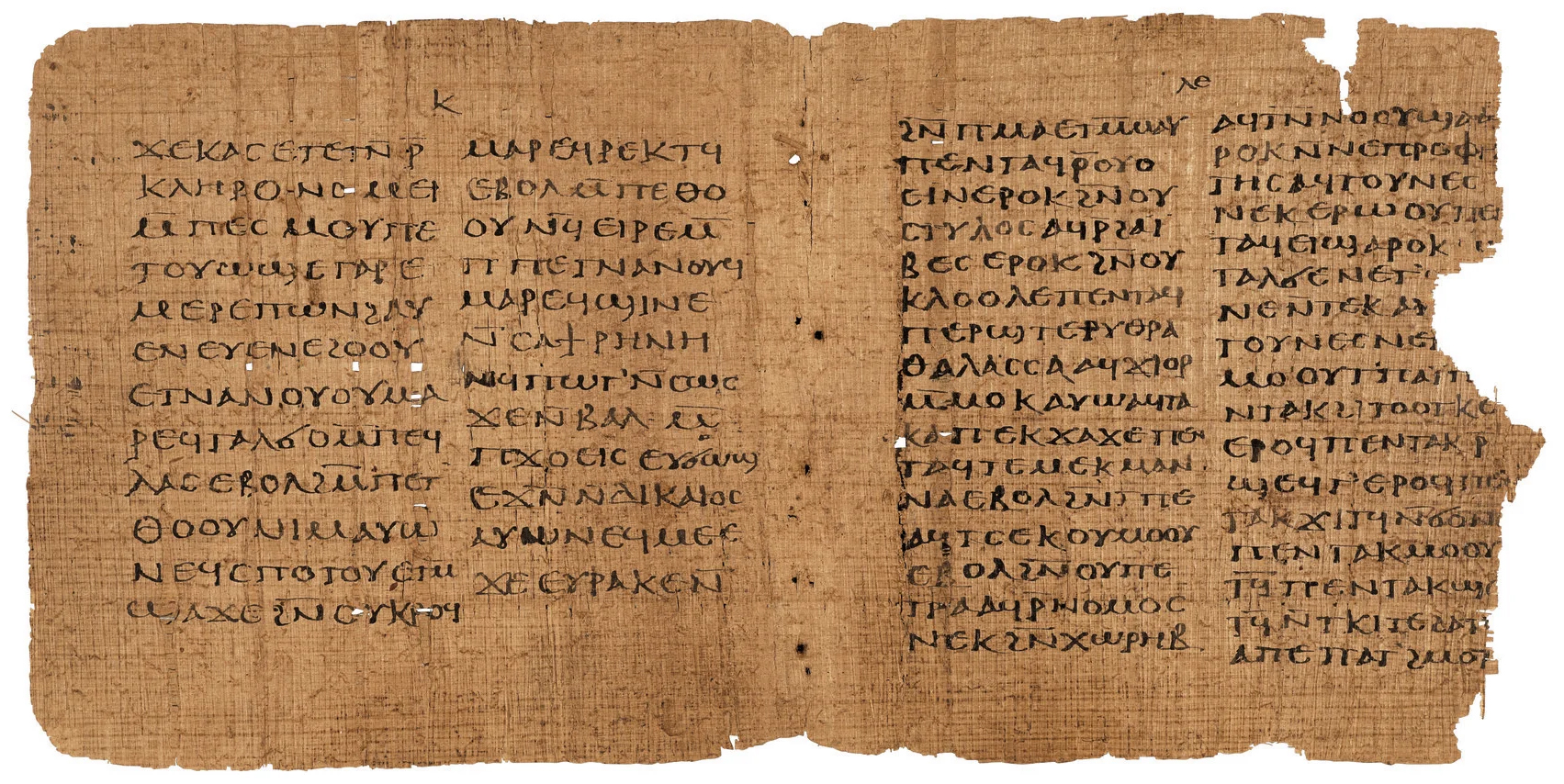
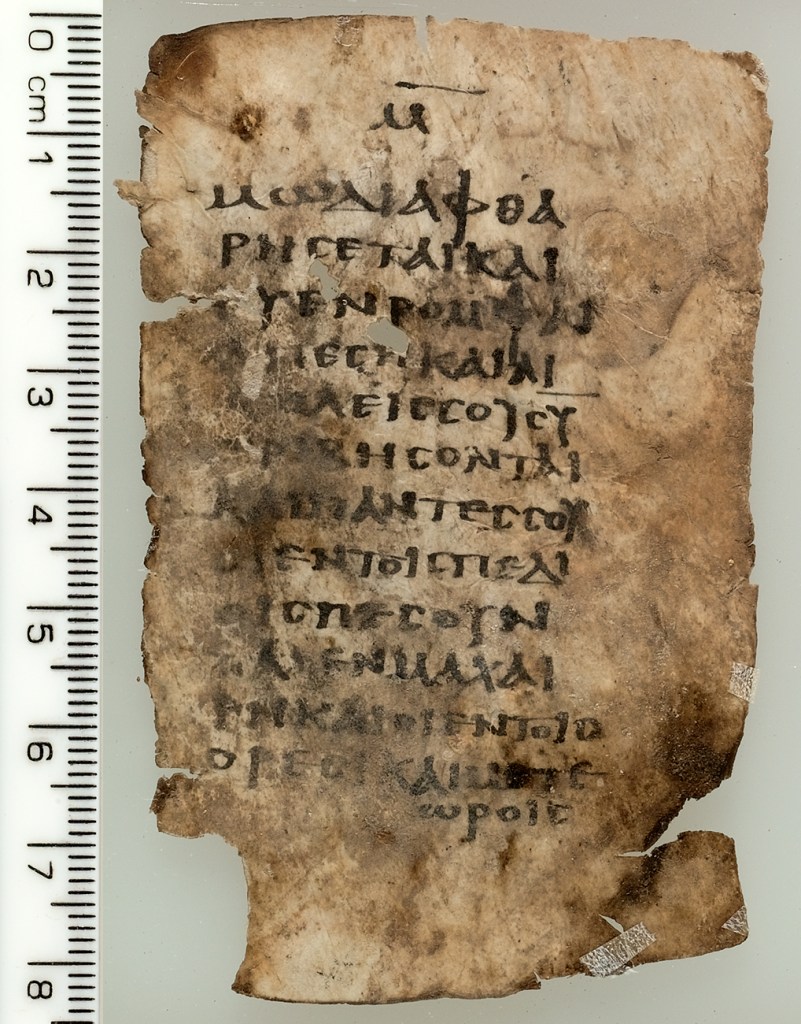
People used pumice (Greek κίσηρις, Latin pumex) for many purposes in antiquity, including the preparation of parchment writing surfaces. Several ancient and medieval discussions of the production of parchment mention the use of pumice at different stages in the process. I’ve previously noted one of these, a few leaves preserved in a papyrus codex of the sixth or seventh century that contain instructions in Coptic for preparing parchment.

What interests me in this article are references to the use of pumice not on parchment, but on papyrus. Several Latin poets refer to the use of pumice on papyrus (all the references are collected in the article). Modern handbooks on papyrology sometimes claim that pumice was used to prepare the surface of papyrus for writing (thus Italo Gallo, Greek and Latin Papyrology, p. 7: “[the papyrus sheet] was then allowed to dry, and was finally polished with a pumice stone, an ebony tool, or a shell”). But doing a bit of experimentation with modern papyrus shows that if you rub even very fine pumice on papyrus, it tears the fibers, resulting in worse conditions for writing (smooth objects like bone or shell flatten the fibers and do create a better writing surface).

Homemade modern papyrus before rubbing with pumice (left) and after rubbing with pumice (right); image source: Brent Nongbri

In fact, the ancient references to the use of pumice on papyrus never say it was used to smooth the writing surface. Rather, it was used on the frontes, the top and bottom of the closed scroll. The pumice would grind off any stray fibers that protruded from the ends of the rolled up cylinder. This seems to have been one of the last stages of the manufacture of a bookroll, one that took place after the papyrus was already inscribed, in some cases even at the shops where books were sold.

The form of pumice used for this task seems to have been a hemispherical block that could be held in the palm of the hand (such a stone was found as part of what seems to be a writing kit in the so-called Tomb of the Scribe in the Vatican). This is very similar to hemispherical pumice stones found at Pompeii, often in bronze holders.

Pumice stone in bronze casing from Pompeii, inv. 7150; image source: Paul Roberts, Life and Death in Pompeii and Herculaneum (The British Museum Press, 2013), p. 132, fig. 142

When the context of these Pompeian hemispherical pumice stones is known, it is most frequently as part of cosmetics kits. This is interesting in light of the personification and sexualization of bookrolls that we sometimes find in Latin poets. The hemisphere of pumice offers us a case of a single tool that could be used on both the human body (for removal of hair and smoothing of skin) and the book (for tidying the frontes).

I enjoyed researching and writing this piece. It led me down several fascinating rabbit holes that I hope to talk about here in the near future.

Posted in Archaeological context, Book Trade in Antiquity, Voluminology | Tagged , , , , , | 1 Comment

The So-called Bust of Josephus

I recently had occasion to spend some time revisiting the works of the Jewish historian Josephus, which was a real pleasure. When working on Josephus, I occasionally come across the “bust of Josephus” that so often serves as an illustration of the historian, as it does on the Norwegian Wikipedia page for Josephus (albeit with an ambivalent caption):

image source: no.wikipedia.org

Eusebius mentions that there was a statue of Josephus in Rome (Eccl. Hist. 3.9.2), but there is no indication that this bust has anything to do with that statue. So, how and when did this bust become “Josephus”?

It turns out that there is an excellent chapter in a recent book that tells the fascinating story of this bust:

René Bloch, “Testa incognita: The History of the Pseudo-Josephus Bust in Copenhagen,” in R. Brody et al. (eds.), “A Vision of the Days”: Studies in Early Jewish History and Historiography in Honor of Daniel R. Schwartz (Leiden: Brill, 2023), 419-442.

The bust, which is now in the Ny Carlsberg Glyptotek in Copenhagen, was first identified as “Josephus” by Robert Eisler (1882-1949) in an article written in 1930. This point had already been noted by Steven Fine in 2013, but Bloch takes a deep dive into both the history of the bust itself and into Eisler’s interesting background. The identification was made on the flimsiest of grounds (Eisler believed the bust had a “Jewish-looking face”), and it is remarkable that the claim was ever given any credence.

But Bloch’s chapter is an engaging read full of wonderful detective work. I highly recommend it.

Some of it has been incorporated into the German Wikipedia article connected to this bust.

Posted in Josephus, Judaism, Sculpture | 7 Comments

More on the mikveh at Ostia and Other Jewish Materials

In March I noted the announcement that a mikveh, a Jewish ritual bath, had reportedly been found in Ostia, the port city of ancient Rome. I had missed an article from the Times of Israel that adds some details to the original press release. The article records an interview with Alessandro D’Alessio, the director of the Archaeological Park of Ostia Antica, who speculates a bit about the building that includes the pool structure:

“Our first hypothesis is that the structure was a luxurious private residence, but it could have also been a public building. …We uncovered at least six rooms. Two of them are equipped with an oven to cook. We also found a latrine and another room that was probably a kitchen. These rooms overlooked a courtyard facing south. A staircase suggests that there were at least two floors.”

It looks like some of the area has now been backfilled, so it’s difficult to see the details of the surrounding architecture.

Excavation of the pool at Ostia; image Brent Nongbri 2025

After noting the discovery of the lamp with Jewish symbols, D’Alessio added, “We found an additional two lamps, one very similar to the artifact from the bottom of the mikveh with the depiction of a menorah, the other one engraved with a Christogram [a combination of letters abbreviating the name Jesus Christ]. …We know that during that period, the Jewish and Christian communities in Rome were still very close; therefore, finding both symbols in the same environment is not surprising.”

It will be interesting to learn more precisely where the lamp with the Christian symbol was found in relation to the lamps with the Jewish symbols.

On a related point, back in August of 2024, I noted that the site museum at Ostia had reopened after a long closure. I also expressed some disappointment that none of the many Jewish artifacts from the site were on display. This has now been partially remedied with a small case containing the recently excavated menorah lamp along with two other decorated lamps. I say “partially” because the display contains almost no didactic material, and what little there is seems wrong. The display label does not say where the lamps were found and gives a date of “II-V secolo” for the whole group. Yet, we do know where the other two lamps (inv. 12495 and 12498) were found. They come from the synagogue excavations of the 1960s. They were found above a floor that post-dates the mid-fourth century and have been assigned by Letizia Ceccarelli to the latter part of the fourth century or the fifth century. I’m not aware of any lamps that exactly match the decoration of the lamp from the mikveh, but similarly shaped African lamps with a central decoration flanked by stylized palm leaves are also assigned to the fourth and fifth centuries.

Display of Jewish artifacts at the museum at Ostia Antica; image: Brent Nongbri 2025

The other item in the display case is described as an inscription of the first century CE. It may in fact be that old, but not necessarily. This is another relatively recently discovered piece of evidence for Jews at Ostia. The inscription was discovered by chance during construction work in 2006 in the Pianabella area southeast of Ostia. It identifies several people as Judaeans (Iudaei), including a certain Quintus Fabius Longor[um]. A Quintus Fabius Longus is known from the Fasti Ostiensis as a duovir and prefect in the 30s CE. The form of the name in the inscription, Longor[um], may indicate that we are dealing here with a freed person of the Fabii Longi, either in the first century or later.

The museum is also now displaying one of the decorated corbels from the synagogue (the other one has for many years been on a podium just outside the museum).

Display of Jewish and Christian artifacts in the museum at Ostia Antica; image: Brent Nongbri 2025

It’s helpful to be able to examine this corbel up close. Mary Jane Cuyler informs me that the reddish color on the menorah on the corbel is indicative of gilding, so these menorahs would have been a colorful addition to the torah shrine, which was itself decorated in different types of cut marble. Gold decorations also raise the question of reflection and lighting within synagogues, an issue discussed in a 2023 article by Karen Stern.

It’s nice to see this material on display.

Posted in Judaism, Ostia, Synagogues | Tagged , , | 3 Comments

Working with Manuscripts

It’s a nice moment when you receive the first copies of a book you’ve written. Yesterday, I had the pleasure of opening the box of authors’ copies of Working with Manuscripts, written together with my colleague Liv Ingeborg Lied.

This book emerged from our own experiences in trying to learn the ropes of working with manuscripts over the last couple decades. It’s a guide that addresses both the practicalities and ethics of studying manuscripts. We wrote it with graduate students in mind, but we hope it is widely useful for any scholar interested in including manuscripts in their research.

Thanks to the critical readers who offered feedback to some or all of the book, to the Research Council of Norway for supporting us (through the Lying Pen of Scribes project and The Early History of the Codex project), and to the editorial and production team at Yale University Press from making a nice looking and affordable volume.

Posted in Working with Manuscripts | 3 Comments

A Newly Discovered mikveh at Ostia

At a press conference this afternoon in the archaeological park at Ostia Antica, it was announced that a mikveh, a Jewish ritual bath, has been discovered in the center of the ancient city.

Ostia is well known to students of ancient Jewish life because of the late antique synagogue that was discovered there in the early 1960s. Just over a year ago, I posted about the publication of a statuette of Venus that was discovered in the synagogue.

The new discovery is in an entirely different sector of the city:

Plan of Ostia showing location of the synagogue near the ancient coastline and the mikveh in the center of the city; image adapted from a plan at Parco archeologico di Ostia Antica

While the synagogue was located close to the ancient coastline, the new discovery is inside the city walls in the central part of the town, not far from the large theater.

According to the press release, the mikveh was excavated in 2024. There are several photos from the excavation posted online:

View of the mikveh at Ostia from above; image source: Parco archeologico di Ostia Antica
View of the mikveh at Ostia during excavation; image source: Parco archeologico di Ostia Antica
View of the steps of the mikveh at Ostia ; image source: Parco archeologico di Ostia Antica

The following description from the press release gives the arguments for identifying the area as a mikveh:

“The peculiar characteristics of the room–such as the steps covering its entire width, the walls lined with hydraulic plaster, the presence of a well for capturing groundwater, the passage for communication with the adjacent room (possibly intended to house a pipe for adding water to groundwater), and again the discovery of the oil lamp with Jewish symbols at the bottom of the well–lead to an interpretation as a Jewish ritual bath (mikveh).”1

And in fact the Ostia Antica homepage also provides an image of the lamp with a menorah:

Lamp with menorah found at the bottom of the well in the mikveh at Ostia; image source: Parco archeologico di Ostia Antica

A couple preliminary observations: First, we seem not to have a date for the installation. The lamp and an accompanying glass vessel are both said to date from the 5th-6th century, so well into the “Christian” period in Ostia. The fill above this area also seems to have contained lamps decorated with the menorah, which are assigned to the 4th to 6th centuries. It will be good to learn what other evidence there is for assigning a date to this space. Second, there was a feature in the synagogue at Ostia that has often been described as a mikveh, but that identification has been challenged, and it must be said, the space in the synagogue looks nothing at all like the newly excavated area.

I’m sure there will be more to say as we learn more about this in the coming weeks. It’s an exciting discovery, and I very much look forward to the full publication of the area, so that we can better understand how this feature fits into the surrounding buildings and neighborhood.

  1. “Le peculiari caratteristiche dell’ambiente – quali i gradini estesi per la sua intera ampiezza, le pareti rivestite di intonaco idraulico, la presenza di un pozzo di captazione dell’acqua di falda, il condotto di comunicazione con l’ambiente adiacente (possibilmente destinato ad alloggiare una tubatura per l’aggiunta di acqua a quella di falda), e ancora il rinvenimento della lucerna con simboli ebraici sul fondo del pozzo – inducono a ipotizzarne una interpretazione come bagno rituale ebraico (mikveh).” ↩︎
Posted in Judaism, Ostia, Synagogues | Tagged , , , , , , , , , , | Leave a comment

The So-called Scriptorium at Bu Njem

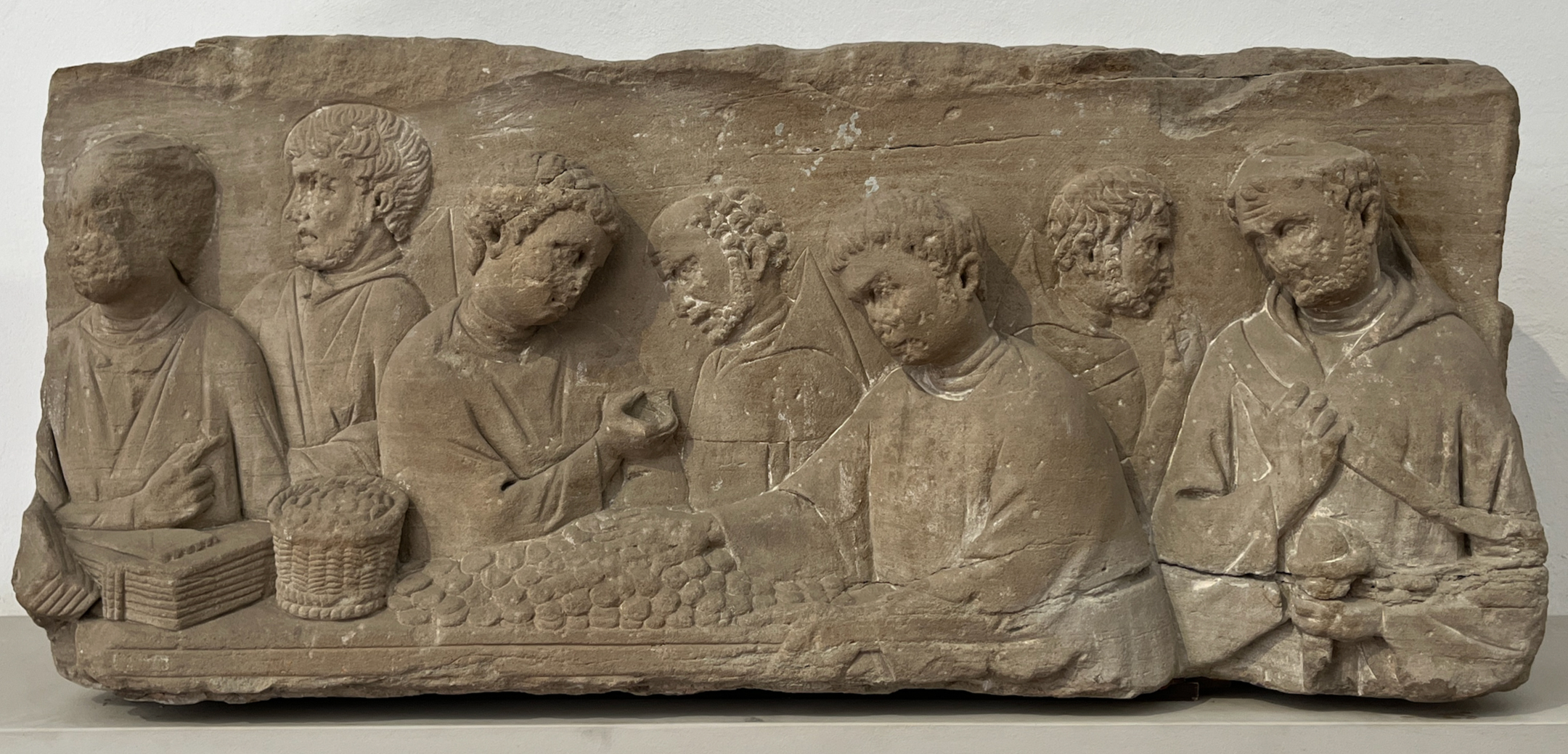
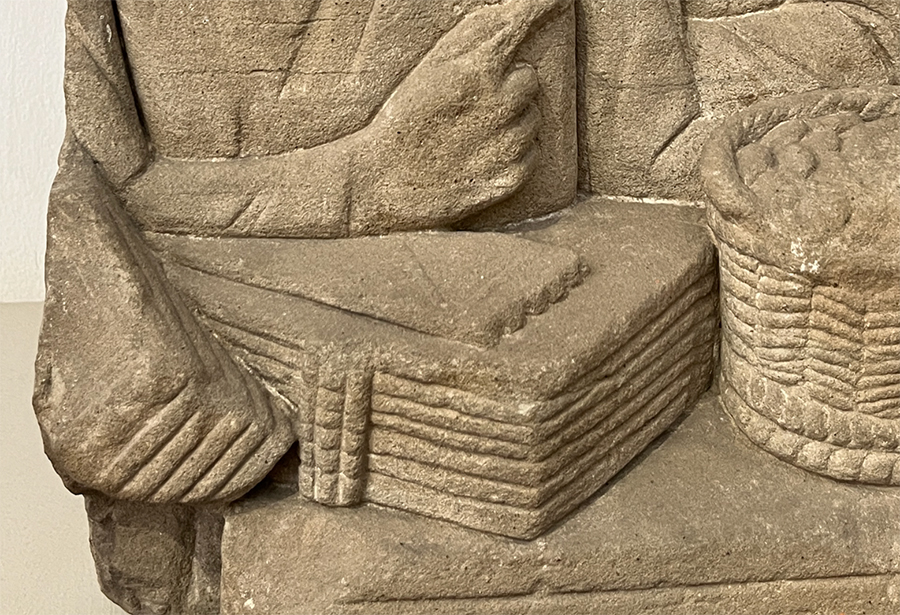
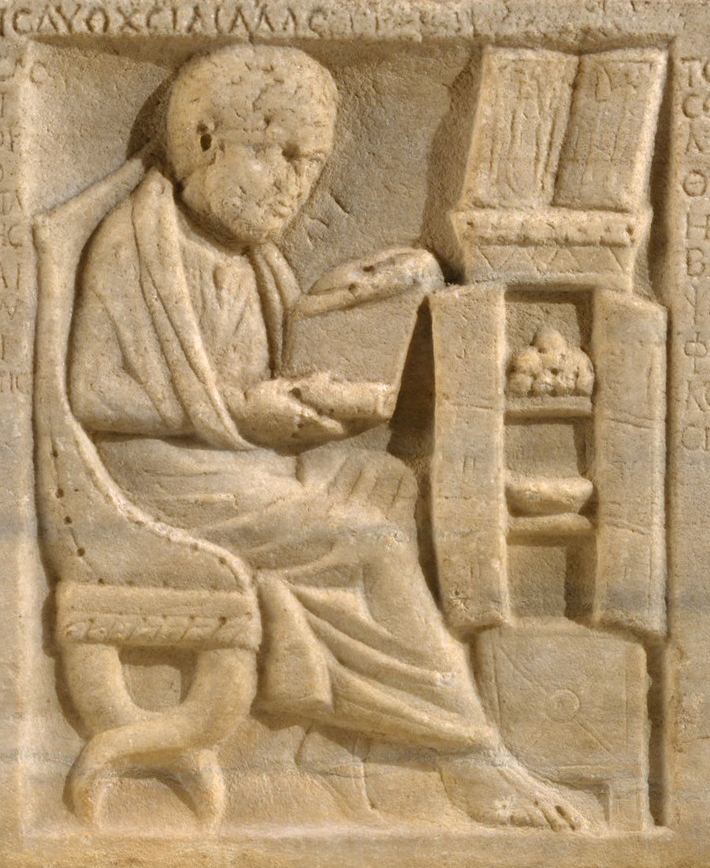
It is common for historians of ancient Rome to state that writers did not use desks (As Theodor Birt put it, “In antiquity, people did not write on desks”).1 I have noted before on the blog that I am not sure this view is entirely accurate. In a well-known article, Bruce Metzger gathered some visual evidence for the use of desks in Late Antiquity, a relief from Ostia Antica, a relief from Portus, and a mosaic from Thabraca that all show writers at desks.

Another aspect of the discussion is the material evidence of so-called scriptoria in the Roman world. The most famous of these is a controversial room found in the ruins of Qumran. Another (the only other?) potential surviving example is a structure in the remains of a Roman military camp at Bu Njem in modern Libya.

The site was excavated between 1967 and 1980 by a team led by René Rebuffat (1930-2019). According to the excavators, the fort was established in 201 CE and used by Roman military garrisons until around 260 CE. It was occupied by squatters after that who left a few traces and then abandoned and buried by wind-swept sand. The fort thus survived to the present in remarkably good condition.

Among the discoveries at the site in 1971 was a space on the south side of the central facility contained benches along the walls and a raised rectangular block (un massif rectangulaire) in the center of the room, highlighted in green in the image:

Fort at Bu Njem, adapted from R. Rebuffat, “Bu Njem 1971,” Libya Antiqua 11-12 (1974-1975)

The excavators described this space as “a scriptorium” that existed in two phases. In the first phase that corresponds to the construction of the fort in 201, the room featured a flat rectangular table (109 cm long, 66 cm wide, about 60 cm high) and two short benches on either side of the table (the report describes the benches as 80 cm high, but this must be an error; the scale indicates they are about 40 cm high). In a second phase, additional benches were added to extend to the north and south walls on both sides of the room, and a triangular “lectern” (pupitre), about 10 cm high at its peak, was added to the top of the flat table. The authors provided a top plan and profile drawing of the area as they found it:

“Scriptorium” at Bu Njem, top plan and profile, adapted from R. Rebuffat, “Bu Njem 1971,” Libya Antiqua 11-12 (1974-1975)

The sloping triangular feature in the profile drawing would be the “lectern.” The dark grey feature above it represents a niche in the south wall that is also visible in dotted lines in the top plan above. The “lectern” was somewhat damaged when the excavators found it, as illustrated in a photo that accompanied the article:

The excavators describe the use of the room in the following way:

“The central block of the Bu Njem scriptorium is not a table but a double-sloped lectern (pupitre). It is likely that the flat table (built in 201) that preceded this development also served as a lectern, because it was much too low, and the slightest test shows the discomfort of the position to which it would have forced a writer. The position remained uncomfortable with the double-sloped lectern, and the extension of the benches shows that one could work without being in front of the block. These benches are not designed for squatting or kneeling: They were obviously set up so that a seated person can be comfortable, and their extension beyond the block also proves that they are not made to raise a kneeling or squatting person in front of the block. The only overall hypothesis is therefore that the lectern served to support documents being read by a reader and listened to by other people sitting on the benches. The reader could naturally write on his lap while reading, and the listeners could also write. The room then fully deserved the convenient name of ‘scriptorium’ that we have given it.”2

The excavators paint an interesting picture here, one in which the “desk” is not used for writing but for holding something in position for reading. The excavators seem to be describing the production of multiple copies of a text by dictation, but what sort of writing do they imagine is happening in this military setting? The written artifacts found at the site included more than 146 ostraca that date from near the end of the occupation of the site, ca. 250-260 CE, and the majority of which were found in the vicinity of the so-called scriptorium.3 But these are mostly daily reports, not really the kind of thing needed in multiple copies. There are inscriptions of a literary nature that have survived at the site, namely poems inscribed on stone and credited to two centurions.4 But again, drafts for inscriptions probably wouldn’t be needed in multiple copies. I’m not sure what kind of texts the excavators have in mind with this imagined scene of dictation.

So, this is a very interesting piece of evidence, but I’m unsure about the proposed use of this space. I think there is more to say, but the bibliography on this “scriptorium” seems very limited. I would be grateful for any tips on other relevant publications on this space. For a good recent overview of the study of Bu Njem, see Anna H. Walas, “New Perspectives on the Roman Military Base at Bu Njem,” Libyan Studies 53 (2022) 48-60.

  1. Theodor Birt, Die Buchrolle in der Kunst (Leipzig: Teubner, 1907), p. 209: “Im Altertum schrieb man nicht auf Pulten.” ↩︎
  2. “…le massif central du scriptorium de Bu Njem n’est pa un table, mai un pupitre à double pente. Il est probable que la table, plate qui a précédé cet aménagement et qui a été construite en 201, servait aussi de pupitre, car elle était beaucoup trop basse, et Ie moindre essai montre l’inconfort de la position à laquelle elle aurait contraint le scripteur. La position restait inconfortable avec le pupitre à double pente, et l’extension des banquettes montre qu’on pouvait travailler sans être en face du massif. Ces banquettes ne sont pas faite pour s’accroupir ou s’agenouiller: elles ont visiblement été réglées pour qu’un homme assis soit confortablement installé, et leur prolongation au-delà du massif est également bien la preuve qu’elles ne sont pa faite pour exhausser un homme agenouillé ou accroupi en face du massif. La seule hypothèse d’ensemble est donc que le pupitre servait à supporter des documents qu’un lecteur, lisait, et que d’autres personnage assis sur le banquettes écoutaient. Le lecteur pouvait naturellement écrire sur ses genoux en même temps qu’il lisait, et les auditeurs en tout cas écrire eux aussi. La salle méritait alors pleinement le nom commode de ‘scriptorium’ que nous lui avons donné d’abord.” ↩︎
  3. See Robert Marichal, Les ostraca de Bu Njem (Tripoli, 1992). Marchial published 146 ostraca, but he prepared others for publication, including alphabetic exercises, that have not yet been fully published. See the discussion here. ↩︎
  4. See J.N. Adams, “The Poets of Bu Njem,” Journal of Roman Studies 89 (1999) 109-134. ↩︎
Posted in desks, Ostraca, Scriptoria | Tagged , , , , , , | 4 Comments

A Mosaic from Thabraca with a Writer at a Desk

In earlier posts, I discussed two pieces of evidence for writing at desks in the late antique period, a relief from Ostia and a relief found at Portus. Another piece of evidence that Metzger mentioned in his well known chapter on desks was a mosaic floor panel from a church in Thabraca on the coast of Tunisia.1 It was published in 1906 by Paul Gauckler.2

The figure behind the desk has been identified as both a banker and a scribe. It is unfortunate that the inscription near the figure’s head is not better preserved (just a couple letters survive, probably the remains of [I]N PA[CE]). The figure holds a stylus and writes–in a way oriented toward the viewer of the mosaic rather than toward the writer–the letters MA. The woman below the desk is identified by the name Victoria.

These mosaic panels covered burials under the church floor. The panel with the writer and Victoria covered a lead coffin in which two skeletons were found. The panel is oddly oriented relative to the other panels and positioned directly in front of the apse, but off center:

Gauckler’s publication includes one photograph from the excavation, and fortunately, it happens to show this mosaic in context. The raised apse is visible on the left side of the image:

The mosaic is now in the Bardo Museum in Tunis, and the details are a bit easier to discern in a color image:

The date of this mosaic is ambiguous. Gauckler places the construction of the chapel in the age of Constantine and dates its abandonment to the end of the fifth century, which means that the production of the mosaics would likely fall into the second half of the fourth century or the first part of the fifth century. Yet, the evidence for this chronology is not clearly articulated, so those dates should probably be regarded as tentative.

  1. Bruce M. Metzger, Historical and Literary Studies: Pagan, Jewish, and Christian (Leiden: Brill, 1968), 123-137. ↩︎
  2. Paul Gauckler, “Mosaïques tombales d’une chapelle de martyrs à Thabraca,” Monuments et mémoires de la Fondation Eugène Piot 13 (1906) 175-228. ↩︎
Posted in desks | Tagged , , , , , | 1 Comment

Ehrman on Titles of the Gospels in Sinaiticus and Vaticanus: Fact Check

Over at his blog, Bart Ehrman has been posting some basic facts about different books of the New Testament. The last couple posts have been about the Gospel According to Mark, and yesterday’s post, which is publicly available, treats the question of the title of the Gospel According to Mark, and includes a short discussion of how the title shows up in our earliest complete manuscripts of Mark. Ehrman writes [[Update 28 January 2025: Ehrman has now adjusted the text of his post.]]:

“Our oldest two manuscripts (Sinaiticus and Vaticanus, for you fellow Bible nerds) come from toward the end of the fourth century (around 375 CE), and they have the shortest titles (“According to Mark”).  But in both cases, the titles were added by a later scribe (in a different hand).  We don’t really know how much later. So it’s impossible to know when the manuscripts began calling it this, except to say that the manuscripts that the authors of both these 4th century manuscripts used apparently didn’t have titles at all (since they lacked them until the later scribe added them). Interesting.”

But is this actually right? On papyrus rolls, titles typically appeared at the end of the text, and this practice carried over into codices. In the case of Codex Sinaiticus, the titles that appear at the ends of the works are widely regarded to be the product of the original copyists of the books. Here is what Milne and Skeat say in their detailed study of the codex:

“That those main titles are written by the same scribe as the immediately preceding text has never been doubted, and is so obvious from the most cursory inspection of the manuscript that it needs no justification here.”1

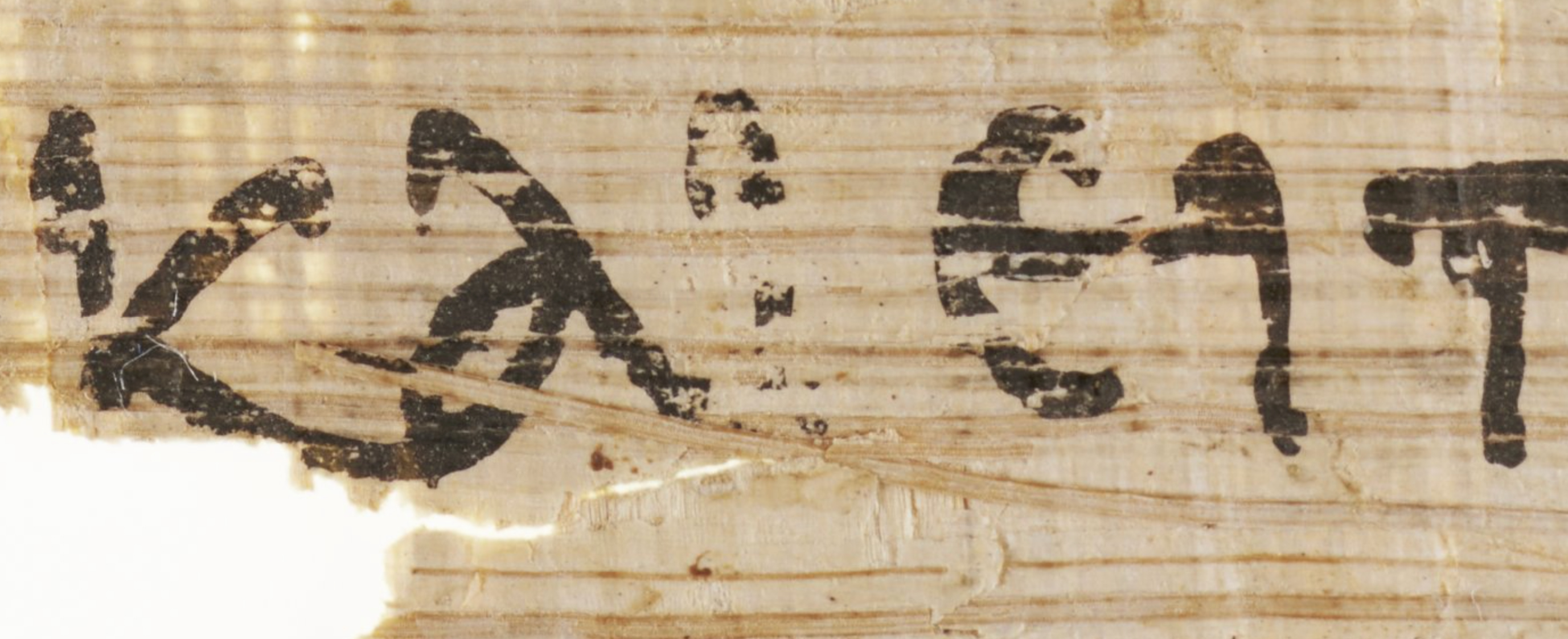
And in fact, the subscript title at the end of Mark in Codex Sinaiticus is not the short version but the longer version (ⲉⲩⲁⲅ’ⲅⲉⲗⲓⲟⲛ ⲕⲁⲧⲁ ⲙⲁⲣⲕⲟⲛ):

The end title of the Gospel According to Mark in Codex Sinaiticus; image source: codexsinaiticus.org

Some aspects of the script differ from that of the main text (the smaller epsilon and omicron raised off the base line, the mu with a curved belly), but other letters are identical with the script of the main text of Mark. There is no reason to doubt that these titles were part of the original production of the manuscript and that the differences in the script are simply decorative.

There are running titles (titles at the top of each page) in the gospels in Codex Sinaiticus that use the shorter version of the title, just ⲕⲁⲧⲁ ⲙⲁⲣⲕⲟⲛ, but these too are generally thought to be the work of the original copyists of the codex.

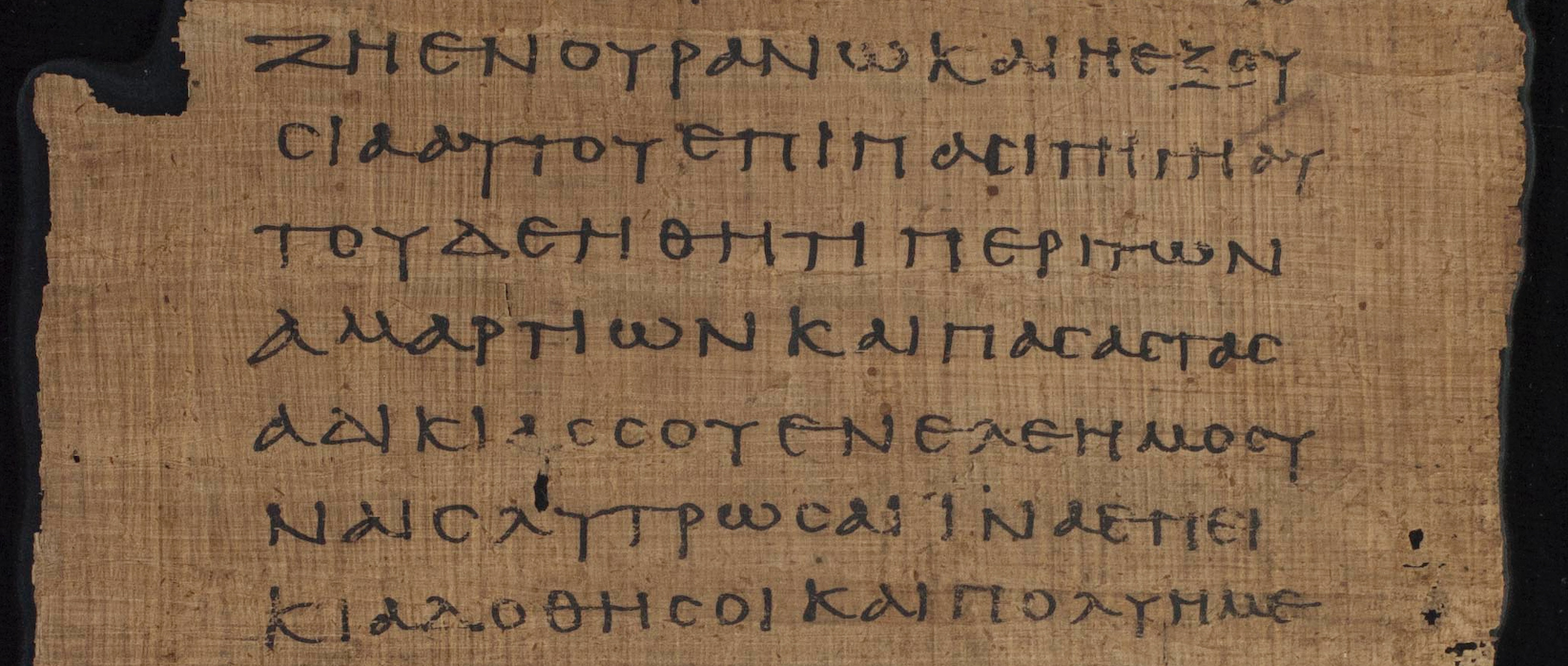
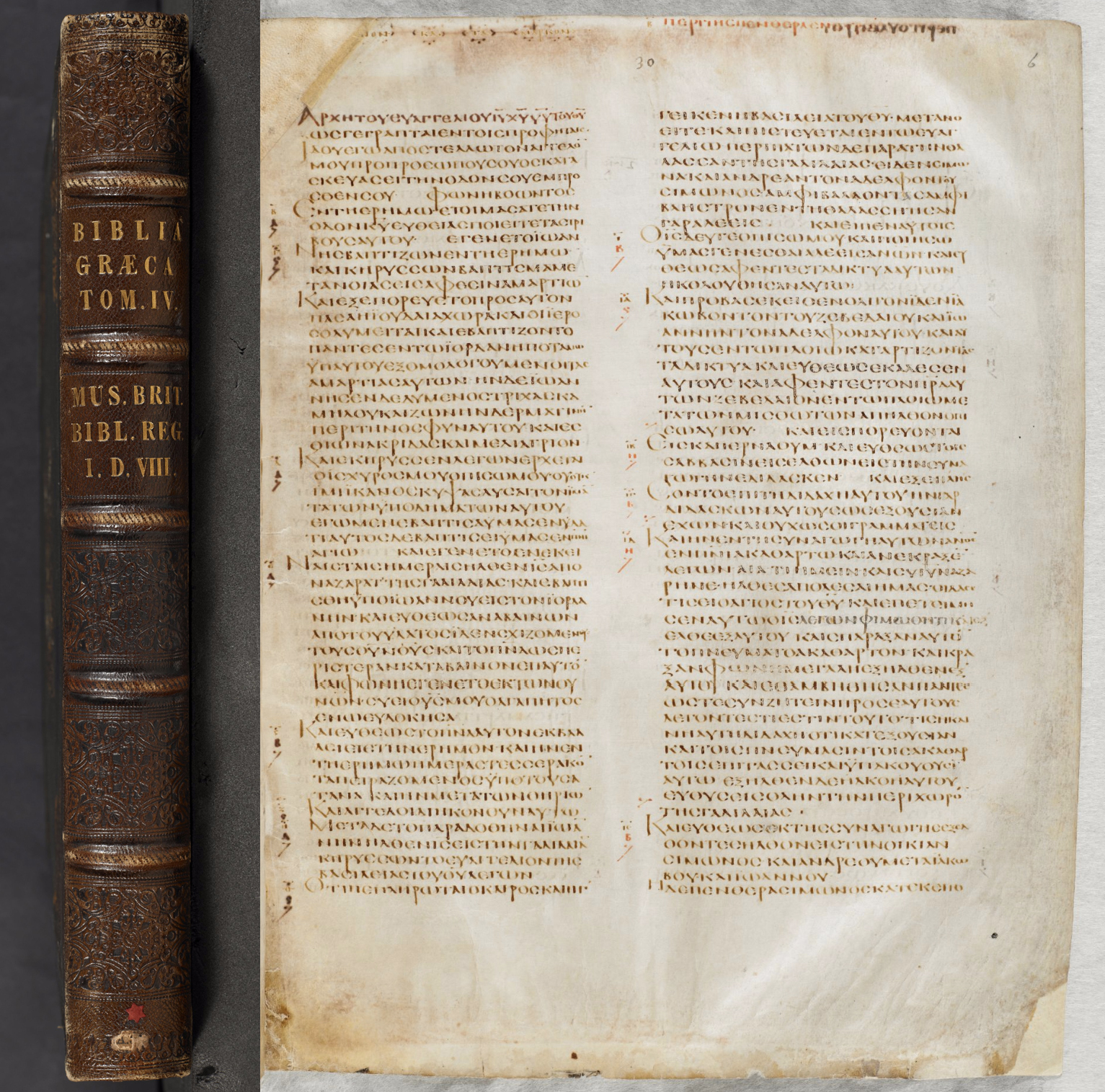
What about Codex Vaticanus? Here, we do indeed find the shorter version of the title at the end of Mark:

End title of the Gospel According to Mark in Codex Vaticanus; image source: DigiVatLib

But was this title a later addition or the work of the original producers of the codex? In this case, it’s a little harder to tell because almost all the letters in this codex have been re-inked by someone who was not as skilled as the original copyists at producing the biblical majuscule script. But again, the consensus view is that these end titles were the work of the copyists who produced the codex.

In a similar fashion to Codex Sinaiticus, Codex Vaticanus has running titles that use the shorter version of the title (ⲕⲁⲧⲁ ⲙⲁⲣⲕⲟⲛ), but these are also generally thought to have been added as a part of the production of the codex (and in fact, they constitute important evidence for the original script of the book because they have not been re-inked for the most part).

So, to summarize: The titles of the gospels in Codex Sinaiticus and Codex Vaticanus were most likely the work of the original producers of these books [codices] and attest to the use of both the longer version of the title (ⲉⲩⲁⲅⲅⲉⲗⲓⲟⲛ ⲕⲁⲧⲁ ⲙⲁⲣⲕⲟⲛ in Codex Sinaiticus) and the shorter version (ⲕⲁⲧⲁ ⲙⲁⲣⲕⲟⲛ in Codex Vaticanus) at the time when these books [codices] were produced.

  1. H.J.M. Milne and T.C. Skeat, Scribes and Correctors of the Codex Sinaiticus (London: The British Museum , 1938), 27 ↩︎
Posted in Biblical Majuscule, Codex Sinaiticus, Codex Vaticanus, Palaeography, Scripts | Tagged , , , , , , , , , , | 22 Comments

The Lying Pen of Scribes Project: An Appreciation


Over the last few years, I have had a number of occasions to mention The Lying Pen of Scribes, a project on the Dead Sea Scrolls funded by the Research Council of Norway. In fact, it may not be quite right to say “project on the Dead Sea Scrolls.” While the Scrolls have been the focus of the project, it has touched many wider issues: the trade in antiquities, fakes and forgeries, the relationship of the physical sciences to manuscript studies, and more.

The funding period of The Lying Pen of Scribes is now coming to a close, and I wanted to take a moment to reflect on the importance of the project and to appreciate its architect. As a discipline, we all owe a large debt of gratitude to Årstein Justnes of the University of Agder. Årstein will deflect any credit with a self-deprecating joke, but I’ll proceed anyway and point out that he did an enormous amount of work organizing and facilitating a large and complicated project that has produced very important results. If you looked only at the publications emerging from the project, that would be impressive in itself.

But The Lying Pen has, I think, had an impact that is broader than its publications. Over the life of the project, there has been a marked shift in the field’s thinking about issues of the materiality of manuscript artifacts, and The Lying Pen was one of the moving forces behind that shift. Even before the project officially received RCN funding in 2019, many of the team’s members were already busy uncovering the fake “Scrolls” in several collections. These discoveries rightfully received a lot of media attention, but the reach of the The Lying Pen extends beyond exposing these scandals. The provenance research that the project supported, the bridges built with the natural sciences, the conversations fostered among scholars and journalists–all of this contributed to creating an environment for thinking differently about manuscript studies. It’s a great achievement.

On a personal level, the project inspired me to think much more critically about my own work on early Christian manuscripts and issues of provenance. And finally, I’m grateful to the project for bringing me back to the Dead Sea Scrolls. I had studied the Scrolls pretty intensely in graduate school, but my research moved off in other directions over the years. The Lying Pen provided a welcome opportunity for me to revisit the Scrolls from the angle of provenance questions and the fascinating narratives surrounding some of the characters involved in the discovery of the Scrolls.

So, thank you to the Lying Pen team and to Årstein for making it all happen.

Posted in Antiquities Market, Archaeological context, Dead Sea Scrolls, Fakes and Forgeries | Tagged , , , , | 2 Comments

P52 on the Joe Rogan Experience: Fact Check

I’m not a regular consumer of “The Joe Rogan Experience,” but I was compelled to check it out when I heard that the podcaster was chatting about P.Ryl.Gr. 3.457, a.k.a. P52, the small fragment of a papyrus leaf containing a bit of chapter 18 of the Gospel According to John. The occasion was a conversation with a Christian apologist.

Joe Rogan with a facsimile of P52

The interview contained a number of standard apologetic talking points, and so it’s not surprising that the general topic of papyrology and the specific topic of P52 comes up (along with a facsimile and a reconstruction of the leaf). I’ve studied this fragment pretty carefully over the years (articles in Harvard Theological Review in 2005 and New Testament Studies in 2020), so I’m fairly familiar with the scholarship. Unfortunately, the apologist makes a number of false or misleading claims, so for anyone who might be interested, here is a brief fact check.

  • “Discovered by C.H. Roberts in the 1940s” False. The piece was among several chosen and bought for the Rylands library by Bernard Grenfell in 1920. C.H. Roberts published the piece in 1935.
  • The codex is “almost exclusively a Christian convention”: False. We have many codices that contain non-Christian material.
  • “Most likely comes from Oxyrhynchus, Egypt.” Misleading. We don’t really know where this piece came from because it was bought on the antiquities market and not scientifically excavated. It’s possible that it comes from Oxyrhynchus, but Grenfell was buying from dealers elsewhere in Egypt in addition to the area of Oxyrhynchus.
  • “There’s still debate about the dating of this” papyrus. True.
  • “But the unanimous consensus is that it’s comfortably second century, potentially beginning of the second century, which means that, this is found in Egypt; John is probably writing his gospel in Ephesus. So it has to be written by John, spread around, find its way to Egypt, copied and then end up in this manuscript, which means at minimum, you’ve already pushed the Gospel of John back into the first century, comfortably.” Very much debatable. This is the same story that was being told pretty much from the time of the publication of P52 in 1935. In older versions, the date of the papyrus was usually given as “circa 125 AD,” but here the rhetoric is a bit more slippery: “comfortably second century, potentially beginning of the second century.” But for the logic to work, that “potentially beginning of the second century” has to become “definitely beginning of the second century.” But the dating of P52 is not at all certain; it is just based on handwriting analysis, and there are good parallels for the script of P52 in papyri from the late second century and even the third century (see my 2020 New Testament Studies piece).

The fact is that we don’t know the date of this piece with confidence. So, trying to use P52 to establish a first-century date for the composition of the Gospel According to John doesn’t work. I don’t have a horse in the race when it comes to the time of the composition of John, but I would stand by the words I wrote back in 2005:

“P52 cannot be used as evidence to silence other debates about the existence (or non-existence) of the Gospel of John in the first half of the second century. Only a papyrus containing an explicit date or one found in a clear archaeological stratigraphic context could do the work scholars want P52 to do. As it stands now, the papyrological evidence should take a second place to other forms of evidence in addressing debates about the dating of the Fourth Gospel.”

The interview also has some misleading statements about P75 (a.k.a P.Bodmer 14-15, a.k.a. Hanna Papyrus 1). I’ve written a bit about the different scholarly views on this relationship and offered my own take on things (Journal of Biblical Literature 2016).

It’s good to see early Christian manuscripts being discussed in a popular setting, but it would be even better if the information was accurate.

Posted in P.Ryl. 3.457, Palaeography | Tagged , , , , , , , , | 11 Comments