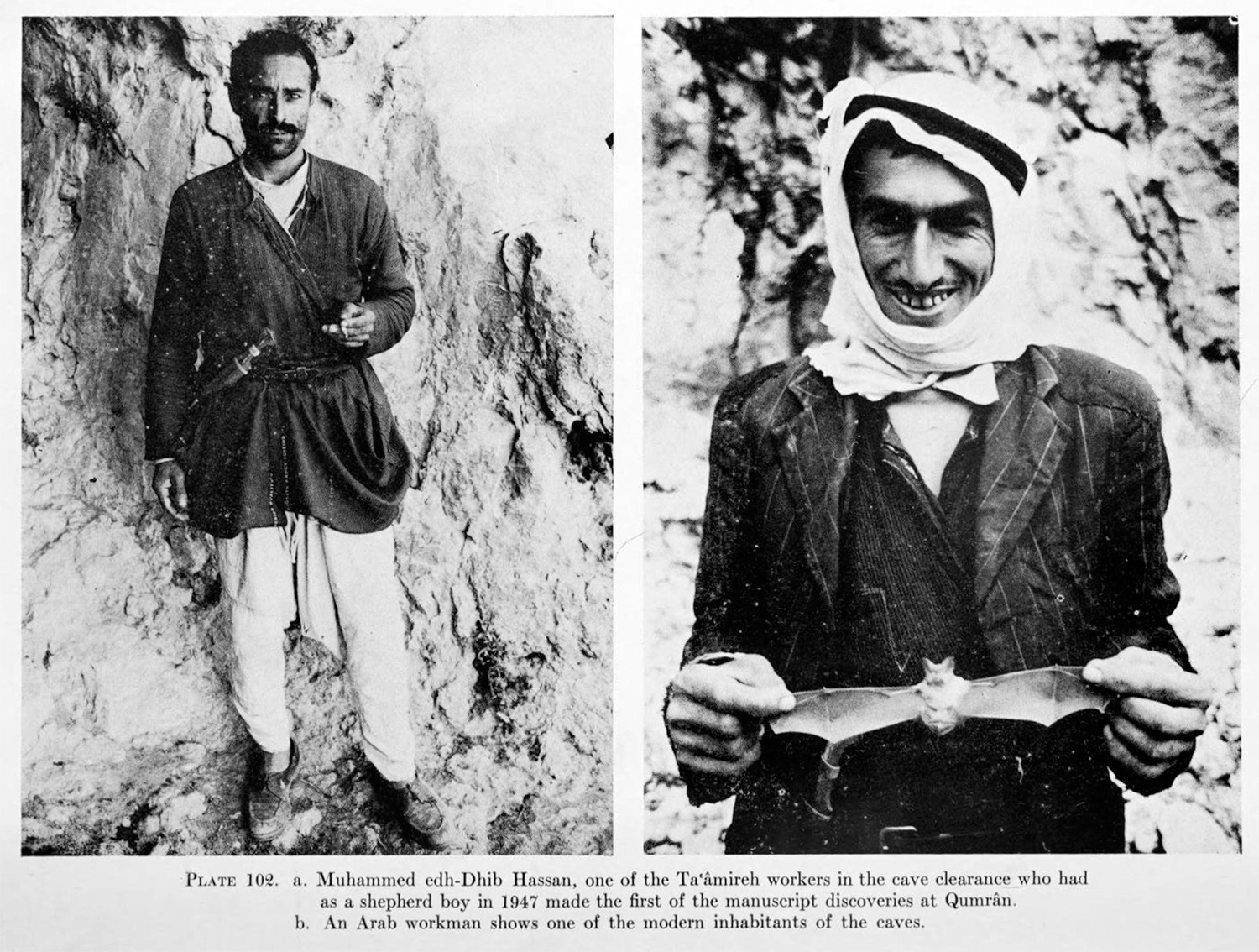
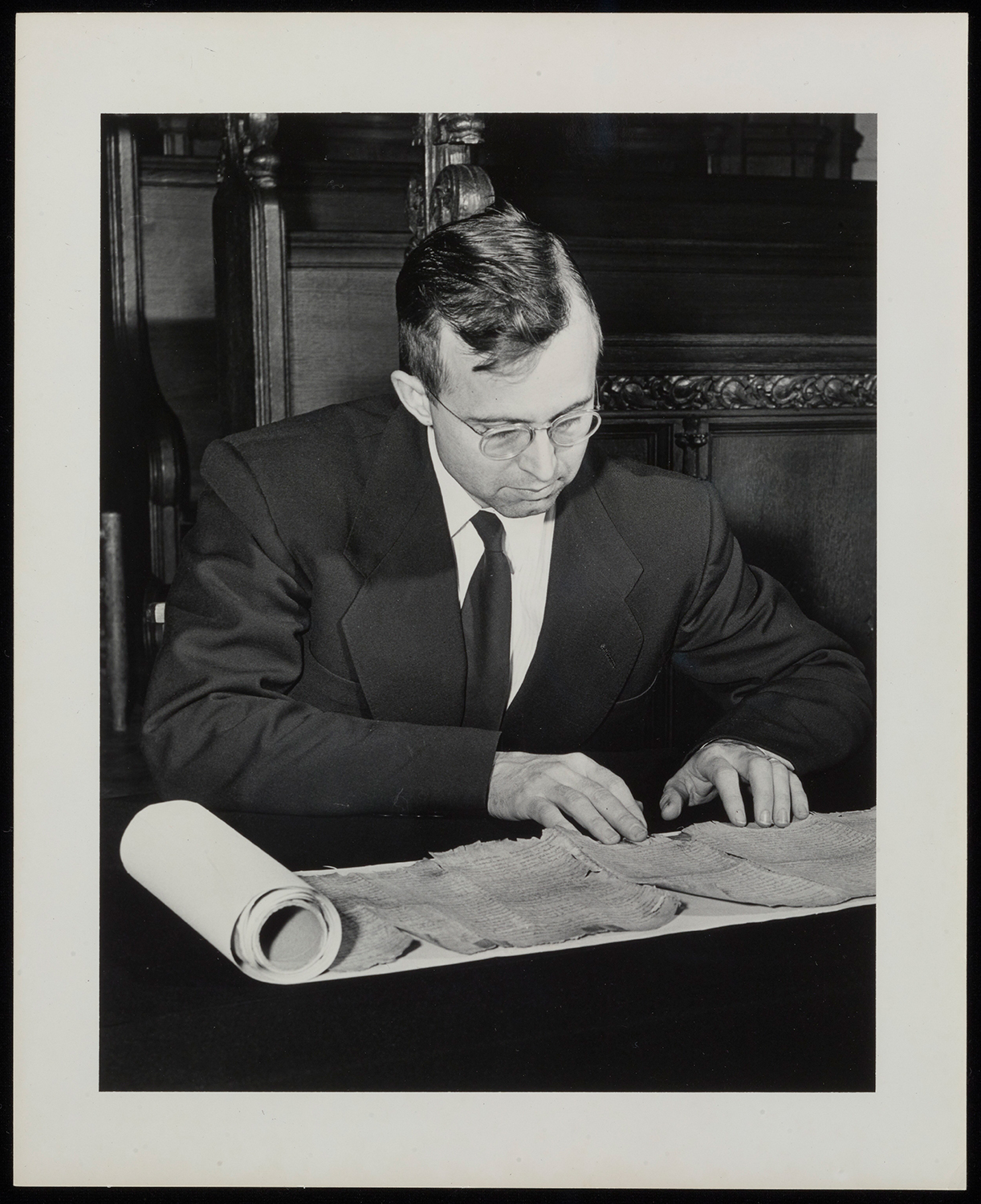
The Earliest Photo of the Man Who Discovered the First Dead Sea Scrolls?

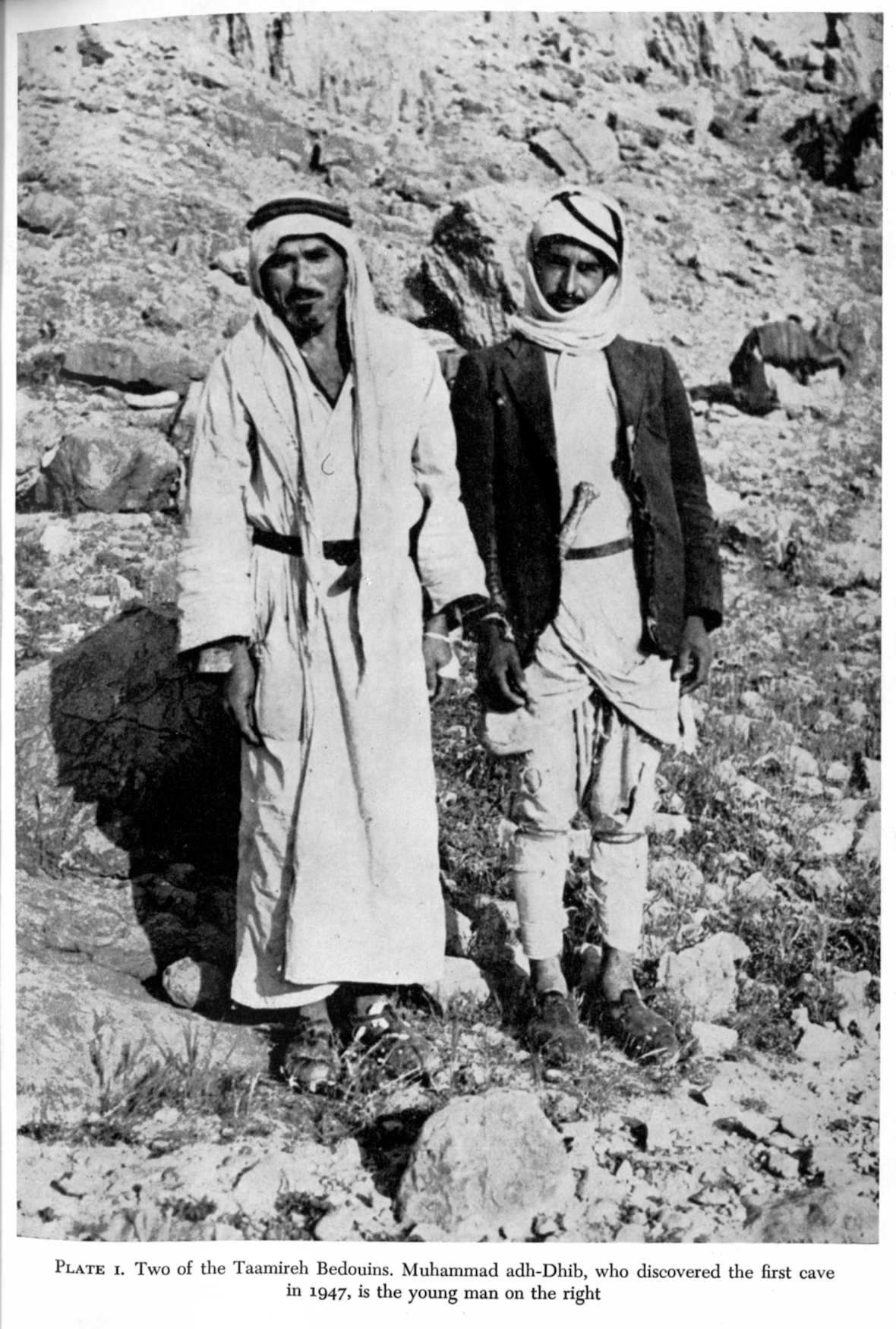
When I was looking into the history of the Dead Sea Scrolls that are said to have been found in Cave 1Q a few years ago, I became interested in the early surviving videos and photographs of the scrolls and the excavators.

I recently came across an article in a popular magazine that I had missed until now. It’s a short piece by Gerald Lankester Harding that ran in Picture Post in August 1953. As the name of the magazine implies, the article is well illustrated with a series of photographs, for which the credit is given to Ronald Startup, a freelance photographer.

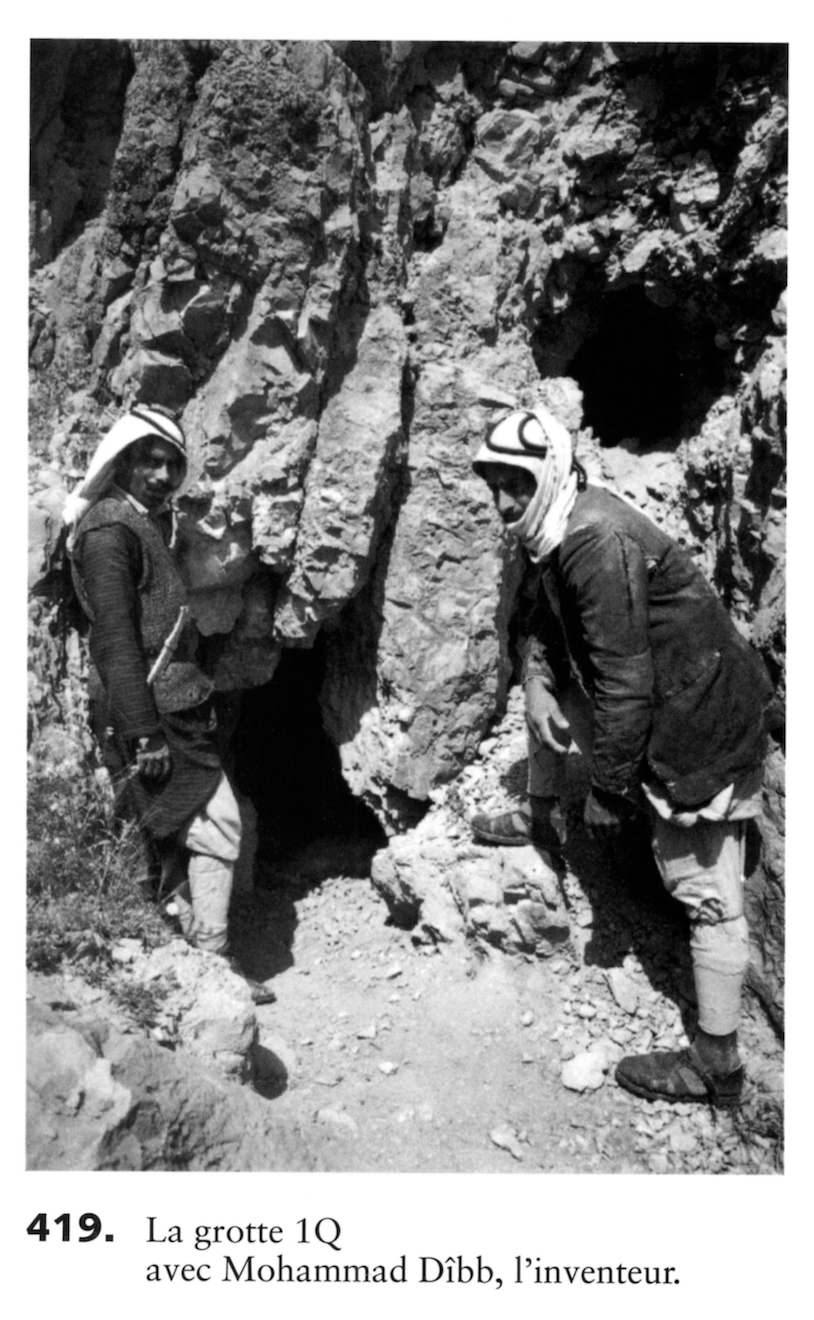
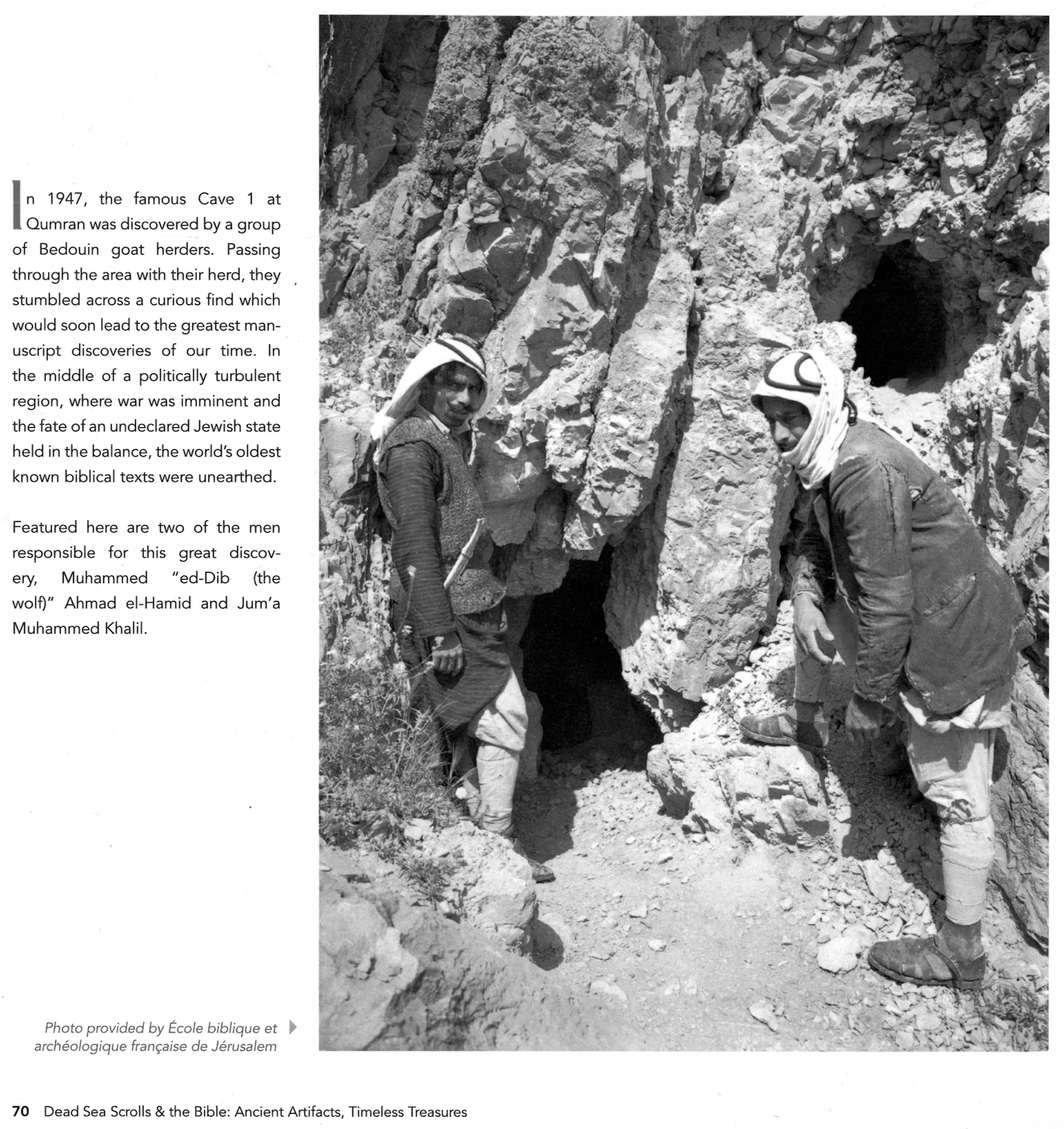
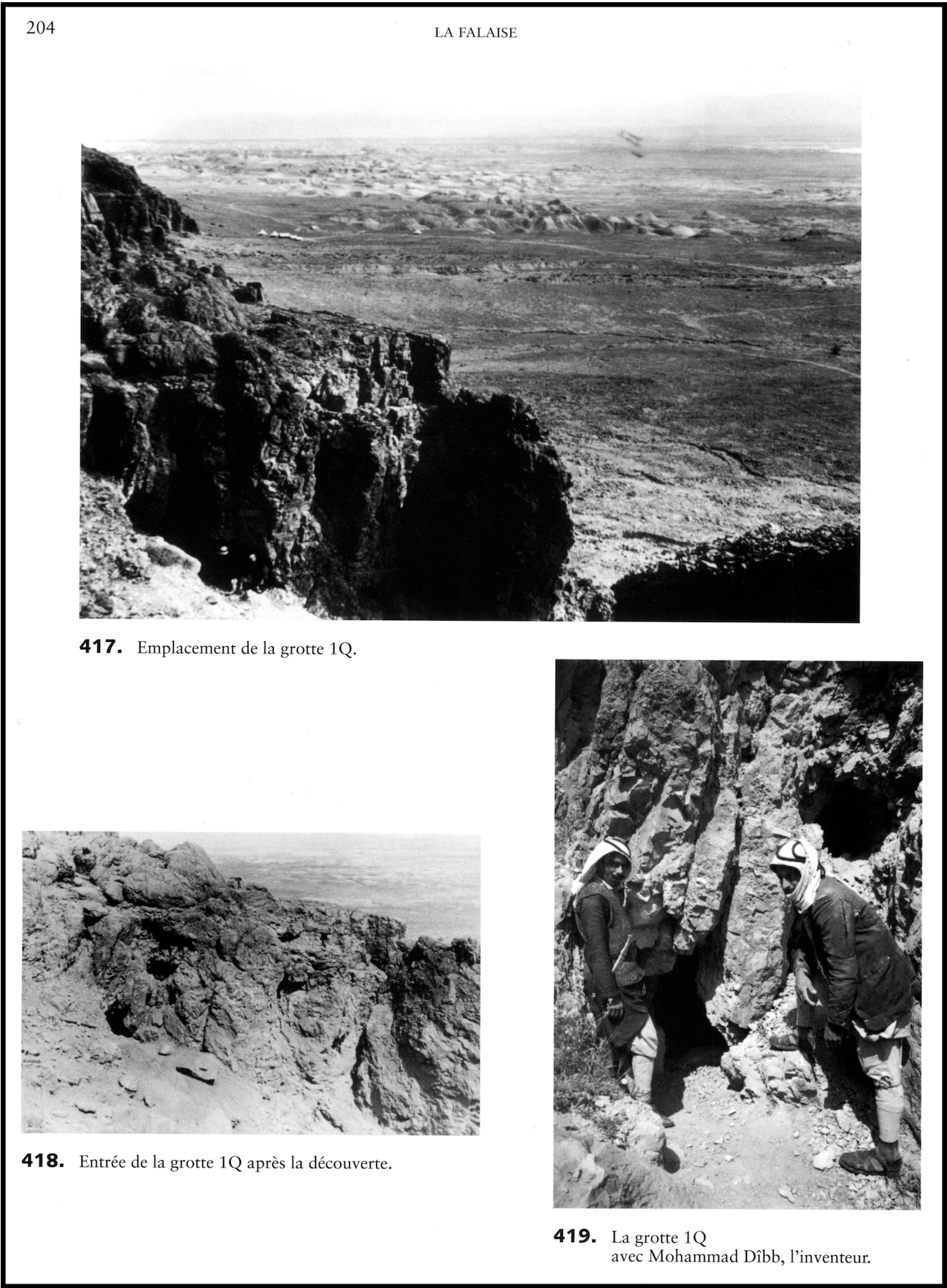
This 1953 photo shoot covers both the excavations at Qumran and the early work of sorting the fragments. I was surprised to see a photo of the “two shepherds” who are said to have been the first to find scrolls standing outside the entrance to Cave 1Q.

“The Bible’s Oldest Texts,” Picture Post, vol. 60, no. 6, 8 August 1953 (p. 32)

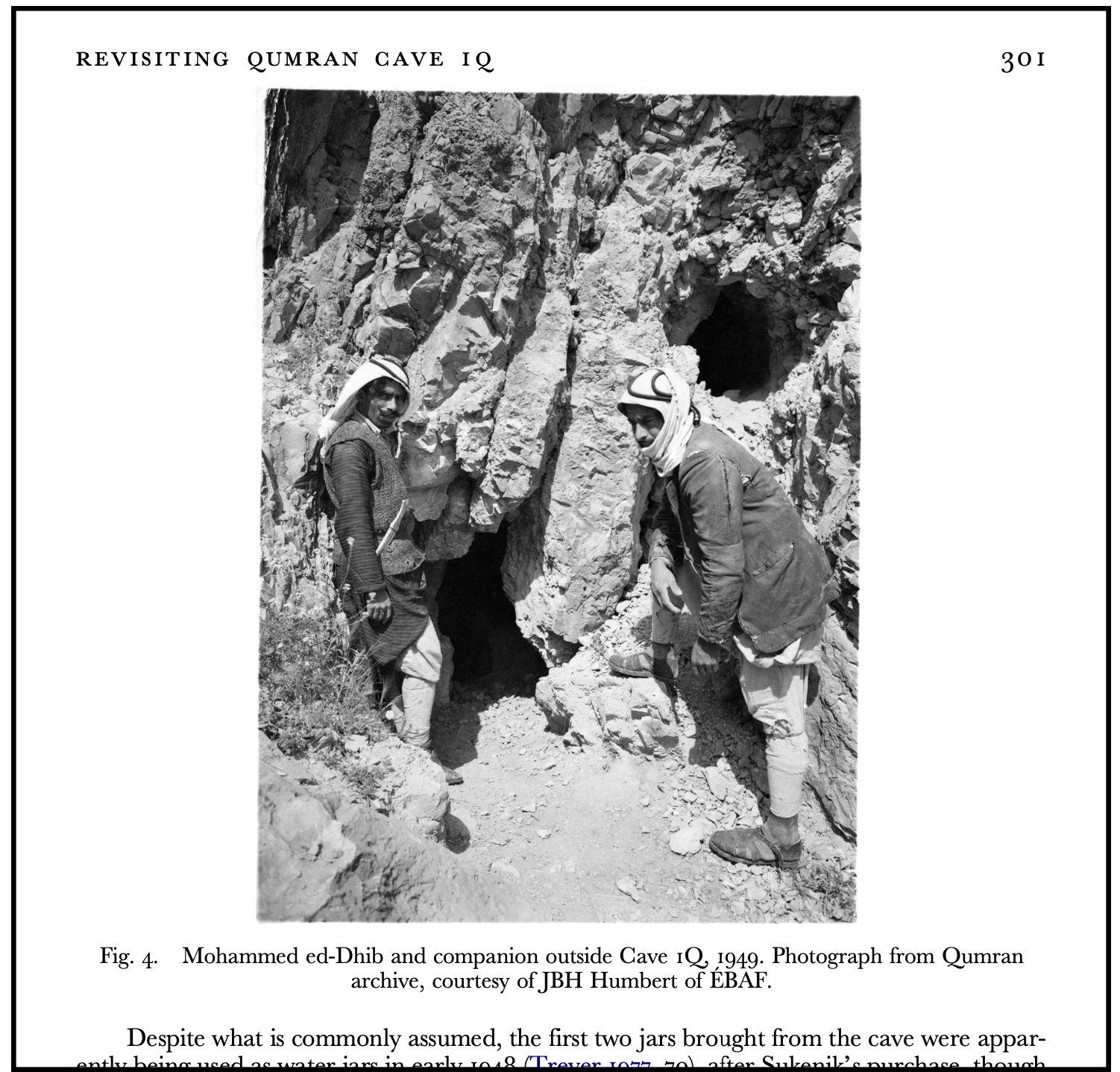
In this version of the image no identification is made beyond “these two shepherds.” When I have seen the image in other publications, one of the figures is identified as Muhammad ed-Dhib, the person usually credited with the initial discovery of the first three scrolls.1 I’m fairly sure that this 1953 publication is the earliest that I have seen this picture in print. What is odd is that when I have seen it in print elsewhere, the credit line is always the École biblique et archéologique française de Jérusalem. So, it seems that Ronald Startup, who took the rest of the photographs for this article, did not take this picture. This made me wonder who took it and when.

In the excellent 2017 article on Cave 1Q by Taylor, Mizzi, and Fidanzio, this picture appears as Figure 4, and it is given a date of 1949 in the caption.

Joan E. Taylor, Dennis Mizzi and Marcello Fidanzio, “Revisiting Qumran Cave 1Q and its Archaeological Assemblage, PEQ 149 (2017) 295-325, at 301.

But I don’t think this date of 1949 can be right. Cave 1Q was identified by archaeologists in late January 1949 and excavated between 15 February and 5 March 1949. As far as I know, that excavation was carried out by the Jordanian Department of Antiquities along with the École biblique and the Palestine Archaeological Museum (with the Arab Legion providing protection at the site). I don’t think there is any published reference to Bedouin teams in general or Muhammad ed-Dhib in particular being present at this cave at this time. Another story by Harding ran in the Illustrated London News on 1 October 1949. It makes no mention of identifying, much less photographing, the alleged discoverers of the first scrolls. I don’t think the identity of the alleged finders of the first scrolls were yet known to the scholars and archaeologists in 1949 (their identities were known by early 1953, when Harding mentioned “Mohammed edh Dhib and Ahmed Mohammed” by name in DJD I). [[Addendum 20 July 2024: I see that Harding did note in a 1949 article that the identity of the alleged finder of the scrolls had only just been discovered.2]]

In any event, the source given for the photo, the École biblique et archéologique française, provides both the true date of the photo and a possible explanation for the date of 1949 given in the article. The first volume of the École biblique’s Qumran excavation report is a catalog of photographs related to the excavations. This picture appears in a series of photos of Cave 1Q as Figure 419:

J.-B. Humbert and A. Chambon, Fouilles de Khirbet Qumrân et de Aïn Feshkha I (Vandenhoeck & Ruprecht, 1994), 204

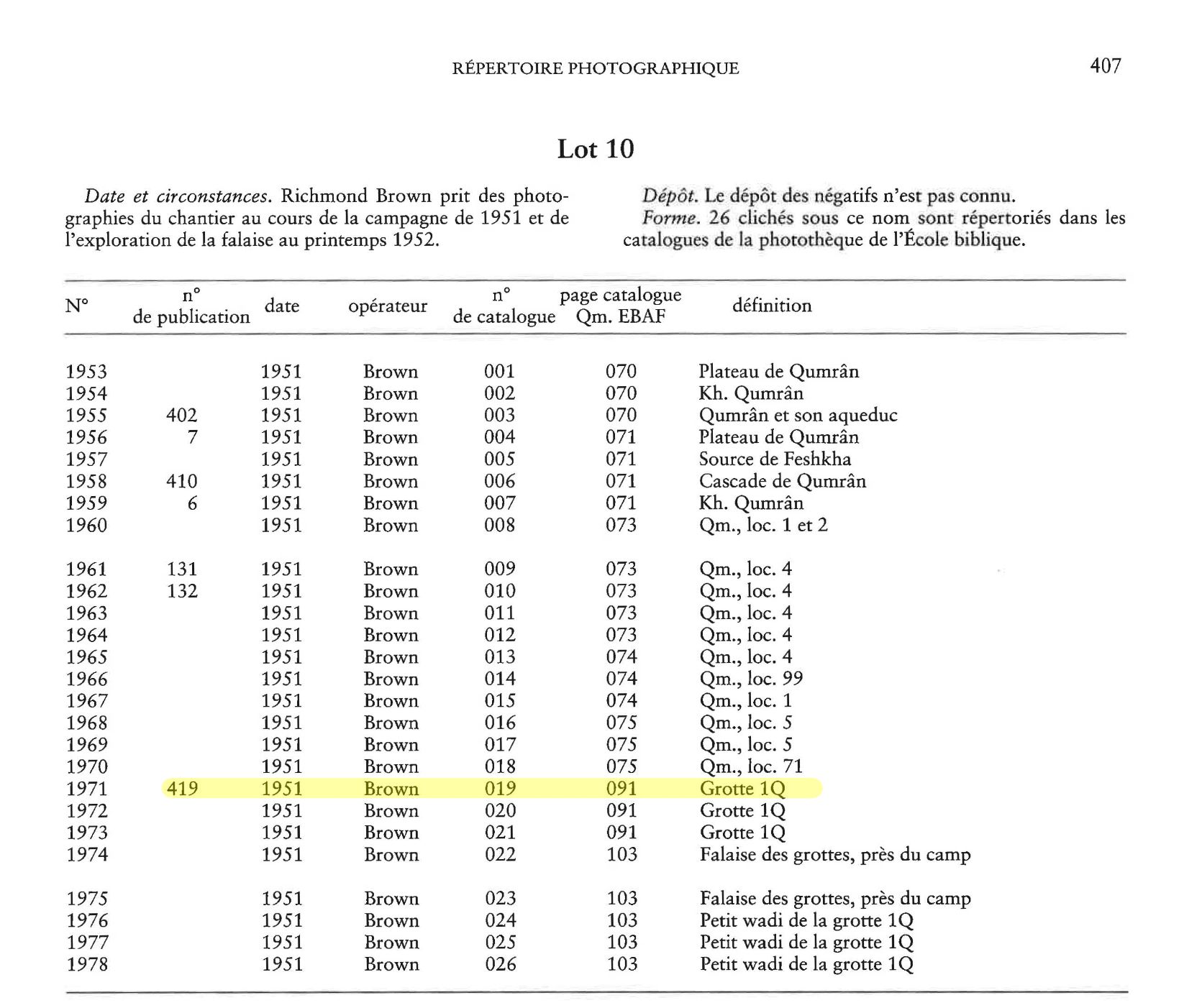
The immediately preceding photo, Figure 418, was indeed part of a series of photos that Roland de Vaux took at Cave 1Q in 1949. But Figure 419 does not belong to that series. It was part of a different set of photos taken by Richmond Brown in 1951, as indicated in the photo log (p. 407 in the excavation volume):

I assume this is the same person as “Mr. R. Richmond Brown” who took some of the infrared photos of the Cave 1Q scrolls. So that seems to answer the question of who took the photo and when.

But what was the occasion in 1951 that brought these Bedouin to Cave 1Q? During the excavations of Khirbet Qumran that began in November 1951 (and the expeditions to the caves in the area that commenced in 1952), the Bedouin played an important role. Scholars often portray the discovery of the scrolls as “archaeologists in a race against the Bedouin,” and while there is some truth in this characterization, it is also the case that de Vaux’s projects employed many Bedouin workers, including the man identified as Muhammad ed-Dhib.3 When discussing William Brownlee’s proposal about a different identification of the location of the discovery of the first scrolls, John Trever mentioned that de Vaux and Muhammad ed-Dhib had at some point been together at Cave 1Q:

“I discussed the matter with Father R. de Vaux at the École Biblique in Jerusalem, and he told of sitting with adh-Dhib on a large rock within a few feet of the entrance to Cave I and listening to his account of the discovery.”4

I wonder if this photo from 1951 is a snapshot from that meeting, and I wonder if the 1953 Picture Post publication of this photo really is the first published image of Muhammad ed-Dhib.

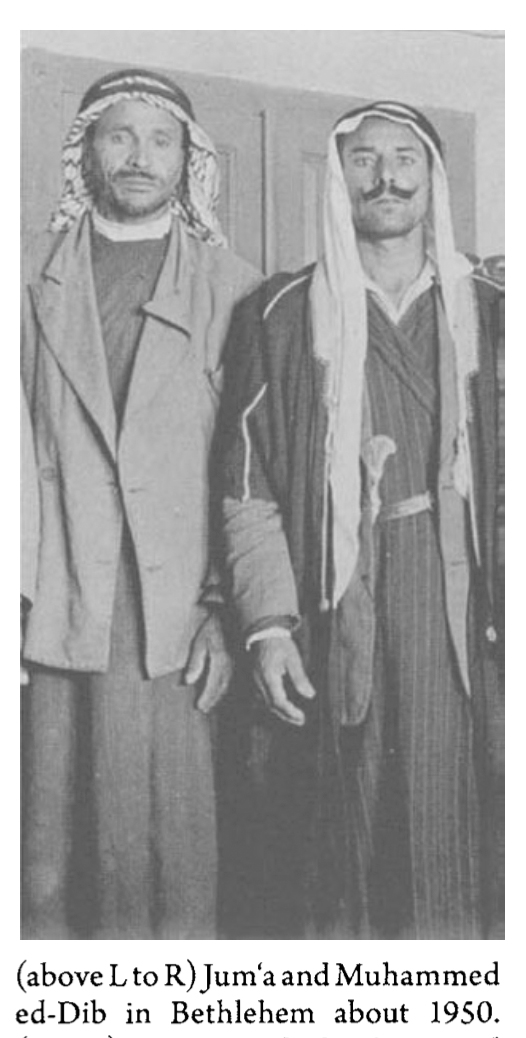
Looking more closely at this photo also raises some questions for me about other photos of the alleged discoverer of the first scrolls. But that will wait for another post.

  1. Trever identifies the full name of this person as “Muhammed Ahmed el-Hamed, whose nickname is ‘Edh-Dhib’ ” (Trever, The Untold Story, 103). Frank Cross called him “Muḥammed edh-Dhîb Ḥassan” (Frank M. Cross, “The Discovery of the Samaria Papyri,” BA 26 [1963] 109–21, at 114 n. 4) ↩︎
  2. Harding wrote, “Up to the time of writing the original finder, who must be a goatherd, has not been located,” but in a footnote added before the article went to press, Harding reported the following: “Since writing this, Mr. Saad, Secretary of the Palestine Museum, has had an interview with the goatherd.” See Gerald Lankester Harding, “The Dead Sea Scrolls,” Palestine Exploration Quarterly 81 (1949) 112-116, at 112. ↩︎
  3. Roland de Vaux, “Les manuscrits de Qumrân et l’archéologie,” RB 66 (1959) 87-110, at 89. ↩︎
  4. John C. Trever, “When was Qumrân Cave I Discovered?” Revue de Qumrân 3 (1961) 135-141, at 140. ↩︎
Posted in Dead Sea Scrolls | Tagged , , , , , | 3 Comments

A Correction and a Codicological Mystery in P.Bodmer 13

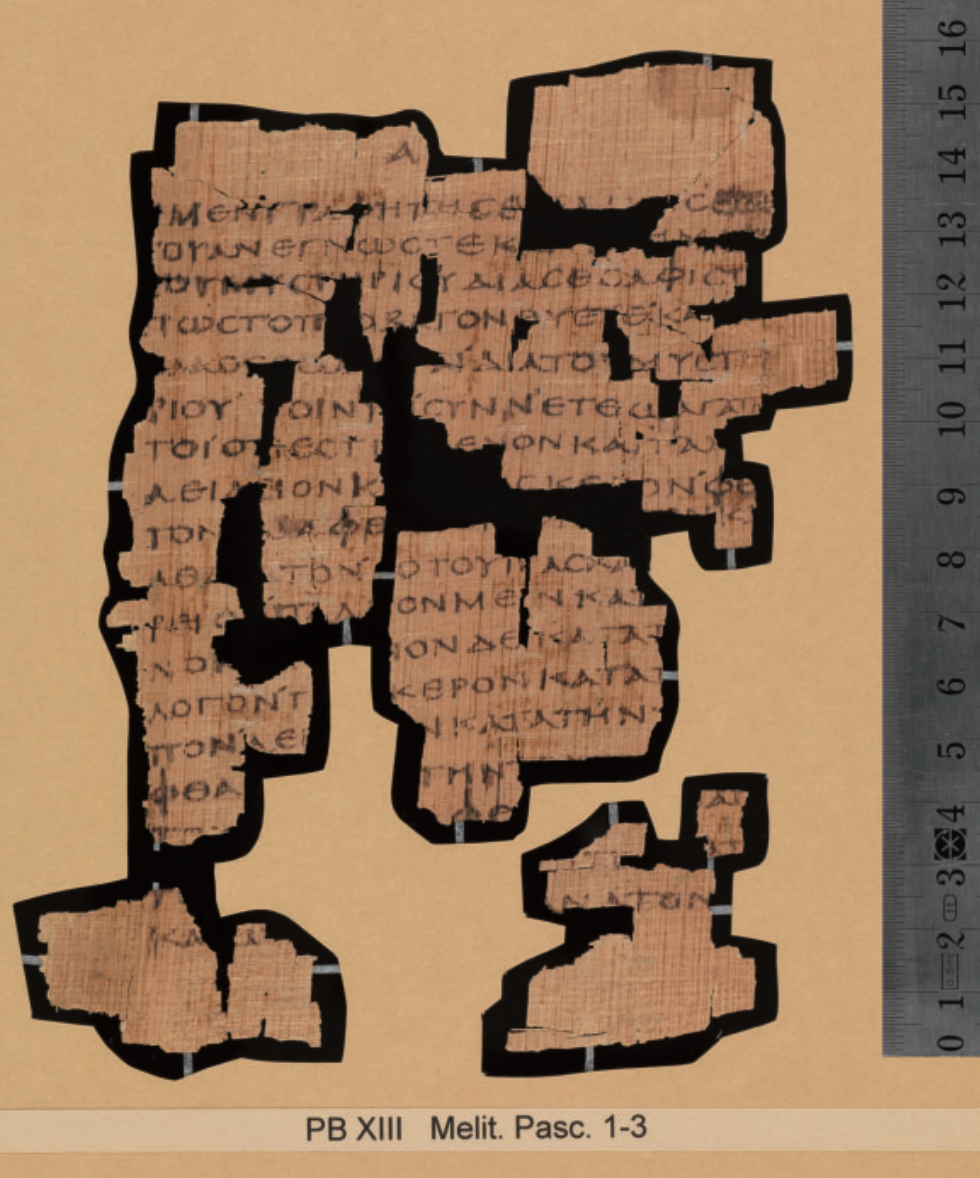
I only recently learned of the death, about a year ago now, of Stuart G. Hall (1928-2023). It sent me back to an article that we wrote together. In 2015, I stumbled across grainy black and white photographs of what up until then had been a “lost” leaf of a papyrus codex containing the beginning of the Peri pascha of Melito of Sardis. The leaf was part of the “Bodmer Composite Codex,” and I was (and am) very interested in the construction of this book. I thought it best to publish the piece, but not being an expert in Melito, I contacted Stuart, who was 87 at the time. He jumped at the chance to revisit his earlier work on Melito, and the two of us published an article on the piece.1

The best available images of the codex can be found on the Bodmer Lab website. For the sake of clarity in the following discussion, I post images of the front and back of the “lost” leaf below.

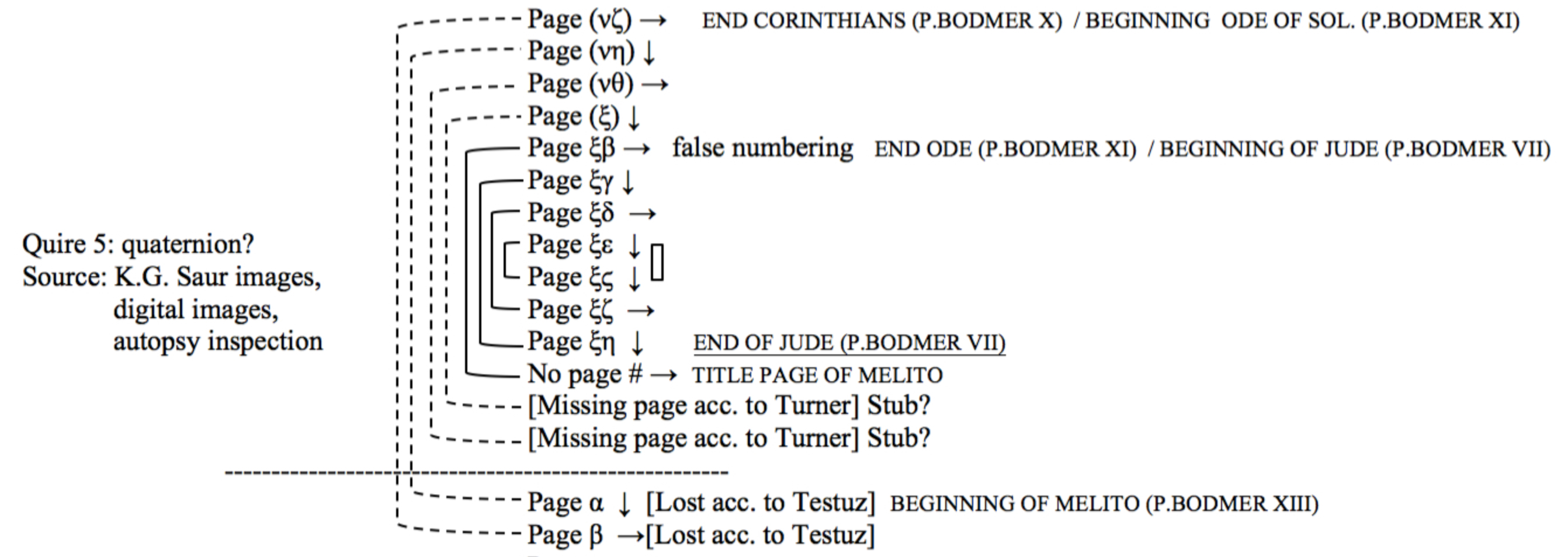
I was responsible for the codicological section of that article, and in revisiting it, I see that I made a substantial mistake. I take the opportunity now to correct it. Below is a diagram of the quire in question and my summary of the problem in the article:


Page ⲅ (3) of Melito begins a new quire, a complete quaternion, which is followed by another complete quaternion. Thus, the first leaf of the text of Melito (pages ⲁ and ⲃ) cannot belong in a quire with the leaves that follow it. By tracing continuity of papyrus fibres across leaves, it can be shown that leaf ⲝⲇ/ⲝⲉ and leaf ⲝϛ/ⲝⲍ form a bifolium. Since the ‘inside’ of this bifolium contains consecutive pages (ⲝⲉ and ⲝϛ), it can be presumed to be the centre of a quire. Continuous fibres also show that leaf ⲝⲃ/ⲝⲅ and the leaf consisting of page ⲝⲏ and the unnumbered title page of Melito also form a bifolium. Thus, we are almost certainly dealing with a quaternion. The question is: how does the first leaf of the text of Melito fit in? Because of damage to its edges, it is not clear whether it forms a bifolium with the first or second leaf of the quire. Also adding to the difficulty is the fact that we have a total of only seven leaves (14 pages). Thus, as Turner noted in 1977, if this quire is a normal quaternion, an additional leaf (two pages) must be missing. Turner speculated that the ‘two pages could have been left empty or held a short Psalm’. 2Yet, given that the structure of the two central sheets of the quire is clear, there are only two possible positions for the missing leaf. It would need to have been located either between the title page of Melito and the first page of the text or between the first and second leaves of the text of Melito (i.e. between pages ⲃ and ⲅ of Melito). Neither option is appealing.


Given that state of affairs, I proposed that perhaps instead of an additional leaf, we may have had just a stub in one of those two positions, as illustrated in this graphic:

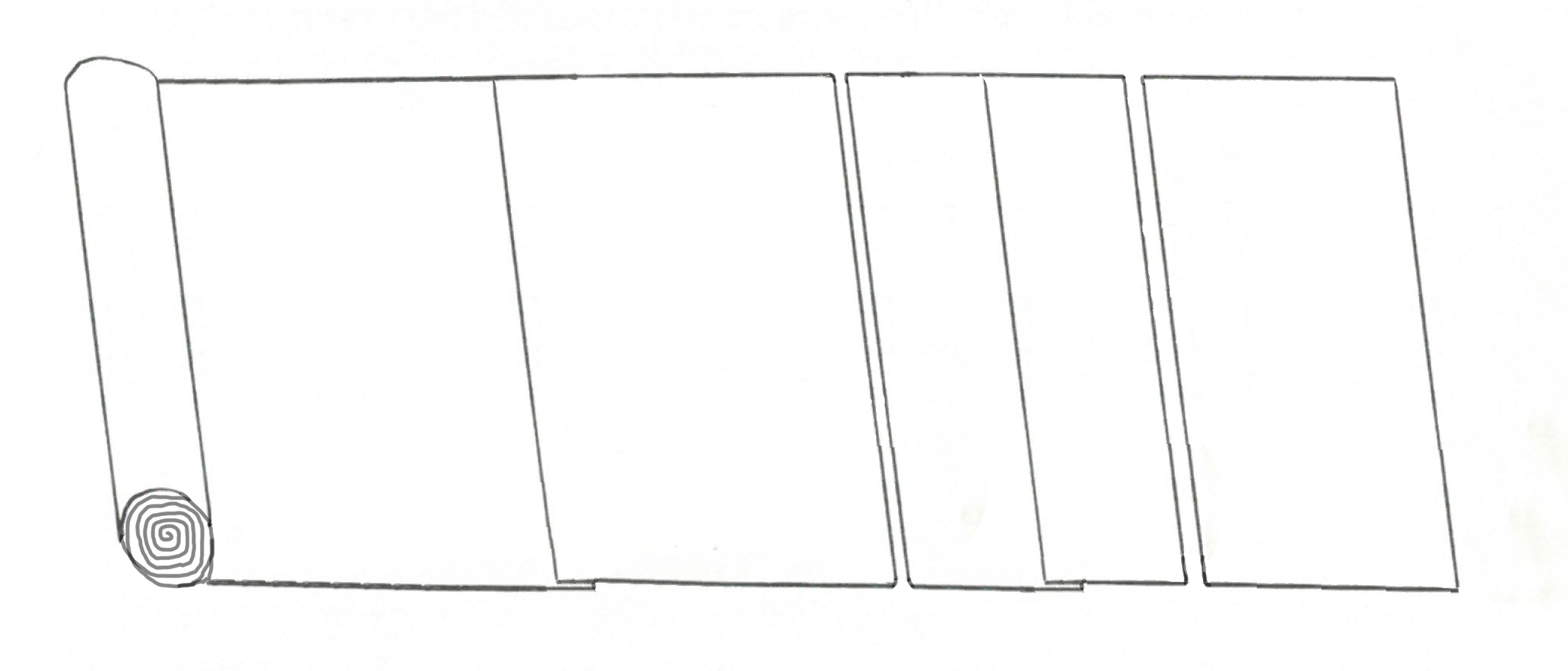
The problem is this: When I subsequently gained access to better images of most of the rest of this codex, I recognized that the bifolia of this codex were cut from the roll not according to how wide the bifolia should be but rather according to how tall they should be, as illustrated below:

Model of papyrus roll being cut into bifolia for a square-format codex by intended height of the bifolium

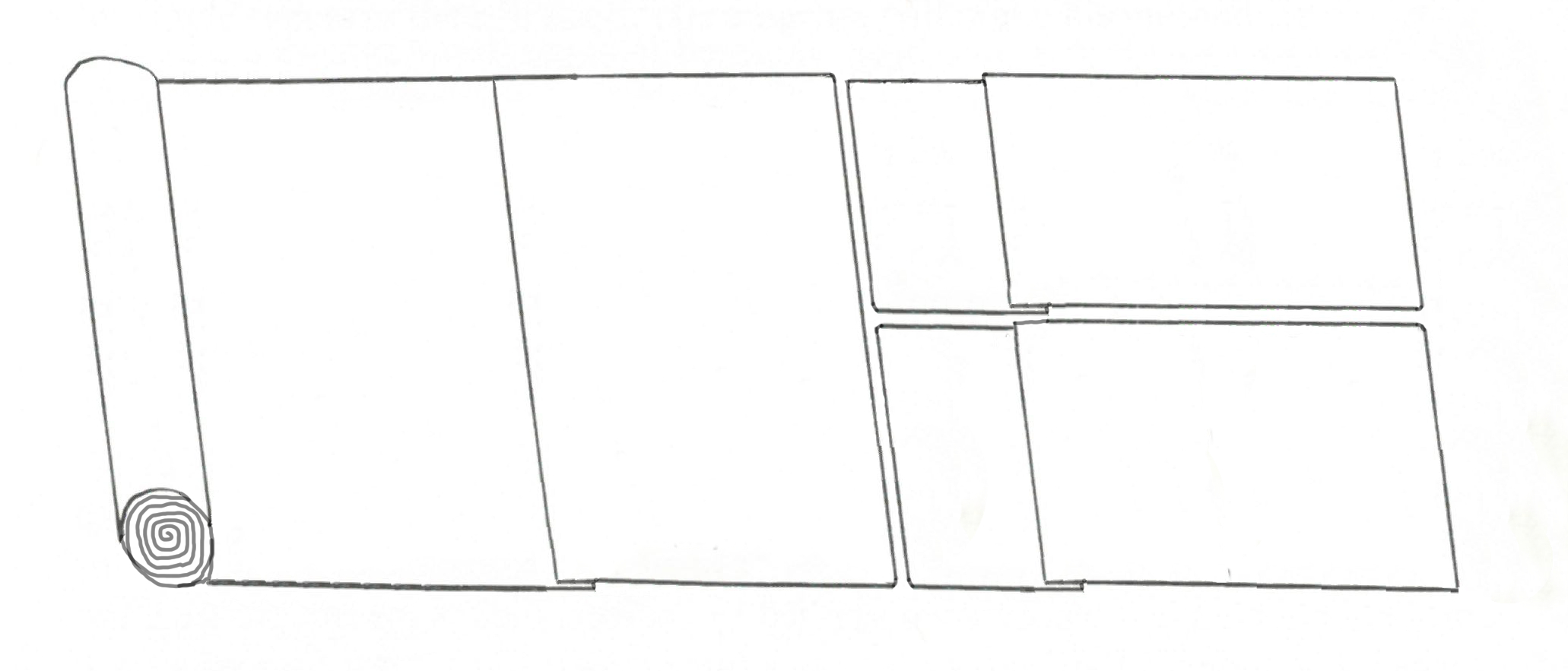
The give-away is the presence of horizontal rather than vertical kolleseis (sheet joins) that run across the full length of the bifolium. All the bifolia for this codex seem to have been cut in this way. Bifolia cut in this way will all have an equal length (the height of the roll). There will be no stubs. As a result, my suggestion that perhaps quire 5 contained a stub rather than a full sheet is simply not possible. To have stubs in a square-format codex of about the height of the Composite Codex (about 15.5 cm), you would need to be cutting the bifolia to the desired width rather than height. You probably need to have either a roll that was not very tall or a more standard roll that was cut both vertically and horizontally as illustrated below:

Model of papyrus roll being cut into bifolia for a square-format codex by intended width of the bifolium

In such a case, we would see vertical kolleseis, but I have not spotted any of these in the Composite Codex.3 This means that we are again faced with the problem of explaining the quire construction. It seems that a folium intervened either between the title page of Melito and the first page of the text or between pages 2 and 3. Neither of these locations really makes sense in terms of the contents of the codex.

So what is the solution? I’m not sure. There seems to be some imprinting of the text of page ⲁ of Melito on the title page, so those two folia were probably pressed against each other at some stage, but a blank folium between pages 2 and 3 of Melito seems very odd. As I said, it’s a bit of a mystery. Suggestions welcome.

  1. For Hall’s earlier work, see Stuart George Hall, Melito of Sardis: On Pascha and Fragments (Oxford: Clarendon Press, 1979), reprinted with corrections 2013. For the changes to the 1979 edition, see Stuart George Hall, “Melito Peri Pascha: Corrections and Revisions,” Journal of Theological Studies 64 (2013) 105-10. For the edition of the extra Bodmer leaf, see Brent Nongbri and Stuart G. Hall, “Melito’s Peri pascha 1-5 as Recovered from a ‘Lost’ Leaf of Papyrus Bodmer XIII,” Journal of Theological Studies 68 (2017), 576-592. The edition of the text of the papyrus in that article was much improved by the suggestions of Ben Henry. ↩︎
  2. Eric G. Turner, The Typology of the Early Codex (University of Pennsylvania Press, 1977), 80. ↩︎
  3. I thought I had identified vertical kolleseis on several folia, like this one, but I am now convinced these are simply creases (the bottom of the folium in the link above seems to make this clear). ↩︎
Posted in Bodmer composite codex, Bodmer Papyri, Book binding, Codices, Codicology | Tagged , , , | Leave a comment

Stichometry 5: Problems with Metzger’s Stichometric Data

This will be my fifth and final post in this series on stichometry. For the earlier posts, see Part 1, Part 2, Part 3, and Part 4.

One of the things that initially confused me about the stichometric data for the New Testament was the set of evidence for the Pauline letters presented in Bruce Metzger’s classic, The Canon of the New Testament: Its Origin, Development, and Significance (corrected ed., Clarendon, 1989). At page 298, Metzger wrote:

“Scribes of Biblical manuscripts would sometimes indicate the length of each Epistle in terms of number of lines, called stichoi. The statistics are as follows:

To Churches
Romans 979 stichoi
1 Corinthians 908 stichoi
2 Corinthians 607 stichoi
Galatians 311 stichoi
Ephesians 331 stichoi
Philippians 221 stichoi
Colossians 215 stichoi
1 Thessalonians 207 stichoi
2 Thessalonians 111 stichoi

Hebrews 243 stichoi

To Individuals
1 Timothy 238 stichoi
2 Timothy 182 stichoi
Titus 100 stichoi
Philemon 44 stichoi”

Metzger cites no source for this data. And if I have understood the evidence of the surviving ancient manuscripts and lists properly, every single one of the numbers reported by Metzger here is incorrect. This strikes me as strange and wholly out of character for Metzger. After making some calculations, I think I see what may have gone wrong. What Metzger reports in this list are not the numbers that “scribes of biblical manuscripts” indicate. Instead, what he seems to be listing are modern estimates based (directly or indirectly) on the work of Charles Graux (1852-1882). In a classic article published in 1878, Graux calculated the number of letters in the editions of several ancient texts, including the Septuagint and the New Testament.1 Metzger (or a predecessor) seems to have divided Graux’s total counts by 36 (the usual number used when a stichos is reckoned as letters rather than syllables) and then rounded either up or down to arrive at these totals. Here are Metzger’s numbers with the calculations from Graux:

Romans 979 stichoi: 35266 letters, divided by 36 ≈ 979.61
1 Corinthians 908 stichoi: 32685 letters, divided by 36 ≈  907.92
2 Corinthians 607 stichoi: 21851 letters, divided by 36 ≈ 606.97
Galatians 311 stichoi: 11202 letters, divided by 36 ≈ 311.17
Ephesians 331 stichoi: 11932 letters, divided by 36 ≈ 331.44
Philippians 221 stichoi: 7975 letters, divided by 36 ≈ 221.52
Colossians 215 stichoi: 7745 letters, divided by 36 ≈ 215.13
1 Thessalonians 207 stichoi: 7468 letters, divided by 36 ≈ 207.44
2 Thessalonians 111 stichoi: 4011 letters, divided by 36 ≈ 111.42
Hebrews 243 stichoi: 26738 letters, divided by 36 ≈ 742.72
1 Timothy 238 stichoi: 8575 letters, divided by 36 ≈ 238.19
2 Timothy 182 stichoi: 6554 letters, divided by 36 ≈ 182.05
Titus 100 stichoi: 3595 letters, divided by 36 ≈ 99.86
Philemon 44 stichoi: 1567 letters, divided by 36 ≈ 43.53

Metzger’s otherwise strange numbers line up remarkably well with Grauxs calculations, but there are a couple problems with this theory of Metzger’s source. First, Metzger doesn’t cite Graux. Second, to get Metzger’s numbers, it is twice necessary to round down when one would expect to round up (Romans and Philippians). Third, Metzger’s number for Hebrews (243) is impossibly low compared to the calculation from Graux (743).

The third problem is easily handled. Metzger has misprinted 243 for 743. The other two problems are trickier. I’m not sure why the numbers for Romans and Philippians are one digit off, and I don’t know why Metzger doesn’t cite Graux (or some intermediate source) for these numbers.

In any event, the “correct” traditional stichometric totals for the Pauline epistles are those reported by J. Rendel Harris (and reproduced below), although, as we saw in the case of Galatians, the stichometric tallies reported in actual surviving manuscripts can vary substantially.2

Romans 920
1 Corinthians 870
2 Corinthians 590
Galatians 293
Ephesians 312
Philippians 208
Colossians 208
1 Thessalonians 193
2 Thessalonians 106
Hebrews 703
1 Timothy 230
2 Timothy 172
Titus 97
Philemon 38

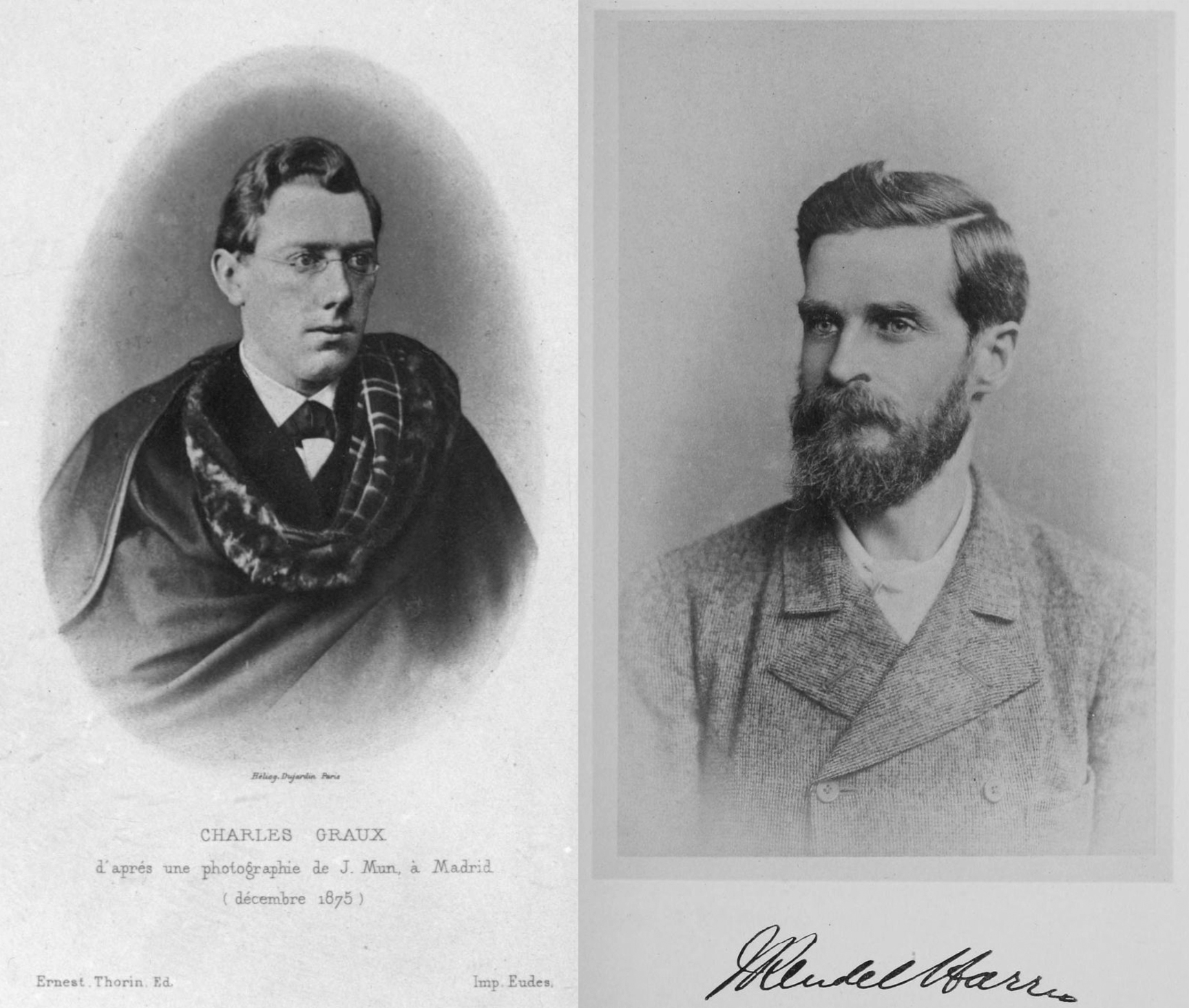
It is fitting to close the series on stichometry with portraits of Graux and Harris, who, as relatively young scholars, opened up the field of stichometry of early Christian manuscripts.3

Charles Graux in 1875 and J. Rendel Harris ca. 1885; image sources: Mélanges Graux: Recueil de travaux d’érudition classique dédié à la mémoire de Charles Graux (Paris: Thorin, 1884), frontispiece, and A History of Haverford College for the First Sixty Years of its Existence (Porter & Coates, 1892), plate facing p. 524.
  1. Charles Graux, “Nouvelles recherches sur la stichométrie,” Revue de Philologie de Littérature et d’Histoire Anciennes 2 (1878) 97-143. ↩︎
  2. J. Rendel Harris, Stichometry (London: C.J. Clay and Sons, 1893), 39. ↩︎
  3. Also foundational (though less focused on early Christian material) is Kurt Ohly, Stichometrische Untersuchungen (Leipzig: Harrassowitz, 1928). ↩︎
Posted in bruce-metzger, J. Rendel Harris, Stichometry | Tagged , , , | 1 Comment

Stichometry 4: Counts for Galatians in Latin Manuscripts

In my earlier post on the stichometry of Greek manuscripts of Galatians, I was surprised to see that the “traditional” Greek stichometric count for Galatians (293 16-syllable stichoi) matched almost perfectly with the count for the text of the Nestle-Aland (when the latter was adjusted to account for nomina sacra). Earlier Greek manuscripts of Galatians, however, had different counts: Codex Sinaiticus with 312 and P46 with 375 (and the important minuscule 1739 had a count of 392). So, what about the Latin tradition?

I had expected that the Latin counts would be a bit lower just on the basis of Latin lacking definite articles. And a rough count of the Stuttgart Vulgate (3rd edition) for Galatians yielded 4804 syllables (that is, 300 versus of 16 syllables and a last line of 4 syllables), which is indeed a little lower than my rough count of Nestle-Aland 28 (303 stichoi + 11 extra syllables). But again, the subtraction of syllables to account for nomina sacra led to some surprising results (surprising to me, at least). Earlier Latin biblical manuscripts tend to contract a smaller set of words as nomina sacra than do their Greek counterparts, so I only subtracted syllables for this smaller set (forms of Deus, Christus, Iesous, and Dominus). That took away 108 syllables. So, we subtract 108 syllables from the the Vulgate Galatians 4804 syllables: 4804-108=4696. Divide 4696 by 16, and we get: 293.5. This is really quite close to the traditional Byzantine (Greek) count of 293. That seems like a very odd coincidence.

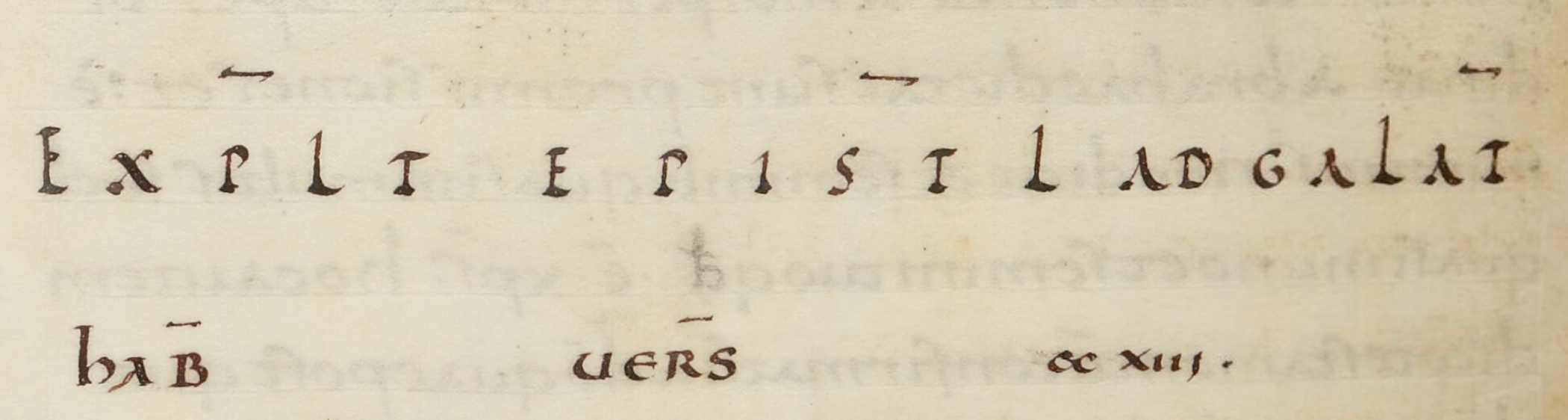
But what do the Latin manuscripts themselves say? Some Latin manuscripts do indeed give this number. Here is St. Gallen, Stiftisbibliothek Cod. Sang. 70, an 8th century codex of Paul’s letters:

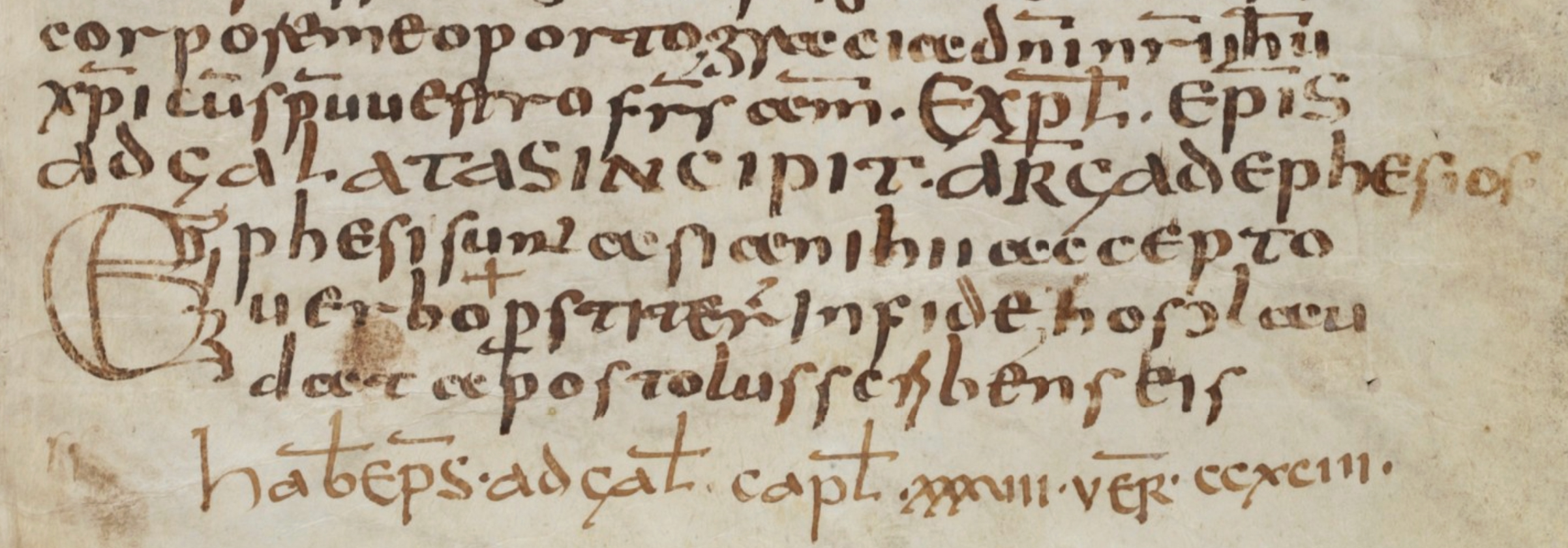
St. Gallen, Stiftisbibliothek Cod. Sang. 70 (p. 137), end title of Galatians, argumentum of Ephesians and stichometric count of Galatians; image source: e-codices

Here the stichometric count is added in lighter ink at the bottom of the page after the Argumentum of Ephesians has already commenced: ver(sus) CCXCIII, 293. Other Latin manuscripts give a considerably lower number, such as the 9th century Bible, BnF Latin 1:

Paris, Bibliothèque nationale de France, Latin 1 (fol. 400v), end title of Galatians and stichometric count; image source: Gallica

After the end title: hab(et) vers(us) CCXIII, 213 versus.1 How could the number be so low? I suppose it’s possible that the 293 syllables could be reduced by a count that took into consideration additional nomina sacra contractions and other forms of Latin abbreviation beyond nomina sacra, such as the relatively common dix(it), fec(it), –er(unt), etc. But I doubt this could reduce the count by 80 versus. I think an easier explanation would be an error, CCXIII for CCXCIII. But 213 is not the only other count given in the Latin tradition. The Latin stichometric list in Codex Claromontanus gives a (much) higher number:

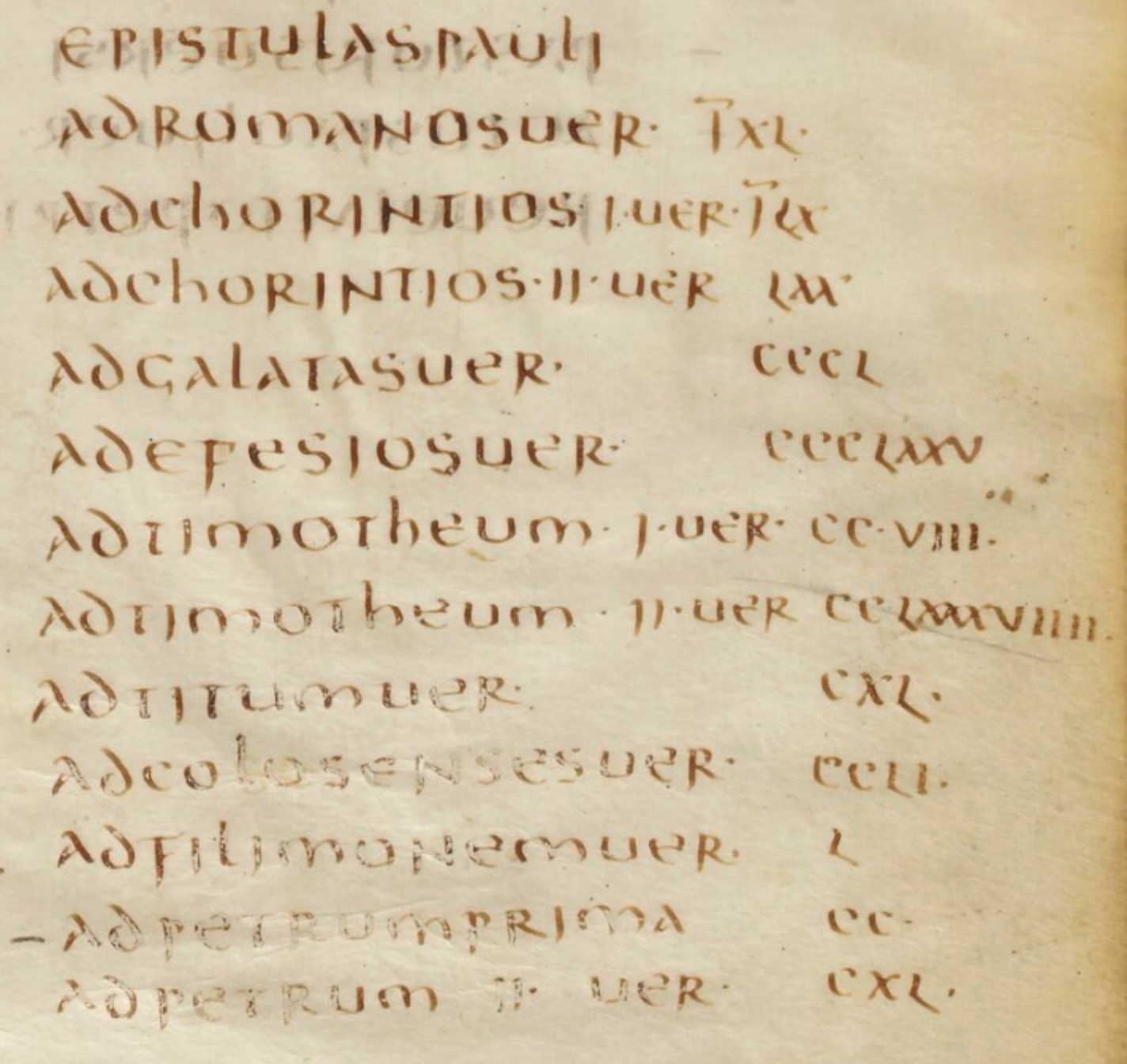
Stichometric list in Codex Claromontanus (fol. 468r), showing stichometry for the Pauline letters; image source: Gallica

Here, we get ad galatas ver(sus) CCCL, 350. So, not as high as the counts in P46 (375) and 1739 (392), but considerably higher than 293. I’m not sure how this count of 350 came to be. But there are a lot of strange things about this list.2 For now, I just note that the count for 2 Corinthians seems very low and that it is an odd coincidence that the count for Ephesians is exactly 375 (that is, the count for Galatians in P46). It makes me wonder if these counts simply became jumbled at some point(s) in their history.

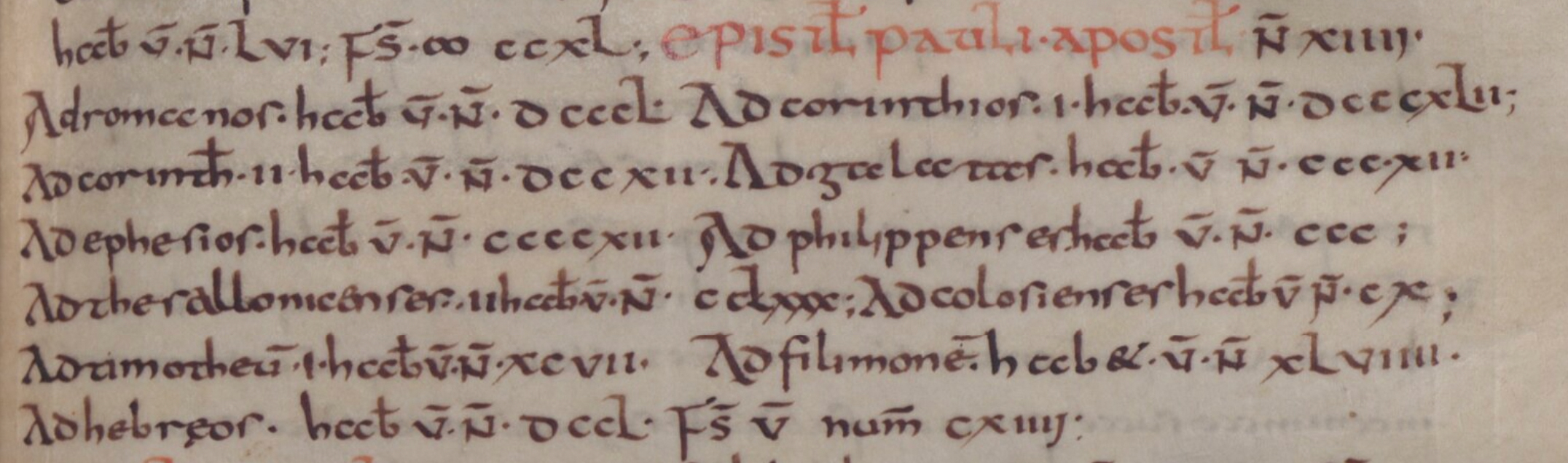
Bayerische Staatsbibliothek Clm 6243, a miscellaneous codex of the 8th or 9th century, contains another biblical stichometric list in Latin, and the count for Galatians here is CCCXII, 312 (the same as what is found in Codex Sinaiticus):

Bayerische Staatsbibliothek Clm 6243 (fol. 190r), showing stichometry for the Pauline letters; image source: MDZ

Looking at the Roman numeral, I’m tempted to wonder if this also might be an error for 293: CCCXII for CCXCIII, but this would require both the transposition of the X and C and the loss of an I. Perhaps a better explanation would be to consider this a count based on stichoi of 15 rather than 16 syllables (see below).

At this point, it might be good to summarize the different stichometric counts we have found for Galatians in Greek and Latin witnesses:

  • 293. This count is best attested, and as we have seen, matches up remarkably well with the actual number of 16-syllable stichoi in both Nestle-Aland 28 and the Vulgate.
  • 213. This total may be a mistake due to the similar representation of 213 and 293 both in Roman numerals (CCXIII for CCXCIII) and in Greek numerals (ⲥⲓⲅ for ⲥҁⲅ).
  • 312. This total may reflect a reckoning of stichoi based on 15 rather than 16 syllables (if we divide the Nestle-Aland total syllables by 312: 4684/312≈15.01). It may also be the result of misplacing the traditional count of Ephesians with Galatians.
  • 350. I have no good explanation for this count.
  • 375. I have no good explanation for this count.
  • 392. This total may reflect a reckoning of stichoi based on 12 rather than 16 syllables, an iambic trimeter line rather than a hexameter line (if we divide the Nestle-Aland total syllables by 392: 4684/392≈11.95).3
  • 393. This total is probably a mistake due to the similar representation of 393 and 293 both in Roman numerals (CCCXCIII for CCXCIII) and in Greek numerals (ⲧҁⲅ for ⲥҁⲅ).

So, of the seven reported counts, five have a reasonably good (or at least plausible) explanation. It would be nice to be able to explain the other two counts, especially the 375 stichoi in P46.

  1. Others among the “Tours Bibles” also give this count (see Köln, Erzbischöfliche Diözesan- und Dombibliothek, Cod. 1, fol. 365r and Bibliothèque nationale de France, Latin 3, fol. 375r). ↩︎
  2. See the interesting recent article by Kelsie G. Rodenbiker, “The Claromontanus Stichometry and its Canonical Implications,”  JSNT 44 (2021) 240-253 https://doi.org/10.1177/0142064X211055647 ↩︎
  3. The tally of 392 that is found for Galatians in 1739 also appears in GA 436 (11th-12th century, Vat. Gr. 367, fol. 124v); GA 209 (14th century, Venezia Biblioteca Nazionale Marciana, gr. Z. 010, coll. 0394, fol. 146r; GA 205 (15th century, Venezia Biblioteca Nazionale Marciana, gr. Z. 5, coll. 0420, fol. 429r). ↩︎
Posted in Stichometry | Tagged , , | 1 Comment

Stichometry 3: Counts for Galatians in Greek Manuscripts

In an earlier post, I set out the evidence used to establish that for ancient Greek and Latin prose writing, a stichos (or versus) was generally equal to 16 syllables. In a subsequent post, I drew attention to the discussion of the payment to writers based on number of stichoi in Diocletian’s Edict on Maximum Prices. So, stichometric counting served to measure works in a standardized way and as a basis for payment of writers. This seems simple enough. The odd thing is that, at least when it comes to Christian texts in the early period, these “notional” or “standard” line numbers don’t actually appear to be very standardized.

A spot check of some later Greek manuscripts of Galatians does give a regular stichometric count. Here is the end of Galatians in Codex Angelicus (GA 020, assigned to the 9th century):

Rome, Biblioteca Angelica, Manoscritti greci, Ang. gr. 39, folio 134 recto, end title of Galatians with stichometric count; image source: Biblioteca Angelica

The last datum given is the stichometric count: ⲥⲧⲓⲭⲱⲛ ⲥҁⲅ, 293 stichoi (using a cursively formed koppa to represent the number 90). This number, 293, is generally accepted as the “standard” stichometric number for the Greek text of Galatians. The problem is that earlier manuscripts give different numbers. For instance, Codex Sinaiticus:

Codex Sinaiticus, end title of Galatians with stichometric notation; image source: codexsinaiticus.org

Written in lighter ink and smaller letters below the closing title ⲡⲣⲟⲥ ⲅⲁⲗⲁⲧⲁⲥ is the notation ⲥⲧⲓⲭ ⲧⲓⲃ, 312 stichoi.1 This count differs again from the tally provided in the Beatty-Michigan Pauline Epistles codex (P46):

Beatty-Michigan Pauline epistles codex (P46), end of Galatians with stichometric count; image source: Chester Beatty Online Collections

Here the notation (in a hand decidedly different from that of the main text) is ⲥⲧⲓⲭ´ ⲧⲟⲉ, 375 stichoi. This is considerably more that the number of lines given in Codex Sinaiticus and the later manuscripts, so much so that I almost suspect that the number could be an error for ⲧⲓⲉ, 315.

There are a few later Greek manuscripts with high stichometric counts for Galatians, but these are mostly explicable as errors for 293 (for instance, some manuscripts have ⲧҁⲅ for ⲥҁⲅ, so 393).2 It is less easy to explain the stichometric total for Galatians in 1739 (assigned to the 10th century):

Monastery of the Lavra B.64 (GA 1739), fol. 75 recto, end title of Galatians showing stichometric count; image source: Library of Congress

Here we get ⲥⲧⲓⲭ´ ⲧҁⲃ, 392. It’s more difficult to see that as the result of an error of copying ⲥҁⲅ. We would have to posit mistakes in copying two out of three digits. (I should add that it’s not clear to me that the stichometric notes were produced by the copyist of the main text; I’ve never seen this manuscript in person.)

I didn’t have the time to count the syllables in each of these manuscripts to see what the “real” number of stichoi is in each of them. But I did do a rough count of the number of 16-syllable stichoi in the text of Galatians printed in Nestle-Aland 28, and I came up with 304 stichoi (or, to be more precise, 303 stichoi + 11 extra syllables, or 4859 total syllables).This is a little closer to the 312 stichoi reported in Codex Sinaiticus than it is to the Byzantine count of 293. But here’s where it gets interesting: My count of Nestle-Aland included unabbreviated nomina sacra. If we contracted the standard nomina sacra (forms of θεός, κύριος, Ἰησοῦς, Χριστός, υἱός, πνεῦμα, πατήρ, and σταυρός/σταυρόω) and count again, we would need to subtract about 175 from the total number of syllables (I say “about” because the forms of contraction can of course vary a little). So 4859-175=4684. Divide that by 16: 4684/16=292.75. That’s shockingly close to the Byzantine standard of 293.3

It makes me curious to know what the “real” stichometric count for the Byzantine text of Galatians is. And I am also at a loss to explain the count of 375 stichoi reported in P46, if it is not indeed an error as suggested above. And overall, I’m not sure what to make of this variety of stichometric counts for Galatians. In another post, I will take a look at the Latin evidence.

  1. 312 is also the stichometric number Codex Sinaiticus gives for Ephesians. But 312 also happens to be the traditional stichometric number for Ephesians. ↩︎
  2. GA 1891 (Jerusalem, Orthodox Patriarchate, Hagios Sabas 107, folio 173r) 10th-11th century, has ⲧҁⲅ, 393. ↩︎
  3. Rendel Harris did this exercise for the whole New Testament using the text of Westcott and Hort, and for Galatians, he also got a stichos count of 304. When he reduced that to account for nomina sacra contractions, he got a slightly higher number than me (296), but he only considered four words as nomina sacra (θεός, κύριος, Ἰησοῦς, and Χριστός). See J. Rendel Harris, Stichometry (London, 1893), 38-41. ↩︎
Posted in Codex Sinaiticus, Stichometry | Tagged , , , , , | 8 Comments

The Sale of the Crosby-Schøyen Codex and its Cost Over Time

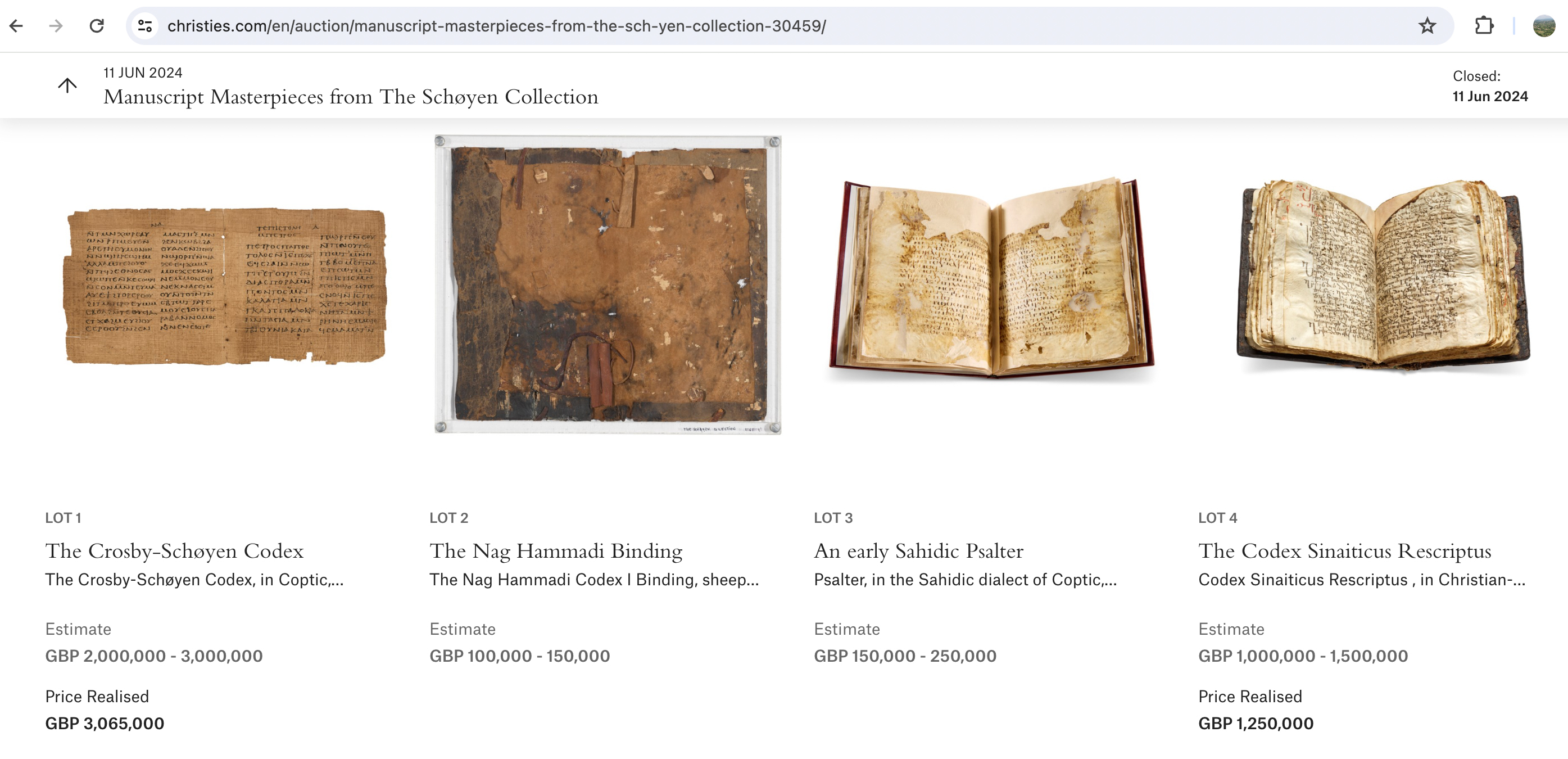
The auction of several items from the collection of Martin Schøyen took place yesterday in London. The highlight of the sale was the so-called Crosby-Schøyen codex, which sold for just over the high end of the estimated price range at £ 3,065,000. Other items, such as the cover of Nag Hammadi Codex I, seem not have sold.

Image source: Christie’s

I do not know who purchased the Crosby-Schøyen codex. According to the BBC, “A spokesperson [for Christie’s] said they could not reveal who bought the book due to client confidentiality.”

The book seems to have been a sound financial investment. When it appeared on the market in 1955, it was sold to the University of Mississippi (together with a substantial part of another codex and loose papyri) for $5,000. When the University of Mississippi sold this codex and the portion of the other codex to the dealer H.P. Kraus in 1981, the reported cost was $250,000. When just our codex alone was sold to Martin Schøyen in 1988, the reported sale price was £ 200,000 (about $350,000 at the time).1 And now the book has sold for £ 3,065,000 (about $3,900,000). So, even accounting for cumulative inflation over time, the cost of the book has soared.

In any event, I do hope the new custodian of the codex will keep it available to scholars for study.

  1. These earlier purchase prices are reported in J.M. Robinson, “The Manuscript’s History and Codicology,” in J.E. Goehring (ed.), The Crosby-Schøyen Codex MS 193 in the Schøyen Collection (Peeters, 1990), xvii-xlvii. ↩︎
Posted in Antiquities Market, Crosby-Schøyen Codex, Schøyen Collection | Tagged , , , , | 4 Comments

Stichometry 2: The Edict on Maximum Prices

In an earlier post, I reviewed the evidence for a stichos or versus being equal (in theory) to 16 prose syllables. The count of stichoi in a work provided a standardized way of describing its length. A stichometric count could also be used as a means of calculating the cost of writing or copying a text. An important piece of evidence for this is the so-called Edict on Maximum Prices of Diocletian issued in the year 301. The complete text of the edict does not survive, but epigraphic remains, some quite substantial, preserve much of it.

Drawing of the Corone fragment of the Edict on Maximum Prices, including the Greek text of the lines on the cost of writing; image source: M.N. Tod, “A New Fragment of the Edictum Diocletiani,” Journal of Hellenic Studies 24 (1904) 195-202.

Both Greek and Latin versions survive for the portion of the edict that is relevant to the discussion of stichometry.

CIL edition of the lines concerning prices of writing from the Stratonikeia inscription of the Edict on Maximum Prices

There are a few lacunae, but between the two versions, the sense is reasonably clear. The text given here is that of Lauffer.1


39 καλλιγράφῳ ἰς γραφὴν κα̣[λλίστην] στίχων ρʹ [𐆖 κεʹ]
40 δευτέρας γραφῆς στίχω̣ν ρʹ [𐆖 κʹ]
41 ἀγοραίοις γράφουσι λιβέλλα ἢ τάβλας στίχους ρʹ [𐆖 ιʹ]


39 scriptori in sc<ri>ptura optima versus n. centum D̸ XXV
40 sequ[enti]s scripturae bersuum no. centum D̸ XX
41 tabellanioni in scriptura libelli bel tabularum [in ver]sibus no. centum [D̸] X

After a word about payment for the parchment maker, the inscription gives maximum prices to be paid to a scriptor or καλλιγράφος (copyist) for two types of writing, “the best writing” and “second quality writing.” In each case the basis for price is the sum of στίχων ρʹ, versus centum, 100 stichoi. A third type of writing is attributed to a different type of writer. The ἀγοραῖος or tabellio,2 figures who execute the writing used in different kinds of documents (the terms libelli and tabulae cover a variety of documentary texts). Again, the unit for determining pay is 100 stichoi.

So accuracy of stichometric counts would seem to be important not just for knowing the length of texts but also for paying those who copied texts of all kinds. One would thus expect that stichometric counts for a given text would be basically stable, but this doesn’t really seem to be the case.3 I will explore this issue a bit in another post.

  1. Siegfried Lauffer, Diokletians Preisedikt (Berlin: de Gruyter, 1971). ↩︎
  2. Presuming that tabellanioni is synonymous with (or an error for) tabellioni. ↩︎
  3. The statement in the Cheltenham List mentioned in an earlier post already suggested that getting such a count might not be an entirely straightforward matter: “Because the index of verses (indiculum versuum) in Rome is not clearly given, and because in other places too, as a result of greed, they do not preserve it in full, I have gone through the books one by one, counting sixteen syllables per line, and have appended to each book the number of Virgilian hexameters it contains.” Edition and translation of Rouse and McNelis, “North African Literary Activity: A Cyprian Fragment, the Stichometric Lists and a Donatist Compendium,” Revue d’histoire des textes 30 (2000) 189-238: Quoniam indiculum versuum in urbe Roma non ad liquidum sed et alibi avariciae causa non habent integrum per singulos libros computatis syllabis posui numero XVI versum Virgilianum omnibus libris numerum adscribsi. ↩︎
Posted in Book Trade in Antiquity, Inscriptions, Stichometry | Tagged , , , , | 2 Comments

Stichometry 1: The Length of a Prose stichos

I’ve been thinking a bit about stichometry lately. As some of the primary sources did not seem to be easily accessible online, I’ve decided to write up a couple posts on the topic. We can begin with the opening of the entry for “stichometry” in the Oxford Classical Dictionary (2012):

stichometry, the modern name for an ancient system of numbering lines in literary texts. In Greek papyri, this numbering takes two forms. (1) Marginal: each hundredth line marked with a letter of the alphabet (A = 100 up to Ω = 2400, then again from A). (2) Final: the sum total of lines in the work (roll) stated at the end, often introduced by ἀριθμός, ‘number,’ and most often in acrophonic numerals. Any individual copy may exhibit both, one, or neither; a few copies show lines checked off in fives, tens, or twenties. In verse, the ‘line’ defines itself. In prose, the numbering assumes a notional or standard line (the actual lines would differ in length from copy to copy): apparently15-16 syllables.”

At present, I am mostly interested in stichometric counts of prose texts. The basis for this standard length of a prose line is an incidental remark in Galen (On the Doctrines of Hippocrates and Plato 8.1.22-25). While engaged in a lively medical dispute, Galen repeatedly apologizes for writing so much when the matter at hand is actually, in his view, quite simple. In the course of one of these apologies, he provides some interesting equivalences. I provide the reference here in full in the translation of Phillip De Lacy.1

“Thus the true account is as short as I shall demonstrate to you; it reaches its conclusion in a few syllables (δι᾽ ὀλίγων συλλαβῶν), as follows: ‘Where the beginning of the nerves is, there is the governing part. The beginning of the nerves is in the brain. Therefore, the governing part is there.’ This one argument has thirty-nine syllables (ἐννέα καὶ τριάκοντα συλλαβῶν), equivalent to two and one-half hexameters (δυοῖν καὶ ἡμίσεος ἐπῶν ἑξαμέτρων). A second argument is in all five lines long (πέντε τῶν πάντων ἐπῶν): ‘Where the affections of the soul more visibly move the parts of the body, there the affective part of the soul is. The heart is observed to undergo a great change of motion in anger and fear. Therefore, the affective part of the soul is in the heart.’ If you thus join these two arguments together, the combined total will be no more than eight hexameter lines (ἐπῶν ἑξαμέτρων ὀκτώ). Who, then, is to blame for my having written five books dealing with these matters that could have been scientifically demonstrated in eight heroic lines (διὰ ὀκτὼ στίχων ἡρωϊκῶν)?”2

On Galen’s reckoning, then, two and a half hexameters lines is 39 syllables of prose. If we do the math:
39/2.5=15.6
At the same time, eight ἡρωϊκοὶ στίχοι (or ἑξάμετρα ἔπη) are greater than 122 syllables. If we again do the math:
122/8=15.25

Berlin, MS. Ham. 270, fol. 98v; image source: Staatsbibliothek zu Berlin

So, it seems then that an epos or a stichos in prose writing is 16 syllables. This finds support in (later) Latin tradition, in which a versus was also equivalent to 16 prose syllables. A Latin Christian sitchometric list generally called the Cheltenham List is preserved in two medieval manuscripts.3 The maker of the list appended the following note (given here in the text and translation of Rouse and McNelis):4

“Because the index of verses (indiculum versuum) in Rome is not clearly given, and because in other places too, as a result of greed, they do not preserve it in full, I have gone through the books one by one, counting sixteen syllables per line, and have appended to each book the number of Virgilian hexameters it contains.”5

The point of stichometric counts (or at least one of the points) seems to be to provide a standard way of measuring the length of a work. But as the statement above from the Cheltenham List indicates, it could be challenging to get an accurate stichometric count for a book. And in fact surviving lists and stichometric notations for biblical books often disagree with each other, sometimes significantly. But that will be the topic of another post.

St. Gallen Stiftsbibliothek Cod. Sang. 133, p. 490; image source: e-codices


  1. Phillip De Lacy, Galen: On the Doctrines of Hippocrates and Plato. Second Part: Books VI-IX, 2nd ed. (Berlin: Akademie Verlag, 2005). ↩︎
  2. De Lacy’s edition of the Greek: οὕτως γοῦν ὁ ἀληθὴς λόγος ἐστὶ βραχὺς ὡς ἐγὼ δείξω σοι δι’ ὀλίγων συλλαβῶν περαινόμενον αὐτὸν ὄντα τοιοῦτον· “ἔνθα τῶν νεύρων ἡ ἀρχή, ἐνταῦθα τὸ ἡγεμονικόν· ἡ δ’ ἀρχὴ τῶν νεύρων ἐν ἐγκεφάλῳ [ἐστίν]· ἐνταῦθα ἄρα τὸ ἡγεμονικόν.” εἷς μὲν οὗτος λόγος ἐννέα καὶ τριάκοντα συλλαβῶν, ὅπερ ἐστὶ δυοῖν καὶ ἡμίσεος ἐπῶν ἑξαμέτρων· ἕτερος δ’ ἐστὶ πέντε τῶν πάντων ἐπῶν· “ἔνθα τὰ πάθη τῆς ψυχῆς ἐπιφανέστερον κινεῖ τὰ μόρια τοῦ σώματος, ἐνταῦθα τὸ παθητικὸν τῆς ψυχῆς ἐστιν· ἀλλὰ μὴν ἡ καρδία φαίνεται μεγάλην ἐξαλλαγὴν ἴσχουσα τῆς κινήσεως ἐν θυμοῖς καὶ φόβοις· ἐν ταύτῃ ἄρα τὸ παθητικὸν τῆς ψυχῆς ἐστιν.” εἰ δὲ συνθείης ὡδὶ τούτους τοὺς δύο λόγους, οὐ πλεῖον ἐπῶν ἑξαμέτρων ὀκτὼ τὸ συγκείμενον ἐξ αὐτῶν πλῆθος ἔσται. τίνες οὖν αἴτιοι τοῦ πέντε βιβλία γραφῆναι περὶ τούτων ἃ διὰ ὀκτὼ στίχων ἡρωϊκῶν ἐπιστημονικὴν ἀπόδειξιν εἶχεν; ↩︎
  3. The list itself is usually assigned to the second half of the fourth century, but the manuscripts that preserve them are later Biblioteca Nazionale Centrale di Roma, Vitt.Em.1325 (tenth or early eleventh century) and St. Gallen Stiftsbibliothek Cod. Sang. 133 (late eighth or early ninth century). ↩︎
  4. Richard Rouse and Charles McNelis, “North African Literary Activity: A Cyprian Fragment, the Stichometric Lists and a Donatist Compendium,” Revue d’histoire des textes 30 (2000) 189-238. It’s not totally clear whether this statement goes with the material that precedes it (a list of the stichoi of biblical books) or the material that follows it (a list of the stichoi of the works of Cyprian). ↩︎
  5. Rouse and McNelis’s edition of the Latin: Quoniam indiculum versuum in urbe Roma non ad liquidum sed et alibi avariciae causa non habent integrum per singulos libros computatis syllabis posui numero XVI versum Virgilianum omnibus libris numerum adscribsi. ↩︎
Posted in Stichometry | Tagged , , | 6 Comments

Cover of Nag Hammadi Codex I for Sale (with a Bowl)

After being down for several days due to a cyber attack, the Christie’s website appears to be back up and running. A more detailed description of the items being auctioned from the Schøyen Collection is now available. Among them is the leather cover of Nag Hammadi Codex I along with the separately framed waste papyrus extracted from the cover.

One observation about the catalog entry for this lot: The buyer will also get the bowl that James Robinson often claimed was used to seal the jar in which the Nag Hammadi codices were said to have been found. I want to point out that this bowl has a provenance history that differs from that of the leather cover (and cartonnage) of Codex I. While the quires and leather cover of Codex I took different paths to their current repositories (the quires to Cairo and the cover eventually to the Schøyen Collection), the bowl had a more direct path: an Egyptian family to James Robinson (in 1976) and then to the Schøyen Collection in 1994.

Now, was this in fact “the” bowl used to seal the jar with the codices? For reasons I have outlined in detail elsewhere, I regard the find story or–more accurately–the multiple, conflicting find stories of the Nag Hammadi codices as unreliable. Nevertheless, it’s worth teasing out the tale of the bowl a bit. To the best of my knowledge, Robinson’s fullest account of the bowl is in his book, The Nag Hammadi Story (2014). While summarizing his story of the discovery of the codices, Robinson gave a detailed description of the jar in which the books were said to have been found (a jar that had allegedly been smashed and that Robinson had never seen). He eventually moved on to describe the way this jar had allegedly been sealed and what happened to the bowl used to seal the jar:

“The jar had been closed by laying into its mouth a pottery bowl, which Khalīfah took with him to al-Qaṣr. There he was employed as a servant and camel driver for a Copt, Sami ʿAbd al-Malāk, who took the bowl as a talisman that would bring a blessing. Through the mediation of his wife Umm Nadya, a relative Salib ʿAbd al-Masīḥ, for a modest consideration, made it available for study.”1

In other words, Robinson bought the bowl and took it back to Claremont. What is interesting about the story is that the connection of the bowl to the alleged discovery of the books is the figure of Khalīfah, that is, the brother of Muhammad ʿAli al-Samman, the man most closely associated with the discovery of the codices, whose story (or rather, stories) Robinson spent years investigating. One part of Muhammad ʿAli’s story was a denial that Khalīfah was present at the time of the discovery of the codices.2 Robinson did not believe this part of Muhammad ʿAli’s story.

James Robinson’s Egyptian bowl, now MS1804/1 (3) in the Schøyen Collection; image source: Christie’s

Another account of Robinson’s purchase of the bowl is provided in James Goehring’s publication of a similar bowl found during excavations of a church at Pbow. Goehring says the following about the bowl Robinson bought:

“Robinson notes that Khalifah took it [the bowl] to the home of the Coptic family of Sami Abd al-Malak and his wife Umm Nadia. When Robinson located the bowl, it was Salib Abd al-Masih, Sami’s nephew, who sold it to him. While Robinson did not know for sure the whereabouts of Sami at that time, one may assume, since Umm Nadia was still present and Salib acted as the one with authority to sell the bowl, that Sami had passed away. Robinson concurred with this assessment.”3

I think it’s important to emphasize that this bowl took a path in the antiquities trade that is different from that of the cover of Nag Hammadi Codex I. We might assume that they had a common origin, but that really is just an assumption. The first time the bowl and the cover of the codex actually have a documented history together is in Claremont, California in 1976 (the cover of Codex I had arrived in Claremont in 1972).4 Treating the cover and the bowl as a unit tends to create the impression of unity and coherence in a “find story” that is actually quite messy when we focus on the details.

Inscription on the bottom of the bowl, MS1804/1 (3) in the Schøyen Collection; image source: Christie’s
  1. James M. Robinson, The Nag Hammadi Story (Leiden: Brill, 2014), 1.35-36. ↩︎
  2. Robinson, The Nag Hammadi Story, 1.35. ↩︎
  3. James E. Goehring, “An Early Roman Bowl from the Monastery of Pachomius at Pbow and the Milieu of the Nag Hammadi Codices,” in L. Painchaud and P.-H. Poirier (eds.), Coptica – Gnostica – Manichaica: Mélanges offerts à Wolf-Peter Funk (Louvain: Peeters, 2006), 57-371, quotation at 361, n. 15. ↩︎
  4. See the account in Robinson, The Nag Hammadi Story, 1.383-390. ↩︎
Posted in Antiquities Market, Book covers, Find Stories | Tagged , , , , | 3 Comments

The Crosby-Schøyen Codex, the Length of kollēmata, and Dates of Codices

The upcoming auction of the Crosby-Schøyen Codex prompted me to revisit the edition of the codex and think a bit about the book’s construction. One datum that didn’t really register with me before I started making papyrus rolls is the length of the kollēmata, the individual sheets of papyrus pasted together to make up a papyrus roll. Pliny the Elder provides descriptions of different classes of these sheets, and the largest that he mentions is the macrocolum, which is 1 cubit long (about 44.4 cm).

Papyrus codices that are sufficiently well preserved sometimes allow us to reconstruct the rolls from which their bifolia were cut. The kollēmata of the rolls reconstructed from some codices do fall below the maximum width reported by Pliny. For example, in 1956 Jean Scherer reconstructed the rolls from which the bifolia of one of the Tura codices of Origen (TM 62347) were cut.

Reconstruction of the kollēmata of the Tura codex of Origen’s Contra Celsum; images sources: CSAD and J. Scherer, Extraits des Livres I et II du Contre Celse d’Origène (Cairo: IFAO, 1956), p. 3

Each individual kollēma was about 20 cm long. The Beatty-Michigan codex of the Pauline epistles (P46, TM 61855) has kollēmata that average about 20 cm long (though they range in length from about 10 cm long to about 33 cm).1 There are usually two kollēseis (pasted joins) on each surviving bifolium.

A bifolium of the Beatty-Michigan codex of the Pauline epistles (P46) with two kollēseis indicated by white lines; image source: Chester Beatty Online Collections

But a number of codices were constructed from rolls that have much longer kollēmata. The conservator Hugo Ibscher (1874-1943) reported that some of the kollēmata used to make the rolls used for the Berlin “Gnostic” codex (P.Berol. 8502, TM 107765) were over 1.6 meters long. Rodolphe Kasser reported that the Bodmer Menander codex (TM 61594) was made up of cut from a single very long kollēma measuring at least 4.20 meters!2 [[Correction 28 Sept. 2025: Kasser claimed the length of the roll was 4.20 meters, but he points out the roll had two kolleseis, so the individual kollemata were shorter, but still quite long.]] This seems implausible given the usable length of a stalk of papyrus. I have not been able to verify or refute Kasser’s claim, but from the digital images now available online, one can reconstruct quite long kollēmata. Here is a set of bifolia certainly from a single kollēma that was at least 75 cm long:

Bifolia of the Bodmer Menander Codex showing a single long kollēma stretching across three bifolia, white arrows highlight especially prominent horizontal fiber patterns; image composed from material from the Bodmer Lab

When the rolls used to make the Nag Hammadi codices were reconstructed, it was found that these kollēmata were also quite long, with lengths of up to 1.62 meters.3 So, there is good evidence for rolls composed of kollēmata much longer than Pliny’s macrocollum. This suggests that the mode of manufacturing papyrus must have undergone a change from Pliny’s day. Eric Turner drew out the implications:

“A roll without kolleseis of a length of about 2 m. would have been constructed using the full height (about seven feet) of the papyrus stem. If such rolls were made, they would appear to be a novelty designed to meet the requirements of codex-makers. It is to be noted that most of these supposed rolls with kollemata 2 m. wide are of very coarse, thick papyrus.”4

Turner located this shift in the fourth century. It is thus possible that the presence of these long kollēmata may be an indicator that a codex was produced no earlier than the fourth century.

The kollēmata of the Crosby-Schøyen codex fall into this later, longer group. The editors of the codex reported kollēma lengths between 1 and 1.5 meters.5 Radiocarbon analysis of the papyrus of this codex would allow for a date anywhere from the middle of the third century to the middle of the fourth century. It may be that the presence of the long kollēmata in the Crosby-Schøyen codex suggest a date in the later part of that range. But some caution is necessary. The number of samples we have is small. And the existence of the relatively short kollēmata in the Tura Origen papyrus noted above (which is assigned to the sixth or seventh century) suggest that shorter kollēmata continued to be used throughout late antiquity. So, shorter kollēmata may not necessarily be indicative of an earlier date, but longer kollēmata (over about 45 cm) may perhaps be an indicator of production in the fourth century or later.

  1. See the data gathered in E.B. Ebojo, A Scribe and his Manuscript: An Investigation into the Scribal Habits of Papyrus 46 (P.Chester Beatty II – P.Mich. inv. 6238) (Ph.D. diss., University of Birmingham, 2014), 79-86. ↩︎
  2. R. Kasser, Papyrus Bodmer XXV, Ménandre: La Samienne (Bibliotheca Bodmeriana, 1969), at 11-12: “En effet, un examen attentif des pages du P. Bodmer XXV-IV-XXVI nous a convaincu du fait suivant: tous les folios de ce codex ont été découpés dans un même rouleau. …Ce volumen devait avoir une longueur de 4,20 m au moins.” ↩︎
  3. J.M. Robinson, The Facsimile Edition of the Nag Hammadi Codices: Introduction (Brill, 1984), 67-70. ↩︎
  4. E.G. Turner, The Typology of the Early Codex (University of Pennsylvania Press, 1977), 53. ↩︎
  5. J.M. Robinson, “The Manuscript’s History and Codicology,” in James E. Goehring (ed.), The Crosby-Schøyen Codex Ms 193 in the Schøyen Collection (Peeters, 1990), xix-xlvii, at xlv-xlvi. ↩︎
Posted in Bodmer Papyri, Codicology, Papyrus Making, Schøyen Collection, Tura Papyri, Voluminology | Tagged , , , , , , | 4 Comments