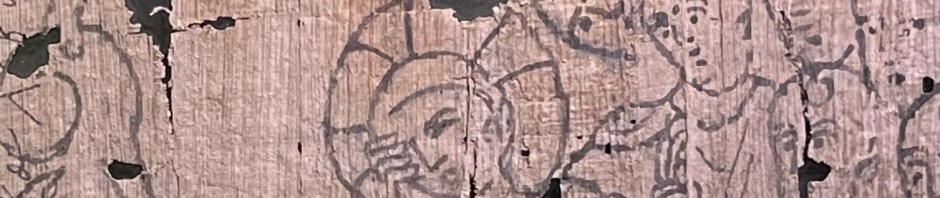
I’ve long been intrigued by a famous illustrated papyrus. You may have seen it on the cover of Lincoln Blumell and Thomas Wayment’s book, Christian Oxyrhynchus: Texts, Documents, and Sources (2015):
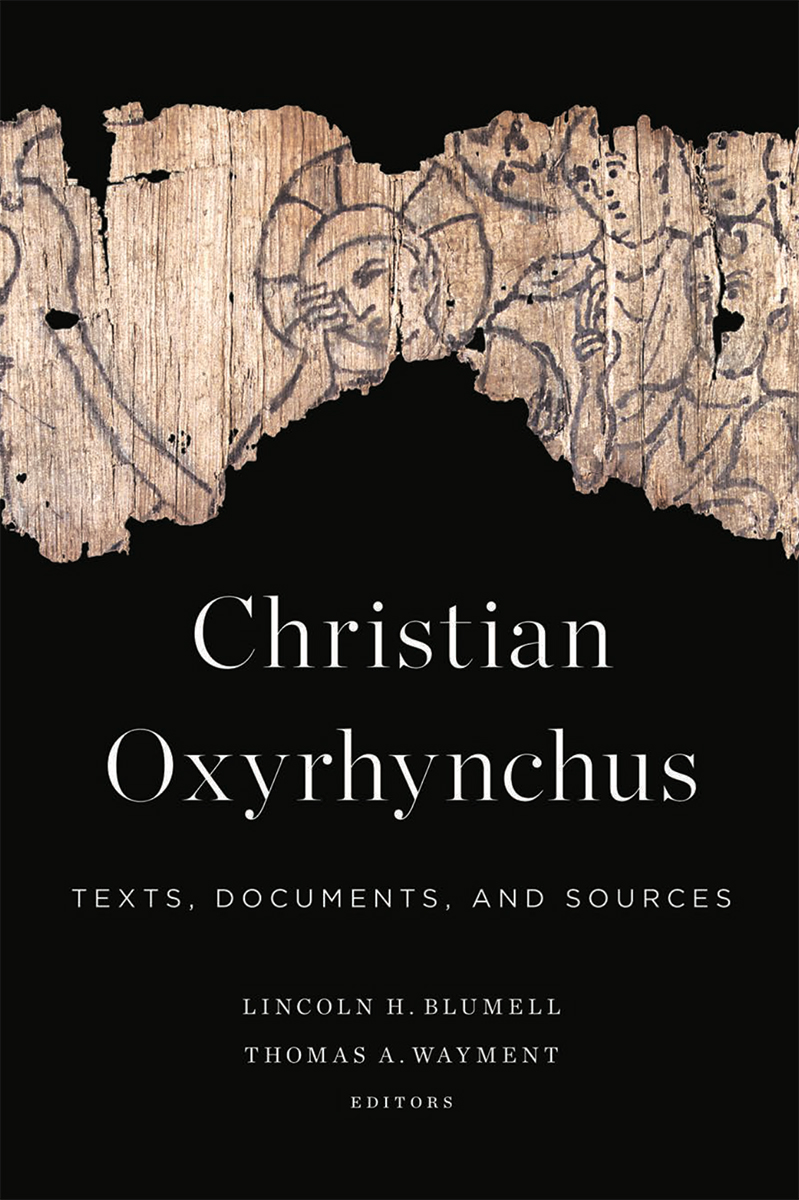
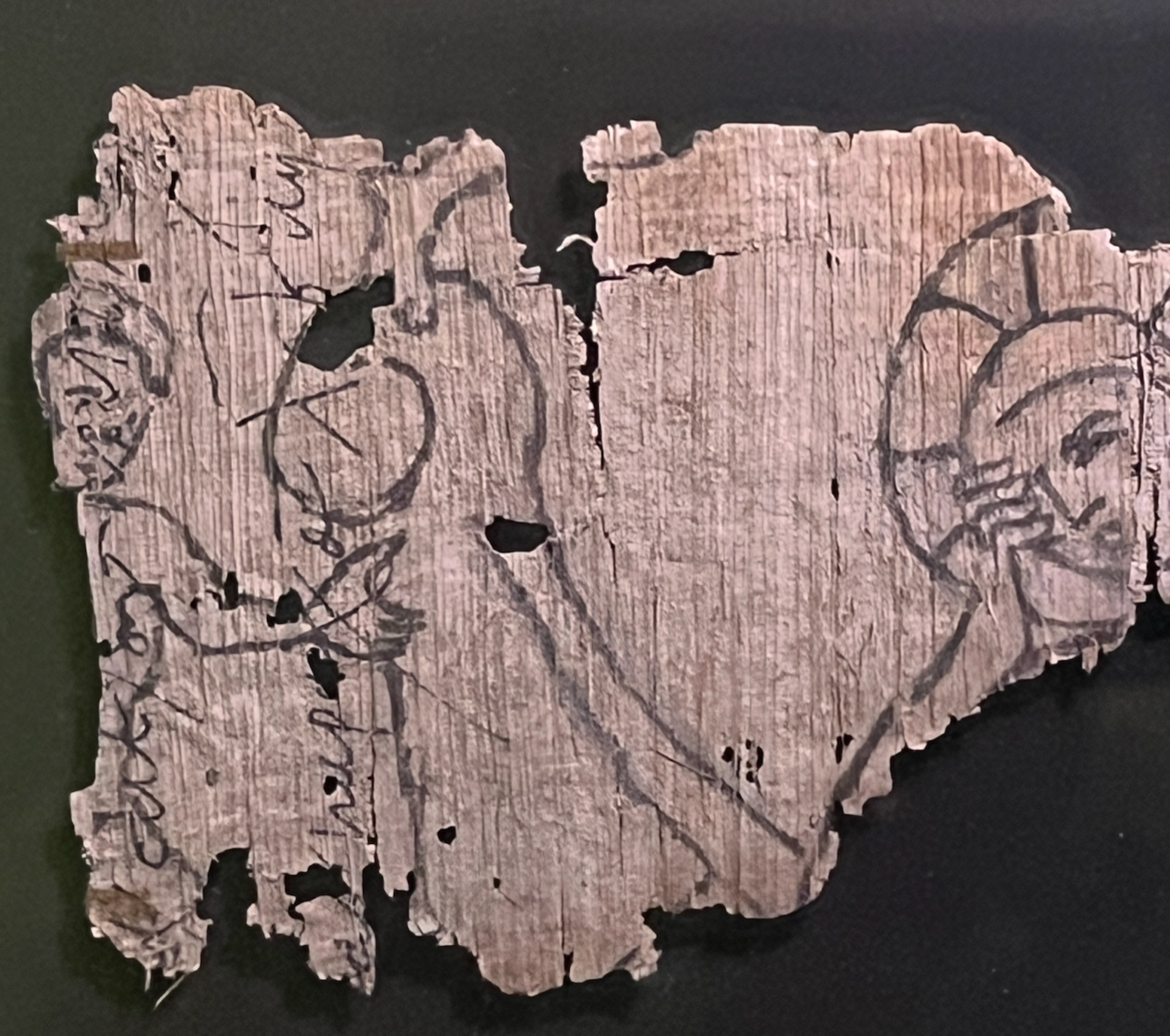
The front matter in the book identifies the illustration on the cover as “Christ on the Sea of Tiberias from Oxyrhynchus. Catalogue no. 8683 from the Egyptian Museum at Florence.” The papyrus does not, however, make an appearance within the text of the book itself because it falls outside the chronological scope of Blumell and Wayment’s collection of Christian materials (“everything from the second through the fourth century,” p. 8). The drawing seems to have been produced in the sixth century. The orientation of the scene in the drawing is “against” the vertical fibers of the papyrus. So, the drawing is most likely a reuse of the sixth-century document (a land lease) that is written along the fibers on the other side of the papyrus (some words in a similar script are also visible on the drawing at left).
The papyrus was purchased in Egypt in 1915 or 1916 by Guido Gentilli (1881-1916) for the Società Italiana per la ricerca dei papiri greci e latini in Egitto. It was, as far as I know, first published in 1925.1 It was then republished in 1927 as PSI 8 920.
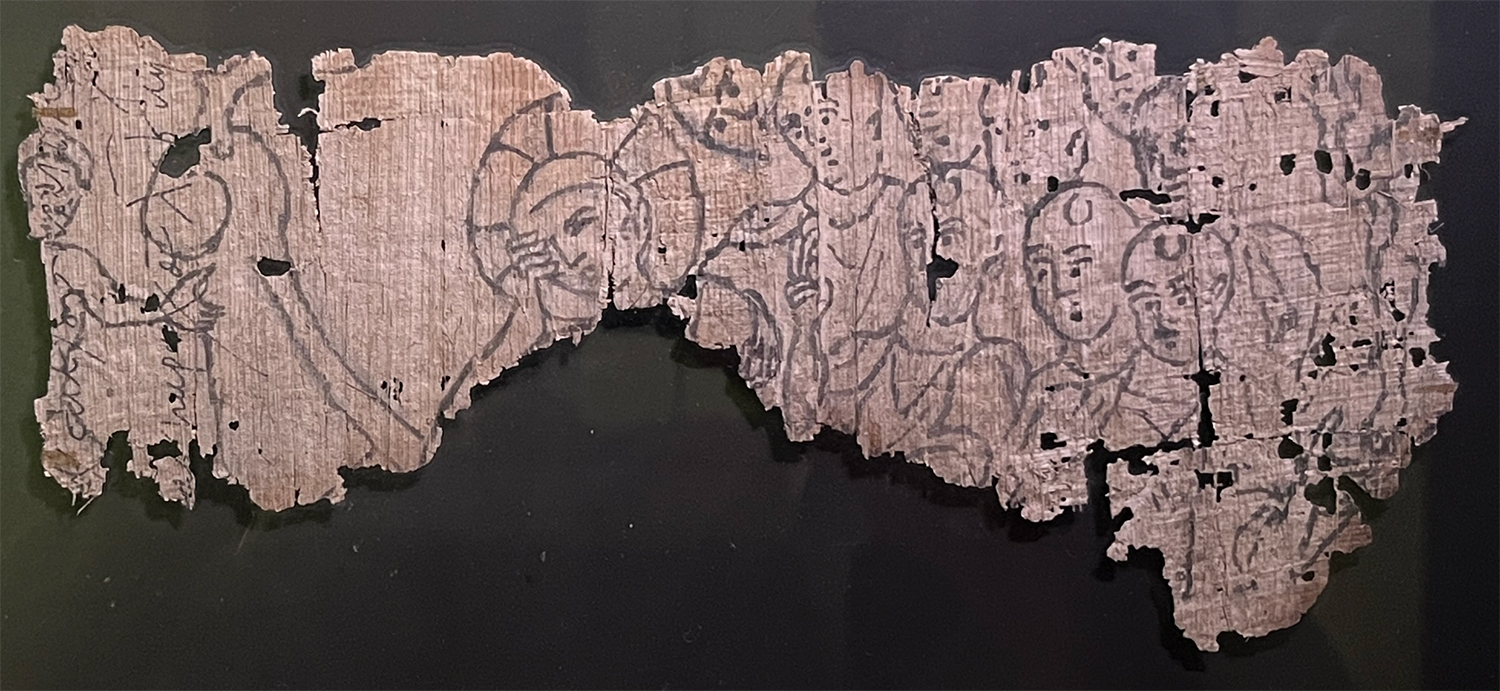
The papyrus is not available for close study, but that’s because it’s part of the permanent display at the Museo Archeologico in Florence. Visitors can come in and see it in a glass case in a dark room alongside another illustrated papyrus from the Roman era (a drawing of cupid and Psyche, PSI 8 919) and some fantastic Coptic textiles.
From the time of its publication, the image has been connected to Matthew 8:23-26 and parallels, “the stilling of the storm.” The stern of a boat partly visible on the left sets the nautical theme, and the central figure with the halo is identified as a sleeping Jesus (in the words of one interpreter, “Jesus sleeps, with his head peacefully resting on his right hand”2). He is roused by a group of nervous disciples on the right.
This seems like a reasonable interpretation of the scene. There are a few odd details. What are we to make of the figure on the left, who seems to be in the water rather than in the boat?
And all the figures on the right are apparently bald and have a curved mark on their heads. The editor of PSI 8 920 explained these marks as “flames on the heads of the disciples” and even suggested that the remains of colored inks were still visible on their heads, but I can’t see anything like that (though, as I said, I’ve not been able to properly study the piece since it’s on display).3
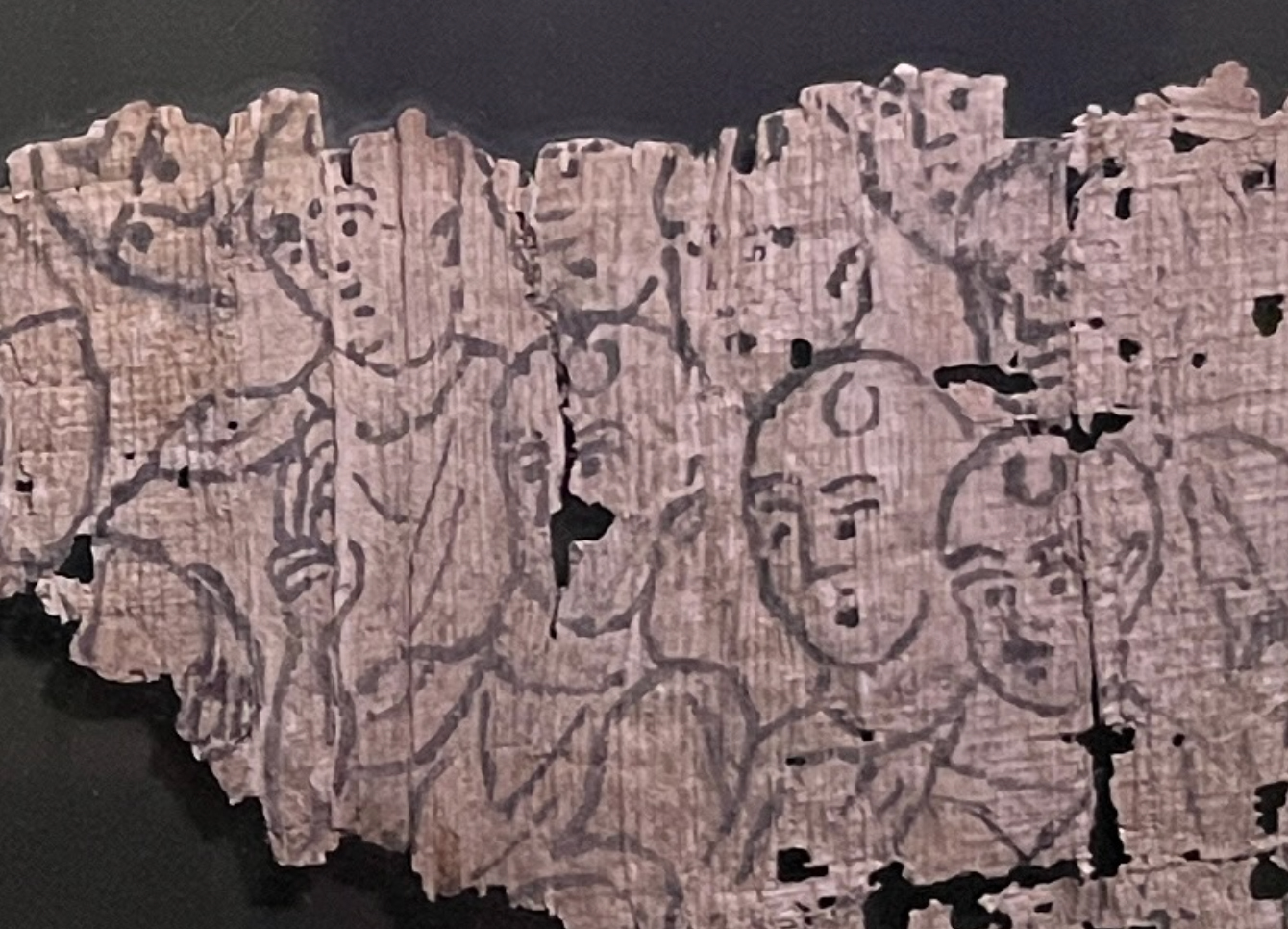
And then there’s the central figure with the halo. In part because of the shape of the surviving fragment, the head with the halo seems like the main focus of the scene. The eye is guided by the angles of the breakage to the encircled head.
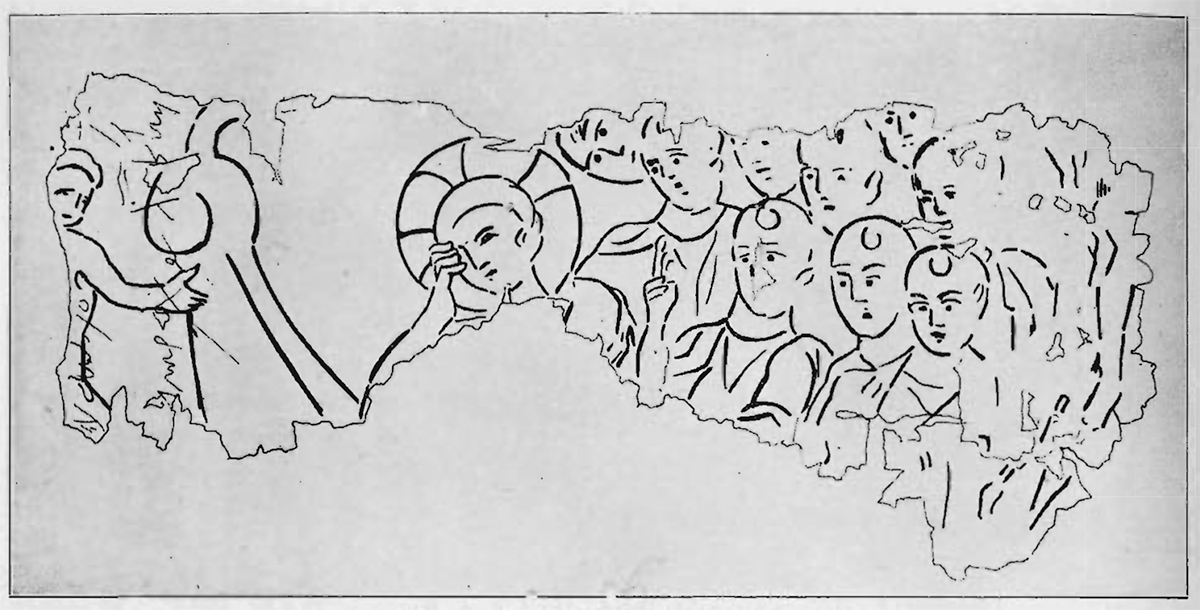
But I wonder if we haven’t lost another depiction of the same figure on the broken right side of the papyrus. In later manuscript illuminations and iconography, a single image like this shows multiple actions of Jesus on the boat. Here is an illustration from the eleventh-century Codex aureus Epternacensis:
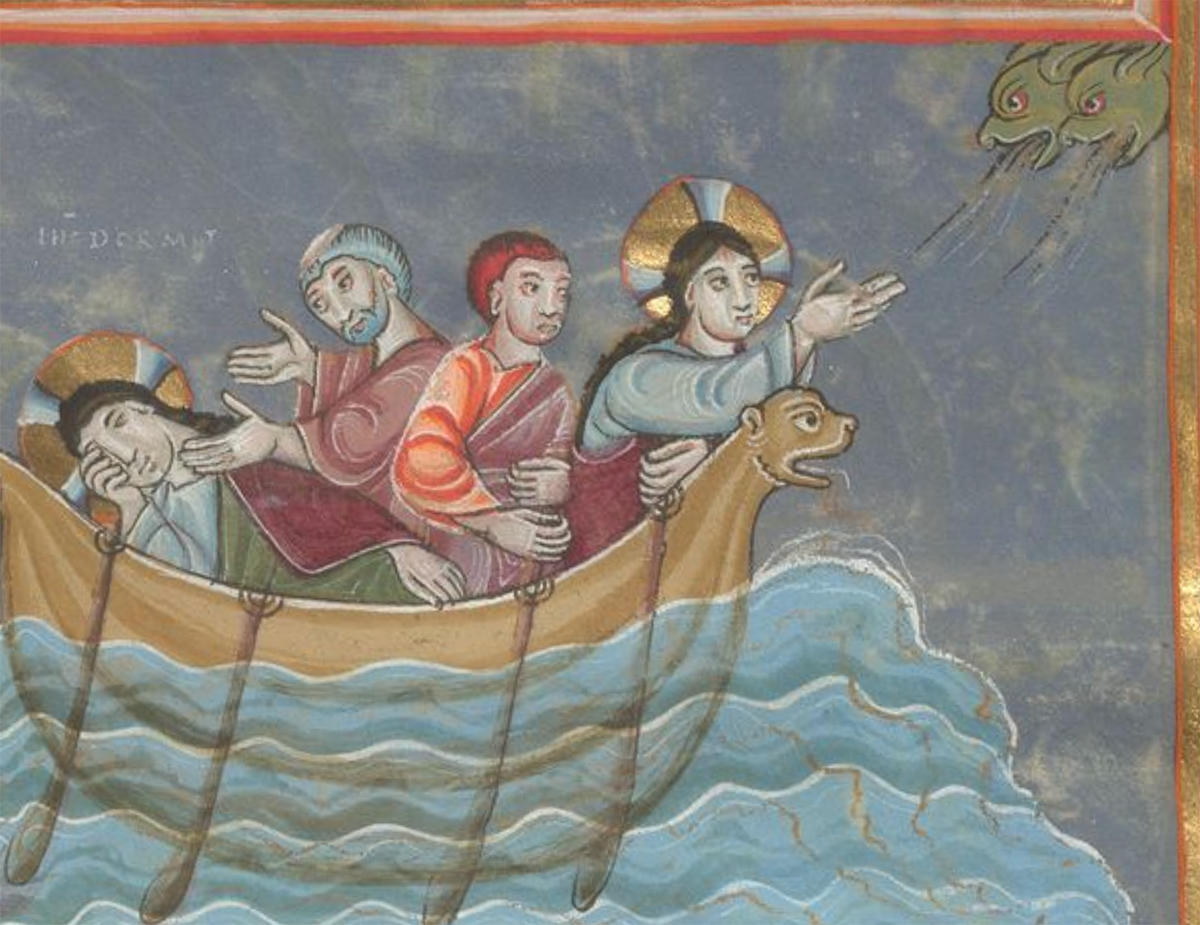
So, a sleeping Jesus in a similar pose on the left is just one part of the scene. The actual stopping of the winds to calm the sea is happening over on the other side of the boat. Perhaps something similar was shown in a portion of our papyrus that is now lost.
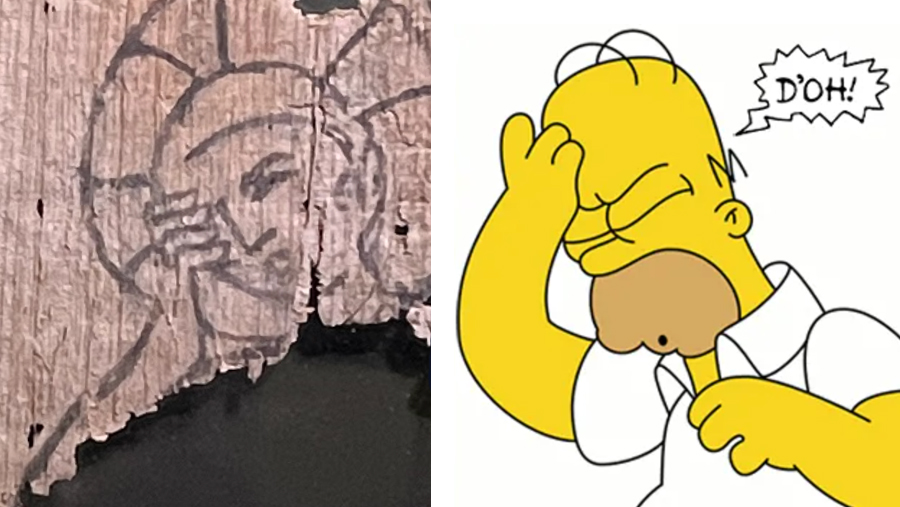
And finally: Given the parallel imagery, it seems certain that the illustrator was depicting a sleeping Jesus. But something about the way that the face is drawn (the arch of the brow? the position of the hand on the head?) evokes either a person who is deep in concentration or one who is perhaps feeling the “sudden recognition of a foolish blunder.” After all, for those of us of a certain age, this image really has just one, truly irresistible visual parallel:
- Antonio Minto, “Frammento di papiro scoperto ad Oxyrhynchos,” Bolletino d’Arte 5 (1925) 190-192. ↩︎
- Mario Naldini, Documenti dell’antichità cristiana: Papiri e pergamene greco-egizie della Raccolta Fiorentina (Florence: Le Monnier, 1965), 39: “Gesù dorme con la testa serenamente appoggiata sulla mano destra.” ↩︎
- PSI 8 920: “Sulla fronte dei discepoli sono le fiammelle che erano forse colorate in rosso: infatti sono rimaste ancora tracce violacee dell’ inchiostro svanito.” ↩︎


 Variant Readings
Could Christ’s expression and “hand-to-the-face” gesture be indicative of someone who was just woken up from a deep sleep? I’m sure I’ve rubbed my face and made the same expression the many times I’ve been woken up by my daughter in the middle of the night!
That makes sense!