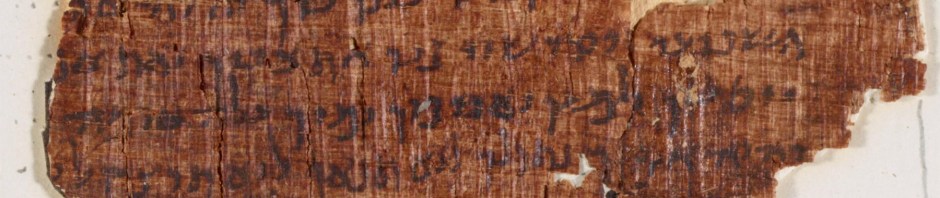
I continue to be puzzled by the problem of the purchase of the Nash Papyrus. In an earlier post, I noted that one finds two different dates in the literature, 1898 and 1902. I cited Emanuel Tov among those who have given the 1902 date. But I now see that in a more recent volume (2020) Tov has also noticed the problem already:
“the Nash Papyrus…purchased in Egypt in either 1898 or 1902”1
No reference is given, but I really am curious about the source of this 1898 purchase date. The earliest reference to it that I have been able to find is a 1962 article about the Jewish materials in the Cambridge University Library. There we find the following statement:
“The most prized possession is the Nash Papyrus, one of the greatest relics of antiquity. It was acquired in 1898 by W. L. Nash, Secretary of the Society of Biblical Archaeology.”2
There is no reference cited to support the claim. It is interesting, however, that the earliest explicit reference to the papyrus being purchased in 1902 seems to be a bit later, J.A. Sanders, The Dead Sea Psalms Scroll (Cornell University Press, 1967), 9:
“One of the oldest Bible fragments emanating from Egypt, but not from the Geniza, was acquired there in 1902 by W. L. Nash. The ‘Nash papyrus’ contains a variant form of the Ten Commandments and Deut. 6:4-5. Paul Kahle dates it in the first century A.D. and W. F. Albright in the second century B.C.”
Again, no reference supports the claim for the 1902 purchase.
And I’ve run into the problem (again) of a Cambridge publication that is potentially relevant but not accessible to me [[Update 6 August 2026: I now have a copy; thanks to those who sent links!]]:
The Cambridge Review: A Journal of University Life and Thought (1903)
If anyone has access, I would be grateful for a copy, and that still holds true for this piece:
Reif, S.C. “The Nash Papyrus.” Cambridge 15 (1984) 41–45 (I believe the periodical is Cambridge: The Magazine of The Cambridge Society).
- E. Tov, “Papyrus Nash and the Septuagint,” in A Necessary Task: Essays on Textual Criticism of the Old Testament in Memory of Stephen Pisano, Analecta Biblica 14, ed. Dionisio Candido and Leonardo Pessoa da Silva Pinto (Roma: Pontificia Università Gregoriana and Pontificio Istituto Biblico, 2020), 33–50, at 34. ↩︎
- H. Rabinowicz, “Cambridge University Library,” Jewish Quarterly Review 53 (1962) 69–76, quotation at 69. ↩︎


https://catalog.hathitrust.org/Record/000055755
Thanks, Gregg–I check HathiTrust, but I often forget that things that are unavailable in Europe often are available in the US! That is the case in this instance. This article does not answer the question about the date of purchase, but it does provide some interesting details!