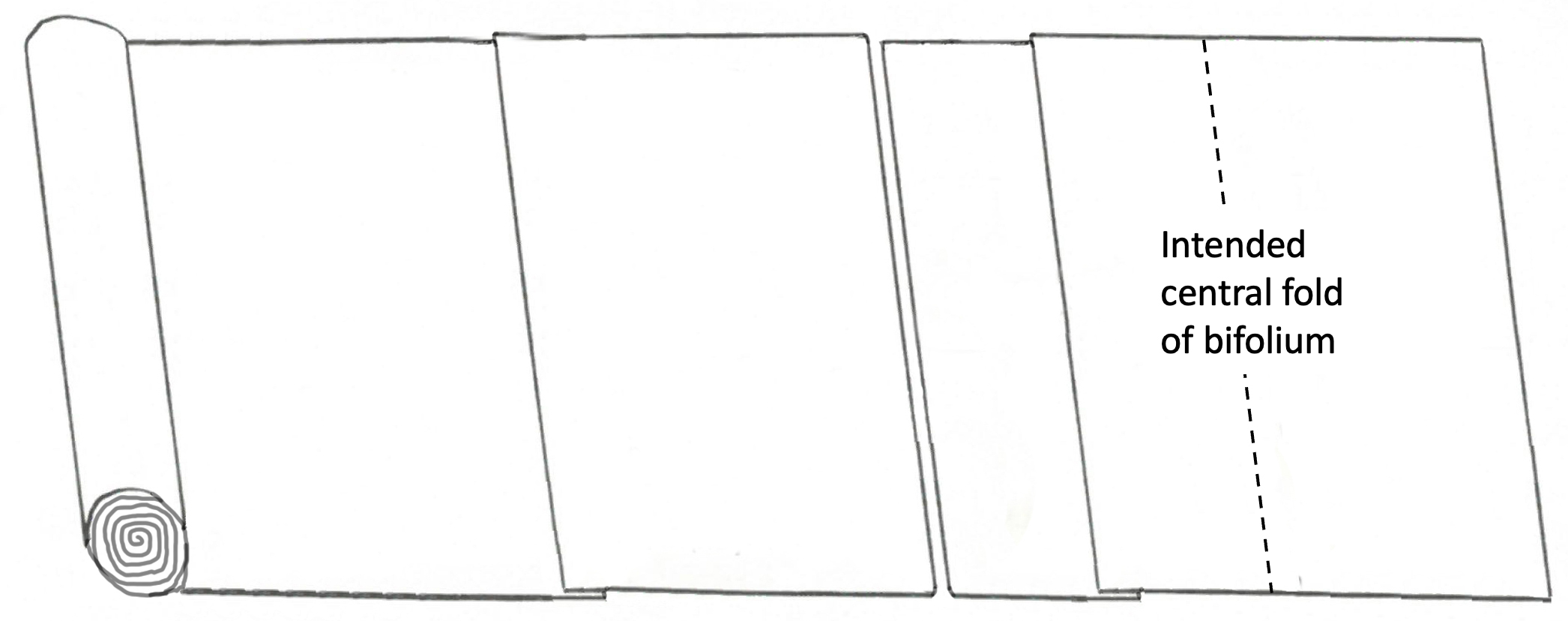
Work on a recent article about the construction and date of P.Bodmer 14–15 had me thinking again about the manufacture of papyrus rolls. I was on the lookout for papyrus codices with bifolia cut from rolls made of very long sheets (kollemata). In the process of reviewing this material, I found more evidence for codices with kolleseis (pasted joints between kollemata) that are horizontal rather than vertical. Typically, bifolia for papyrus codices were cut according to the width of the intended bifolium (kolleseis are thus usually parallel to the central fold of the bifolium):
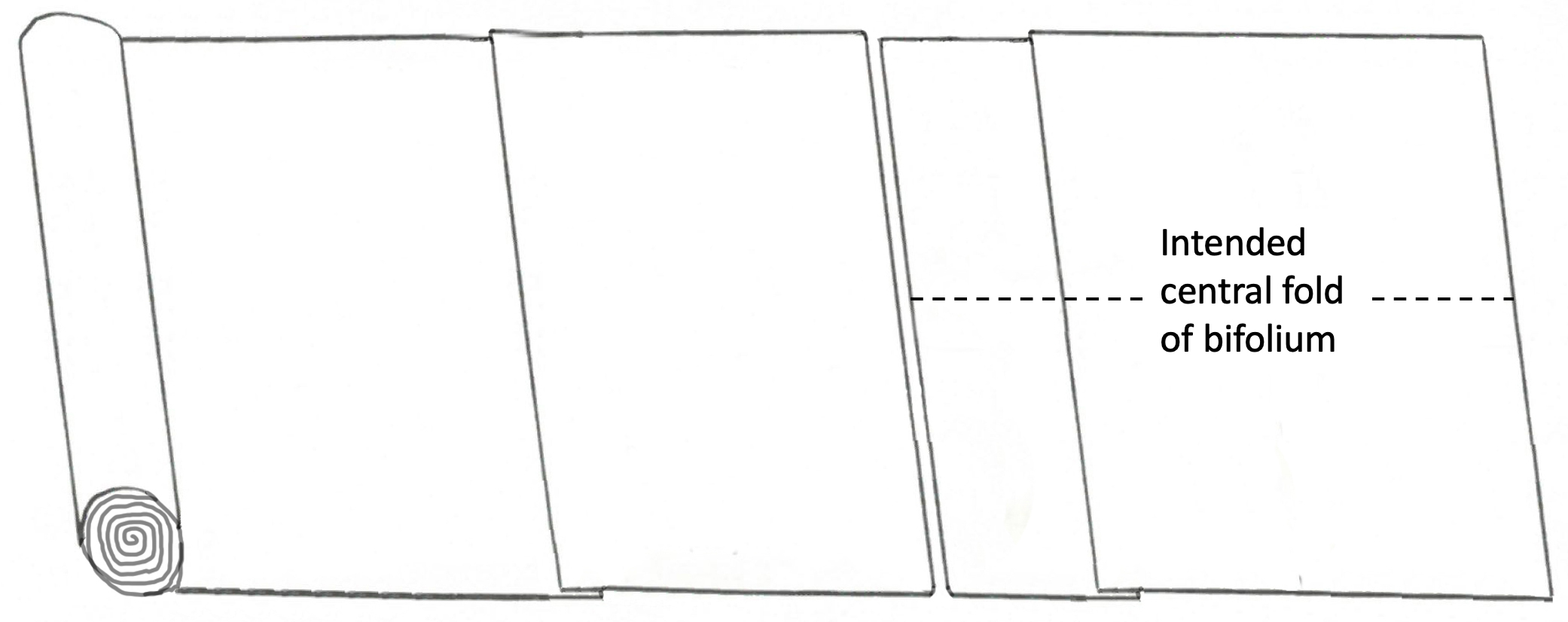
But there are also examples of cutting bifolia to the intended height of the bifolium (meaning the kolleseis are perpendicular to the central fold of the bifolia).
This phenomenon is a bit more common than I had first thought. I’ve mentioned a couple examples before on the blog:
The Bodmer Composite Codex Miscellaneous Christian texts (TM 61420)
Paris, BnF Copte 135E Apocalypse of Sophonias and the Apocalypse of Elias (TM 108728)
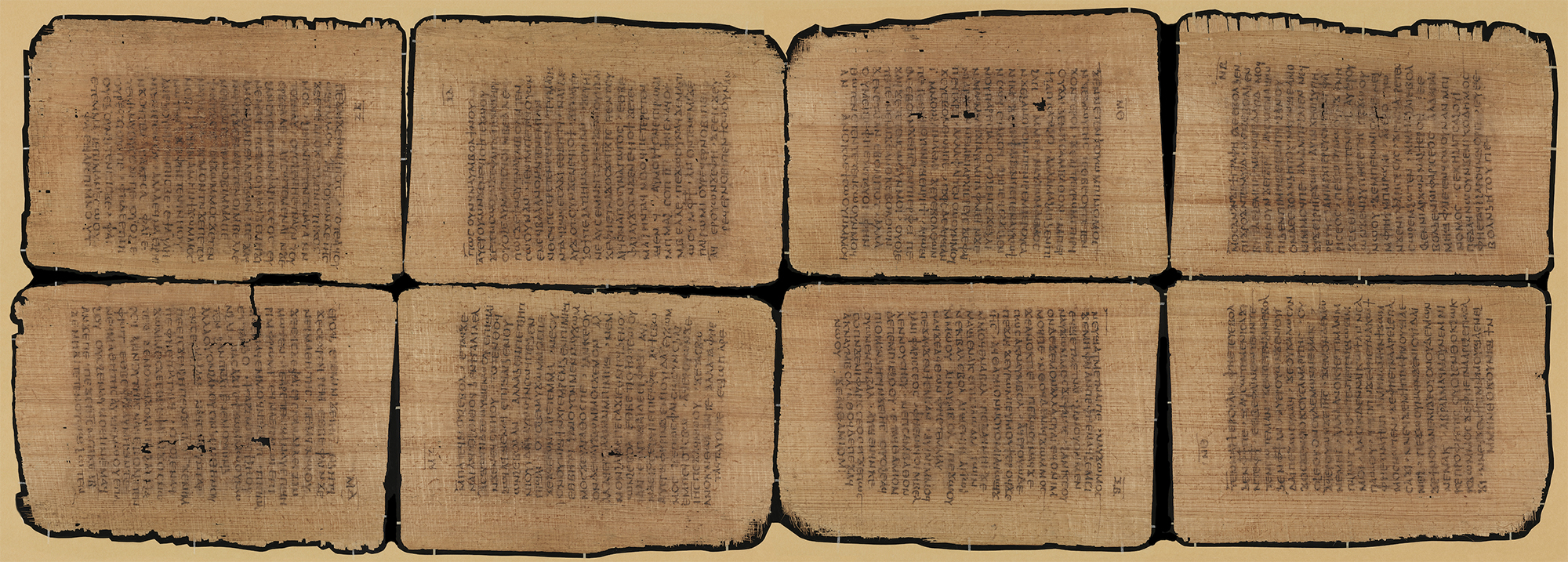
In the article on P.Bodmer 14–15, I note P.Bodmer 3 (TM 107758), a copy of Genesis and the Gospel According to John in Bohairic Coptic. The person who assembled this codex placed the bifolia cut from the roll into the quires in a curious manner, such that when the roll is reconstructed (using fiber patterns), the bifolia are sometimes “head to head” and sometimes “tail to tail”:
There are other examples:
Nag Hammadi Codex XIII, Trimorphic Protennoia, On the Origin of the World (TM 107753)
P.Bodmer 21 + Chester Beatty Cpt 2019, Joshua and Tobit in Coptic (TM 108537). In P.Bodmer 21, a protokollon is also visible (with the result that a single page has both vertical and horizontal fibers visible):

Finally, Bentley Layton’s catalog of the Coptic Manuscripts in the British Library actually records information about kolleseis for papyrus codices (most catalogues do not). I find the following examples of horizontal kolleseis:
P.Lond.Copt. 2 15, Psalter (TM 108549)
P.Lond.Copt. 2 137, Life of Phif (TM 108754)
P.Lond.Copt. 2 164 Monophysite Miscellany(?) (TM 108740)
P.Lond.Copt. 2 171 Miscellany (TM 108063)
P.Lond.Copt. 2 172 Miscellany (TM 108064)
P.Lond.Copt. 2 183 Biblical Concordance(?) (TM 108742)
P.Lond.Copt. 2 190 Disciplinary Fragment(?) (TM 108757)
No doubt there are more papyrus codices that show this feature. I would be happy to learn of them and add them to the list here.


