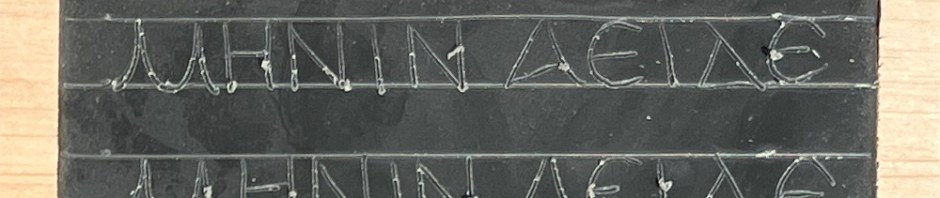
I’ve had waxed tablets on my mind for the last few months. In 2025, I had the opportunity to meet up with the ERC TabulaRasa project, which is doing some very interesting cross-cultural work on erasable media from antiquity to the early modern period.
I’ve used models of wax tablets in my teaching in the past. When working with several students writing, erasing, and rewriting in tablets, I’ve found that at the end of the session, I had to clean up a lot of wax shavings. This is because the students used the blunt end of the stylus to erase writing that has been scratched into the wax.

Depending on how thick the wax is and how deeply the writing is incised, this process can involve gouging out quite a bit of wax, which eventually needs to be replaced. A more efficient method involves heating the blunt end of the stylus over a flame to erase the writing by melting the wax and working it into a smoother surface without loss of wax. This is clearly a better method, unless you happen to be using a bone stylus instead of a metal one. And open flames probably run afoul of normal classroom safety rules.
I was discussing these topics with a colleague who said that her grandmother had actually used waxed tablets in school, and it was customary to just leave the tablets in the sun in order to erase them. The warm summer weather encouraged me to give it a try.
I inscribed a couple lines on a the inner side of a waxed diptych (bound together with a link stitch, in deference to Georgios Boudalis), and then left it out in the sun.

According to the weather report, it was about 34° C (about 94° F). After three hours in the sun, the wax was liquified (to the point that it was visibly seeping into the wooden frame).
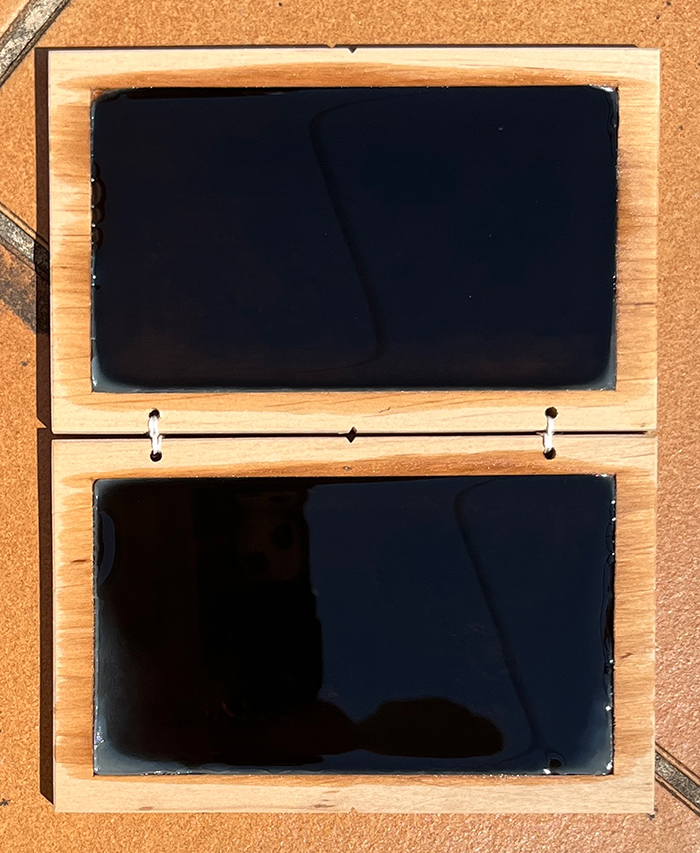
After a couple hours cooling off in the shade, it solidified into a smooth, clean slate with no wax lost (aside from what was absorbed into the wood.

This seems like a good method for achieving a fresh reset of wax tablets, at least in warm climates. It’s probably a bit impractical if one needs to reuse the tablets quickly (the whole melting-and-hardening process took about five hours).
For more on erasing and reusing wax tablets in antiquity, see Anna Willi, “Refill, Reuse, Recycle Reusing Wax Tablets in the Roman North-western Provinces,” in Erasing and Rewriting in Manuscript Cultures Practices of Text Obliteration and Manuscript Reuse in a Global Perspective, ed. Michele Cammarosano (De Gruyter, 2025).


Dear Brent,
Thank you so much for this very clever and interesting post, which we will definitely take into account during the systematic tests we will be conducting in the coming years as part of TabulaRasa – and heartfelt thanks, of course, for mentioning and linking to the project! :*
If of interest as related issue: the question of the sun’s effect on the inscribed layer of wax tablets had occupied me years ago when I was studying their use in the Ancient Near East, and various colleagues would ask me whether writing on wax at those latitudes didn’t expose it to the risk of melting what had been written… Taking advantage of a summer Hitzewelle in Würzburg (it must have been 2017 or 2018), I conducted a rough-and-ready experiment, trying to write during the day and leaving the tablets outdoors for a while, some in the shade and others in the sun. For anyone curious about the results, I reported them on page 165 of the article ‘They Wrote on Wax. Wax Boards in the Ancient Near East’, Mesopotamia LIV, 2019, 121–180 (co-authored with K. Weirauch, F. Maruhn, G. Jendritzki, and P. Kohl), which is freely available at https://osf.io/vj2e8/files/v58ze : “Also, our tests suggest that the hot climate of the Near East did not pose a problem to writing on wax. Only when left in the sun for hours with a room temperature of ca. 30 °C or more, did the layer of a board made of 75% beeswax and 25% ochre (cf. board A3) melt (Pl. 3). When the board is not left directly in the sun, even room temperatures of 35-40 °C do not disrupt the written surface.”
If anyone else feels like doing similar experiments, let me know how they turn out! 😊
xxx and again best thanks, yours Michele (Cammarosano)
Thanks for the link to the article! Your conclusions make sense. I’ve stored my tablets in some pretty warm places over the years, and they have never melted. I think one would have to deliberately set them in direct sunlight to get the effect that I obtained with this tablet. I was mainly just curious to see if my friend’s story about her grandmother checked out, and it did!
There was a recent project reconstructing a Roman river boat which had trouble getting encaustic paint to set in a 21st century German summer.
Thanks, Sean. Given what Michele said, I wonder if direct sunlight had a role to play?
I seem to recall they had problems when the boat was still in a tent under a 21st-century summer sun. It might have been one of Prof. Dr. Boris Dreyer’s projects at FAU Erlangen-Nürnberg but I can’t dig up the trade magazine with the article.
Have you found a good source for 1/8″ (ish) quarter-sawn lumber for the boards? You can make it with a tablesaw but those are dangerous tools. I also wonder how the colours like verdigris or lampblack affect the wax’s response to heat. I think I have even read of a find that used orpiment to colour the wax which is one way to keep mice from nibbling it.
I checked and Boris Dreyer talks about the encaustic and Pliny’s comments in Ancient Warfare (Karwansaray Bv) XII.4 (2019) and XIII.2 (2019). He used some damar resin and turpentine to help the wax resist 21st-century summer sun.