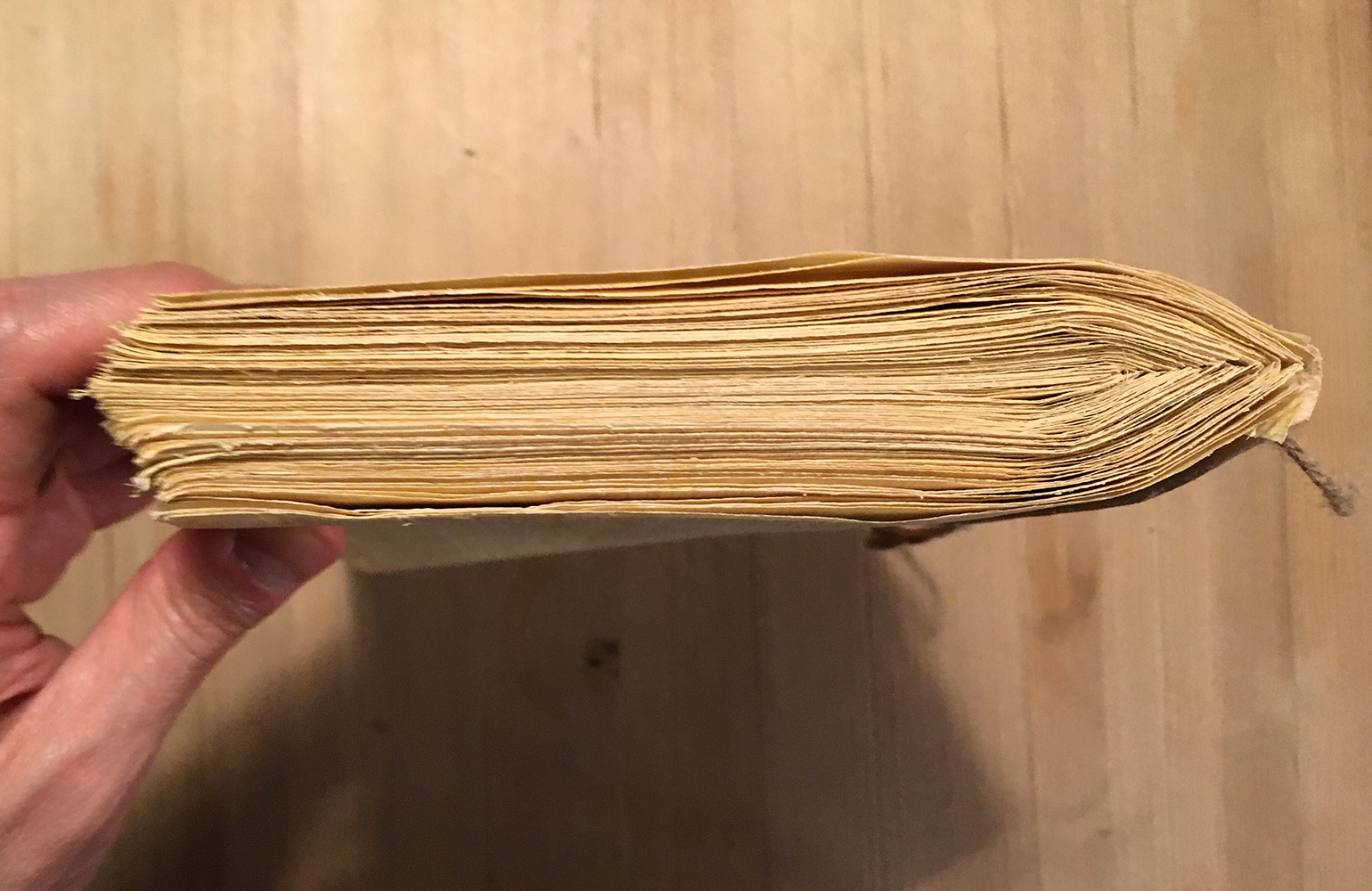
Over on the blog for my current research project (The Early History of the Codex), I have written a series of posts about making a model of the Beatty-Michigan Pauline epistles codex (P46).
Making models is always a useful exercise, and that was certainly true in this case. There are three posts that address different aspects of the process:
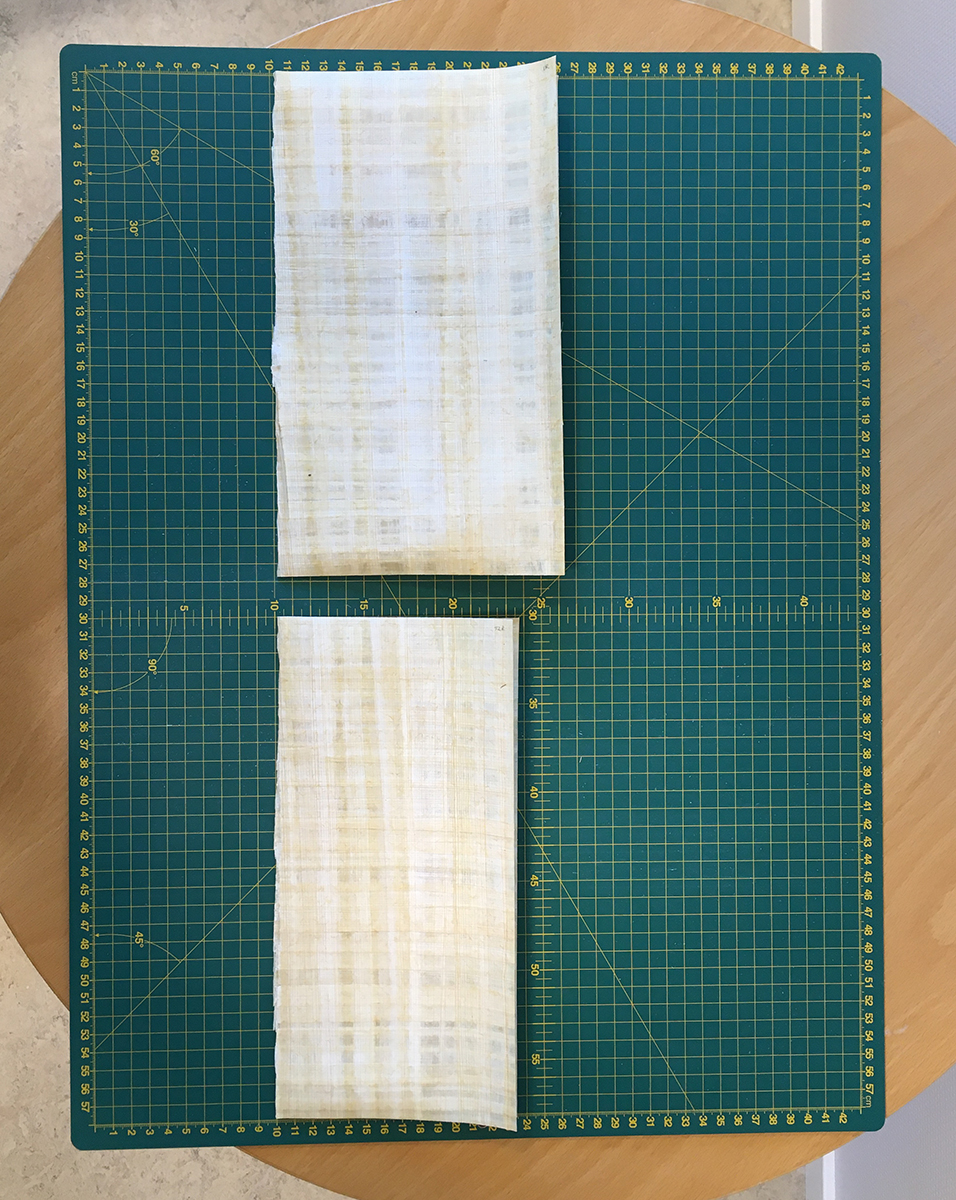
Folded bifolia for a model of P46 showing difference in size between outer and inner leaves in the quire (outermost bifolium on top, innermost bifolium on bottom)
The surviving portion of the papyrus codex of the letters of Paul split between the Chester Beatty Library and the University of Michigan (𝔓⁴⁶) consists of a well preserved but damaged single quire containing parts of nine of Paul’s letters. Because the pages of the codex are numbered, scholars have believed that it is possible to reconstruct the original size of the quire, which turns out to be too small for the traditional Pauline corpus of fourteen letters. Many scholars have taken this to mean that the codex did not contain the Pastoral letters (1–2 Timothy and Titus). Jeremy Duff has argued that the copyist increased the number of letters per page in the second half of the codex and intended to add extra leaves in order to produce a codex with all of the fourteen letters found in the majority of undamaged Greek manuscripts of Paul’s letters. While Duff’s hypothesis has been critically engaged on other grounds, this article assesses Duff’s proposed ancient comparanda for the addition of extra folia to the end of a single-quire codex and revisits the problem of the contents of this codex in light of the construction techniques of better preserved single-quire codices.
This was a fun article to research and compose. I had noticed that some of what Duff had written about the Nag Hammadi codices was not quite accurate, and I set out to make corrections on these points. In the process, I revisited the corpus of single-quire papyrus codices and made several realizations that I had missed before. For one thing, we (or I, at any rate) have assumed that we can use ancient page numbers to reconstruct precisely the original size of single-quire codices that are damaged or fragmentary. This is what we usually do with P46 with the result that–so I thought–there would have been insufficient space for 2 Thessalonians, 1-2 Timothy, Titus, and Philemon in the remaining leaves of P46. But in fact, some of our better preserved single-quire codices are asymmetrical when it comes to numbers of inscribed pages in the two halves of the codex. Nag Hammadi Codex II, for instance, has 70 inscribed pages in the first half of the codex and 75 inscribed pages in the second half of the codex. Blank front flyleaves and the presence of stubbed singletons account for the differences in this case, but other factors can contribute to asymmetry in the two halves of a single-quire codex. The upshot of this is the possibility that there were more missing pages at the end of P46 than we have generally thought, which opens up the possibility that the quire did originally contain all of the fourteen letters of Paul that we find in later Greek manuscripts of Paul’s letters. I did not at all expect to reach this conclusion, but I suppose that is why we do the research!
I should also note that in this article I especially benefitted from the rich collection of data on P46 in the PhD thesis of Edgar Battad Ebojo, “A Scribe and His Manuscript: An Investigation into the Scribal Habits of Papyrus 46 (P. Chester Beatty ii—P.Mich.inv. 6238)” (Ph.D. diss., University of Birmingham, 2014).
For those who have institutional access, the article can be found at the Novum Testamentum site. If you don’t have access, contact me for an offprint.
Thanks to Stephen Goranson for sending a reference to Arthur L.P. Norrington, Blackwell’s 1879-1979: The History of a Family Firm (Oxford: Blackwell, 1983), which provides identifications of several of the figures in the Muirhead Bone pastel of Blackwell’s book shop from 1950 that I wrote about in an earlier post. I had ventured an identification of the papyrologist Colin H. Roberts. Norrington identifies several of the figures with reference to a quotation by Basil Blackwell (1889-1984), a.k.a. “The Gaffer,” son of the founder of Blackwell’s, and chairman of Blackwell’s for forty-five years.
Image source: Arthur L.P. Norrington, Blackwell’s 1879-1979: The History of a Family Firm (reprint; Oxford: Blackwell, 1985), page 122.
“The Gaffer’s key to Muirhead Bone’s drawing on facing page. On the right is the Revd. Colin Stephenson, Vicar of St. Mary Magdalen and later Chaplain of the Slipper Chapel at Walsingham. Beyond him Colin Roberts, Secretary of the Delegates, J.D. Mabbott, President of St. John’s, and the fine figure in the centre of Professor Hugh Last, Principal of Brasenose. (G. N. Clark originally posed for this position, but was dismissed by Bone as not being of sufficient height and dignity, and Last was sent for). Seated on the left is an an undergraduate … D.L. Edwards of Magdalen. Behind him is Professor Garrod, my Mods tutor, of Merton, and in the far distance Enid Starkie (in all the colors of the Rimbaud!–a witticism attributed to me but above my blood. I tackled Bowra on this head, but he denied it). At the foot of the staircase, seen in profile, is son Richard; coming down the staircase–myself.”
So, the people identified in the picture are:
John Colin Stephenson (d. 1973) [[20 June 2022: See comment by Llewelyn Morgan below]] Colin Roberts (1909-1990) John David Mabbott (1898-1988) Hugh M. Last (1894-1957) David L. Edwards (1929-2018) Heathcote William Garrodd (1878-1960) Enid Mary Starkie (1897-1970) Richard Blackwell (1918-1980) Basil Blackwell (1889-1984)
Norrington adds that Ewart ‘Edgar’ Hines “is the figure behind the serving desk.” Mentioned but not pictured are George N. Clark (1890-1979) and Maurice Bowra (1878-1971).
It is interesting that Last and Roberts are together in the image, as Last appears in the obituary for Roberts in the Proceedings of the British Academy 84 (479-483):
“In H.M. Last he had an ancient history tutor who could be extremely stimulating, and Colin had from boyhood always thought of himself as a historian rather than a pure scholar. It may well have been Last who determined Colin’s choice of career, as he was to do three years later with another young Oxford classic, Eric Turner.”
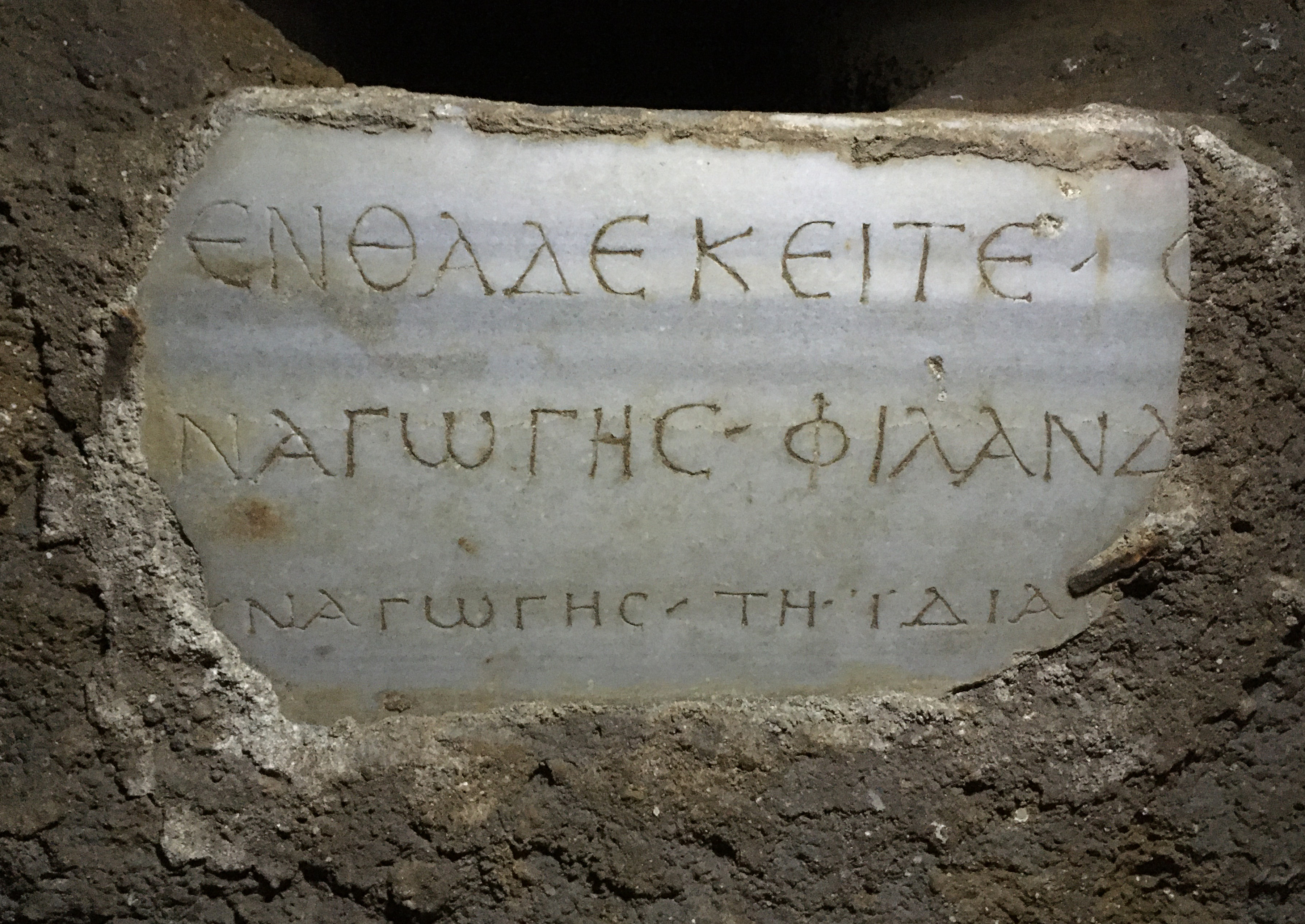
Thanks to the amazing Silvia Prosperi at A Friend in Rome, I recently had the good fortune to be able to visit the Jewish catacomb at Vigna Randanini out on the Via Appia. It was a wonderful visit, and I especially enjoyed the chance to see the inscriptions there. These inscriptions were published a long time ago (in 1862 by Rafaelle Garruci, who also found the famous “Alexamenos” crucifixion graffito), but seeing them in person was quite exciting and revealing. While the texts are familiar from publications, the inscriptions themselves as material artifacts are something else altogether. For instance, I did not realize how much similarity exists between the scripts used to copy literary manuscripts and the writing used in these inscriptions. Here’s one example, CIJ I 166 (=JIWE 2 251):
CIJ I 166; image source: Brent Nongbri, February 2022
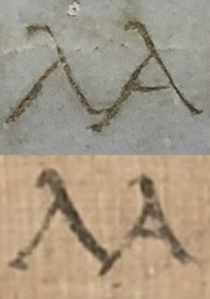
The details and overall impression of this script remind me very much of the “Roman Uncial” or “Rounded Majuscule” script that was used to copy, for example, the Hawara Homer papyrus.
The letter shapes and proportions are quite similar, and also the square modulus of the letters (except the inscribed nu, which is sometimes a bit narrower than the other letters):
These letters seem to me to be aiming for a similar aesthetic. I am impressed by the qualities of the small serifs or thickenings at the beginnings and ends of strokes. They are especially prominent on alpha, delta, and lambda.
When writing on papyrus with a reed pen, these types of serifs are produced with a slight movement of the flat edge of the nib either at the beginning or the end of the main part of the stroke. That is to say, this seems to me to be a case in which the epigraphic style of the stone inscriptions is imitating the style of the pen-and-ink manuscript writing.
Now, what’s especially interesting to me about this is the dating (shocking, I know). For this inscription, David Noy (Jewish Inscriptions of Western Europe, vol. 2) offers a date of “3rd-4th century?” which is the date he assigns to nearly all the inscriptions from this catacomb, presumably on the basis of the interpretation of the archaeological evidence of the catacomb itself. Examples of this particular style in pen-and-ink manuscripts are generally assigned to the second century, or to a period of “revival” in the fifth century.
I’ve wondered if the tendency to assign these scripts to either the second century or the fifth century might be a bit restrictive. Might the style not have persisted throughout this period? It would be interesting to learn exactly how secure the evidence is for the dating of the phases of use of the Vigna Randanini catacomb.
It was a fantastic visit, and I highly recommend A Friend in Rome!
Colin H. Roberts (1909-1990) will be known to some as the papyrologist who published editions of many important papyri, including early Christian pieces like P.Ryl. Gr. 3 457 (a.k.a. P52) and the Magdalen College fragments of the Gospel of Matthew (P64). To others he will be known as the Secretary to the Delegates (basically the CEO) of Oxford University Press from 1954 to 1974.
His obituary in the Proceedings of the British Academy concludes, as these obituaries often do, with a few words about his physical appearance. That description includes the following interesting note:
“His physique and what it told about his character were well caught…in the well-known Muirhead Bone view of Blackwell’s, in which he is one of the browsing scholars.”
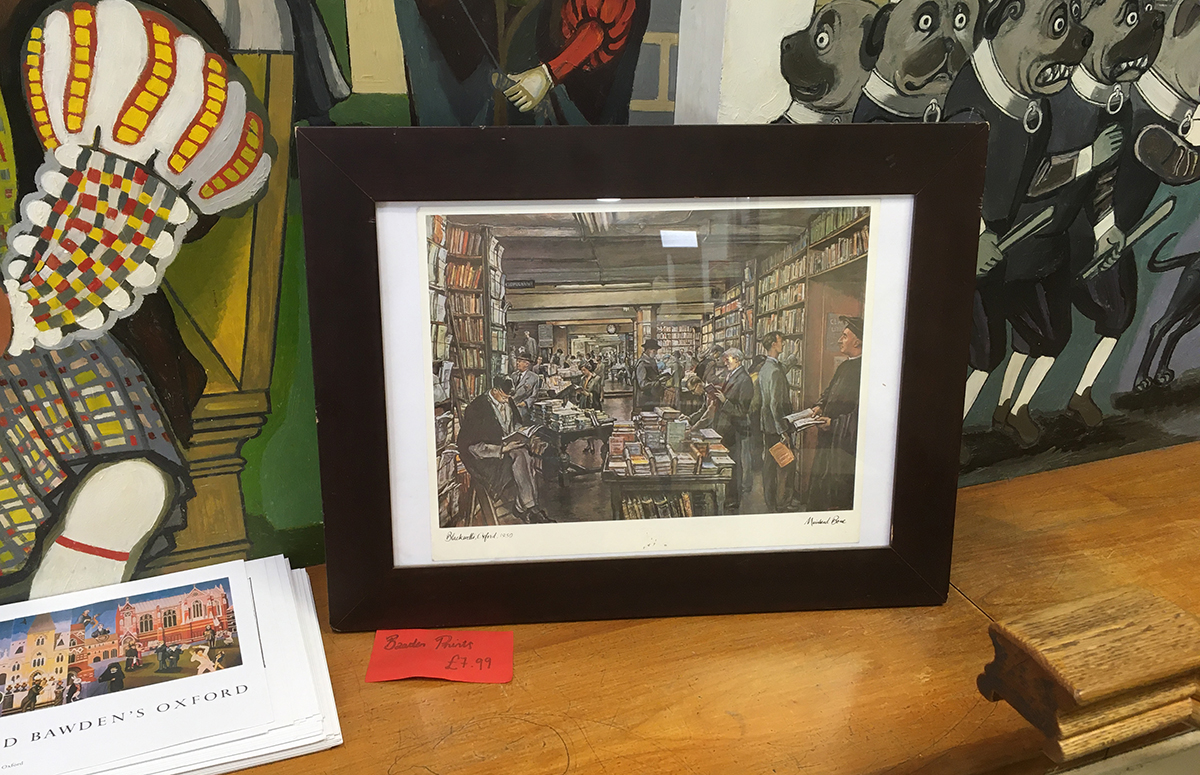
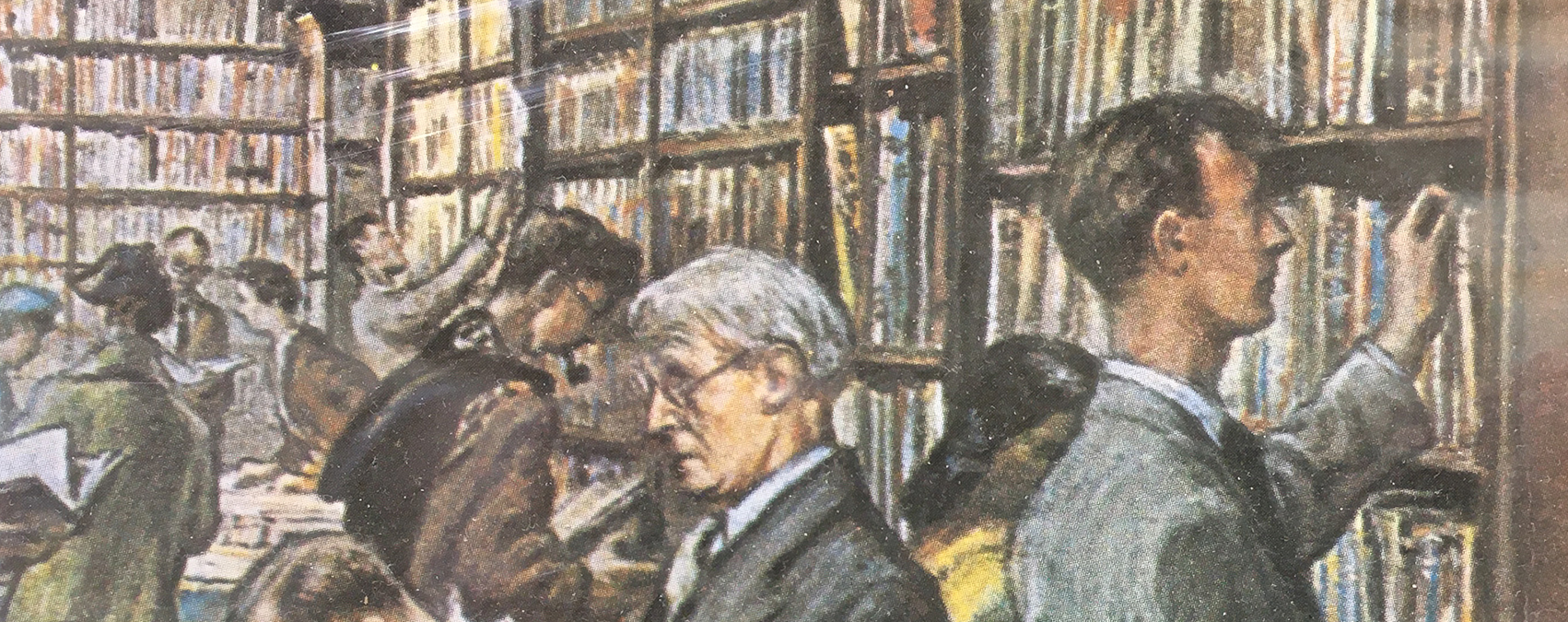
In my first trip to Blackwell’s in several years yesterday, I stumbled across this picture in person for the first time. I noticed it sitting in a somewhat beat-up frame, leaning randomly against one of the walls near a stairwell. I was surprised to see it was in color, as I had only ever seen a black and white reproduction. I’m guessing that Roberts must be the nearest figure facing right on the right side of the picture.
“Blackwell’s, Oxford, 1950” by Muirhead Bone; image April 2021
A comparison with a roughly contemporary picture of Roberts shows some similarities:
Left: C.H. Roberts ca. 1954; image source: Wm. Roger Louis (ed.), The History of Oxford University Press, Volume III: 1896-1970 (Oxford University Press, 2013) p. 131; Right: Detail of Blackwell’s, Oxford, 1950″ by Muirhead Bone
I wonder if the identities of any of the other figures in the picture are known? [[Update 19 June 2022: The identities of several of the people in the picture are revealed here!]]
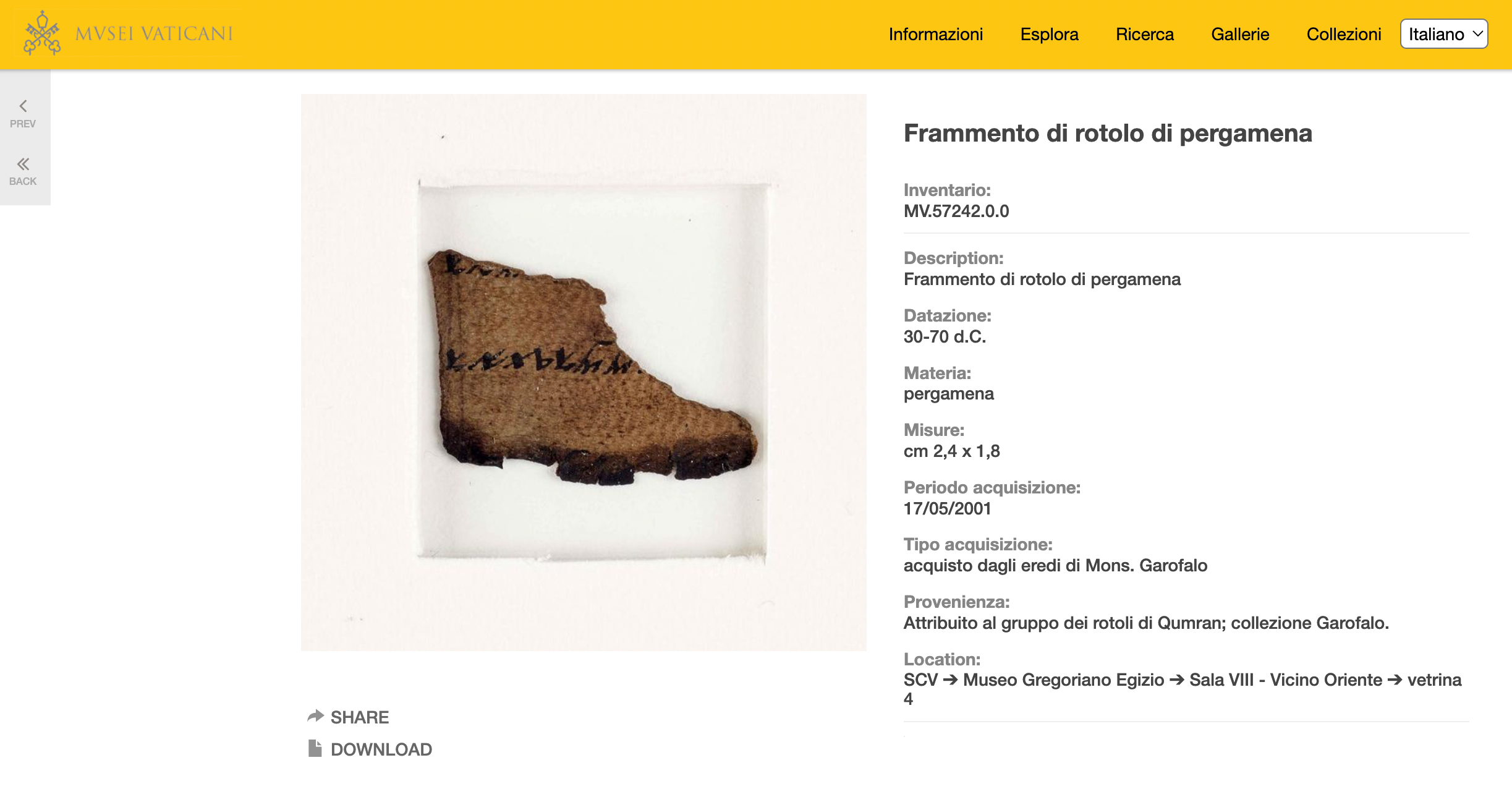
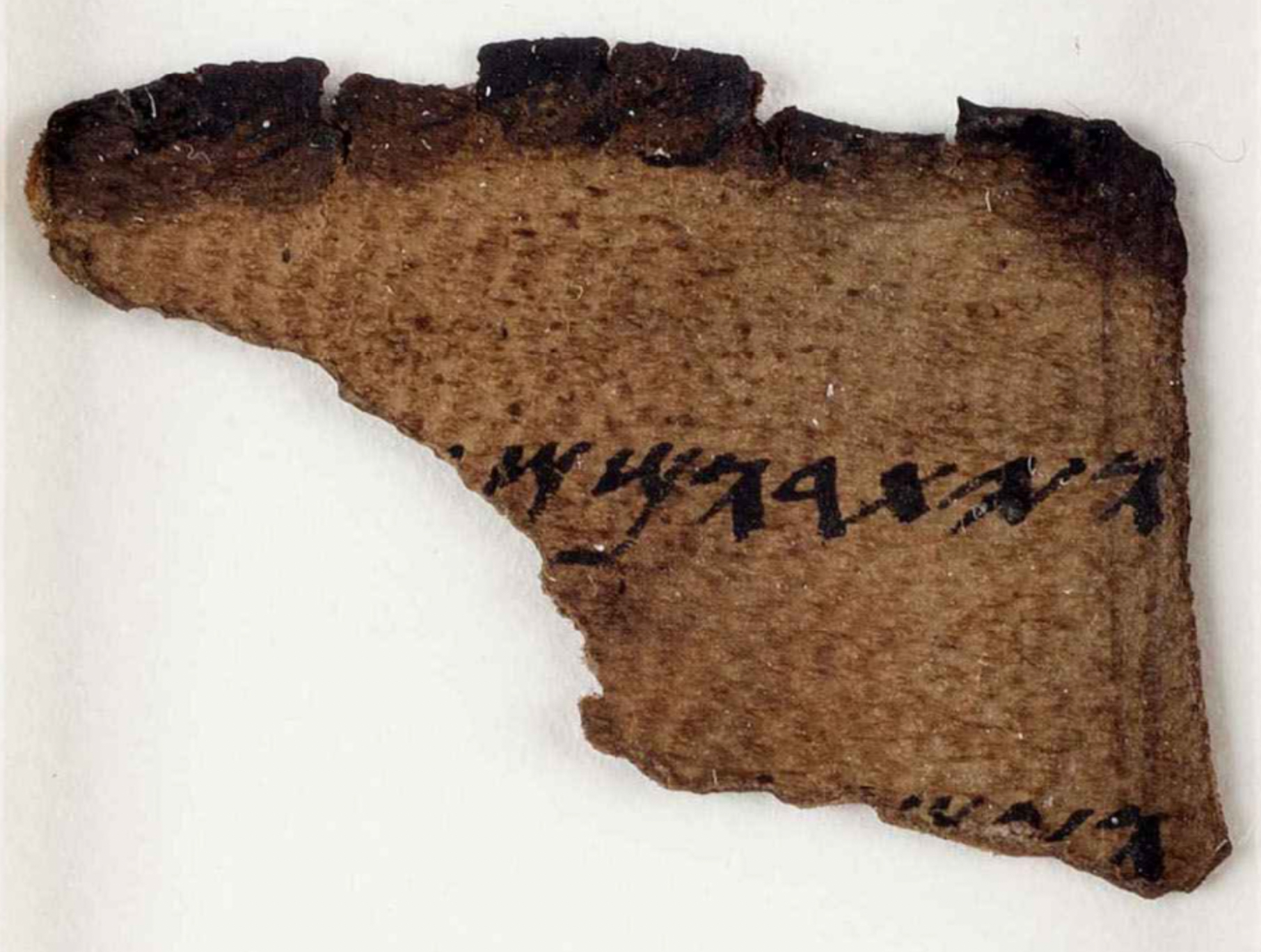
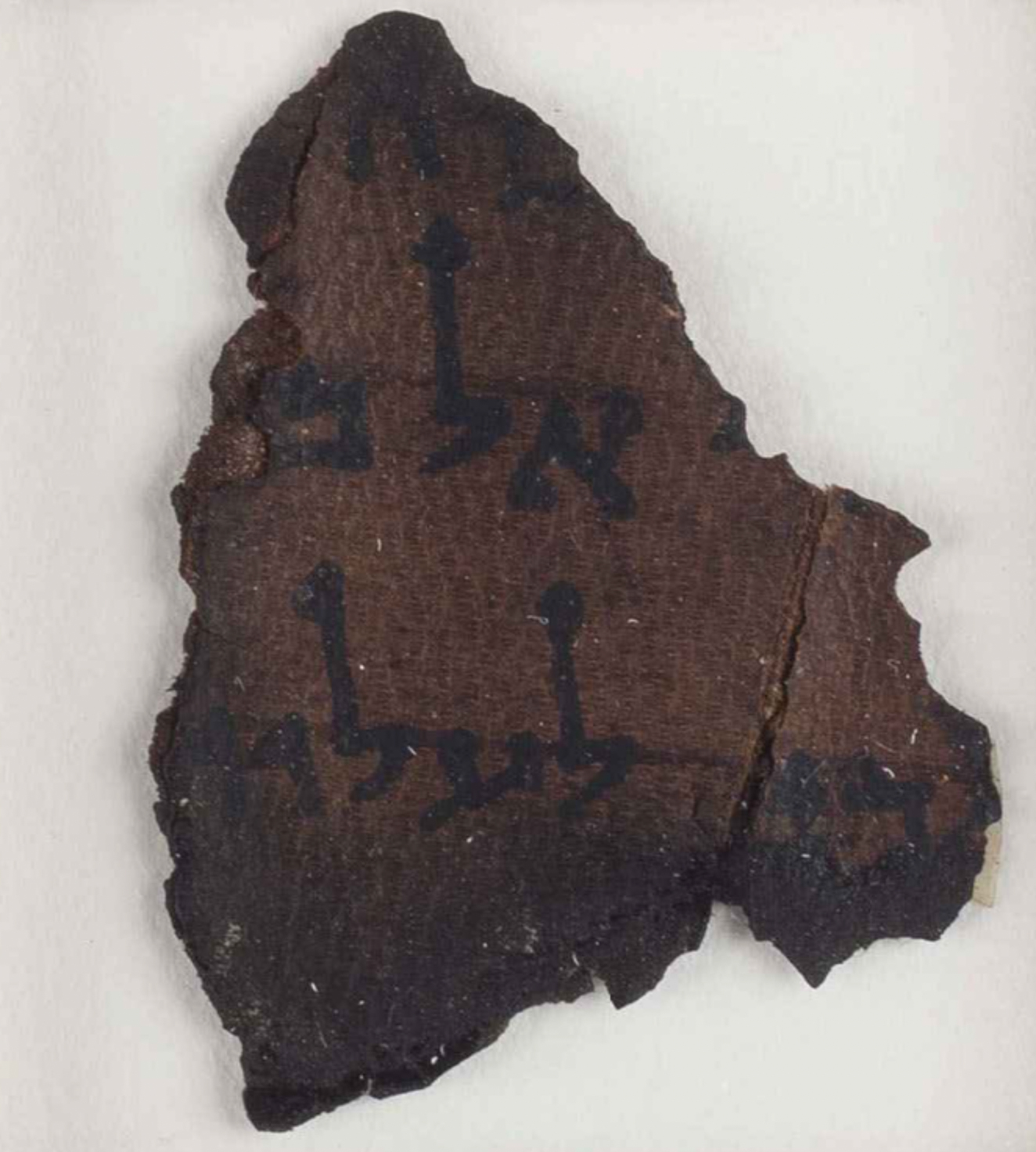
I mentioned in a post in 2021 that the Vatican Museum had on display two small fragments of animal hide with Hebrew letters that are identified as “inscribed fragments of Qumran scrolls.” They were donated in 2001 from the personal collection of Salvatore Garofalo (1911-1998), a priest and theologian. At the time, I could not find any quality digital images of the pieces. I see from some browsing on the excellent online catalog of the Vatican Museum that much better images are indeed available (though, like the display in the Museum, the fragments are upside down):
I was unable to get the files to download, but there was a solid zooming feature available that provided good detail (the images of the fragments below have been flipped so that they are oriented properly).
I’ve been meaning to post for quite some time on a fascinating video from the 2021 Birmingham Colloquium on New Testament Textual Criticism. Elijah Hixson presented on P50, a papyrus bifolium containing Acts 8:26-32 and 10:26-31 kept at Yale’s Beinecke Library (P.CtYBR inv. 1543, LDAB 2861). It was bought in Paris from Maurice Nahman in 1933. It’s generally assigned to the fourth century, but Hixson argued this piece might be a modern fake. I think he’s right.
I don’t want to give away too many of the details. Hixson builds a cautious cumulative case for forgery that is definitely worth watching, either in the original Birmingham presentation here or a more recent version here.
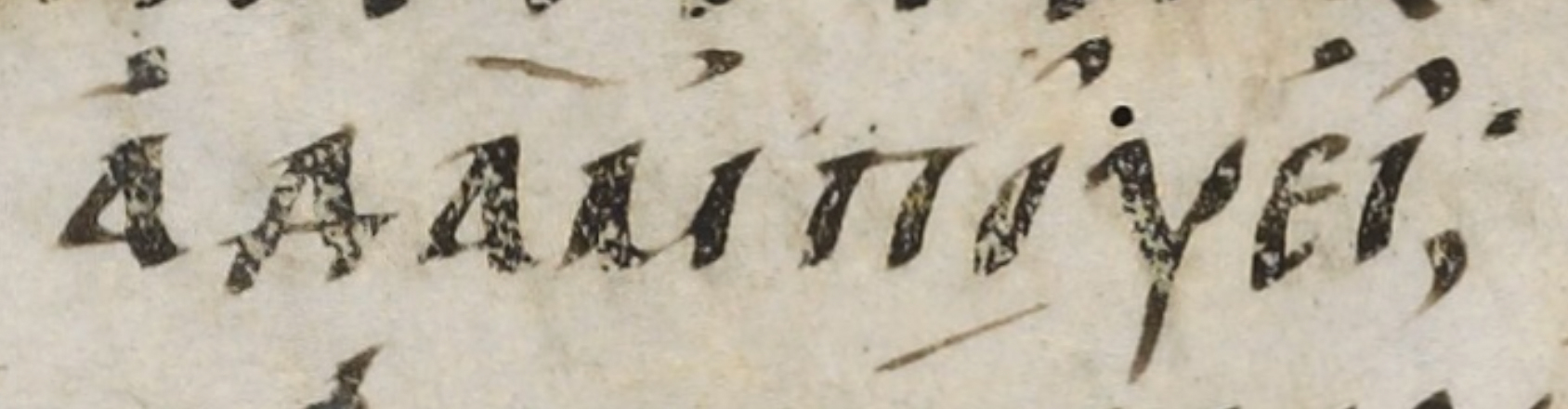
I just want to dwell on one issue that came up in the video that has been of interest to me for a while. In both videos, Elijah comments upon the presence of the symbol ; used to mark questions on two occasions in P50, the end of Acts 8:31 and the end of Acts 10:21.
As Elijah notes, this seems out of place in a fourth century manuscript. In fact, as far as I know, this would be unique among papyrus manuscripts of the fourth century, as the “semicolon”-style question mark does not occur regularly in Greek manuscripts until much later. This seems to me to be, by itself, a strong indication of that P50 is a modern forgery.
But I have wondered for a while: When, exactly, do we start seeing the ; symbol as question mark in Greek manuscripts? The textbooks have not been especially helpful. The clearest statement I have seen is Edward Maunde Thompson writing in 1912 (An Introduction to Greek and Latin Palaeography):
“The mark of interrogation also first appears about the eighth or ninth century” (p. 60).
Frustratingly, Thompson does not provide any examples. The earliest instance I know of is a manuscript of Genesis in the Bodleian Library at Oxford (Bodleian Library MS. Auct. T. inf. 2). This is a parchment manuscript copied partially in majuscules and partially in minuscules. Some authorities assign it to the 9th century, others to the 10th century.
The phrase ἀδαμ ποῦ εἶ is already marked as a question by the circumflex accent over the diphthong in ποῦ (“Adam, where are you?”), but the copyist has also added the ; symbol. As I noted, this is the earliest piece I have been able to find with the ; question mark. But there must be some earlier examples that Thompson had in mind. Does anyone know of any?
Someone has done a real number on the Wikipedia page for 7Q5. [[Update 20 March 2022: I see that a good citizen has cleaned up some of the Wikipedia page. The version I cited is here. Let’s hope the page keeps improving.]] [[Update 11 Aug 2025: The page is now a complete disaster.]] Some older versions of the page were both more informative and much less cluttered. Now it is a mess. So it goes with Wikipedia.
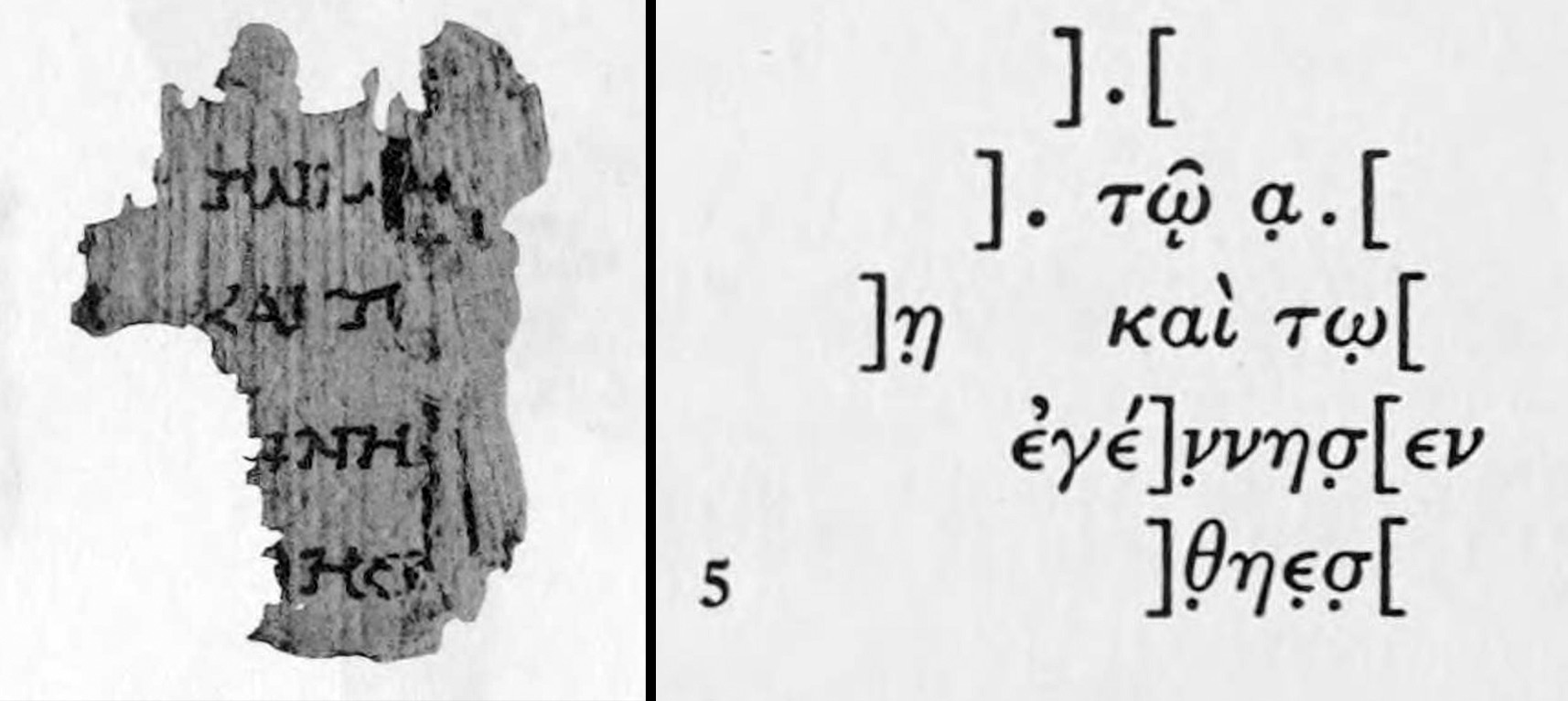
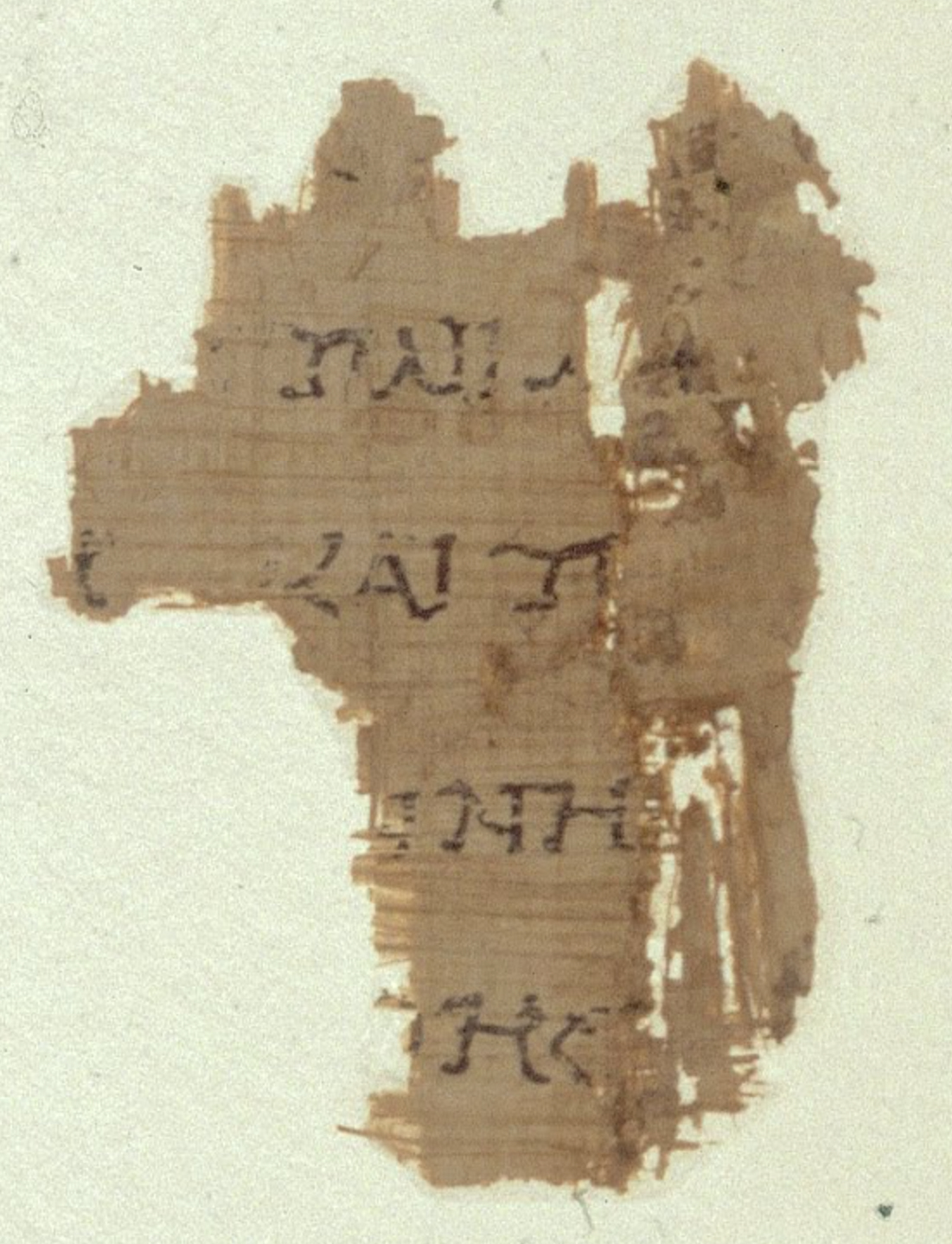
For those who might not know this manuscript, it was one of several small fragments of papyrus found when archaeologists excavated Cave 7Q at Qumran. The profile of the manuscripts from this cave was a bit different from that of the other caves near Qumran. The Cave 7 manuscripts were all papyrus (as opposed to animal skin) and all in Greek (as opposed to Hebrew or Aramaic). Maurice Baillet (1923-1998) published the 7Q texts in 1962. He was able to identify two texts (7Q1=Exodus, 7Q2=Letter of Jeremiah). Unfortunately, many of the fragments contain just a few letters and could not be identified with known texts with any degree of confidence. Among these was 7Q5, a small fragment that Baillet published with the assistance of Marie-Émile Boismard (1916-2004). Here is the plate published in DJD alongside the editors’ transcription:
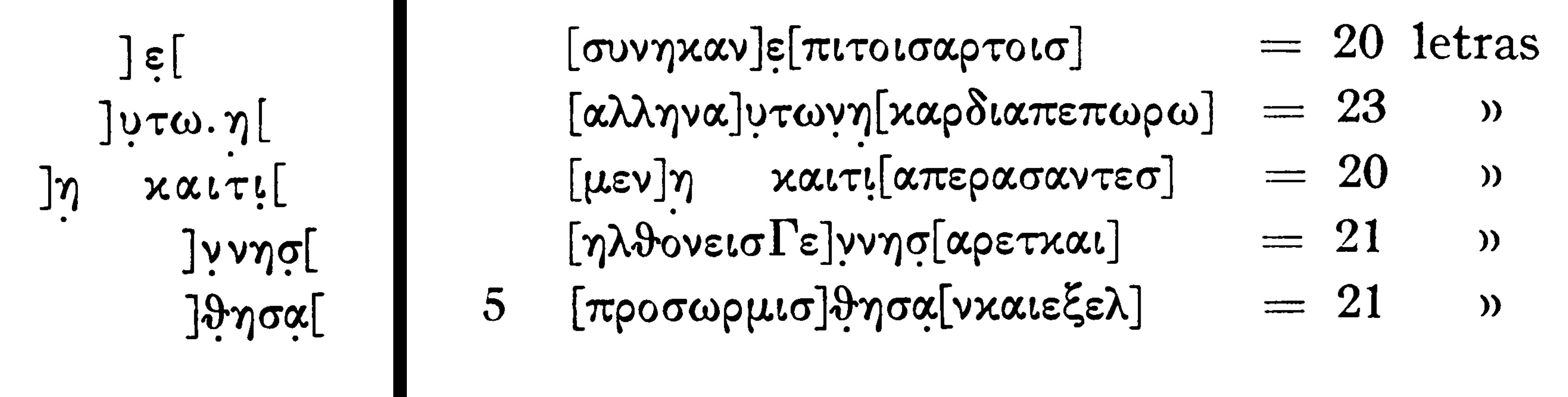
Beginning in 1972, José O’Callaghan (1922-2001) tried to identify several of the 7Q scraps as New Testament texts. Because the material in the caves near Qumran is generally thought to have been deposited before or during the war against Rome in the 60s CE, any manuscripts found there could in theory be assigned on objective grounds to a period before the war. Hence, O’Callaghan was claiming to have identified the earliest surviving Christian manuscripts, allegedly copied within thirty years of the death of Jesus. O’Callaghan’s claims thus attracted a great deal of attention. Most specialists were not persuaded by O’Callaghan’s arguments, and some of his proposed identifications have been conclusively refuted (for instance, 7Q4 and 7Q8, which O’Callaghan identified as parts of 1 Timothy and James, are now widely regarded as both being part of a roll that contained 1 Enoch). But the identification that has received the most attention was O’Callaghan’s claim that 7Q5 was a fragment containing the remains of Mark 6:52-53. O’Callaghan’s diplomatic transcription is below at left, and his transcription with reconstruction is at right.
This proposed identification provoked a strong reaction. The vast majority of qualified scholars emphatically rejected O’Callaghan’s arguments for several reasons. O’Callaghan’s reconstruction
depended upon highly suspect readings of several letters (such as the proposed nu in the second line, omitted in O’Callaghan’s diplomatic transcription but present in his contextual transcription).
required the existence of an otherwise unattested textual variant (the absence of the words επι την γην in Mark 6:53). [[Update 21 February 2024: Not true! See the comments below for discussion.]]
necessitated that one of the nine undisputed letters on the papyrus must be a scribal error (tau for delta in line 3).
After a flurry of articles in the 1970s demonstrating the problems with O’Callaghan’s thesis, the guild moved on. But the idea was resurrected by Carsten Peter Thiede (1952-2004) in the late 1980s and 1990s. Thiede made his case mostly through a sensationalist media campaign. This effort again elicited an overwhelmingly negative response from scholars, but, as the current version of the Wikipedia page indicates, the theory refuses to die in some circles, despite its documented weakness.
Over the years, much of the discussion about the papyrus has revolved around the identity of the letters after the omega in line 2. O’Callaghan read a nu while the original editors read an iota-space-alpha. If the nu is not present, then O’Callaghan’s already shaky identification loses any plausibility. In the years after O’Callaghan’s proposal, better images of the fragment were made available (such as the one below), and the original editors’ reading of an iota after the omega has been accepted by nearly all specialists. But the palaeographic argument–to the extent that there even is a meaningful argument–is not what got my attention in this story.
In a short pamphlet published in 1989, Stuart Pickering and Rosalie Cook of Macquarie University pointed out something that I had not noticed before: Much (or all?) of the hoopla surrounding this fragment was based on O’Callaghan’s misreading of a printed text. It’s kind of amazing. The whole debacle of this proposed identification seems to have resulted from O’Callaghan’s inability to properly equate a photographic plate with a printed transcription. Let me unpack this a little. Here is what O’Callaghan wrote back in his 1972 article criticizing the original edition of the papyrus:
“After the ⲱ, the ⲁ suggested by the editors seems inadmissible. The traces of the facsimile are too uncertain to allow a satisfactory reading, even though one comes to discover the left vertical stroke and the peculiar descending contour of a ⲛ similar to that of line 4. However, I am not quite able to explain the movement of this inner stroke, which rises too much in its last phase. For all these reasons, in the new transcription, I prefer to limit myself to putting a dot instead of a letter.” (“Detrás de la ⲱ la ⲁ sugerida por los editores parece inadmisible. Los trazos del facsímil son demasiado inciertos para permitir una lectura satisfactoria, a pesar de que se llega a descubrir el palo vertical izquierdo y el peculiar contorneo descendente de una ⲛ semejante al de la línea 4. Sin embargo, no me acabo de explicar el repliegue de este trazo interior que en su última fase sube demasiado. Por todo ello, en la nueva transcripción prefiero limitarme a poner un punto en vez de una letra.”)
O’Callaghan seems to have mistakenly thought that in the view of Baillet and Boismard, an alpha followed immediately after the omega in line 2. So, it’s not the case that O’Callaghan judged the editors’ omega–iota-space-alpha sequence to be a bad reading in need of improvement. Rather, he appears to have failed to understand that Baillet and Boismard rendered the script ⲱⲓ (omega–iota) by means of a printed ῳ employing the iota subscript. O’Callaghan took the printed ῳ to represent just one letter–ⲱ–and then believed the editors had misconstrued the following vertical line (“el palo vertical”) as part of an alpha. Amazing. So much ink spilled as a result of nothing more than a silly error.
But wait! There’s more! In the following issue of Biblica, Baillet, one of the original editors, weighed in and actually pointed out O’Callaghan’s mistake: “After the omega, the reading ⲛⲏ is absolutely impossible. There is first of all an iota, which is adscript in the document but subscript in the edition, and which J. O’Callaghan has completely ignored. The iota is certain, and it is absurd to see it as the left stroke of a nu.” (“Après l’oméga, la lecture ⲛⲏ est absolument impossible. Il y a d’abord un iota, qui est adscrit dans le document, mais souscrit dans l’édition, et que J. O’Callaghan a complètement négligé. Cet iota est sûr, et il est absurde d’y voir le jambage gauche d’un nu.”)
With this mistake pointed out already in 1972, the same year of O’Callaghan’s publication, the matter should have ended there. A quick retraction from O’Callaghan would have been appropriate. But O’Callaghan did not admit to his initial mistake. Instead, after his own visit to see the papyrus in person, O’Callaghan defended his readings, even this obvious error, in a series of subsequent publications (though in 1976, he allowed that some of his other 7Q identifications were open to question).
We all make mistakes, and if we’re lucky, the peer review system catches them before they go into print. It is disappointing that the journal editors and peer reviewers did not catch this particular error and save all of us a great deal of time and energy.
Sources mentioned:
Baillet, Maurice. “Les manuscrits de la Grotte 7 de Qumrân et le Nouveau Testament.” Biblica 53.4 (1972), 508-516.
Baillet, Maurice, J.T. Milik, and R. de Vaux (eds.). Les ‘petit grottes’ de Qumrân, DJD 3.2. Oxford: Clarendon, 1962.
O’Callaghan, José. “The Identifications of 7Q.” Aegyptus 56.1 (1976), 287-294.
O’Callaghan, José. “¿Papiros neotestamentarios en la cueva 7 de Qumrān?” Biblica 53.1 (1972), 91-100.
Pickering Stuart R. and Rosalie R.E. Cook. Has a Fragment of the Gospel of Mark Been Found at Qumran? Sydney: Macquarie University Ancient History Documentary Research Centre, 1989.
In volume 220 of Zeitschrift für Papyrologie und Epigraphik (2021), there is a short article by Cornelia Römer: “Die Datierung des Kölner Mani-Kodex” (pp. 94-96).
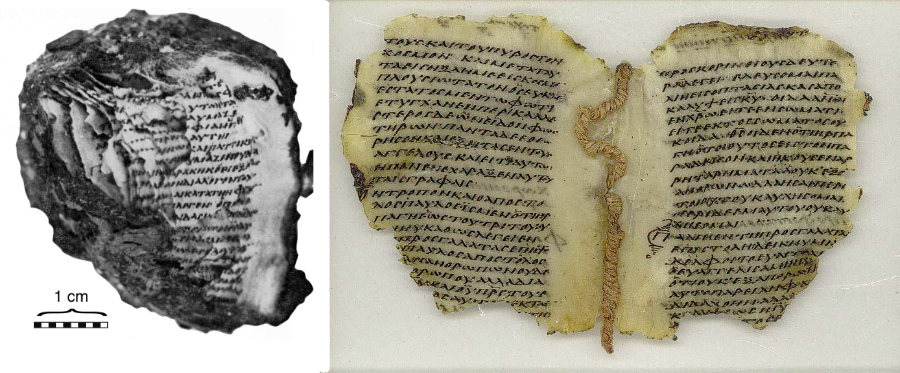
The article reports the results of AMS radiocarbon analysis of the Cologne Mani codex. For those who don’t know this remarkable little book (TM 64574): It is a miniature parchment codex whose leaves are about 3.8 cm wide and 4.5 cm high. It contains a biography of the prophet Mani (c. 216-276 CE) in Greek. It is copied in finely executed letters that are just 1 millimeter high.
Cologne Mani Codex before and after conservation (Kölner Papyrussammlung)
The codex was reportedly bought in Egypt in the late 1960s, but the details are very sketchy. According to Albert Henrichs (in 1979) “next to nothing is known about the fate of the Mani Codex before it reached Cologne.” Rumors that the codex had been subjected to radiocarbon analysis have been circulating since the 1990s, but no publication had appeared. Until now.
To briefly recap the ranges of dates that have been proposed for the codex: When the existence of the codex was first reported in 1970, Albert Henrichs and Ludwig Koenen believed on the basis of its script that the codex was likely produced in the fifth century CE (“Aus paläographischen Gründen ist er wahrscheinlich dem 5. Jh. zuzuweisen”). In 1977, Eric Turner opted for fourth century or fourth-fifth century. In 1990, B.L. Fonkič and F.B. Poljakov assigned the copying of the codex to the eighth century CE. More recently, Pasquale Orsini has argued that the codex preserves the work of two copyists working in two different periods. One hand that “could be dated to the sixth century” was the initial copyist, and then “some time between the second half of the eighth century and the beginning of the ninth century” a second copyist, probably “intervened later to ‘restore’ parts at the beginning and end of the codex which had been damaged.”
Now to the radiocarbon analysis: The process was undertaken at the initiative of Ludwig Koenen in 1995. What was sent off for analysis was a 7.25 mg sample taken from the binding thread of the codex. To supplement the report provided in ZPE: It is very important to recall that the codex was in a delicate state when it was purchased, and it underwent an extensive process of conservation in the hands of Anton Fackelmann. I am not aware if there is a detailed and reliable account of the exact procedures used for conservation. In 1979, Albert Henrichs reported that the codex arrived in Vienna as a collection of four clumps of leaves gummed together. Then, “with the help of a chemical solvent manufactured in the United States, Dr. Fackelmann managed to soften the brittle material. …[T]he pages came off much faster than I could transcribe them.” It would be very good to know what exactly this chemical solvent was–and whether it came into contact with the binding thread of the codex. If the solvent contained carbon, the possibility of contamination arises.
The results of the analysis were reported as follows in a letter from the AMS facility at the University of Arizona dated 20 January 1996:
“Radiocarbon Age: 1,652 ± 60 yr BP”
“Calibrated Age: 267 – 434 AD (1 sigma, 68% confidence) 240 – 540 AD (2 sigma, 95% confidence)”
Römer supplements these results with a more recent IntCal13 calibration expressed in the following way:
“Für die 2 Sigma Fehlergrenzen (95%) erhält man folgendes detaillierte Resultat:
Wahrscheinlichkeit 263 – 274 AD (0,048) 330 – 432 AD (0,745) 490 – 533 AD (0,207)”
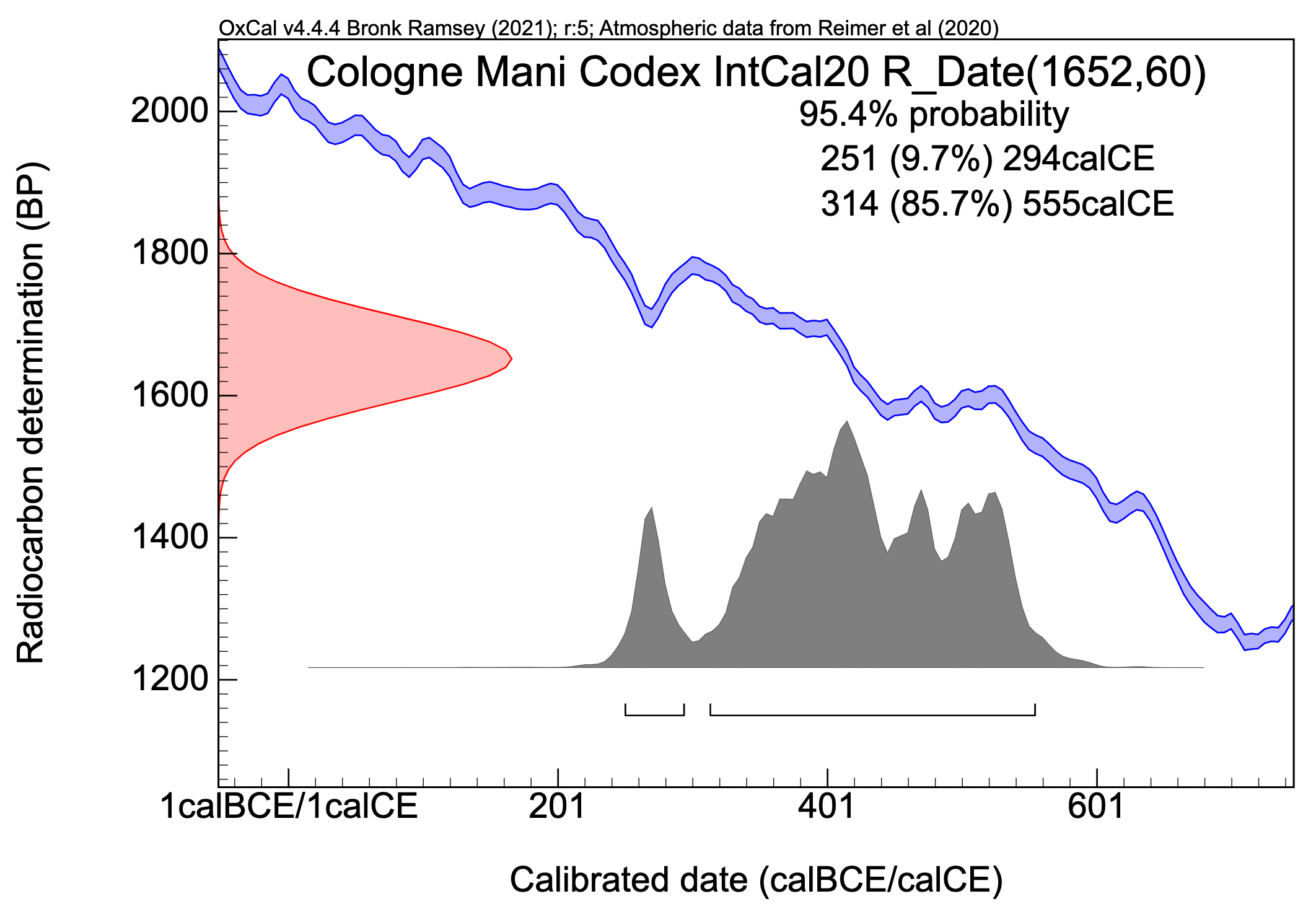
We can now adjust again with the still more recent IntCal20 data using the OxCal v4.4.4 program:
The estimated date ranges at 95.4% probability are:
251 – 294 CE (09.7%) 314 – 555 CE (85.7%)
The results across all three sets of calibration data are relatively uniform. The latest calibration offers a slightly wider range of possible dates–from the middle of the third century to the middle of the sixth century. The third century dates can probably be safely excluded, as the biography of Mani contained in the codex is generally thought to have been composed in the fourth century.
The original date assigned by the editors (fifth century) along with Turner’s wider range (fourth-fifth century) are both consistent with the radiocarbon data. That the codex was originally produced in the eighth century, as Fonkič and Poljakov had argued, now seems most unlikely. These radiocarbon results do not, however, rule out Orsini’s hypothesis (that the book was originally copied in the sixth century and then damaged with portions later recopied in the eighth or ninth century). If, however, the codex (or a part of it) was disassembled and rebound, it would be somewhat surprising that the same (older) thread would be used again. But the report does not inform us of the exact place from which the sample of thread was taken (that is: From which of the several quires that have thread preserved was this sample taken?). This would be very helpful information to know, along with the identity of the aforementioned chemical used to separate the leaves. It would also be interesting to test further samples from the quires assigned to different copyists.
Finally, what is the best way to describe the date of the codex in light of all the data (palaeographic and radiocarbon)? We can now say with a high degree of confidence: “fourth century to mid-sixth century.”
Despite the remaining questions, it is good to have this new data more widely available.
Sources mentioned:
Fonkič, B.L. and F.B. Poljakov. “Paläographische Grundlagen der Datierung des Kölner Mani-Kodex.” Byzantinische Zeitschrift 83 (1990), 22-30.
Henrichs, Albert. “The Cologne Mani Codex Reconsidered.” Harvard Studies in Classical Philology 83 (1979), 339-367.
Henrich, Albert and Ludwig Koenen. “Ein griechischer Mani-Codex (P. Colon. inv. nr. 4780).” Zeitschrift für Papyrologie und Epigraphik 5 (1970), 97-216.
Orsini, Pasquale. Studies on Greek and Coptic Majuscule Scripts and Books, trans. Stephen Parkin and Laura Nuvoloni. Berlin: de Gruyter, 2019.
Römer, Cornelia. “Die Datierung des Kölner Mani-Kodex.” Zeitschrift für Papyrologie und Epigraphik 220 (2021), 94-96.
Turner, Eric G. The Typology of the Early Codex. Philadelphia: University of Pennsylvania Press, 1977.
I’m happy to report that the first 2022 issue of Harvard Theological Review contains my article on the Dead Sea Scrolls said to come from Cave 1 at Qumran:
“How the ‘Jerusalem Scrolls’ Became the Dead Sea Scrolls from Qumran Cave 1: Archaeology, the Antiquities Market, and the Spaces In Between”
This paper emerged out of The Lying Pen of Scribes project. A big thank you to Årstein Justnes for encouraging me to dig into these questions back in 2020, and thanks also to Eibert Tigchelaar and Stephen Reed for spending a good deal of time answering questions and generally helping me out.
I workshopped a number of ideas related to this article on this blog over the last couple years, and I’m very grateful for the input of many people in the comments and via email. I thought this might be a good occasion to gather those posts in an organized way (and also to add some updates to a couple of the posts):
A few other posts from the last several months touch on related topics, such as the Dead Sea Scrolls that Mar Samuel, the Archbishop of the Syrian church, kept in the US:
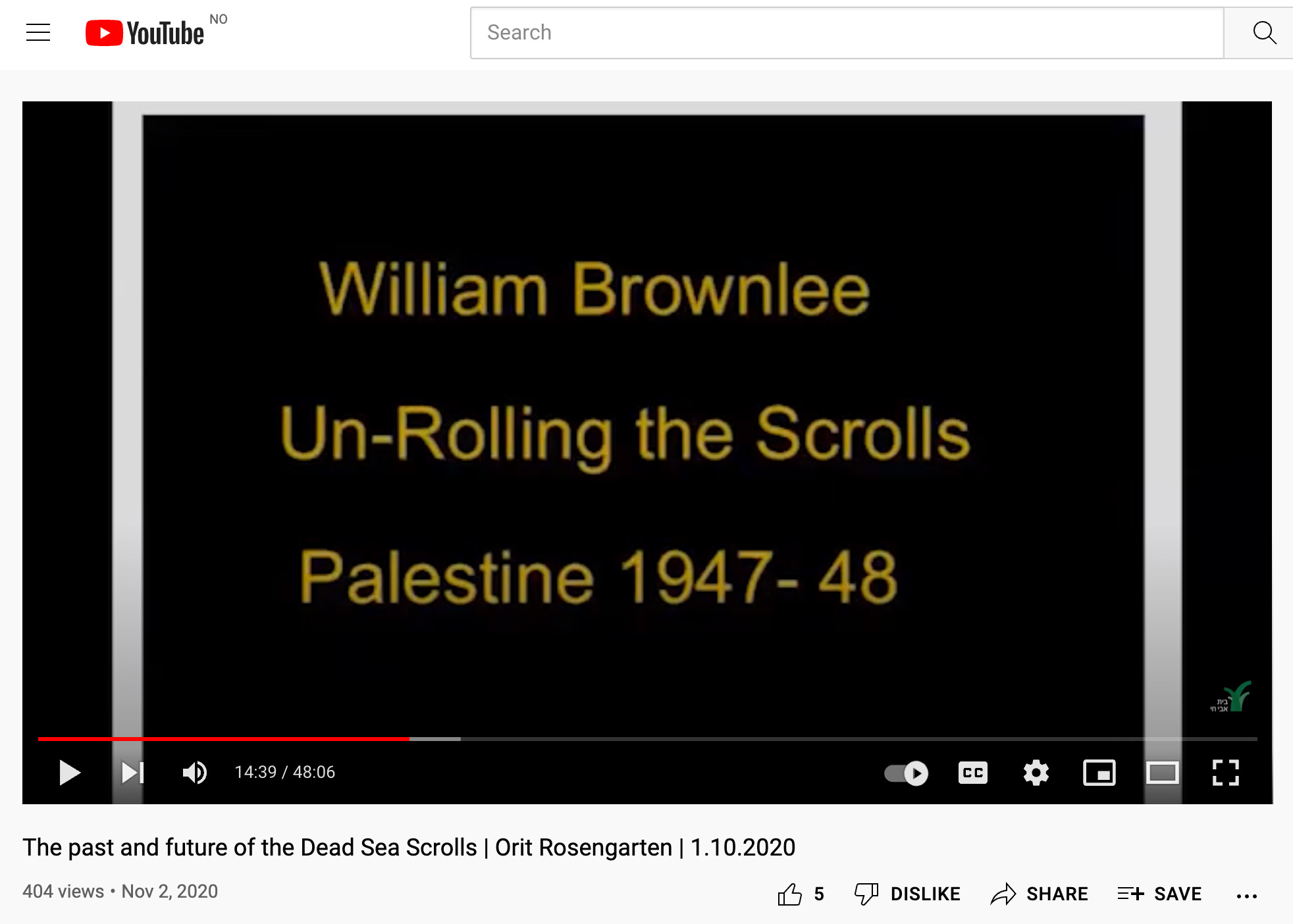
As a follow up to that post, I should add that Alexander Schick subsequently alerted me to the existence of video footage of William Brownlee and John Trever with the Scrolls in Jerusalem in the very early days. He noticed that some of this footage was presented on YouTube by Orit Rosengarten. The archival footage begins at 14:31:
There is also a freely available online copy of Trever’s photos of the “Cave 1” scrolls:
In connection with this photo shoot, I should add that Alexander Schick, while working through the estate of Claus-Hunno Hunzinger, has located a publication that used these pictures, a pamphlet produced by the Jordan Tourist Department under the title “Qumran und die Schriftrollen vom Toten Meer”:
Brochure with PAM images from 1950s photo shoot; image courtesy of Alexander Schick
This was a very enjoyable project. Thanks again to everyone for putting up with my questions!