
The Eusebian apparatus for the gospels has been getting some much deserved attention in the last few years. This remarkable system for navigating the parallel material in the gospels has formed the topic of a very useful monograph by Matthew Crawford, The Eusebian Canon Tables: Ordering Textual Knowledge in Late Antiquity (Oxford University Press, 2019) and a collection of essays (open access!) edited by Alessandro Bausi, Bruno Reudenbach, and Hanna Wimmer, Canones. The Art of Harmony: The Canon Tables of the Four Gospels (de Gruyter, 2020).
Codex Sinaiticus presents an early example of this system, but the apparatus in Sinaiticus has several odd features:
- No canon tables survive in Sinaiticus either at the mutilated beginning of the codex or at the start of the New Testament.
- The section numbers are only partially present (they are missing for sections 107-242 in the Gospel According to Luke).
- The first 52 sections in Matthew are a bit more elaborately executed than the numbers in the other sections.
It’s also not immediately obvious when the section numbers were added (whether during the production of the codex or at a later time, as Tischendorf believed). The most thorough study of the physical features and layout of the codex is Milne and Skeat’s Scribes and Correctors of the Codex Sinaiticus (1938). They discuss all of the characteristics of the Eusebian apparatus listed above in a series of somewhat technical arguments. In this post, I’m going to try to walk through their logic and provide some illustrations.
First up is the question of whether the Eusebian numbers were a part of the original production of the codex. The Eusebian numbers were placed to the left of the columns of text and written in red ink (the Ammonian section number is on top, and the Eusebian canon number is on bottom).
But the numbers of the apparatus are executed differently in different parts of the codex. For one thing, they are copied in different hands.


In this early portion of Matthew (on the left), both the section number and the canon number are accompanied by a supralinear stroke. The numbers are also noticeably smaller than the letters in the main text. In the example from John (right), only the section number has such a stroke, and two of the three letters are roughly the same size as the letters in the column. Note the distinctive forms of mu in the section numbers. The example on the left (Matthew) is similar to the “Biblical Majuscule” of the main text. The example of mu on the right (John) with its low medial dip and curved flourishes on the vertical strokes, presents a very different look from the mu of the main text.
Milne and Skeat, however, drew attention to the use of red ink elsewhere in the codex, namely for the numeration of titles of the Psalms. They note that this use of red ink must have been executed by the copyists of the Psalms (namely, Scribe D for Psalms 1:1-97:3 and Scribe A for Psalm 97:3-151:7). They reach this conclusion because the red ink is used within the columns of text in addition to being used for the marginal numbers and paragraphos marks:
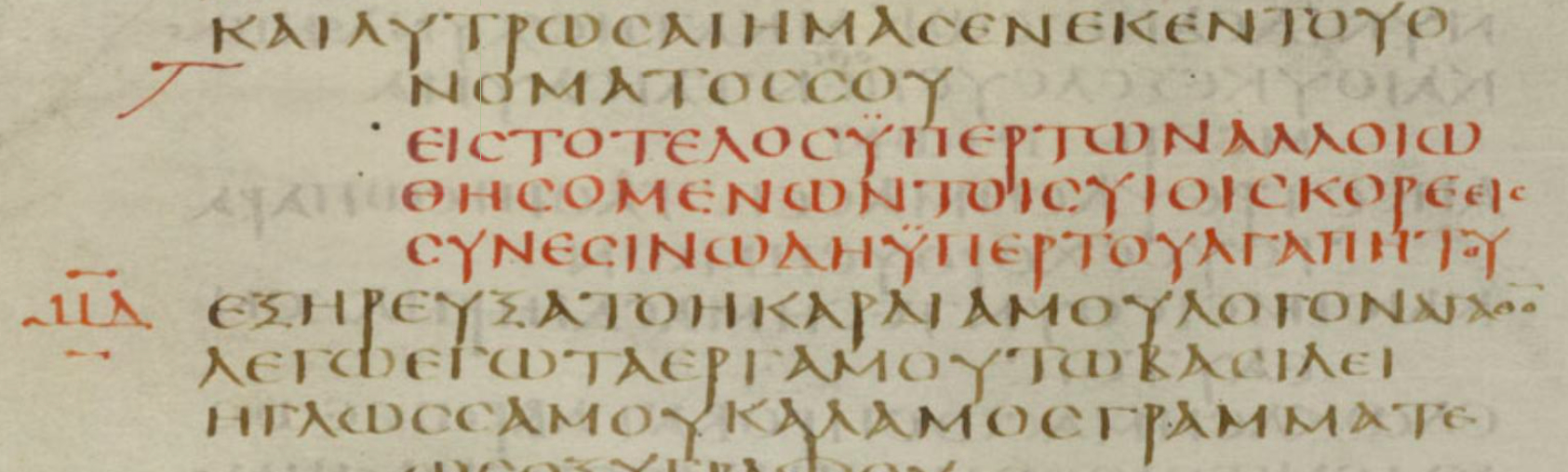
Milne and Skeat thus argue that “the broad flourished mu” and the bold paragraphos mark are both to be included in the repertoire of Scribe D. They make similar arguments for the more decorative letters used by Scribe A in the marginal numbers in the latter portion of the Psalms. Through this reasoning, they establish that the starting assumption should be that the Eusebian numbers were in fact executed during the production of the codex by Scribes D and A. They adduce further evidence that also addresses some of the other strange features mentioned above.
Why are there no canon tables in Codex Sinaiticus? Milne and Skeat have explained this situation by noting that, according to one sequence of quire signatures, there is a full quire missing between the last quire of the Old Testament and the first quire of the New Testament. They hypothesize that a quire containing a set of tables was planned but never completed because the effort to add the section numbers in the text was abandoned before it was finished. In this regard, they point to the abandonment of the extra decorations after section 52 in Matthew and the complete lack of Eusebian numbers in much of Luke (Scribes and Correctors, pp. 7-9 and 36-37). This solution involves considerable speculation, but it makes some sense: If the canon tables had been completed and contained in the codex, it is hard to explain why the missing section numbers in Luke were not added by any later users of the codex.
Finally, it seems that we can be fairly precise about exactly when in the production of the codex the Eusebian numbers were added. Milne and Skeat point out that a correction in the lower margin at Matthew 10:39 carries a section number in identical red ink and made in sequence with the section numbers used in the main text:
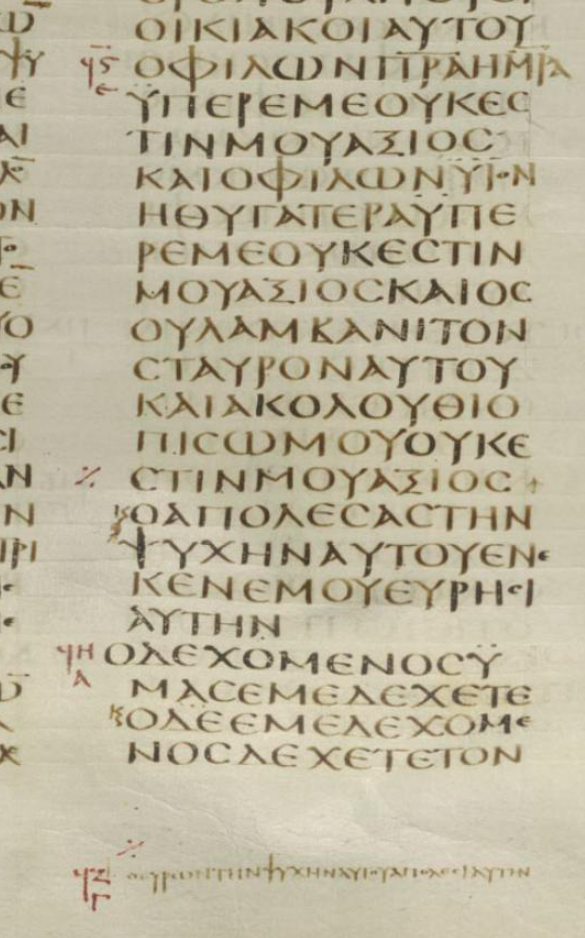
The numbers in the left margin are ϥⲋ and ϥⲏ (the first character is a cursive form of the archaic Greek letter koppa, 90), 96 and 98. The number beside the correction is ϥⲍ, 97. As Milne and Skeat point out, the fact that the process of section numbering included the numbering of this correction suggests that the process of numbering took place after the text had been both copied and corrected. But there is more. The bifolium consisting of New Testament folio 10 and 15 is part of a quire copied by scribe A (quire 2), but this particular bifolium is copied by scribe D and lacks the Eusebian section and canon numbers (the surrounding leaves copied by scribe A all have the Eusebian numbers). Thus, following Milne and Skeat’s logic, we may say that the Eusebian numbers were added after an initial correction of the work by Scribe A but before the more extensive correction by Scribe D that involved the replacement of the cancel leaves (though this proposal is slightly complicated by the fact that Scribe D replaced another bifolium in a quire copied by A–the central bifolium in Quire 77–but did include the Eusebian numbers on that bifolium).
On the whole, I think it is justified to agree with Milne and Skeat that the Eusebian apparatus was part of the production of the codex and therefore provides us with a good terminus post quem for the construction of the book Unfortunately, we don’t know precisely when Eusebius developed the canon tables, but a terminus of ca. 300-340 CE seems reasonable. How much later the codex could have been copied is an open question that I will address in a forthcoming article.
For a more detailed discussion of the Eusebian apparatus in Sinaiticus, see Dirk Jongkind, Scribal Habits of Codex Sinaiticus (Gorgias, 2007), 109-120.







 Variant Readings