Fake Dead Sea Scrolls and the People Who Sell Them: One Fragment’s Story

Two posts in recent days prompt me to wonder about the cast of characters involved in the marketing of the “post-2002 Dead Sea Scrolls like fragments” that most of the guild now regards as forgeries (though respected Dead Sea Scrolls scholar Emanuel Tov seems to be withholding judgement on that point).

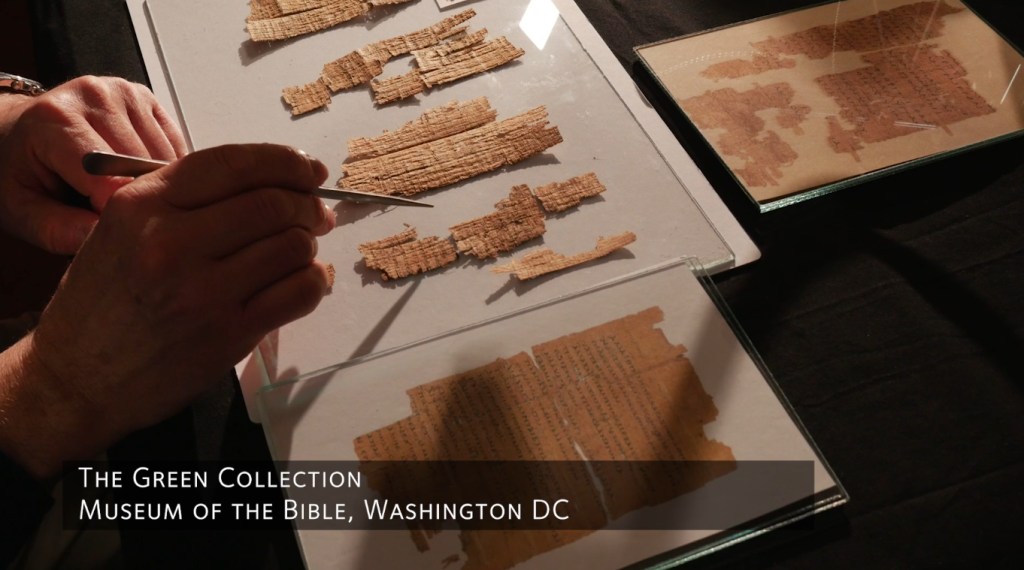
The first post is by Paul Barford, who helpfully reminds us about the Museum of the Bible’s “Objects with Incomplete Provenance” page. Here is a quick summary of the information about the acquisition of their 16 fragments that have now been determined to be fakes:

  1. Four purchased from Dr. Craig Lampe in November 2009: SCR.000120 (Exodus), SCR.000121 (Psalms), SCR.000122 (Leviticus?), SCR.000123 (Instruction).
  2. One purchased from Michael Sharpe Rare & Antiquarian Books in February 2010: SCR.000124 (Genesis).
  3. Seven purchased from William Kando in May 2010: SCR.003170 (Daniel), SCR.003171 (Jonah), SCR.003172 (Jeremiah), SCR.003173 (Numbers), SCR.003174 (Ezekiel), SCR.003175 (Nehemiah), SCR.003183 (Micah).
  4. Four purchased from Andrew Stimer in October 2014: SCR.004742 (Leviticus), SCR.004741, SCR.004768, and SCR.004769 (the latter three are unidentified and were not included in the Brill volume).

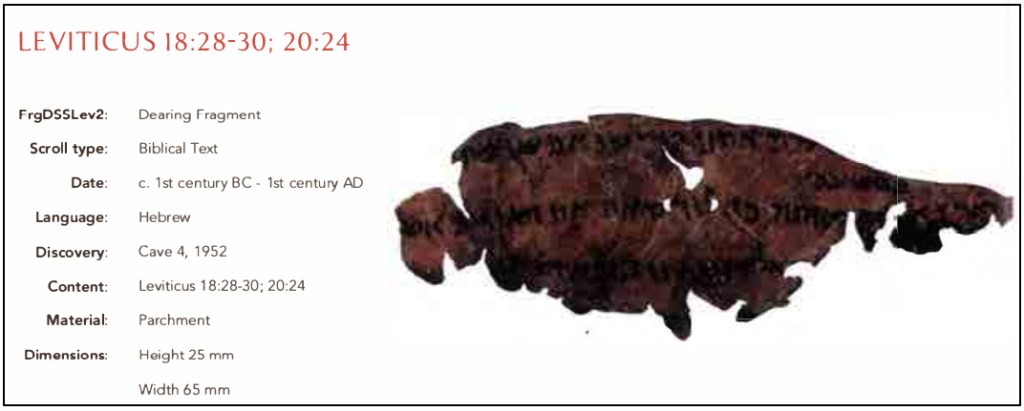
The second post was by Årstein Justnes, who gathered together some early statements about the origins of one of the fake fragments of Genesis. It seems to me that there is a lot of value in exercises like this, pulling together what we know about individual fragments and their recent histories. With some of these fragments, many of the major names of sellers and scholars mix together, with the result that the actual change of ownership is sometimes unclear (who is acting as “owner” and who is a “broker”?). A good example of this is one of the first fragments to be flagged as suspicious, a purportedly ancient fragment containing Neh. 3:14-15 (DSS F. 122, number 41 on the Lying Pen website). Jim Davila expressed skepticism almost immediately after the fragment appeared in 2008 (“one has to wonder about [its] authenticity”).

Much of what follows here is derived from various excellent (and encyclopedic) posts by Ludvik A. Kjeldsberg and Årstein Justnes of the Lying Pen project, so this will be old news to some. But I think there is some value in gathering these links together and thinking a bit about the movements of this forgery.

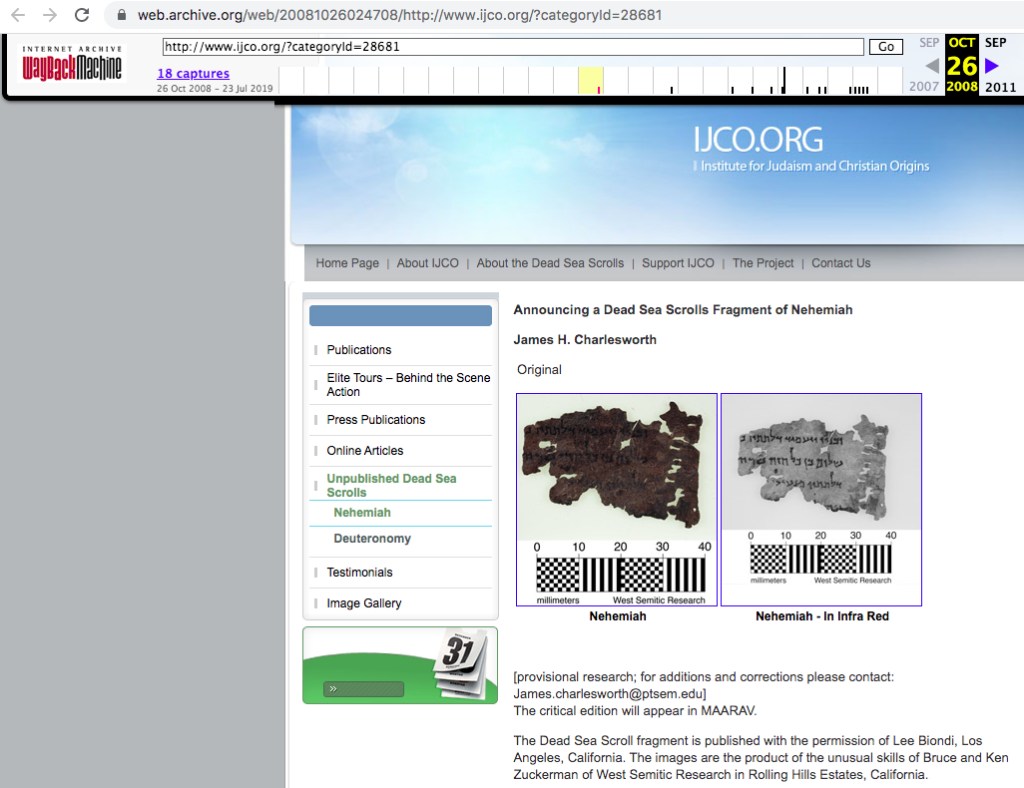
This fake fragment seems to have first surfaced in 2008, when it was published online in a provisional form by Professor James Charlesworth of Princeton Theological Seminary, who noted the publication was “with the permission of Lee Biondi,” the rare manuscripts dealer based in California who I have mentioned before in connection with Professor Dirk Obbink’s activities on the antiquities market.

Professor Charlesworth said little about the origins of the fragment other than noting that “the one who had the fragment since the sixties reports that it is from Qumran Cave IV.”

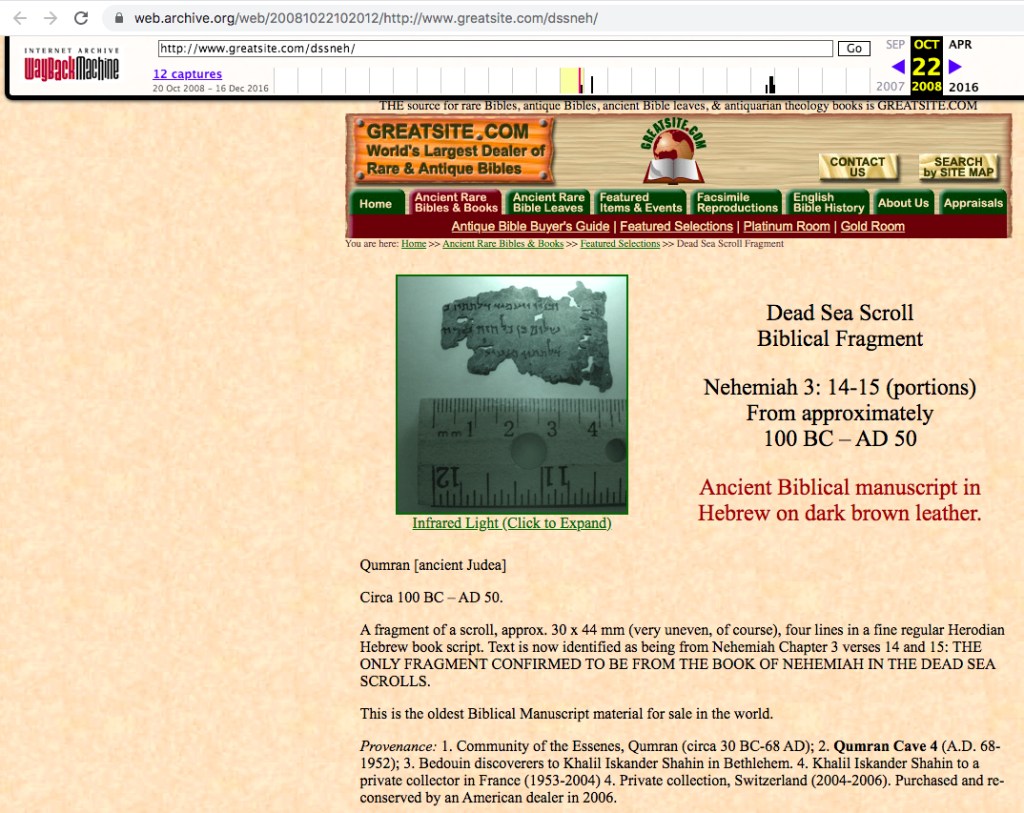
At roughly the same time, the fake fragment appeared for sale at Greatsite.com, the online showroom of The Bible Museum (not to be confused with the Museum of the Bible), an online seller of rare books associated with Craig and Joel Lampe:

The provenance information provided on the site was this:

“Provenance:
1. Community of the Essenes, Qumran (circa 30 BC-68 AD)
2. Qumran Cave 4 (A.D. 68-1952)
3. Bedouin discoverers to Khalil Iskander Shahin in Bethlehem
4. Khalil Iskander Shahin to a private collector in France (1953-2004)
[5]. Private collection, Switzerland (2004-2006).
[6]. Purchased and re-conserved by an American dealer in 2006.

The item is guaranteed to be authentic, legally exported from the Middle East in the 1950s and legally imported into the United States.

The item is accompanied by a full scientific and scholarly report.”

There are several interesting features of this description of provenance for this item that is “guaranteed to be authentic.” It would be good to learn the identities of the “private collector” in France,” the “private collection” in Switzerland, and the “American dealer.” And I would be quite curious to see that “scholarly report.” Specifically, I wonder to what degree it resembles the material published online by Professor Charlesworth, whose name shows up further down on the seller’s page:

“This fragment is published online and is scheduled to be published in 2008 by Prof. James Charlesworth of the Princeton Theological Seminary and Head of Princeton’s Dead Sea Scroll project in the academic journal MAARAV: A Journal for the Study of the Northwest Semitic Languages and Literatures. Prof. Charlesworth intends to follow the journal publication with a monograph.”

This impressive set of academic credentials serves as a preface to the sales pitch itself:

“With the understanding that Dead Sea Scroll Fragments have an estimated sale price that is well into six figures if you wish to explore the possibility of obtaining one, just…contact us.”

Early in the following year (2009), the Nehemiah fragment was part of an exhibit in Arizona. It appears on the cover of the exhibition catalog written by Lee Biondi:

All of this points to Biondi as the owner of the fragment, but it is interesting to note that the publisher of the catalog is Legacy Ministries International.

In 2009, Legacy Ministries International (LMI) was the name of an organization now known as Hope Partners International. LMI was itself trading in suspicious Dead Sea Scrolls fragments, several of which it sold to Azusa Pacific University in 2009.

The chairman and chief executive officer was Andrew Stimer. Mr. Stimer, it will be recalled, both sold (fake) Dead Sea Scroll fragments to the Museum of the Bible and purchased (real) early Christian papyri stolen from the Oxyrhynchus collection. So, the group of names somehow connected to this fragment now includes Lee Biondi, James Charlesworth, Craig and Joel Lampe, and Andrew Stimer.

Still in 2009, apparently, the fragment was sold to the Norwegian collector Martin Schøyen (MS 5426). Unless I miss something, the fragment next turns up in 2012 in publicity connected with the forthcoming publication of several “Dead Sea Scroll-like fragments” in the Schøyen Collection:

But when the Schøyen Collection volume appeared in 2016, the Nehemiah fragment was not in it, a point noted by reviewers (link to a pdf file). Did the editors refuse to publish the piece because they regarded it as a forgery?

The answer to that question was forthcoming in the 2017 volume of the journal Dead Sea Discoveries, which contained an article co-written by several people including the editors of the Schøyen volume.

These authors concluded the Nehemiah fragment and eight other “Dead Sea Scroll-like fragments” in the Schøyen Collection were most likely forgeries. I’m unaware of anyone who has come forward to defend the authenticity of the fragment.

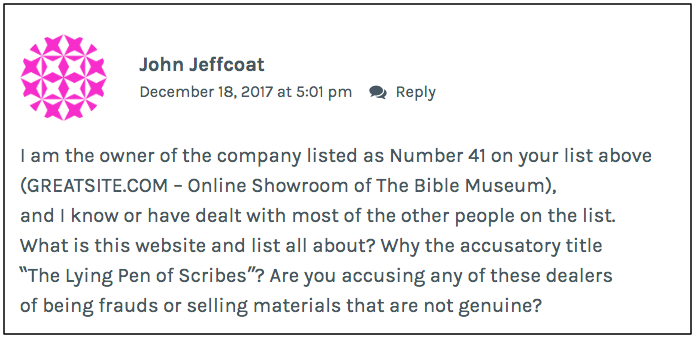
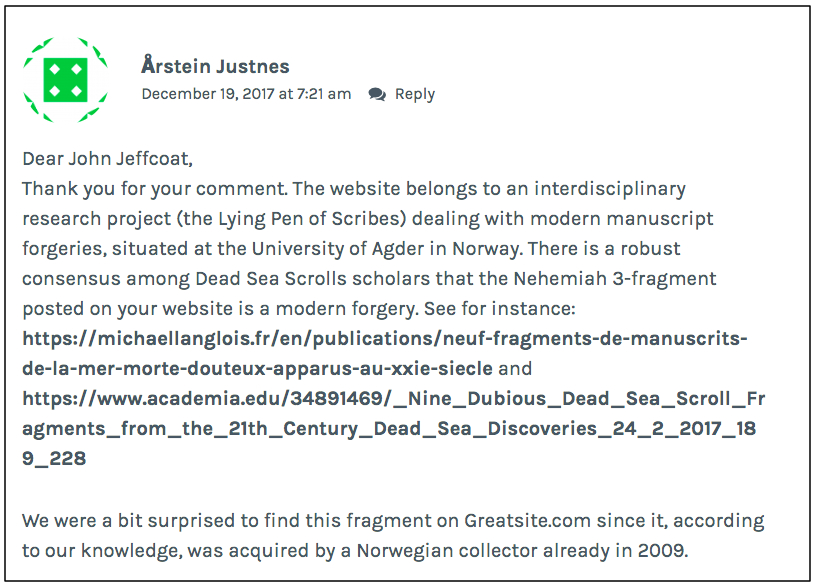
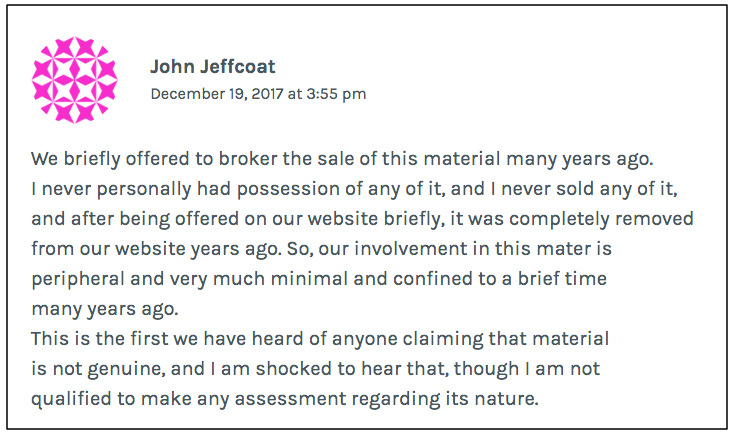
It is understandable that in the aftermath of all this, some of the parties involved in the early days have distanced themselves from this fragment. In an exchange from December 2017 in the comments on the Lying Pen site, the owner of Greatsite.com, John Jeffcoat, posed some questions and offered some explanations:

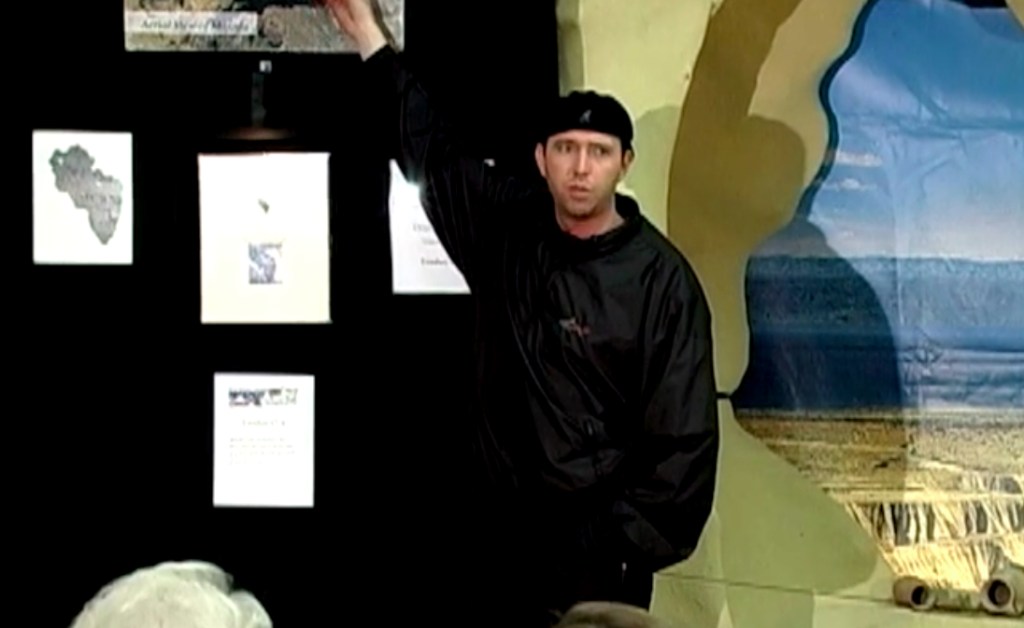
But the Lampe family did have custody of other fragments now widely regarded as fakes (although I have no knowledge of these pieces ever being offered for sale on Greatsite.com). As the information at the beginning of this post indicates, Craig Lampe sold four pieces to the Green Collection. We see some of the fakes on display along with enlarged, enhanced photographs, for instance, in a promotional video, Mysteries of the Dead Sea Scrolls (2006), starring Joel Lampe standing in front of what appears to be a portable Qumran cave (I do not know if either the fragments or the portable Qumran cave were for sale at this event).

I think it worthy of note that some pieces in the video were also featured in the Biondi/Legacy Ministries International catalog, such as the item below, a fragment now owned by the Museum of the Bible and considered a fake containing a bit of the Psalm 11 (DSS F. 199, number 43 on the Lying Pen website):

So, the Psalms fragment was sold to Hobby Lobby by Craig Lampe, publicly displayed by Joel Lampe, published in a book that was written by Lee Biondi and produced by Legacy Ministries International. It definitely seems like all these parties are somehow related. What all of this tells me is that there is still a major lack of clarity about the buying and selling of these pieces. Which dealers owned what, exactly? And from whom did they buy these pieces? And, of course, who made these forgeries to begin with?

And it seems significant that some of the people involved in the circulation of the fake Dead Sea Scrolls (Lee Biondi and Andrew Stimer, to say nothing of Scott Carroll, the Green Family, and the Museum of the Bible) are also connected either to Professor Dirk Obbink or to the stolen Oxyrhynchus papyri. Even after the big report about the fakes at the Museum of the Bible, there are still lots of questions to answer here.

Posted in Antiquities Dealers and Collectors, Antiquities Market, Dead Sea Scrolls, Fakes and Forgeries, Green Collection, Lee Biondi, Schøyen Collection | Tagged , , | 4 Comments

A Missing “Robinson Papyrus” Found?

[Update 22 November 2023: The data here is now superseded by the information gathered in Daniel B. Sharp, “The Provenance of the Robinson and Mississippi Papyri,” Archiv für Papyrusforschung 69 (2023) 162-192.]

A few years ago, I started looking into the so-called “Robinson Papyri,” a collection of pieces assembled in the first half of the twentieth century by David M. Robinson, a professor archaeology at the University of Mississippi. Upon Robinson’s death, the papyri were bequeathed to William Willis, who donated many of them to Duke University. In 2017, I assembled an inventory of these pieces here. What was curious was that there were some missing numbers in the “P.Rob.inv.” sequence. I’ve since found a couple of the numbers that escaped me. But there are still a few that are, as far as I can tell, unaccounted for: P.Rob.inv. 11, 21, 23, and 46-47. Now I think I’ve found one of them, and it turns out there is an interesting twist in the story.

Sometimes a simple google search does the trick. Googling “P.Rob.inv. 46” yielded exactly two hits. These were two versions of the same data, one at the Duke library in the form of a .dat file, and one a text file on the APIS papyrological website.

Bottom line: According to these files, P.Rob.inv. 46 = P.Duk.inv. 782. But if you look up P.Duk.inv. 782 on the current version of the Duke Papyrus Archive, you find that it is identified differently. Here are the two records side-by-side:

Version in Text FileCurrent Version in Duke Archive
Literary text, [not before 199 B.C.]Title: Literary text, [not before 199 B.C.]
papyrus, mounted in glass, very incomplete ; c7 cm.Material: 1 item : papyrus, mounted in glass, very incomplete ; 7 cm.
Actual dimensions of item are 6.5 x 4.8 cm.Note: Actual dimensions of item are 6.5 x 4.8 cm.
9 lines.9 lines.
Written along the fibers on the recto in a careful hand.Written along the fibers on the recto in a careful hand.
P.Duk.inv. 782 was formerly P.Rob.inv. 46P.Duk.inv. 782 was formerly P.Deaton 28.
Literary text from Egypt, written on papyrus. Possibly a comedy.Literary text from Egypt, written on papyrus. Possibly a comedy.

The designation “P.Deaton” will ring a bell for those who have been following the Sappho story. Recall that Professor Dirk Obbink claimed that the source of the cartonnage from which the new Sappho papyri were extracted was a lot of papyri sold at auction by Christie’s in November 2011. It was said to be composed of a mixture of Robinson Papyri and “P.Deaton” papyri. The nature of these “Deaton” papyri is not well known. In addition to this Duke piece, Roberta Mazza has noted that some of them ended up at BYU.

P.Duk.inv. 782 = P.Deaton 28 (= P.Rob.inv. 46?); image source: Duke University Special Collections Library

It is probably also worth noting that the whole sequence of P.Duk.inv. 747-798 all are donations from Willis with one exception, P.Duk.inv. 782, which, of course, is P.Deaton 28. I’m not sure exactly what this means, but if Deaton papyri potentially are Robinson papyri, perhaps these BYU pieces might account for some of the other missing Robinson numbers, and it would also help to explain why pieces identified as being from these two collections might have ended up together on the auction block in 2011. There’s more work to be done here.

Posted in Antiquities Dealers and Collectors, Antiquities Market, Dirk Obbink, P.Sapph. Obbink, Robinson Papyri | 1 Comment

Report: All the “Dead Sea Scrolls” at the Museum of the Bible Are Fakes

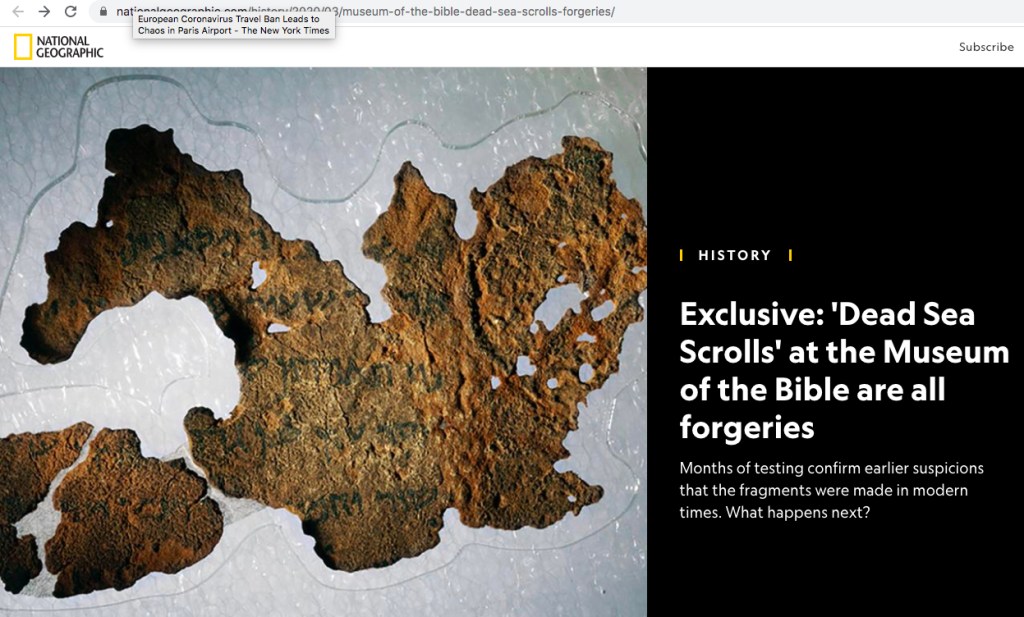
In an article posted online earlier today, National Geographic reported something that is not that surprising to many of us who have been following this story: All 16 of the so-called “Dead Sea Scrolls” owned by the Museum of the Bible are fakes. To be clear, suspicions about these fragments have been voiced by scholars like Eibert Tigchelaar and Arstein Justnes for a number of years now. This report is not so much “exclusive” news as it is simply another confirmation of everything these scholars have been saying.

I encourage people to read the whole article. For the moment, I’ll just mention three things jumped out at me.

First, National Geographic reports that these findings have been known for many weeks:

“From February to October, the team periodically visited the museum and pulled together their findings. By the time their report was finalized in November 2019, the researchers were unanimous. All 16 fragments appeared to be modern forgeries.”

So, the results of the investigation have been known since November. By coincidence they have been made public months later when the world is in the grip of an unprecedented pandemic.

Second, I am somewhat taken aback by the statements from the scholars responsible for authenticating the pieces in the first place, namely James Charlesworth, former George L. Collord Professor of New Testament Language and Literature at Princeton Theological Seminary and Emanuel Tov, emeritus professor at the Hebrew University of Jerusalem. Other scholars were involved in authenticating the fakes, such as Hanan Eshel (1958-2010) and Esther Eshel of Bar-Ilan University, who jointly published some of the suspect fragments, but only Professor Charlesworth and Professor Tov are quoted in this article. Here are the comments of Professor Charlesworth about a fragment with text from Genesis:

“In an email, Charlesworth noted that when he described the fragment to other scholars in the past, he reported that it was probably authentic but not from the same time and place as the Dead Sea Scrolls found in Qumran. But after another look at a picture of the fragment, Charlesworth voiced fresh skepticism. ‘I am bothered by the handwriting; it now seems to be suspicious,’ he says.

Charlesworth also says he has seen pieces of blank, ancient leather in circulation. ‘In the past, when I told the Bedouin that a piece was worthless because it had no writing, I inadvertently suggested how to make it valuable,’ he says.

I am uncertain whether the Genesis fragment in question is the same one that Professor Charlesworth himself reportedly owned at one point.

And here is the statement that Professor Tov, who edited the volume of fake Dead Sea Scrolls for the Museum of the Bible, provided to National Geographic:

“I will not say that there are no unauthentic fragments among the MOB fragments, but in my view, their inauthenticity as a whole has still not been proven beyond doubt. This doubt is due to the fact that similar testing has not been done on undisputed Dead Sea Scroll manuscripts in order to provide a base line for comparison, including the fragments from the Judean Desert sites that are later than Qumran. The report expects us to conclude that abnormalities abound without demonstrating what is normal.”

As the former Editor-in-Chief of the international Dead Sea Scrolls publication project, Professor Tov is presumably in a position to strongly encourage such testing to be carried out on undisputedly authentic Dead Sea Scrolls. I hope that he is doing so.

Third and finally, when it comes to the dealers selling the fakes, there are a lot of names that will be familiar to people who have been following other manuscript stories in the news. One of the sellers of the fakes is California collector Andrew Stimer, chairman and CEO of Hope Partners International (HPI), “a Christ-centered international ministry,” who also bought stolen Oxyrhynchus papyri. Other Museum of the Bible fakes also passed through the infamous collection of Bruce Ferrini. The article also mentions the fakes that were part of the collection of William Noah, the force behind the “Ink & Blood” travelling exhibition.

The origin of these forgeries remains a mystery. So, there is still more work to be done.

Posted in Antiquities Dealers and Collectors, Antiquities Market, Bruce Ferrini, Dead Sea Scrolls, Fakes and Forgeries, Green Collection | 9 Comments

Dirk Obbink and the Hobby Lobby Sappho Fragments

In yet another fascinating video unearthed by David Bradnick, “Seeking Sappho,” we see Oxford Professor Dirk Obbink at work on the Hobby Lobby (Green Collection) Sappho fragments:

There are several strange features of this video. First, some of the footage is the same as that which is included in a promotional video released in 2013 for the “Ancient Lives” project. Second, there appears to be some chronological confusion. At the 3:45 mark in the video, the first appearance of the London Sappho fragments is placed in spring of 2015, which cannot be right, as the London fragments had been publicly revealed already in 2014 (full chronology here). But that is just the beginning.

In one segment, the Green Collection Sappho fragments seem to be in the papyrology rooms of the Sackler Library, quite far from their new home in Oklahoma (or is it Washington, D.C.?). The film editing is choppy and odd, but it does seem that the plate of Green fragments was with the scholars at Oxford. I wonder when that visit took place? Watch the clip at about 6:37-7:07:

Finally and most alarmingly, there is a segment that, according to the captions of the video, seems to have been filmed at the Museum of the Bible in Washington, D.C. Professor Obbink works on the Green fragments. The item to the right of them looks like a photograph of the London fragments:

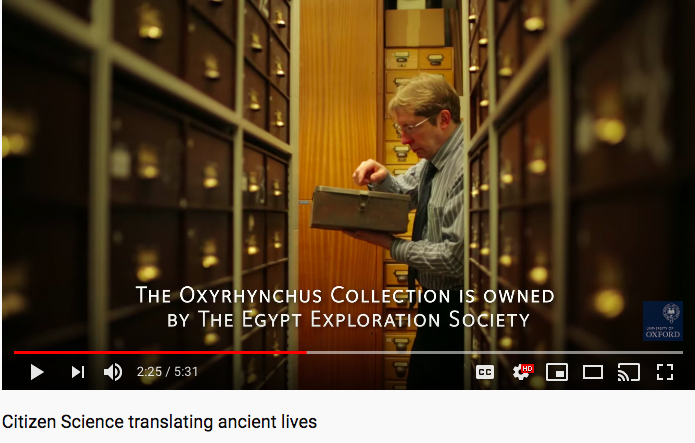
What is alarming is when the camera angle shifts, we see in the lower right corner of the frame what appear to be two tin boxes of exactly the kind that are used to house the unpublished fragments from Grenfell and Hunt’s Oxyrhynchus excavations for the Egypt Exploration Society:

For the purposes of comparison, here are a couple images of this type of box back at Oxford (note the latches):

So, if the caption of the Sappho video is accurate, and if it’s right that the tin boxes in the video are from the EES (big “if”s, I know), it raises the question of what exactly these boxes were doing at the Museum of the Bible in Washington, D.C., which opened in 2017.

I would tend to think the caption in the Sappho video is simply a mistake, as the microscope at the desk looks much like those in use at the Sackler and the wood panels in the background also look like those in the Sackler. But that would again raise the question of when the Green Collection Sappho fragments would have made the trip from the US to Oxford. I wonder if any Museum of the Bible staff could clarify?

Lots to ponder with this video (and thanks again to David Bradnick for digging it up). I encourage people to watch the whole video here.

Posted in Antiquities Dealers and Collectors, Antiquities Market, Dirk Obbink, Green Collection, Green Collection Sappho, P.Sapph. Obbink | 14 Comments

More Mummy and Cartonnage Material in the Green Collection

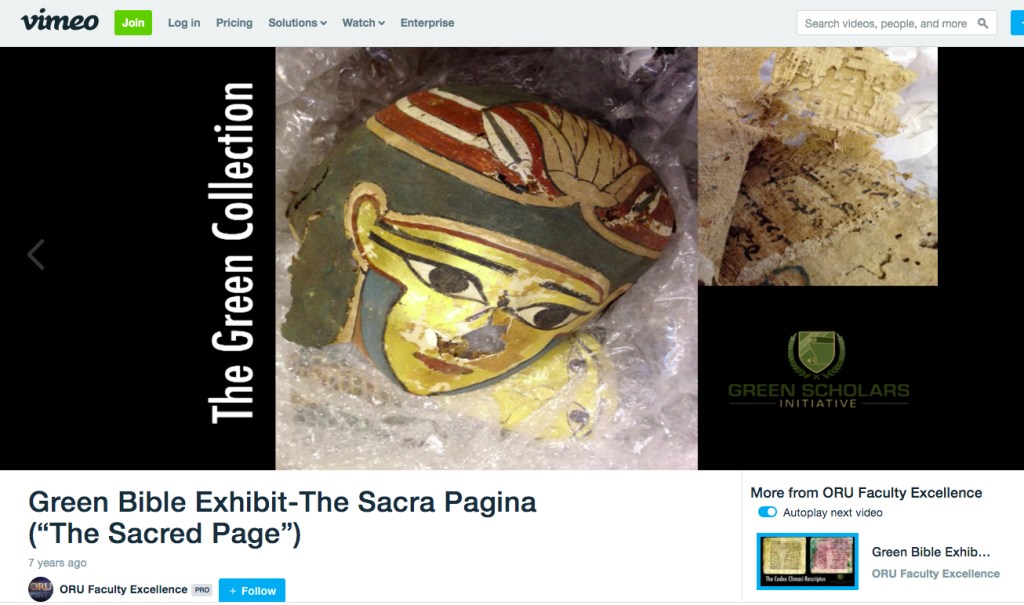
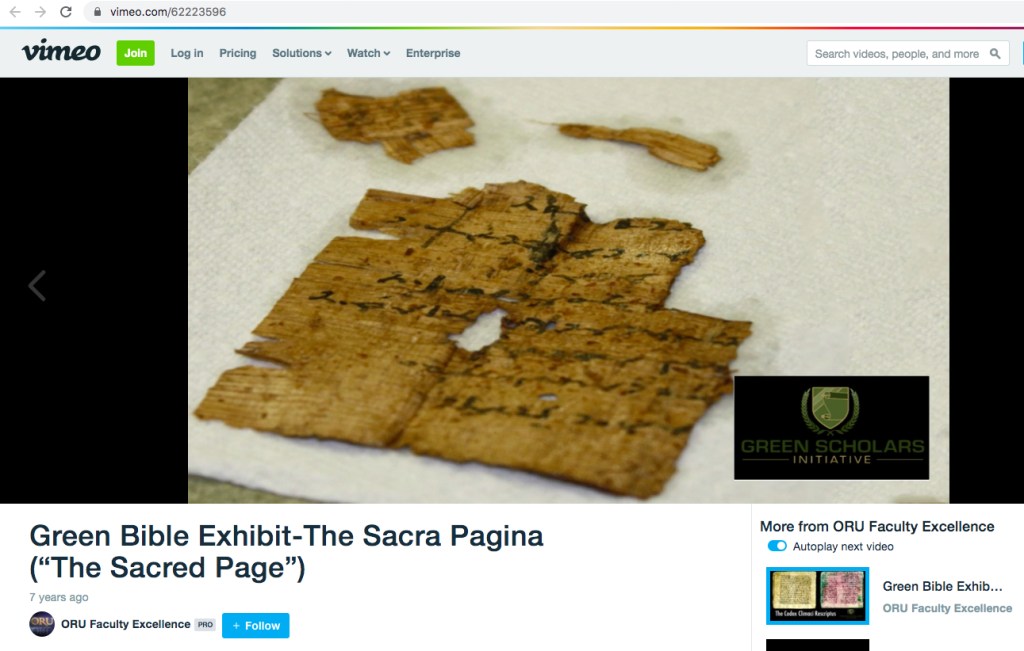
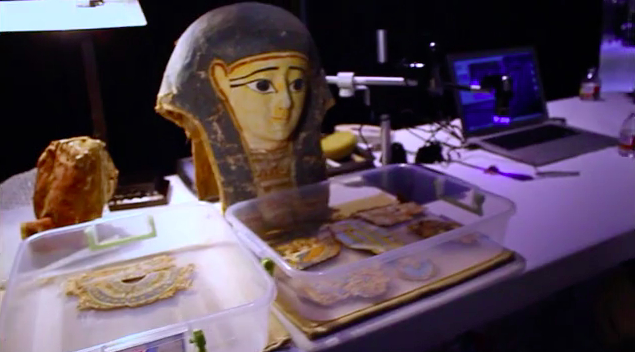
Courtesy of David Bradnick, here are a few more examples of mummy masks and other cartonnage associated with the Green Collection (I have been keeping a record of mummy masks in the Green Collection here). I note that the two videos from which these screenshots were taken date from the time after the exit of Scott Carroll from the Green Collection. The first video is a lecture by Jerry Pattengale given at Oral Roberts University in January 2013 in association with the “Sacra Pagina” exhibit of Green Collection items. At several points, “discoveries” from cartonnage are mentioned. The following graphics show some items from the Green Collection’s cartonnage (the mummy mask shown here is one I have not seen before):

Also included in this first video is a listing of academics participating in the Green Scholars Initiative, including Professor Dirk Obbink:

This provides a segue to the next video, a short promotional feature for the travelling Passages exhibition in Colorado Springs in 2013. There is some additional footage here of Professor Obbink dismantling cartonnage at the VIP event held in conjunction with that exhibit:

Assuming that the two masks shown here belong to the Green Collection, I count at least eight masks associated with the Green Collection that have been publicly displayed. When I asked Mike Holmes at an SBL session in November 2019 about the number and the source of the mummy masks in the Green Collection, he replied that there were eight masks, of which four were purchased from Dirk Obbink. Josephine Dru (former curator of papyri at MOTB) was present in the audience and remarked that eight masks seemed like a low estimate to her and may not take note of items that were purchased but never delivered. There is probably more to be learned about the mummy masks in the Green Collection.

Posted in Antiquities Dealers and Collectors, Antiquities Market, Dirk Obbink, Green Collection, Mummies, Mummy cartonnage | 6 Comments

More on Sappho, Romans, and the Baylor “Mummy Mask” Extraction

In my last post on the new information regarding the origin of Hobby Lobby’s Sappho papyrus fragments, I noted some parallels with the claimed mummy mask origins of a papyrus fragment of Paul’s letter to the Romans (now known to have been stolen from the Oxyrhynchus collection). Recall again Steve Green’s description of the fragment from the CNN interview on 18 January 2012:

This [fragment] has just been discovered within the last 48 hours. Ah, Dr. Scott Carroll, who is a Bible expert that we have been working with was at Baylor and discovered this…This is in part of the acquisitions that we have, that we have, ah, uh, in uncovering layers of papyrus and as we’re pulling layers away, all different kinds of texts show up, and this happens to be, is, as Dr. Scott Carroll has identified it, the oldest portion of the book of Romans known, dating to middle second century.”

As I said, Mr. Green’s statement and one of Scott Carroll’s FB posts very much give the (false) impression that that the Romans papyrus was extracted from a mummy mask at Baylor probably on 16 January. I thus wondered whether the stolen Oxyrhynchus Romans made an appearance that day at Baylor.

I now notice something that I should have noticed earlier. The Oxyrhynchus Romans papyrus does indeed appear to have been among those present at the Baylor event on 16 January 2012. The papyrus shows up in a sequence of photographs of the event presented by the Christian apologist Josh McDowell in one of his talks shortly after the Baylor event (a video of McDowell’s talk was first flagged by Brice Jones in 2014). In the course of giving a list of items discovered at Baylor that day (at about the 30:50 mark in the video), McDowell mentions “Sapphos [sic], some you know the great writer Sapphos [sic]” (were the Sappho fragments identified as such on the spot at the event?) and then displays a series of images on the screen. At the 31:11 mark (slide 59), a partial picture of a fragmentary papyrus appears briefly. Despite the poor quality of the still image from McDowell’s video, I feel safe in saying that it is certainly the same papyrus as the stolen Oxyrhynchus fragment Steve Green showed on CNN:

Screenshot of the Stolen Oxyrhynchus Romans papyrus displayed by Steve Green on CNN on 18 January 2012 (left); the same papyrus in Josh McDowell’s sequence of photos from the Baylor mummy mask dismantling on 16 January 2012 (right)

It looks like there is a little glare coming off the papyrus in McDowell’s photo, which suggests that the Romans papyrus was already mounted between glass plates at the Baylor event and not wet like the Sappho fragments. There were several other mounted pieces at the event, including a stolen Oxyrhynchus fragment of 1 Corinthians and what may well be an unidentified work of Aristotle.

If the Romans fragment was indeed already between glass panes at the event, it’s unclear how exactly it was supposed to be “discovered” on that day. But it’s also not totally clear how many steps of the extraction “process” took place at the event. At one point, McDowell describes what was going on, saying, (31:00) “…and you just peel away. And then of course we put ’em, we put ’em in between paper towels; you dry it, and then we put ’em into glass to protect ’em.” Were “extracted” items also mounted that day at Baylor?

In addition, some of Scott Carroll’s comments at the beginning of the video of that Baylor session now take on a rather different significance (at about the 1:30 mark in the video). As he holds the mask that will be dismantled, Carroll says:

“This will have, because this dates, and we know from artistic evidence and all, um, to the early Christian period, and we know it comes from the region where they use papyri, we also are very certain that there’s Greek papyri that’s in here. And I’ve done some probing, um, as well, to, to see, and we work with different things to try to do this without destroying the mask, and I can tell you, that, uh, we’re in for some interesting things today.”

Indeed.

[[Update 13 May 2020: In an article in The Atlantic, Ariel Sabar demonstrates that yes, the Sappho was identified on the spot at Baylor, and yes, Scott Carroll did in fact plant the stolen Romans fragment to make it appear as if it came from the mummy mask.]]

Posted in Antiquities Dealers and Collectors, Antiquities Market, Green Collection, Green Collection Romans, Green Collection Sappho, Mummy cartonnage, Scott Carroll | 7 Comments

Contextualizing the New Sappho Information

Mike Holmes of the Museum of the Bible has released some intriguing new information about the Sappho papyrus fragments owned by Hobby Lobby. I posted Mike’s statement here.

There really is a lot to unpack with this situation. I want to focus now on the timeline of events around mid-January 2012, because some pieces seem to be falling into place with regard to the early history of the Green Collection and the practices of Scott Carroll and Oxford University Professor Dirk Obbink.

So, we can say that the Green Collection Sappho fragments appeared publicly for the first time on 16 January 2012 when Scott Carroll dismantled a mummy mask at Baylor University, an event that was recorded in the now (in)famous video that was uploaded to YouTube on 19 May 2014.

The implication for a viewer of the video is that these Sappho fragments were among those extracted from the mask, but in his statement Mike Holmes noted that this seems highly unlikely, because of the existence of a photograph (provided to MOTB by Professor Dirk Obbink) of a chunk (or perhaps “pad”?) of non-mummy-mask cartonnage apparently bought from Yakup Eksioglu (a.k.a. MixAntik) that appears to show one of the Hobby Lobby Sappho fragments also visible in the damp clump of pieces at Baylor in 2012 (the connection here between Dirk Obbink and MixAntik definitely cries out for further elucidation, but that is not my goal here [[Update 30 January 2020: See Paul Barford’s reflections here.]]).

Scott Carroll holding a frame containing the Green Collection Sappho fragments on 7 February 2012 (left); the published Green Collection Sappho fragments (middle); a piece of “cartonnage” apparently showing one of the Green Collection Sappho fragments (right); image provided by Mike Holmes, Museum of the Bible

As I said, this piece of cartonnage does not appear to be part of a mummy mask. Furthermore, the bulk of the visible material extracted by Scott Carroll from the mask on 16 January 2012 looks at first glance to be considerably older–late Ptolemaic or very early Roman–than these Sappho fragments, which are assigned to the 2nd or 3rd century CE.

Material extracted from the Baylor mummy mask; image source: Josh McDowell presentation

It is possible that more than one piece of cartonnage was dissolved that day at Baylor, but I don’t see any strong evidence of that in the video. As I said, the editor of this video seemingly wants to give the impression that the Sappho fragments came from the mummy mask.

But there is more. First, I need to thank Candida Moss for having the foresight to create a record of Scott Carroll’s facebook posts from 2012 relating to his collecting activities and for sharing these with me. Here are two sequential posts from early 2012:

So, freshly back from a trip to Oxford in early January 2012, Scott Carroll comes to Baylor on 16 January 2012 with a mummy mask that he dissolves. Two days later, 18 January, he strongly implies that he recovered papyrus fragments of Homer, Euripides, Thucydides, along with “the earliest-known text of Romans” and “numerous large sections of the most-illusive and valuable of all Greek works–the lyricist SAPPHO!!” from that mask.

18 January 2012 also just happens to be the same day that Steve Green went on CNN and claimed to own a newly discovered papyrus fragment Romans that was the earliest surviving copy of the letter (a fragment that we now know was stolen from the Oxyrhynchus collection):

“This [fragment] has just been discovered within the last 48 hours. Ah, Dr. Scott Carroll, who is a Bible expert that we have been working with was at Baylor and discovered this.” When the surprised CNN host asked him, “How…how did you get this?” Mr. Green responded:

“Well, um, this is in part of the acquisitions that we have, that we have, ah, uh, in uncovering layers of papyrus and as we’re pulling layers away, all different kinds of texts show up, and this happens to be, is, as Dr. Scott Carroll has identified it, the oldest portion of the book of Romans known, dating to middle second century.”

Mr. Green’s statement and Carroll’s FB post strongly imply that the Romans papyrus was extracted from a mummy mask, at Baylor, within 48 hours of 18 January. It is hard to escape the conclusion that Mr. Green thought this fragment of Romans was extracted from the mummy mask in the YouTube video.

But we now know that this fragment did not come from cartonnage and in fact was stolen from the Oxyrhynchus collection and is alleged to have been sold to Hobby Lobby by Professor Dirk Obbink. Yet, Carroll seems to have presented the fragment as having been obtained from the mummy mask at Baylor.

From his Tweet, it seems that Scott Carroll makes the same claim for the papyrus fragments of Sappho, some of which appear as a wet clump in the Baylor video from 16 January. Did the stolen Oxyrhynchus Romans papyrus also make an appearance that day?

Back in 2012, just after Steve Green’s interview on CNN aired, the Evangelical Textual Criticism blog made a post about the new Romans fragment (thanks to the commenter Aractus for drawing my attention to this). In the comments section, there were several posts that were somewhat skeptical of the story Mr. Green presented and some posts that were wary of the travelling “Passages” exhibit and the need to pay to see the Green Collection manuscripts. But one commenter, posting anonymously on 22 January 2012, offered the following defense of Mr. Green:

“Well, I was there when we ‘harvested.’ For people who are on a blog that says to be ‘evangelical’ I must say that the responses are saddening. It was something for the general public. The BBC has actually filmed a similar ‘event.’ And, yes, publications will follow. No need for demeaning people or spouting about ‘having to pay.’ The public comes with hundreds of thousands at the time. There actually will be a showing in the Vatican for several weeks (with the pope seeing it on Feb 29). Just let it be. Isn’t the whole point that the Word is made attractive to the world? Why make it a ‘liberal thing.’ Never forget your goal.”

So, it seems that at least one person claims to have seen the stolen Oxyrhynchus Romans papyrus “harvested” from a mask. (Sidenote: This is the second reference to a mummy mask dismantling filmed by the BBC in early 2012: Does anyone know where to get this footage?)

We are left to ask: How is it that the Romans papyrus (likely datable to the 3rd or 4th century CE) and the Sappho fragments (usually assigned to the 2nd or 3rd century CE) are said to have come out of a mummy mask that seems to be Ptolemaic? It would be great if Scott Carroll or one of the several people present that day at Baylor could speak up and shed some light on what exactly transpired. It was troubling before the latest revelations. Now it is even moreso.

And we shouldn’t forget that Professor Obbink’s “anonymous London owner” of the larger Sappho fragments seems to have been dissolving them at just about the same time in January 2012. Busy month.

Posted in Antiquities Dealers and Collectors, Antiquities Market, Dirk Obbink, Green Collection, Green Collection Romans, Green Collection Sappho, Mummy cartonnage, P.Sapph. Obbink, Scott Carroll | 16 Comments

Important Developments with the New Sappho Papyrus

Mike Holmes of the Museum of the Bible has just released some new discoveries from the Museum’s ongoing provenance research to me and several other people via e-mail. There are several important revelations. Especially important are 1) a stunningly sharp observation by MOTB curator Brian Hyland and 2) the news that Yakup Eksioglu (“Mixantik”) appears to be the source of the Hobby Lobby Sappho fragments. I post Mike’s text below:


The Hobby Lobby Sappho fragments: some additional information

Michael Holmes, MOTB

Last summer, in response to a question from Roberta Mazza, I informed her that Sappho material was not listed as a specific item on any invoice in museum records, and that it was not at that time possible to identify the seller of the Sappho fragments in the Green Collection. Since then, MOTB curators, in keeping with the Museum’s commitment to research and make available provenance information on artifacts in the Museum Collection and in collections curated by the Museum (see: https://www.museumofthebible.org/collections/provenance), have continued to research the HL Sappho fragments. In recent months, it has been possible to verify some additional information about them. Working in reverse chronological order, I will mention two known points, which will provide context for presenting some additional information.

1. In 2014, images of the HL Sappho fragments were published in an article in ZPE (Bd. 189, pp. 1-28).

2. On Feb. 7, 2012, at a lecture event in Atlanta, Scott Carroll displayed 20+ HL Sappho fragments between glass plates and claimed that they “came out of a mummy mask I dismantled a few weeks ago” (see: https://brentnongbri.com/2018/12/13/the-green-collection-sappho-papyrus-some-new-details/).

Sappho image 2 (SC)

Several scholars have commented on the significance of this “sighting,” most recently Mike Sampson (as reported by Charlotte Higgins, in her recent Jan. 9th, 2020, Guardian article).

3. Brian Hyland, an MOTB curator, pointed out to me that about one-third of the HL Sappho fragments are visible in a video filmed at Baylor University on January 16, 2012 (https://www.youtube.com/watch?v=j_gwgGcpD1M; this is the well-known video of Scott Carroll dismantling a mummy mask). One example of a visible fragment: in the published ZPE image of the fragments, the small fragment just to the right of the label “Sa.16.5” can be seen at the 6:35 mark of the video.

Some of the Sappho fragments are visibly wet, giving the impression that they were being extracted from the mummy mask at the time the video images were taken—an impression that is, however, almost certainly incorrect, in light of the next point. 

4A. A purchase agreement dated January 7, 2012, and signed by Yakup Eksioglu is
accompanied by (i) an invoice for the following items:

  1. “Ancient Greek-Coptic language Papyrus fragments parobably between 800-
    1000 fragment Shown as in the group pictures”
  2. “Cartonagge Masks and other cartonagge fragments Shown as in the group
    pictures”

and (ii) several “group photographs” of the items purchased, arranged in rows and
columns. The “group photographs” clearly show the shape and general appearance of
the items, but do not show enough detail to identify the contents of any particular item.

4B. A photo, shared by Dirk Obbink with Brian Hyland (via Dropbox on August 17, 2016), is a close-up image of one of the “cartonnage” pieces visible in one of the “group photographs” accompanying the invoice mentioned in 4A above. In the close-up image, the piece of “cartonnage”—more like a wad of multiple layers of stuck-together papyrus—is in the same relationship to the other pieces around it as it is in the “group photographs.”

According to its metadata, this image was taken on December 7, 2011, 3:25 a.m. In this photograph the small Sappho fragment visible in the ZPE photograph just to the right of the label “Sa.16.5” (and also visible at the 6:35 mark in the January 12, 2012, Baylor video) is clearly visible.

To summarize briefly:

  1. The presence of HL Sappho fragments in the Baylor video definitely moves the date of the earliest “sighting” from Feb 7 to Jan. 16 2012.
  2. The metadata on the “close up” photo apparently moves the earliest “sighting” to Dec. 7, 2011.
  3. The HL Sappho fragments were not recovered from a mummy mask.
  4. Eksioglu (“Mixantik”) is the apparent source of the HL Sappho fragments.

Many questions remain (including, e.g., this one: from whom did Obbink obtain the image he shared with Hyland?), and the MOTB curators are continuing their research. But for now, this note shares the additional evidence that we have been able to confirm to date; additional documentation will be available when a fuller statement is formally published.


The information that Mike and his team have shared raises a number of questions, which we will no doubt be unpacking in the coming days.

Posted in Antiquities Dealers and Collectors, Antiquities Market, Dirk Obbink, Find Stories, Green Collection, Green Collection Sappho, Mummy cartonnage, Scott Carroll | 35 Comments

Dead Sea Scrolls Archival Newsreel Footage

DSS Wall Street Journal Ad 1 June 1954Pretty much everyone with a passing knowledge of the Dead Sea Scrolls will recognize the famous ad in The Wall Street Journal (1 June 1954) placed at the request of the Syrian Archbishop Mar Athanasius Yeshue Samuel. Mar Samuel had brought four scrolls to the US. These were some of the first scrolls that had come to light in late 1946 or early 1947–the well preserved scrolls said to have come from “Cave 1”– the Isaiah Scroll (1QIsaa), the Rule of the Community (1QS), the Habakkuk Pesher (1QpHab), and the Genesis Apocryphon (1QgenApoc). Until recently, however, I was unaware that there was newsreel footage in the Sherman Grinberg Film Library of the publicity tour put on by Mar Samuel shortly after his arrival in the US in 1949. It’s fascinating to see the scrolls actually being handled and rolled out (this looks like the Isaiah Scroll being laid out on a table):

Source: Sherman Grinberg Film Library

In October of 1949, Mar Samuel brought these four scrolls to the US, and they were displayed in a series of venues:

  • The Library of Congress in the Great Hall of the Thomas Jefferson Building, Washington, D.C. (23 October – 6 November 1949) Newsreel clip of exhibit here.
  • The Walters Art Gallery in Baltimore (10-17 November)
  • Duke University (12-17 February 1950)
  • The Oriental Institute in Chicago (17-26 November 1950)
  • The Worcester Art Museum (October 1951)

There are a few other clips at the website of the Grinberg Film Library (search “Dead Sea Scrolls”). This footage (along with the similar clips at Getty Images) all relates to the display of the scrolls in Washington, D.C., but it appears there must be other records of these exhibits. In his thorough account of the Dead Sea Scrolls, Weston Fields includes this image from the display at Duke University:

Image source: Weston W. Fields, The Dead Sea Scrolls, A Full History: Volume One, 1947-1960 (Leiden: Brill, 2009), p. 102

It would be good to learn if there is other existing video footage of the Scrolls at this relatively early date.

Posted in Antiquities Market, Dead Sea Scrolls, Videos | 21 Comments

More on Dirk Obbink and the Marketing of Cultural Heritage Items

In The Guardian today, Charlotte Higgins has a follow-up to her longer story on Professor Dirk Obbink. Apparently Professor Obbink bought an important 15th century manuscript at auction in 2014 and then sold it to “an overseas buyer” (at a loss) in an auction in 2019. Now, the British government has put an export bar on the item in order to give “UK buyers the chance to fundraise to purchase the item. A UK buyer would have to raise £168,750 by 13 April to save it for the nation.” The government views the manuscript as a heritage item, so ideally it would reside in a public museum or library, but this move by the government could, as the article notes, “lead to the unusual scenario of a civic institution raising funds from the public to acquire an item from a person who is suspected of wrongdoing.” Read the full story here.

Posted in Antiquities Dealers and Collectors, Antiquities Market, Dirk Obbink | 2 Comments