This past semester, for the first time in a long while, I taught a few sessions on New Testament textual criticism. I tried to refresh myself on some of the changes in the field in the last couple decades. I’m well aware that I don’t have an especially strong grasp of the details of the Coherence-Based Genealogical Method (CBGM) that is being used by the Institute for New Testament Textual Research to produce the Editio Critica Maior of the books of the New Testament. So, I wanted to take the opportunity to brush up on this somewhat technical methodology.
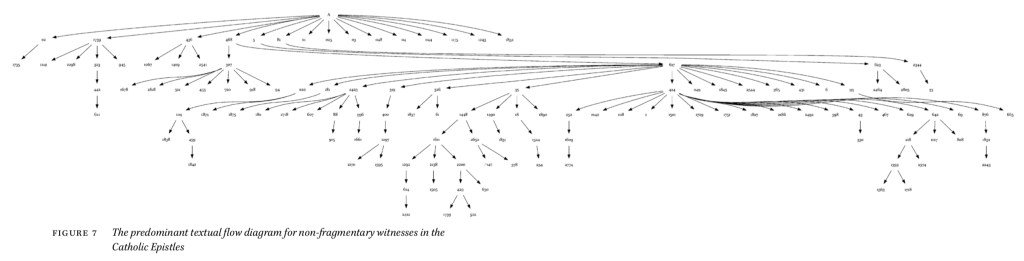
The predominant textual flow diagram for non-fragmentary witnesses in the Catholic Epistles; image source: Peter J. Gurry, A Critical Examination of the Coherence-Based Genealogical Method in New Testament Textual Criticism (Brill, 2017), pp. 60-61
First off, let me offer a hearty endorsement of Tommy Wasserman and Peter Gurry, A New Approach to Textual Criticism: An Introduction to the Coherence-Based Genealogical Method (SBL Press, 2017). Concise, clear, and really, really useful for those of us struggling to get our heads around this approach. I still have some questions, but I feel a lot better having read this book.
One of the confusing things about the CBGM is the definition of terms. A major point on which I still lack clarity relates to the Ausgangstext, the “initial text” that is the outcome of the application of the CBGM. In Wasserman and Gurry’s helpful glossary, the “initial text” is defined as “the hypothetical witness from which all the extant witnesses derive.” To me this sounded quite similar to what we would call the “archetype” in classical textual criticism (although in the framework of the CBGM what is at issue are immaterial witnesses rather than material manuscripts). But I see now that Klaus Wachtel draws a sharp line between the “initial text” and the “archetype” in the following way:
“…the definition of the term ‘initial text’ must be carefully distinguished from the archetype of the tradition, on the one hand, and from the original text of the author, on the other. The archetype of the tradition was a real manuscript, the copy by which the transmission started that put forth the manuscripts we have―and many more that are lost. The original text of the author predates the manuscripts we have by more than a century in most cases. The initial text is the hypothetical reconstruction of the text as it was before the archetype of the tradition emerged. The initial text is the result of methodical efforts to approximate most closely the lost text of the author based on all relevant evidence, not excluding any trace of transmission predating the archetype.” (“Conclusion” to The Textual History of the Greek New Testament: Changing Views in Contemporary Research, SBL Press, 2011)
I think I understand what is being argued here, but I am not quite clear on–I’m not sure exactly how to say this–how far behind(?) the archetype one can go with “traces of transmission that predate the archetype.” I suppose it would depend upon the quality of the “traces”–in this case references to NT passages in the texts of early Christian authors (which, themselves have material manuscript histories with which we must deal). If I understand correctly, then, the “date” of the initial text will vary from book to book (or even from passage to passage?) in the New Testament, depending on the quality of (the texts of) the available manuscripts and “traces of transmission preceding the archetype.”
Gurry has a very informative dissection of Wachtel’s chapter and other contributions to the Textual History volume in his more detailed monograph, A Critical Examination of the Coherence-Based Genealogical Method in New Testament Textual Criticism (Brill, 2017, see especially the third chapter,”Recovering the Initial Text”). And he comes close to addressing the issue that is nagging me:
“…the solution to the misunderstanding about the use of the term ‘initial text’ is to distinguish the meaning from the referent. The term means ‘that text from which the extant tradition descends,’ a definition which allows it to refer to any number of historical entities including the author’s original text, the archetype, or some editorialized text subsequent to both. The benefit of this understanding is that it may allow those with differing opinions about the referent to nevertheless agree on the editorial text itself.”
I think I like this distinction, but I miss a definition of “tradition” in the sense that Gurry uses it here [[see Update below]], which seems different from the use of Wachtel, who refers to “the archetype of the tradition” in direct contrast to “the initial text.” For Gurry, it would seem that “tradition” also includes “traces of transmission predating the archetype.” But maybe I am missing something?
I wonder if it would be helpful to think in concrete terms: 2 Timothy. I think the earliest surviving material manuscript of 2 Timothy would be Sinaiticus (generally assigned to the fourth century), although I guess the earliest surviving immaterial text might be considered 1739, perhaps pushing things back to the time of Origen. Would the initial text of 2 Timothy that we could produce through the CBGM then be considered a text supposedly extant in the middle of the third century, with the exception of those passages cited in Clement of Alexandria, for which we could then say our initial text dates to closer to the end of the second or the beginning of the third century (on the assumption that our critical text of Clement is sound)?
Or am I misunderstanding something in the method?
Update 10 June 2020: Gurry elaborates via e-mail: