Another Part of Scott Carroll’s Manuscript Network

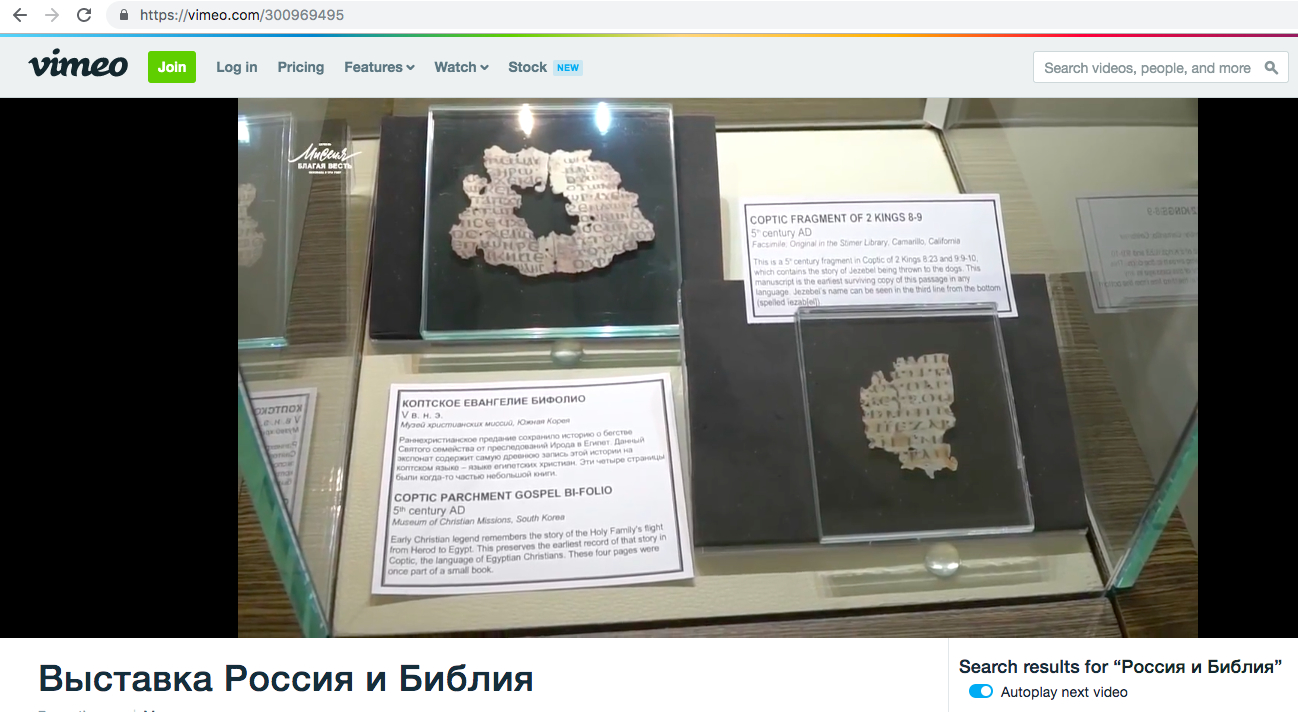
A couple days ago, Roberta Mazza pointed out that Scott Carroll and Josh McDowell have been active recently in Russia. Thanks once again to the sharp eye of David Bradnick, another piece of Scott Carroll’s network of manuscript dealers is beginning to come to light. David notes the image below, which comes from a video describing Scott Carroll’s exhibition in St. Petersburg, Russia:

The manuscript on the right is a facsimile of a fragment of 2 Kings in Coptic on parchment. It is pretty clearly meant to represent the manuscript that Carroll was displaying back in 2016:

Continue reading
Posted in Antiquities Dealers and Collectors, Antiquities Market, Scott Carroll | 11 Comments

The Son of Man is Lord of the Sabbath: Synoptic Problems

I’ve been knee-deep in Synoptic Problem things for the last couple weeks, and it has been quite enjoyable. The degree of complication you face when trying to balance the best critical text of each synoptic gospel with the question of dependence among the gospels really is tricky. The saying in Matthew 12:8 (and its parallels) presents a fun puzzle. After the Pharisees confront Jesus because his disciples plucked grain on the sabbath, each gospel ends the passage with a version of this saying. Here are all three gospels in Throckmorton’s synopsis (NRSV translation):

Matthew 12:8
“For
the Son of Man is
lord

of the sabbath.”
Mark 2:28

“the Son of Man is
lord
even
of the sabbath.”
Luke 6:5

“The Son of Man is
lord

of the sabbath”

Aside from the introductory “For” in Matthew, the core saying differs in just one word across the three synoptic gospels, the “even” in Mark. Thus, the passage presents a very minor agreement between Matthew and Luke against Mark. That is how the NRSV translation makes it appear, anyway. The situation in the Greek text is a little more complicated. Here is the text of the passage in the 28th edition of Nestle-Aland along with its critical apparatus:

Continue reading
Posted in Codex Vercellensis, New Testament, Textual criticism, Uncategorized | 2 Comments

The Harris Homer Roll Online

Harris Homer Roll Small

Detail of British Library Papyrus 107, the Harris Homer roll; image source: The British Library

A couple years ago, I wrote an article on two papyrus manuscripts now housed in the British Library, the so-called Harris Homers. I’ve written on this blog before about the curious story of their discovery in the “Crocodile Pit of Maabdeh” in Egypt in the middle of the nineteenth century. They were supposedly found by the British collector Anthony Charles Harris (1790-1869) and later sold by his daughter, Selima Harris (ca. 1827-1899) to the British Museum. One of these manuscripts was the remains of a papyrus roll, perhaps copied in the first or second century CE, containing book 18 of Homer’s Iliad. The other, the other was (in its present form) a single papyrus quire consisting of of 9 sheets of papyrus folded in half with parts of books 2-4 of the Iliad, probably copied in the third century CE and inscribed only on the recto of the leaves (the versos were apparently left blank and reused at a later date). Continue reading

Posted in Anthony Charles Harris, Antiquities Dealers and Collectors, Find Stories, Harris Homer, Mummies, Selima Harris | Leave a comment

The New York Public Library and P52

There was a rather depressing article in the New York Times about the New York Public Library a few days ago. But reading the story brought back some fond memories for me. I first visited the main branch of the library at 5th Avenue and 42nd Street when I was a graduate student. I was writing a term paper that would become an article called “The Use and Abuse of P52.” In those days, I was lucky enough to have access to the wonderful libraries at Yale University, but on a handful of occasions over the years, even they couldn’t manage to get some resources I needed. One of these instances resulted in a trip to the New York Public Library.

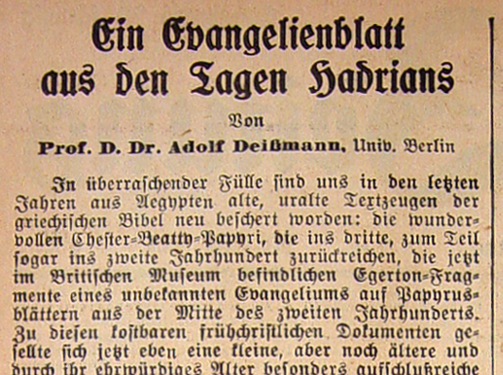
Deissmann P52 Headline

I went in search of the December 3, 1935 issue of the Deutsche allgemeine Zeitung, which contained an article by the famed New Testament scholar Adolf Deissmann, who had given his opinions about the newly published Rylands fragment of the Gospel According to John (P.Ryl. 3.457=P52=LDAB 2774) in this popular periodical. The NYPL was one of the few places in the US that had a copy. Quite a few institutions carried the title on microfilm, but the microfilms inevitably lacked the 1935 issues. Continue reading

Posted in Adolf Deissmann, P.Ryl. 3.457, Palaeography, Rylands Papyri | Leave a comment

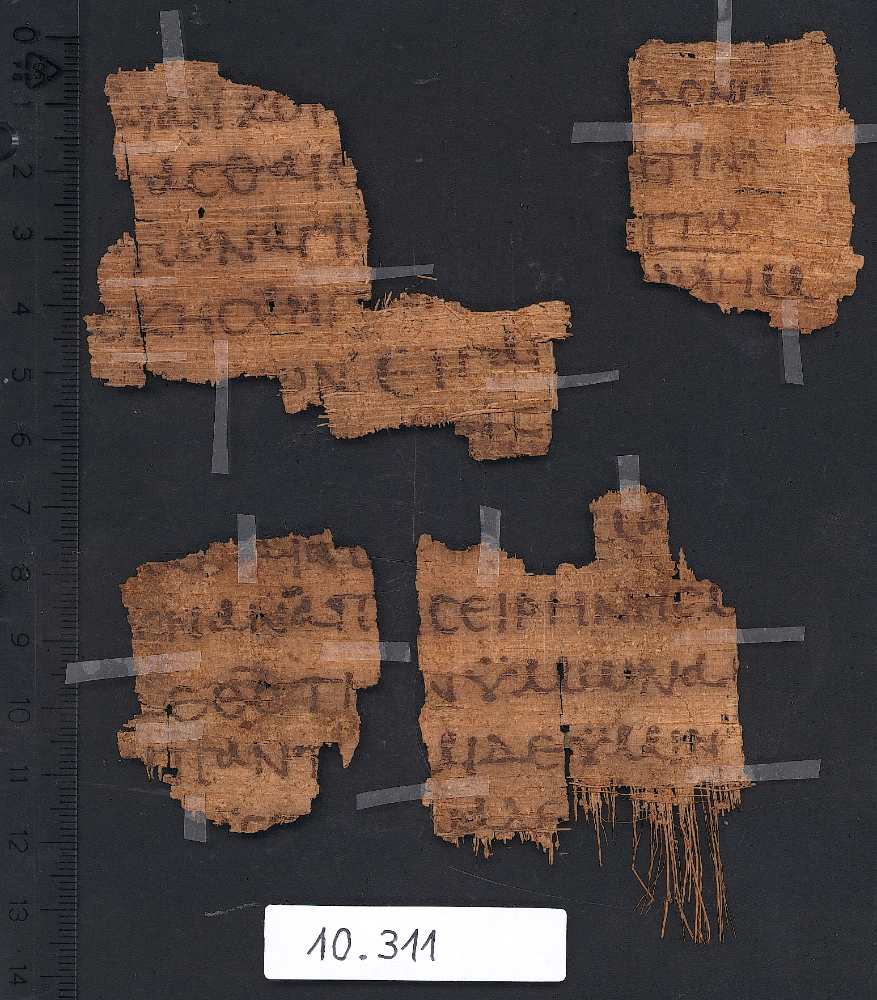
The Date of P.Köln 10.406 (P118)

One of the habits of papyrologists and New Testament scholars that I’ve tried to highlight over the last decade is the practice of dating the handwriting of ancient manuscripts by comparing them to other samples of handwriting that are themselves of uncertain date. Another good example of this phenomenon is P.Köln 10.406 (better known to New Testament scholars as P118), fragments from a leaf of a papyrus codex containing Paul’s letter to the Romans (LDAB 10081) copied in two columns per page.

P118 PKöln 10 406

P.Köln 10.406, fragments of a leaf of a papyrus codex containing Romans; image source: Die Kölner Papyrus-Sammlung

Continue reading

Posted in Codices, P.Bodmer II, Palaeography | 2 Comments

Venn Diagrams and the Synoptic Problem

I mentioned that I gave a paper in Oslo some weeks ago on the issue of manuscripts and the synoptic problem. While it was the issue of manuscripts and variant readings that was the focus of my attention, writing this paper forced me to revisit some foundational scholarship on the gospels and challenged me to try to visualize some data for a general audience. I did so using Venn Diagrams. Now I see that Mark Goodacre, in a series of posts (here, here, and here) prompted by the insightful work of Matthew Larsen, has also been experimenting with Venn Diagrams to model synoptic relationships (see also the interesting contribution by Joe Weaks). Continue reading

Posted in New Testament | 19 Comments

P.Bodmer 58 and Ancient Instructions for Preparing Parchment

PBodmer 58 Spine

While the Bodmer Papyri are best known for the subset of Greek and Coptic codices that Martin Bodmer acquired from Egyptian sources through the Cypriot dealer Phocion Tano in the 1950s, there are other early Christian materials in the collection that were acquired under different circumstances. One of the most curious of these is now known as P.Bodmer 58 (LDAB 107785). This papyrus codex, usually said to have been copied in the sixth or seventh century, contains a series of works in Coptic: a dialogue between two deacons and Cyril of Alexandria, letters of Theophilus, a dialogue between Horsiesius and Theophilus, a dialogue between Phausos and Timotheos with Horsiesius, and a collection of works attributed to Agathonicos, along with a set of instructions for the preparation of parchment. Unlike the more famous Bodmer Papyri that first appeared on the antiquities market in the 1950s, P.Bodmer 58 has been known since the nineteenth century. It was formerly in the collection of Thomas Phillipps (1792-1872). The individual papyrus leaves have been placed between a kind of wax paper, and these “sandwich” leaves have been bound together in a modern binding in a somewhat jumbled order. Three different copyists seem to have been responsible for the production of the leaves now bound together in the codex. Continue reading

Posted in Antiquities Dealers and Collectors, Bodmer Papyri, Book binding, Codices, Monastery of Epiphanius, Thomas Phillipps | 8 Comments

An Oxyrhynchus Manuscript of Romans

Oxyrhynchus RomansIn light of the recent report on unpublished early Christian manuscripts from the Oxyrhynchus collection, it may be worth revisiting an old video. In 2006, the PBS television program Nova: ScienceNow presented a segment on the use of multispectral imaging (MSI) on ancient manuscripts, including some in the Oxyrhynchus collection. Continue reading

Posted in Oxyrhynchus Papyri | 2 Comments

Article in The Ancient Near East Today

ANE Today Article

The April 2019 edition of The Ancient Near East Today is carrying a very nicely illustrated article about my book, God’s Library. You can check it out at their site.

Posted in Archaeological context | 1 Comment

Kenyon’s Editions of the Chester Beatty Biblical Papyri Online

Kenyon Beatty Papyri Fasc 1In addition to digital images of many of their manuscripts, the Chester Beatty Library in Dublin has also made available the text and plates of Frederic Kenyon’s editions of the Beatty Biblical Papyri. As I have noted before, these volumes are extremely difficult to find on the used book market, so this is a fantastic development. Many thanks to the people at the Beatty Library in Dublin! I can’t find an organized set of links to the pdf files, so I’ve made one below. Please use the comments to let me know if there are problems with any of the links. Continue reading

Posted in Chester Beatty Papyri | 11 Comments