Big Discount on God’s Library at Amazon

If for some reason you haven’t picked up a copy of God’s Library yet, it is currently being sold at amazon (US) at a discount of over 50%–$15.84 USD. It also makes a great Christmas gift. I have no idea how amazon pricing works, so this deal might not be around for long.

Amazon God's Library Sale

Posted in Manuscript Collections | Leave a comment

Once More: An Oxyrhynchus Papyrus of Exodus and Revelation, Part 2

In my previous post, I reviewed a recent article by Scott Charlesworth on British Library Pap. 2053, a papyrus from Oxyrhynchus with the ending of Exodus on one side (P.Oxy. 8.1075) and the opening verses of Revelation on its reverse (P.Oxy. 8.1079). In a 2013 article in Novum Testamentum, I had argued that this papyrus was probably a leaf from a codex rather than a portion of a roll, as was usually believed. Charlesworth’s claim that “all indications” point to this piece being a roll and not a codex was not persuasive.

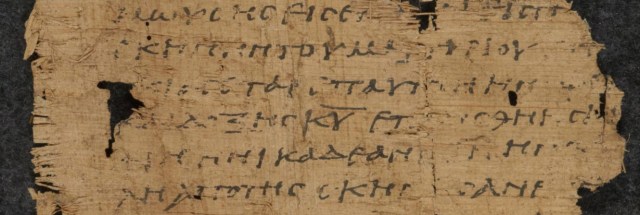
POxy 8 1075 Detail

P.Oxy. 8.1075 (→ of British Library Pap. 2053); image source: The British Library

In the current (2019) issue of New Testament Studies, Peter Malik makes a case similar to that of Charlesworth, although Malik’s argumentation is more nuanced. Malik’s full article can be viewed here. Let’s have a look at his case. Continue reading

Posted in Codices, Oxyrhynchus Papyri | 4 Comments

Once More: An Oxyrhynchus Papyrus of Exodus and Revelation, Part 1

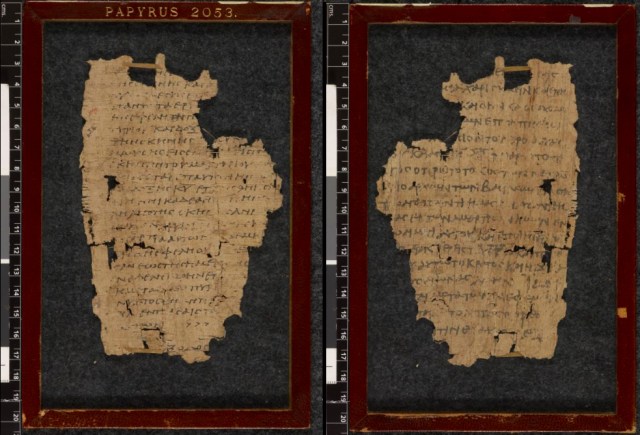
Among the Christian papyri from Oxyrhynchus is an interesting piece now in the British Library (Pap. 2053) that contains the final verses of Exodus in Greek with an end title (P.Oxy. 8.1075) and on the reverse, in a different script, the opening verses of Revelation (P.Oxy. 8.1079):

British Library Papyrus 2053

British Library Papyrus 2053, showing P.Oxy. 8.1075 (Exodus) on the horizontal fibers (left) and P.Oxy. 8.1079 (Revelation) on the vertical fibers (right); image source: The British Library

The original editor (Arthur S. Hunt) published the texts separately and believed that the piece was a roll of Exodus that was later (but not much later) reused by copying the text of Revelation on the back of the roll. A few years ago, I suggested that this piece was equally likely (if not more likely) to be a leaf of a codex. The abstract of that article in Novum Testamentum laid out the lines of my argument: Continue reading

Posted in Bodmer composite codex, Codices, Oxyrhynchus Papyri, Scott Charlesworth | 3 Comments

National Geographic’s “Bible Hunters” Article Online

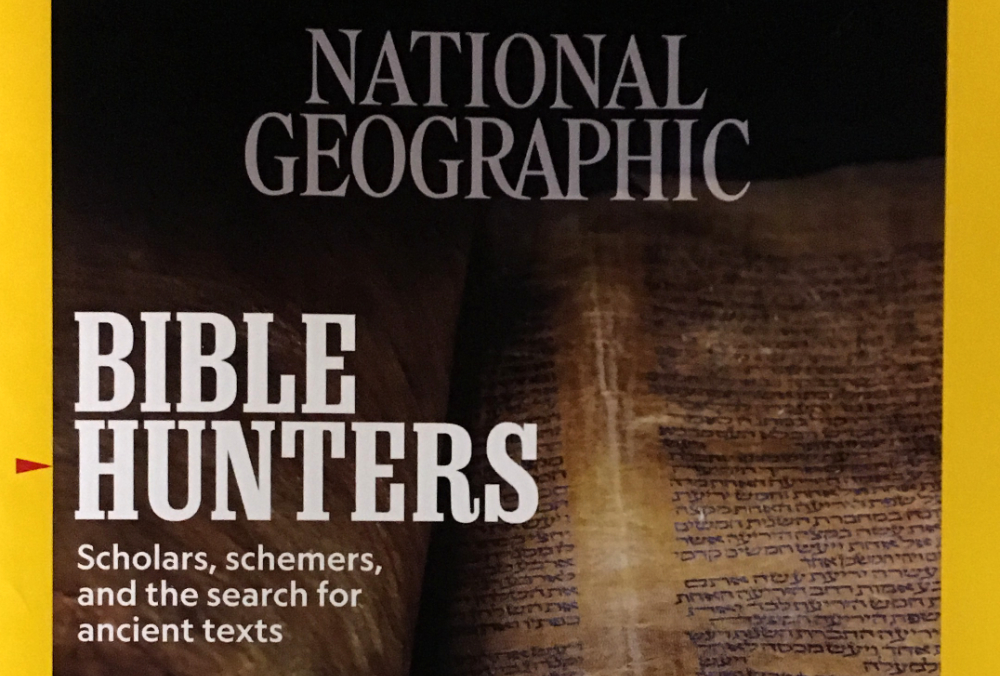
I mentioned in an earlier post that cover story of the December 2018 issue of National Geographic magazine features “Bible Hunters”–the search for early Christian and Jewish manuscripts. The full story is now online (along with some images that are not in the print magazine). The link is here:

https://www.nationalgeographic.com/magazine/2018/12/inside-bible-collectors-search-other-original-christian-texts/

Posted in Antiquities Market, Find Stories | 1 Comment

National Geographic’s “Bible Hunters”: Some Observations

As Larry Hurtado mentioned on his blog a couple days ago, the cover story of the December 2018 issue of National Geographic magazine is on “Bible Hunters,” that is to say both nineteenth century figures like Constantine von Tischendorf and contemporary figures like Hobby Lobby’s president Steve Green. There’s actually a lot going on in both the scope and execution of this article. It is bookended with accounts of an ongoing American/Israeli led dig in caves near Qumran in the occupied West Bank, which is, as the article’s author notes, widely considered “illegal under international law.”  It also contains a discussion of the manuscript formerly known as “first-century Mark.” For now, I’ll just lay out some initial observations. Continue reading

Posted in Antiquities Dealers and Collectors, Fakes and Forgeries, First Century Mark, Oxyrhynchus Papyri, P.Ryl. 3.457, Van Kampen Collection | 2 Comments

Tertullian and the Ending of the Gospel According to John

Tertullian BnF Latin 1622 De Anima 158v

Selection from Tertullian’s De anima (BnF Latin 1622, 9th century)

In response to my recent article on the ending of John in P.Bodmer 2, Michael Lattke brought to my attention an article of his that is relevant to the question of the circulation of the Gospel According to John without chapter 21 in the second and third centuries:

Michael Lattke, “Joh 20 30 f. als Buchschluß,” Zeitschrift für die Neutestamentliche Wissenschaft 78 (1987), 288-292

Lattke focuses on a passage in Tertullian’s Adversus Praxean that describes John 20:31 as “the conclusion of the gospel” (25.4, here in the Latin text of Kroymann): Continue reading

Posted in Textual criticism | 8 Comments

Palaeography and Codices: A Couple Thoughts on Larry Hurtado’s Review of God’s Library

Over on his blog, Larry Hurtado has posted a detailed review of God’s Library. Early on in the book, I mention three of the main scholars who paved the way for those of us working on early Christian manuscripts today: Roger Bagnall, Harry Gamble, and Larry Hurtado. So I’m very gratified to see that Hurtado’s review is largely positive.

I’ll take this opportunity to follow up on Hurtado’s assessment of one of my more sweeping criticisms of the use of palaeography to assign precise dates to Greek literary manuscripts of the Roman era. Hurtado writes as follows: Continue reading

Posted in Codices, Palaeography | 2 Comments

Manufacturing Square Papyrus Codices: Two Ways to Cut the Roll

When trying to understand the process of making small format papyrus codices, it is sometimes tricky to figure out how the papyrus bifolia were cut from the roll. For books that are more tall and narrow, like the Nag Hammadi codices, it is generally clear that the bifolia were cut from a roll with a height equal to that of the bifolia. But for codices whose height is smaller than that of the typical roll, there are other possibilities. Some of the newly available images of the Bodmer nicely illustrate one of them. Continue reading

Posted in Berlin Coptic Proverbs Codex, Bodmer composite codex, Bodmer Papyri, Codices, Codicology | 3 Comments

Images of the Bodmer Papyri Online

Bodmer Papyri SiteI’m happy to announce that as part of the ongoing work of the Bodmer Lab, images of the Greek and Coptic manuscripts from Egypt held at the Fondation Martin Bodmer are now available online. The website remains a work in progress, but the bulk of the images are now available, and the site is live. A couple points to note as you use the site: Continue reading

Posted in Bodmer Papyri, Codices | 4 Comments

An Old Quote from Frank Moore Cross on Unprovenanced Artifacts

Fake Dead Sea Scroll

A Fake “Dead Sea Scroll” in the Museum of the Bible Collection

I’ve just returned from a stimulating week at the University of Agder. I had loads of interesting conversations about a number of topics, many of them stemming from the Museum of the Bible’s admission that (at least) five of their recently purchased, unprovenanced “Dead Sea Scroll” fragments are fake. This admission has inspired a number of reactions in various online forums, the most interesting of which have less to do with the fact of the forgeries (which have been suspected by The Lying Pen project and others for some time) and more to do with the ethical issues involved in the purchase (by collectors) and publication (by scholars) of unprovenanced artifacts. Continue reading

Posted in Antiquities Market, Dead Sea Scrolls, Fakes and Forgeries, Frank Moore Cross, Palaeography | 10 Comments