Palaeography and the Hawara Homer: Part 1

In an earlier post, I talked about the archaeology of the Hawara Homer (LDAB 1695), a papyrus roll containing the second book of the Iliad found with an unadorned mummy during Flinders Petrie’s excavations in Hawara in 1888. In this post, I want to talk a bit about the dating of the manuscript, which provides a nice illustration of how things functioned in the early days of palaeographic dating of ancient Greek handwriting. The handwriting of the papyrus is striking in the regularity of the letters, which were clearly executed by a skilled copyist.
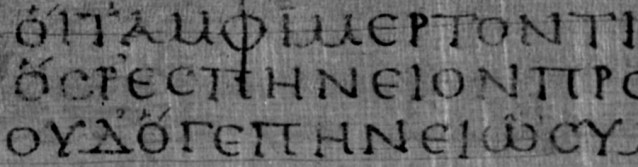
Hawara Homer Sample

Sample of writing from the Hawara Homer (Bodleian MS Gr. Class A.1 (P); Image from the Centre for the Study of Ancient Documents
Continue reading

Posted in Ambrosian Iliad, British Museum, Edward Maunde Thompson, Frederic Kenyon, Hawara Homer, Palaeography, William Matthew Flinders Petrie | 7 Comments

The Bodmer Papyri: 3D Views

In an earlier post, I provided an up-to-date inventory of the papyrus and parchment books from Roman Egypt in the Fondation Martin Bodmer. I’ve been working on these books for a while, and I recently partnered up with the Bodmer Lab (University of Geneva), a digital humanities initiative that is making the materials at the Fondation Martin Bodmer more widely available. My colleague Daniel Sharp and I are working to produce a detailed catalog of “P.Bodmer” material, and we’re hoping to have this data, along with high-quality digital images of many of the books, online later in 2018.

Another aspect of this effort involves experiments with 3D visualization. Continue reading

Posted in Bodmer Papyri | Leave a comment

Anton Fackelmann and Cartonnage

Since I began this blog midway through 2017 with a post about Anton Fackelmann and some of the papyri he allegedly removed from mummy cartonnage, I thought I might close out the old year and open up the new with one more post on Fackelmann’s papyri and their somewhat less-than-clear provenance. Continue reading

Posted in Antiquities Market, Anton Fackelmann, Book covers, Carl Schmidt, Fakes and Forgeries, First Century Mark, Mummy cartonnage | 1 Comment

The Tura Papyri: Archival Footage

Tura Codex VI Didymus Zechariah Page 182

Tura Codex IV, Didymus the Blind, Commentary on Genesis

In my previous post on the Tura Papyri, I mentioned that the books are said to have been discovered in 1941 during the clearing of quarries south of Cairo for use by the British military. The earliest detailed account of the discovery, which wasn’t published until 1946, describes this cleaning operation as follows: Continue reading

Posted in Find Stories, Tura Papyri, Videos | 1 Comment

The Tura Papyri

While many of the papyrus and parchment codices in the Fondation Martin Bodmer appear to be part of a single ancient find, several of these codices are known to have distinct origins. One of these is P.Bodmer LVII, a portion of a large papyrus codex containing a commentary on the Psalms by Didymus the Blind. It is part of a find generally known as the Tura Papyri. Along with the Didymus’s commentary on the Psalms, the Tura find also included parts of at least seven other papyrus codices containing works of Didymus and works of Origen in Greek (see the details of each codex below). Relative to other finds of early Christian manuscripts, the Tura Papyri have been somewhat neglected in scholarship. What follows is a brief overview of the codices and the story of their discovery. Continue reading

Posted in Antiquities Market, Bodmer Papyri, Find Stories, Tura Papyri | 2 Comments

Provenance and The Oxyrhynchus Papyri

Over at rougeclassicism there are a few questions posed about the provenance of the recently publicized identification of a Greek papyrus as The First Apocalypse of James. The papyrus is to be published in an upcoming volume of The Oxyrhynchus Papyri series. Candida Moss has written up a nice summary of the background of this piece and its significance that corrects some mistaken news reports that have been circulating in recent weeks. Since a chapter in my forthcoming book is dedicated to the Christian literary papyri from Oxyrhynchus, I’ve had to work through some of the interesting issues surrounding this collection of material. It’s a little more complicated than is generally recognized. Continue reading

Posted in Antiquities Market, Find Stories, Oxyrhynchus Papyri | 4 Comments

Ancient Book Covers and “Cartonnage”

As a follow-up to my last post on the development of the use of the French term “cartonnage”: It looks like it was the late 1950s when the term “cartonnage” began to be applied to the material sometimes used in ancient book covers. Today, this is a common usage among papyrologists. Some scholars of bookbinding have not been entirely happy with this development. Continue reading

Posted in Anton Fackelmann, Book covers, Codices, Mummy cartonnage, Nag Hammadi, Schøyen Collection, Uncategorized | 2 Comments

Cartonnage (Mummy and Otherwise)

A question from a commenter on a recent post prompts me to write up a quick discussion of the history of the word “cartonnage” and its current use to describe both mummy casings and the covers of some ancient books. As far as I know, this term was first adopted by Anglophone Egyptologists in the nineteenth century to talk about the material sometimes used to make mummy casings. Continue reading

Posted in Book covers, Find Stories, Mummies, Mummy cartonnage, William Matthew Flinders Petrie | 3 Comments

The Hawara Homer

A chapter in my book is dedicated to “find stories” of early Christian manuscripts. Along the way, I touch upon similar narratives of discoveries of other Roman era manuscripts as well, but I didn’t really have the chance to go into as much detail as I would have liked with these cases. I’ve already mentioned on this blog the story (or stories) of the Harris Homers and the crocodile pit. A second especially interesting narrative involves another “named” manuscript of the Iliad, the so-called Hawara Homer. Continue reading

Posted in Fayum Portraits, Find Stories, Harris Homer, Hawara Homer, Mummies, William Matthew Flinders Petrie | 8 Comments

The Bodmer Papyri: An Inventory of “P.Bodmer” Items

The longest chapter of God’s Library is dedicated to “The Bodmer Papyri,” a group of manuscripts that can be confusing even for scholars of early Christianity. The name derives from the Swiss collector Martin Bodmer (1899-1971), who bought a number of papyrus and parchment manuscripts from Egypt in the 1950s and 1960s. Many (though not nearly all) of these pieces are thought to derive from a single ancient find in Upper Egypt.

Bodmer and Menander

Martin Bodmer with a leaf of the Bodmer Menander codex (P.Bodmer XXV+IV+XXVI)

So, the term “Bodmer Papyri” usually refers to this ancient find (which also contained material that Bodmer did not buy), but Bodmer’s collection of early Christian manuscripts also contains early Christian manuscripts from Egypt that were not part of this find. The early papyrus and parchment manuscripts in Bodmer’s collection, now part of the Fondation Martin Bodmer, carry the papyrological designation “P.Bodmer.” There does not seem to be a complete, up-to-date list of these “P.Bodmer” items online, so I am producing one here. Most of these manuscripts are presently in the Fondation Martin Bodmer in Geneva, although some of them are now elsewhere (and now have other additional names, just to make things a little more confusing).

Continue reading

Posted in Bodmer Papyri | 12 Comments