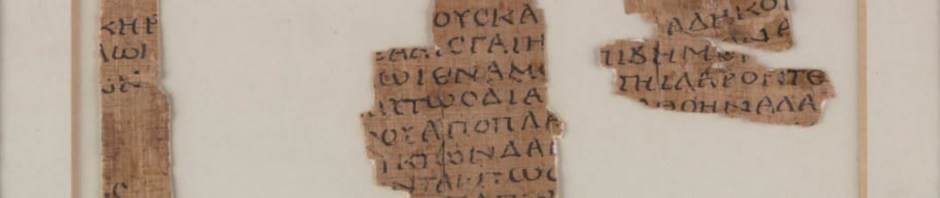
In the last couple days, the Cambridge University Library has been posting about a papyrus in their collection that contains a passage from the Odyssey.
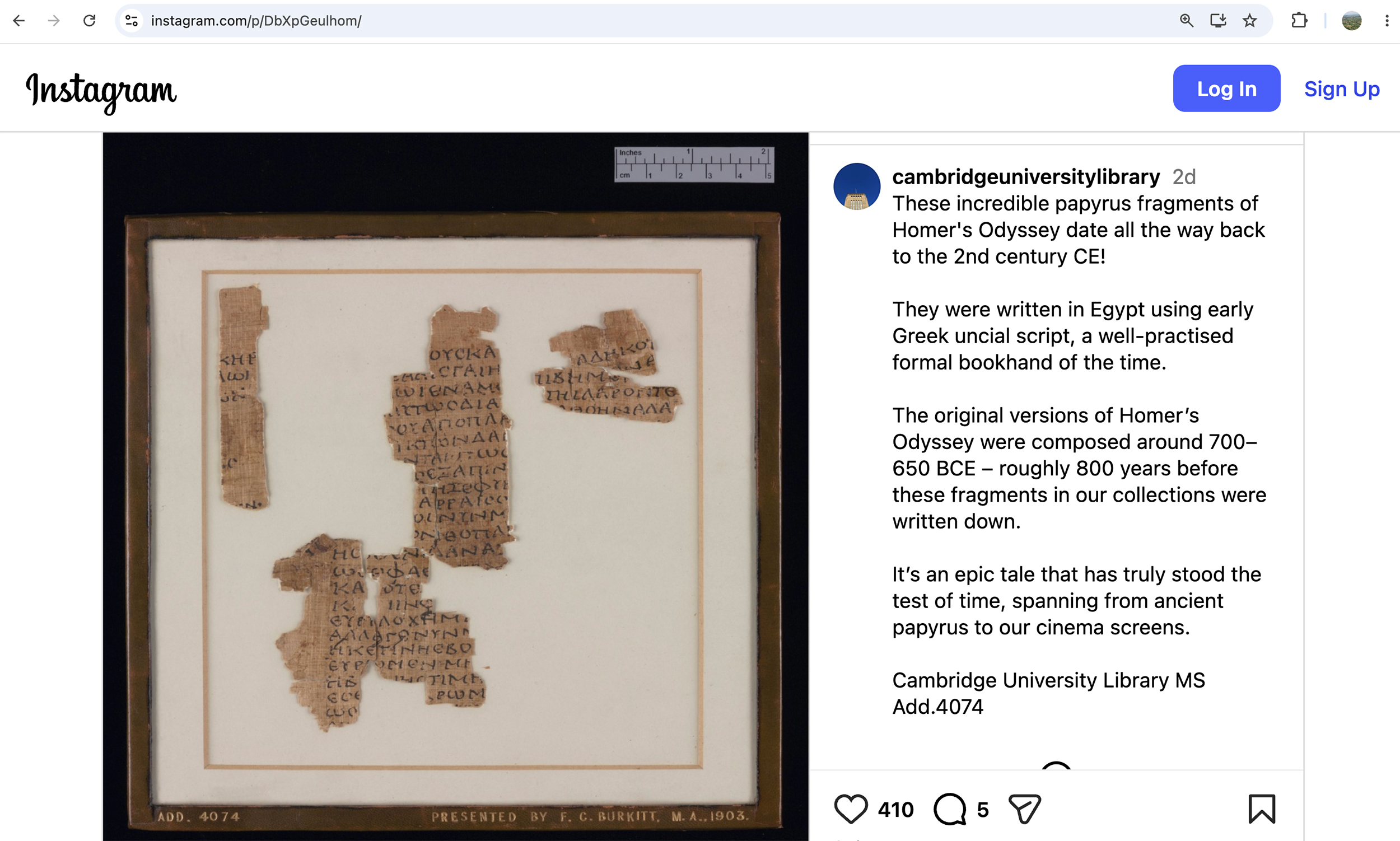
This is Cambridge University Library Add MS 4074 (TM 61188), containing some fragmentary lines of Book 12. What caught my eye about the post was the note on the tape that seals the glass frame: “Presented by F.C. Burkitt, M.A., 1903.” There are many sub-collections of papyri kept at Cambridge, but I was not aware of a “Burkitt” collection. In any event, a little digging revealed that these fragments are said to have been purchased together with the much more famous “Nash Papyrus” (Cambridge University Library MS Or.233), a Hebrew papyrus containing a version of the ten commandments now usually assigned to the second century BCE on the basis of palaeography. Burkitt published the Odyssey fragments in 1902, but he provided his most detailed statement of their purchase in an article on the Nash Papyrus:
“The recent history of the [Nash] Papyrus is involved in some obscurity. It came into the possession of Mr. W.L. Nash, the Secretary of the Society of Biblical Archaeology, having been bought in Egypt from a native dealer along with some very early uncial fragments of the Odyssey. Mr. Nash thinks it very probable that the whole ‘find’ comes from somewhere in the Fayyum. These Greek fragments must be as old as the second century A.D., and are probably much earlier: they contain portions of Odyssey XII. 279–304, and have been edited by the present writer with a facsimile in the Proceedings of the Society of Biblical Archaeology.”1
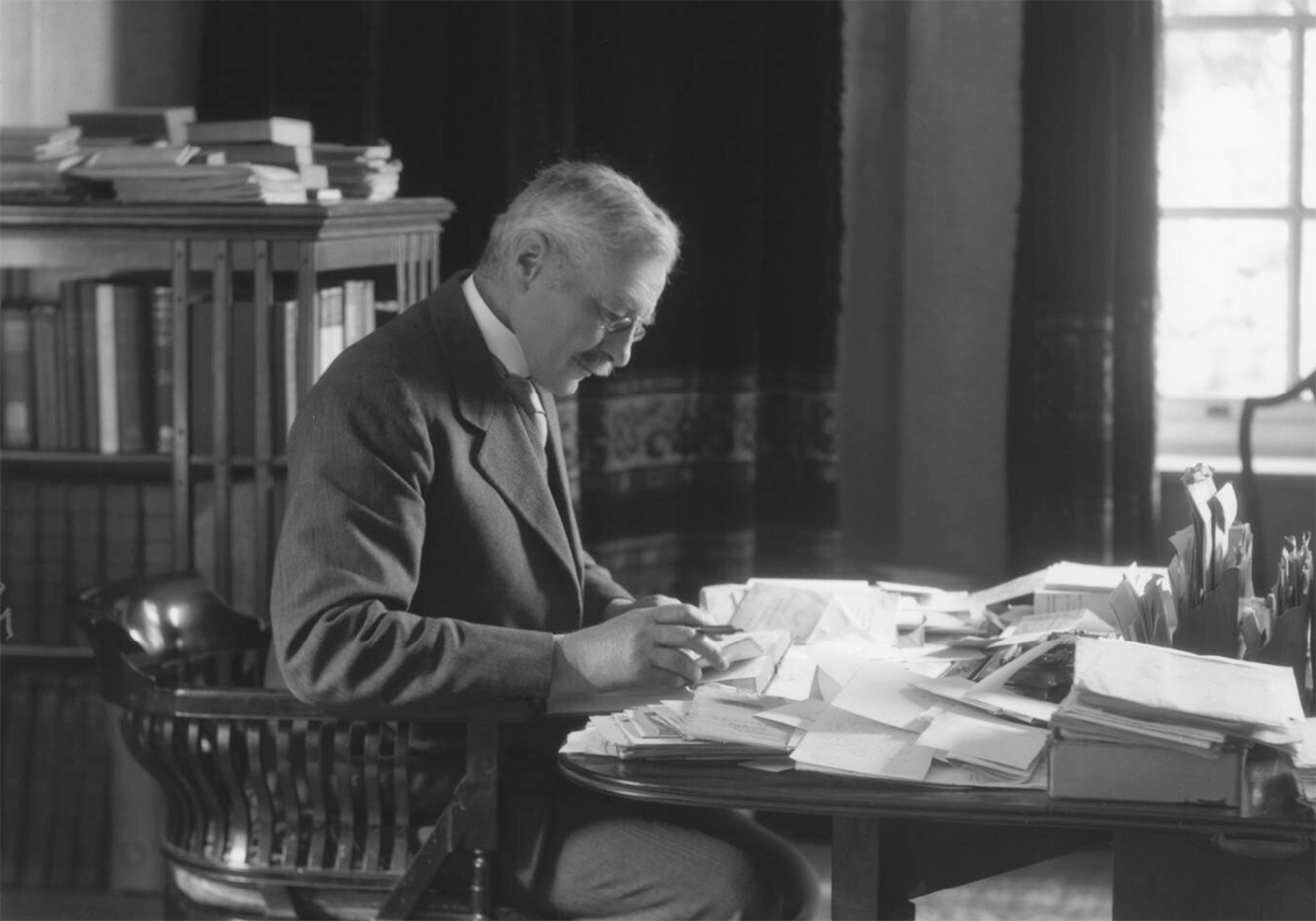
So, the papyrus was bought in Egypt in the first years of the twentieth century, although I’m not sure about the exact date and place of purchase. Walter Llewellyn Nash (1842–1920) was a physician and archaeological enthusiast. He was involved in different archaeological societies, attending the meetings of the Egypt Exploration Fund, becoming a fellow of the Society of Antiquaries of London, and acting as secretary of the Society of Biblical Archaeology. Francis Crawford Burkitt (1864–1935) held different professorships at Cambridge from 1903 to 1935, but during the period of the acquisition and publishing of the Odyssey fragments, Burkitt seems to have been an independent scholar. In his obituary for Burkitt, Kirsopp Lake wrote that Burkitt, having been denied a fellowship at Trinity College, Cambridge, refused other offers: “He could afford to do so, as he was endowed with ample means, and he settled down in Cambridge to the life of a private scholar.”2 It’s not clear whether Nash simply gifted the Odyssey papyrus to Burkitt or whether Burkitt purchased the fragments from Nash and then donated them to Cambridge.
The date of the Odyssey fragments is also an interesting question. In the classic article that redated the Nash Papyrus from the second century CE to the second century BCE, W.F. Albright made passing mention of the Odyssey fragments:
“I have consulted the two eminent papyrologists, Dr. H. Idris Bell of the British Museum and Dr. Herbert C. Youtie of the University of Michigan; both date them between 50 and 150 A.D. Dr. Bell writes: ‘Though usually reluctant to be very positive on questions of dating I feel very confident in this case that the papyrus is Roman, not Ptolemaic. I should date it, with less hesitation than usual, in the latter part of the first or the early part of the second century A.D.’ He goes on, however, to observe: ‘I doubt whether the date of the Odyssey fragments is really relevant to that of the Hebrew papyrus; unless the two can be shown to have been found together simultaneous acquisition proves nothing, since dealers often combine the most diverse pieces.'”3
I can’t really offer an independent assessment because I have not seen either the papyrus itself or a good digital image (I have not been able to find an image of this papyrus on the Cambridge University Library website, which is a bit strange, since they clearly have an image available for their social media accounts).
- F.C. Burkitt, “Fragments of Some Early Greek Mss. Written on Papyrus,” Proceedings of the Society of Biblical Archaeology 24 (1902) 290–292; F.C. Burkitt, “The Hebrew Papyrus of the Ten Commandments,” Jewish Quarterly Review 15 (1903) 392–408, quotation at 392. ↩︎
- K. Lake, “F.C. Burkitt,” Journal of Biblical Literature 55 (1936), 17–19, quotation at 17. ↩︎
- W.F. Albright, “A Biblical Fragment from the Maccabaean Age: The Nash Papyrus,” Journal of Biblical Literature 56 (1937) 145–176, quotation at 146. ↩︎


The overall impression (and the peculiar finials) suggest rather first century CE, I would say.
Pingback: The Purchase of the Nash Papyrus: Two Different Dates | Variant Readings
Pingback: Early Publications on the Nash Papyrus | Variant Readings