
I’ve been thinking quite a bit in recent years about the places where Roman books were stored and used. So I was interested to see several news stories in the last couple days with headlines like “One of the Best Preserved Roman Libraries Discovered in Spain” and “Archaeologists Find Oldest Library in Iberian Peninsula.”
These stories concern the fourth-century phase of the Fuente Álamo villa in southern Spain and are based on a new article:
Antonio López García, Javier Martínez Jiménez, and Eduardo Cerrato Casado, “New Approaches to Identifying Roman Libraries: Two Late Antique Examples from Stobi (North Macedonia) and Fuente Álamo (Spain),” Journal of Mediterranean Archaeology 39 (2026)
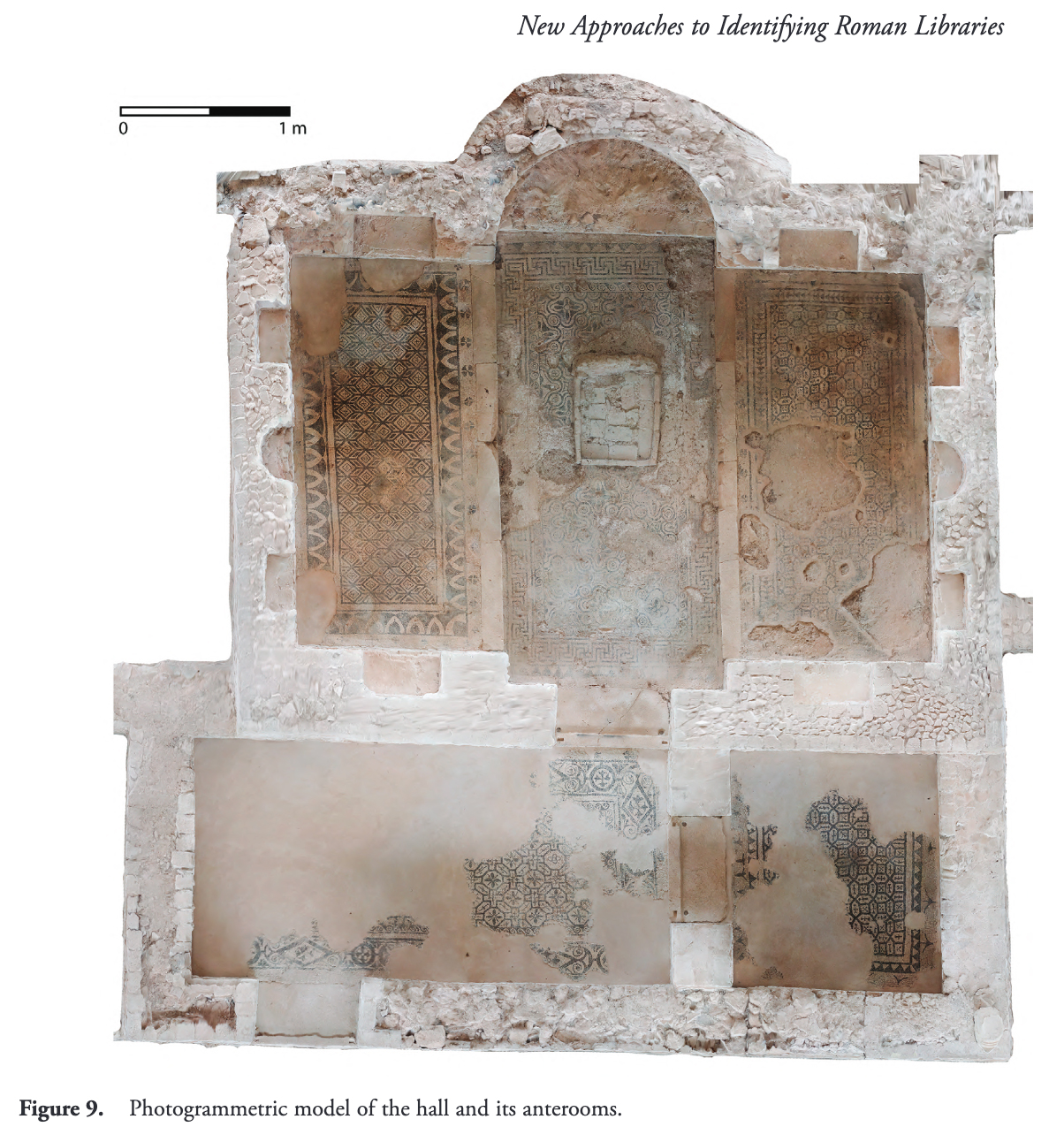
The structure was excavated over a period of time between the 1980s and the early 2000s. As the article’s authors note, the space had been identified earlier as “an office or library,” which seems quite plausible.1 And indeed, the present study supports that identification with a different kind of analysis (“shape grammar,” a computational technique previously applied to Roman library architecture by Myrsini Mamoli). So far, so good, although perhaps not exactly the “discovery” the headlines indicated.
The authors then introduce an artifact that is new to me, a piece in they call the “declamatio sarcophagus.” This damaged sarcophagus seems to have been found in the general area of the villa (its exact point of discovery appears to me to be unknown, but I may have missed some bibliography). The authors raise the possibility that the sarcophagus might be connected to the owner of the villa (or even depict the owner of the villa in the left panel). The authors’ illustration of the sarcophagus is below:

Leaving aside the authors’ proposed association of the sarcophagus with the villa, I must admit that I am a little puzzled by the authors’ description of the left panel of the sarcophagus:
“The sarcophagus is contemporary with the second phase of the Fuente Álamo villa (fourth century AD), when the apsed hall was in use. The left side of the main face shows a bearded man sitting on a chair in columnar frame with his feet resting on a footstool. He holds a scroll in his right hand and an open codex in his left hand. The man is addressing another bearded figure wearing a toga, in what has been described as a declamatio scene.”
I see the seated person on the left instead holding a roll, with one end of the roll in each hand, a fairly typical pose in sarcophagus reliefs. This was also the interpretation of Manuel Rodríguez de Berlanga in 1903:
“With his left arm extended and the right held close to the chest, the figure appears to be unrolling a papyrus roll to read it—a scroll rolled up at both ends.”2
It would be interesting if this sarcophagus did depict a figure holding both a roll and a codex, but I don’t think we have any images of codices here.
The relevant portions of the sarcophagus became separated from it at some point and have had a different modern display history. At one point, they were embedded in the wall of a museum (as the background of the inset image above seems to show. I am unsure whether all the pieces have been reassembled now. In any event, if anyone has better images of these parts or of the rest of the sarcophagus, I would be grateful to see them.
- C. Cosana et al., “Análisis de los morteros y pinturas murales de la villa romana de Fuente Álamo,” Antiquitas 30 (2018) 79–88, at 80: “una sala considerada como despacho o biblioteca de la vivienda.” ↩︎
- M. Rodríguez de Berlanga, Catálogo del Museo Loringiano (Málaga: Tipografía de Arturo Gilabert, 1903), 99-101, at 100: “Con la izquierda estendida y la diestra recogida cerca del pecho, figura estar desarrollando un volumen para leerlo, el cual aparece enrollado en ambos extremos.” ↩︎


 Variant Readings
Interesting that the 1903 publication rejects a view that had been expressed that the depiction is of Christians, though it dates the sarcophagus in the post Constantine fourth-century Christian era. I wonder whether that view, of Christians, was expressed orally or in writing; the latter may be less likely if this is the first scholarly publication, though speculative or sensational (?) newspaper reports might have been earlier. Also, I wonder if the judgement that the images were not of Christians was made partly because they hold scrolls rather than codices. Or whether scrolls continued to be depicted partly as archaizing or habitual because some pattern books had not kept up with the change.
Is there any indication whether this library housed scrolls or codices or both?
Not as far as I know. I think most of the buildings identified as “Roman libraries” pre-date the full-fledged “rise of the codex” and are assumed to have held mainly papyrus rolls. But this is just my impression.