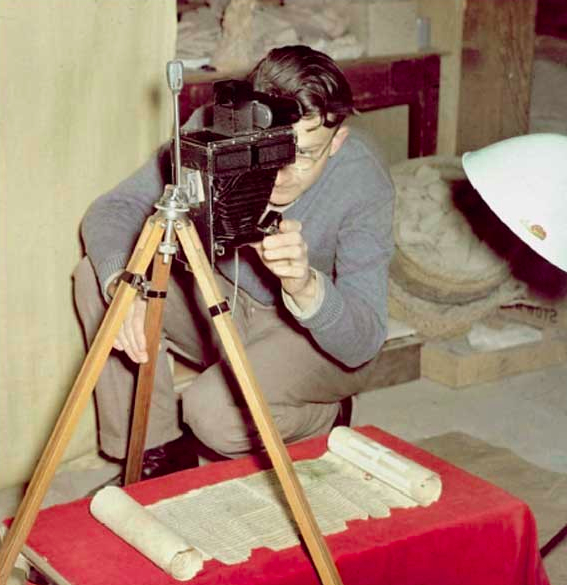
In spare moments, I continue to work on the manuscripts generally associated with Cave 1 at Qumran. I’ve become very interested in the photographs of the excavations of Cave 1. Both Gerald Lankester Harding and Ovid R. Sellers took pictures during the excavations at the site in 1949. I’ve seen a scattering of these published in different places, but I stumbled across a very interesting one recently. I had seen a couple versions of this image before. The first one appeared in an article by Sellers in BASOR in 1949:
Photographs by Ovid Sellers showing the excavation of “the cave at ‘Ain Fashkha”; image source: O. R. Sellers, “Excavation of the ‘Manuscript’ Cave at ‘Ain Fashkha,” BASOR 114 (1949), p. 8
Another “colorized” version appeared in a detailed article on Cave 1 that was published a few years ago:
Joan E. Taylor, Dennis Mizzi, and Marcello Fidanzio, “Revisiting Qumran Cave 1Q and its Archaeological Assemblage,” Palestine Exploration Quarterly 149 (2017), 295-325.
The authors of the article had identified a collection of tinted slides at Oberlin College that included photos taken by Sellers.
Photographs of the excavation of the “Ain Feshka cave”; image source: Oberlin College Libraries (The Professor Herbert G. May Teaching Collection on Biblical Archaeology and the Bible)
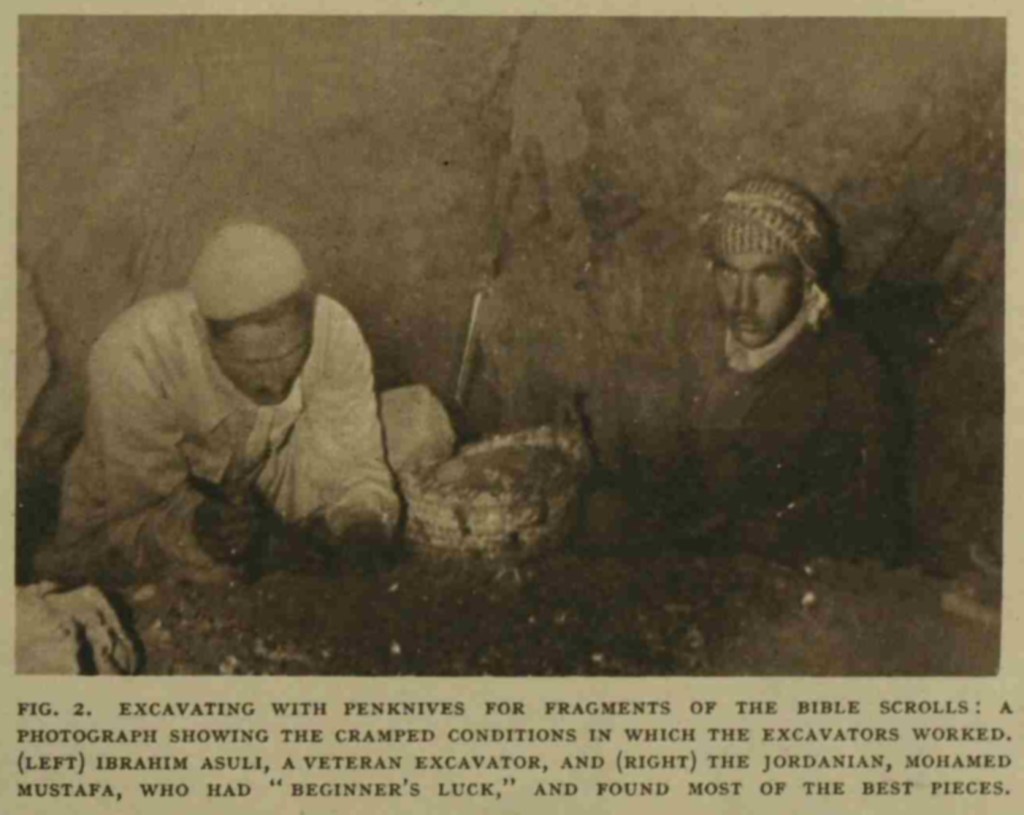
The label on the slide reads as follows: “Ain Feshka cave, BASOR 114; (1) interior of cave from the entrance (2) interior of cave from the entrance. Harding & de Vaux looking at box MSS fragment[s].” It is of course interesting to see de Vaux and Harding at work, but who are the others carrying out the excavation in these images? I came across yet another version of the photo on the left recently that answers this question. It has a caption naming the two excavators in the photo: Ibrahim Asuli and Mohamed Mustafa. It’s included in an article by Harding in the Illustrated London News:
Image source: Illustrated London News (1 October 1949), p. 493
Harding elaborated a bit on the information in the caption:
“In addition to Père de Vaux and myself, the actual work of excavation was carried out by Ibrahim Asuli, a veteran excavator of twenty-three years’ experience, Azmi Khalil, both of the Palestine Archaeological Museum, and Mohamed Mustafa, a Jordanian, and a newcomer to the profession. He had the usual beginner’s luck and found most of the best pieces.”
Both Ibrahim Asuli (sometimes spelled Assuli) and Azmi Khalil also worked on de Vaux’s 1952 expedition that explored the region and inventoried the other caves in the area. They are mentioned as part of the team in an article by William L. Reed, “The Qumrân Caves Expedition of March, 1952,” BASOR 135 (1954). During that project, they oversaw (together with Hasan Awad Qutshan of Amman) a crew of 24 Bedouin searching the cliffs looking for artifacts.
Presumably, it is these two who were still working with de Vaux in 1956 on Cave 11. In one of his notebooks from that year, de Vaux mentions “Ibrahim and Azmi” as team members (see Humbert and Fidanzio, Khirbet Qumrân and Aïn Feshkha IVA, Vandenhoeck & Ruprecht, 2019, p. 12, note 5). These men were clearly important participants in the excavation of the Qumran caves. It is good to be able now to put faces with the names.
I gave a talk on early Coptic books a few weeks ago in which I mentioned the results of some radiocarbon analyses of Coptic codices. Now I learn that some of what I said is already out of date! A recent e-mail from Mike Holmes prompted me to check in on the OxCal website, where I saw that a new version of the OxCal calibration program is up and running using new data (IntCal20). The new calibration curve appears to have a noticeable effect on the dates of some early Christian manuscripts.
The results of radiocarbon analysis yield ages in terms of “radiocarbon years before present (BP).” Because levels of carbon-14 in the atmosphere fluctuate over time, these results need to be converted into calendar dates through a process of calibration. Objects with known dates, usually tree rings, are subjected to radiocarbon analysis, and these results are compiled and used to translate radiocarbon years BP into calendar dates for objects of unknown dates. Every so often, the accumulated and refined data for calibration is used to generate a new calibration curve.
The appearance of a new calibration curve means that older analyses can be re-calibrated using the new data. For this reason, authors who publish the results of radiocarbon analyses should report not only calendar ages but also radiocarbon years BP so that the calendar dates can be easily recalculated when new calibration data becomes available (less conscientious authors will omit BP dates). In some cases, the new calibration yields very little change to the resulting calendar dates, but in other cases, the change is meaningful.
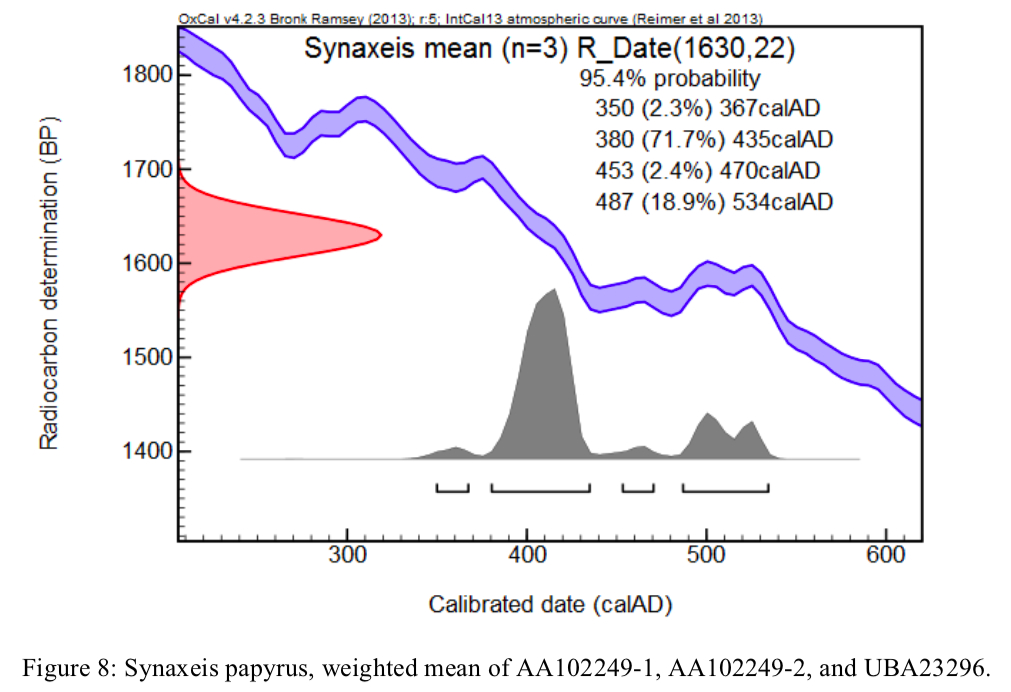
I’ll illustrate with a couple of the examples that I mentioned in my talk. The first is the Manichean Synaxeis codex at the Chester Beatty Library. Samples of papyrus from a leaf of this codex were subjected to AMS analysis in 2013. The weighted mean for the samples was 1630 ± 22 radiocarbon years BP. The calibration (using IntCal13) yielded the following outcome:
Image source: Jason BeDuhn and Greg Hodgins, “The Date of the Manichaean Codices from Medinet Madi,” in Samuel N.C. Lieu et al. (eds.), Manichaeism East and West (Turnhout: Brepols, 2017), p. 28, Figure 8.
The resulting span of calendar years was 350-534 CE (95.4% probability). The authors who published the analysis quite reasonably interpreted these results in the following way: “70 to 72% of the probability density function spans the period 380 CE to 435 CE. All things being equal, it is most probable that the Medinet Madi codices date to somewhere within the last quarter of the 4th to the early decades of the 5th centuries AD.”
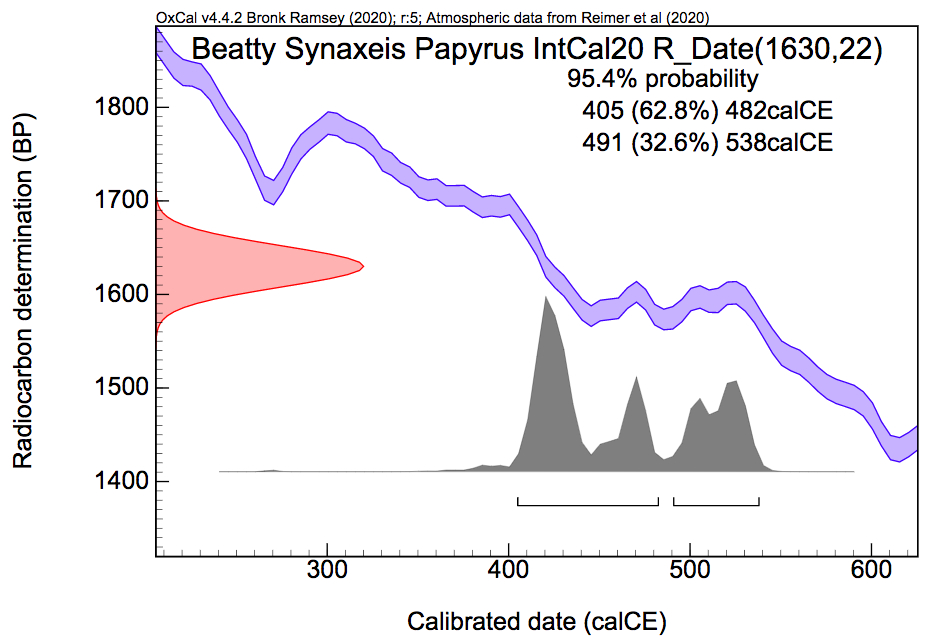
Calibrating this radiocarbon years BP date with the new program noticeably adjusts the calendar dates.
Image source: OxCal v4.4.2
The calendar range is now 405-538 CE (95.4% probability). Using the new calibration curve, then, the possibility of a fourth century date for the papyrus appears diminished. The probability of a date in the first part of the fifth century remains relatively high, but a date in the sixth century is no longer quite so easily excluded.
We see less change in the case of another Coptic book, the Glazier codex. In 1994, a piece of the leather wrapping band of the codex was tested and yielded a result of 1565 ±45 BP. When this data was published in 1999, the calibrated age was reported as 420-598 CE (95% probability). Using those numbers with the new curve, we get the following results:
Image source: OxCal v.4.4.2
The range of calendar dates is now 418-590 CE (95.4% probability). So, we see in this instance very little change.
From a general comparison of the IntCal13 and IntCal20 curves over the period of 100-700 CE, it seems that IntCal20 will shift calendar dates slightly later in most cases or keep them roughly the same. One of the frustrating things about the fluctuations of carbon-14 levels is reflected in the wiggle in the calibration curve that occurs during the third and fourth centuries CE. This dip has become more pronounced in IntCal20 with a higher peak and a lower trough, which means that the usefulness of AMS analysis remains very limited for distinguishing between material dating to the third century CE and material dating to the fourth century CE.
Thanks to Doubleday for sending along an advanced copy of Ariel Sabar’s new book, Veritas. I really didn’t know what to expect with this book. Sabar’s detailed article on the so-called “Gospel of Jesus’ Wife” in The Atlantic in 2016 was so full of blockbuster revelations regarding the owner of the papyrus and his concocted backstory, I genuinely wondered what a book-length treatment of this episode could add to the discussion.
A lot, as it turns out.
The book is written in Sabar’s usual engaging style, so from that perspective, it’s a very easy read. But the content of the book is pretty devastating. I had to put it down on a few occasions just to collect my thoughts and absorb the impact. Veritas reveals things about our field that we, as scholars, don’t like to think about or talk about. But Sabar, a journalist with an outsider’s viewpoint, clinically dissects the Gospel of Jesus’ Wife episode in a way that reflects pretty poorly on parts of our guild.
The first half of the book proceeded much as I expected, expanding on many of the details of Sabar’s Atlantic article. If you needed any further convincing of the importance of investigating the provenance of (allegedly) ancient manuscripts that appear for sale on the antiquities market, this first portion of the book should be required reading.
The second half of the book, however, took what was for me an unexpected turn. It is a deep dive into the career of Karen King, the Harvard Divinity School professor who published the papyrus in 2014, and into the politics of Harvard Divinity School itself.
I’ll preface my comments by saying that Karen King has been very kind to me on the occasions that we’ve met. I don’t know her well, but I know a lot of her students who are themselves excellent scholars. Her book, What is Gnosticism? (2003) was a very thought-provoking read for me when I was a graduate student and has influenced the way that I approach the use of Christian heresiologists as historical sources. All of this to say: I admire Karen King, and reading this part of Veritas was at times difficult.
Sabar’s research is extensive (340 pages of text and an additional 40 pages of notes). I want to focus on one of the (many) points that Sabar identifies at which this whole thing could have been avoided before the papyrus was ever published in Harvard Theological Review. I think we all suspected there was something a little odd about the peer review of this article, but Sabar’s investigation lays out this process in all its grim detail, pointing out multiple layers of conflicting interests that began with the initial submission of the article in 2012.
Some of these conflicts are to be expected: A Harvard Divinity School professor submitting work to HTR, also edited by Harvard Divinity School professors, seems a little awkward, but a quick glance at the CVs of Divinity School faculty shows a good number of publications in HTR (although I would be curious to know how often the editors of HTR reject an article submitted by a faculty colleague).
The problems really begin to arise in the peer review process. Sabar was able to identify the three “blind” peer reviewers of the original article. Two very negative reviews came from a pair of the world’s premier Coptologists, Bentley Layton and Stephen Emmel. Layton told the editors of HTR that publishing the fragment “would be very embarrassing for the Harvard Theological Review.” And Sabar reports that Emmel’s review clearly identified the papyrus as a fake and pointed out “nearly every sign of forgery that would surface over the next four years.”
The third reviewer, somewhat surprisingly, was the papyrologist Roger Bagnall, whose advice King had sought before submitting the article to HTR. Bagnall identified his earlier involvement with King and the papyrus, writing to the managing editor of HTR “I wouldn’t want there to be any illusion that I’m in any way an outsider in the way that referees typically are,” but the editors of HTR solicited his review anyway. In my experience this phenomenon is not that uncommon. I’ve been sent materials for review that I recognized as the work of colleagues. I flag this to the editors of the journals and as often as not, the editors will ask me to go ahead with the review as long as I believe I can be objective in my evaluation. So, having Bagnall as a reviewer is not that surprising.
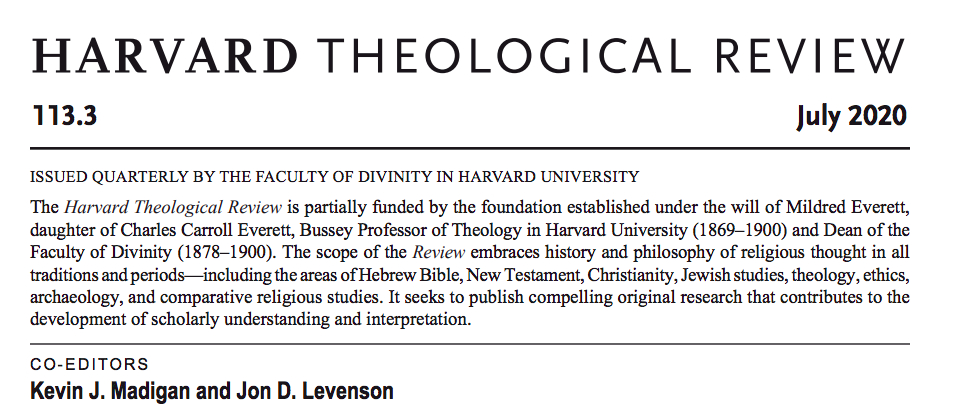
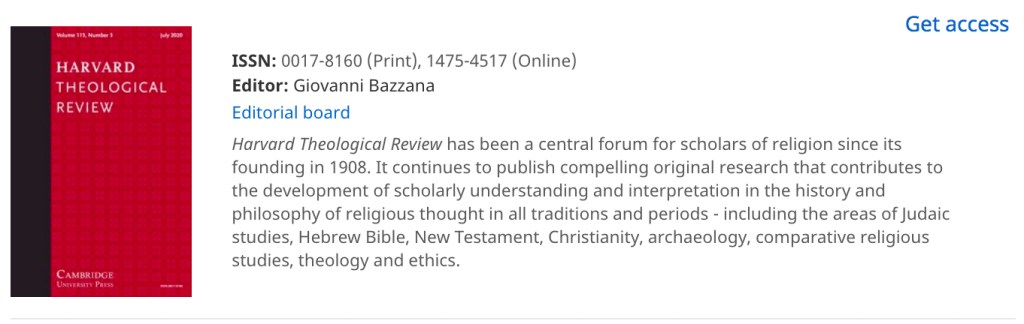
What is surprising is the subsequent actions of the editors of HTR. Rather than accepting the advice of the two expert Coptologists and rejecting the article, the editors allowed King to assemble a team to conduct technical tests on the papyrus (analysis of materials, ink, and AMS radiocarbon testing) to try to “scientifically” prove its authenticity. Sabar’s investigations, however, reveal that the materials and ink teams were in fact headed by personal friends of King and Bagnall, conflicts of interest that were not revealed to the journal. But before letting HTR off the hook, Sabar points out that “the journal didn’t peer review the lab studies” (p. 297), and as far as I can tell, King’s revised article also seems not to have been given a second review. This seems to be a complete abdication of duty on the part of the editors of a major scholarly journal. Incidentally, these editors (Kevin J. Madigan and Jon D. Levenson, both professors at Harvard Divinity School) seem to have ceased to be the editors of HTR at roughly the time the review copies of Veritas were mailed out. Here’s the header for the front matter for the July 2020 issue:
And here’s the editorial info at the Cambridge Core site today:
It’s interesting timing for a change in leadership.
In any event, the peer review process at HTR failed badly in this instance. And if there are heroes in Sabar’s story, they are those people who subjected the papyrus to the scrutiny that King herself failed to apply before the papyrus was published. In this connection, Sabar gives an excellent summary of the clever work of Andrew Bernhard and Christian Askeland in finding the smoking guns that exposed the papyrus as a forgery for all to see. It should be noted, though, that the community of Coptologists doubted the fragment’s authenticity from the start, as outlined in this post from Hugo Lundhaug and Alin Suciu (and the thread of comments) made just days after the Rome conference at which King announced the existence of the papyrus in 2012.
Sabar’s book is a gripping read, and I recommend it to anyone interested in the study of early Christianity or ancient manuscripts. What are the takeaways? For me, it’s definitely a cautionary tale. At one level, of course, the lesson is to thoroughly investigate provenance when working with artifacts, and here Sabar’s investigative reporting really shines. But at a more general level, the lesson is this: Be able to admit when you’ve made a mistake. Accept justified correction with humility and grace, and just move on.
[[Update 22 July 2024: I see that this book is among the many that have ceased to be available on archive.org since the decision in Hachette v. Internet Archive court case.]]
I’ve written before on this blog about the dispersion of libraries, and I have another instance to report. The Claremont School of Theology has begun the process of merging with Willamette University in Salem, Oregon. As a part of this process, the Claremont library has donated some 250,000 volumes to the Internet Archive. Some of their materials have already been digitized and are available online for download. These include (as the title of the post indicates), the 1972 edition of John Trever’s photographs (taken in 1948) of three of the Cave 1 Scrolls–the Great Isaiah Scroll (1QIsaa), The Community Rule (1QS), and the Habakkuk Pesher (1QpHab):
More recent images of these scrolls are available online at The Digital Dead Sea Scrolls, but Trever’s images made in 1948 preserve bits of the scrolls that have were lost during their travels to the United States and back to Jerusalem. The donation to the Internet Archive also includes some important early works in Scrolls studies like John Allegro’s The Dead Sea Scrolls (Penguin, 1956). Additional useful books will no doubt be forthcoming from this venture.
I understand that this donation also included the materials held at “The the Ancient Biblical Manuscript Center” formerly housed at Claremont. One part of this collection is of particular interest to me at the moment, namely the “John C. Trever Dead Sea Scrolls Collection” of photographs. I have not yet been able to figure out if this material was included in the donation. An email query to archive.org frustratingly resulted only in a completely uninformative auto-response. It would be good to know what is the fate of this important material.
For the full story of the donation, see the Internet Archive’s blog post.
As I continue to work through the Cave 1 scrolls to try to sort out the purchases from the excavated materials, I spent some time today with the lists of photographs in Tov and Pfann, Companion Volume to the Dead Sea Scrolls Microfiche Edition (2nd rev. ed; Leiden: Brill, 1995). One of the descriptions mentioning a series of photos caught my eye: “Qumran, cave 1 mss, from excavation, Feb. 15-Mar. 5, 1949”:
Tov and Pfann, Companion Volume to the Dead Sea Scrolls Microfiche Edition, p. 75
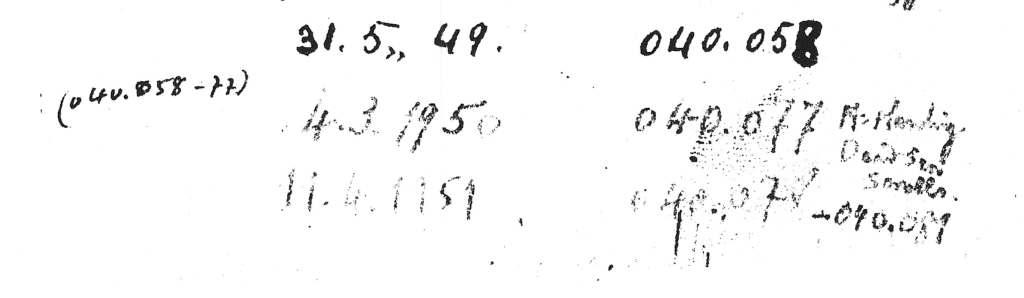
But after looking at most of these photos (the ones available online), I don’t think this description can be right. The detail “from excavation” and the 1949 dates seem to be (incorrect) extrapolations on the part of the editors. The handwritten photo log for these numbers is even more sparse:
Tov and Pfann, Companion Volume to the Dead Sea Scrolls Microfiche Edition, p. 156
To the right of the last of this sequence (040.077) is written simply, “M. Harding Dead Sea Scrolls.” The date, 4 March 1950, is clear. These are not excavation photos from 1949. The photos do, however, help to contribute to a solution to a mystery. This sequence of photographs seems to exclusively involve a well-defined set of manuscripts as follows:
All of the items photographed in this sequence belong to 1Q8, 1Q20, and 1Q28, exactly the set of items singled out by the editors of DJD 1 as a discreet purchase:
“parmi les fragments édités ci-après, les ensembles nos. 8 (Isaïe), 20 (Apocalypse de Lamech), et 28 (Annexes à la Règle de la Communauté) ont été achetés à un marchand d’antiquités de Bethléem” (DJD 1, p. 43)
“Tous les fragments que nous groupons sous le n°. 28 appartiennent certainement au même ensemble que 1QS. En effet ils ont été vendus au Musée Palestinien en 1950 par le marchand d’antiquités de Bethléem en même temps que des fragments de ‘l’Apocalypse de Lamech’ (publiés ici sous le sigle 1Q20) et de l’Isaïe de l’Université Hébraïque = 1QIsb publiés ici sous le sigle 1Q8)” (DJD 1, p. 107)
So these items were bought by the museum from “the Bethlehem dealer” (Kando) in 1950. If the date in the photo log reproduced above is correct, then we have a terminus ante quem for this purchase: 4 March 1950. So, this is a small victory.
There is just one loose end that has been driving me nuts for the past couple weeks. In a footnote in The Untold Story of Qumran, Trever says the following in passing:
“A small piece of 1QSb (Col. II) also was sifted from the debris” (p. 203, note 2).
Trever is normally quite careful about this kind of thing, but I can’t find any corroborating evidence for this claim anywhere. And it’s already slightly suspect because Harding specifically said that the soil from Cave 1 was not sifted (“sieving was not possible,” DJD 1, p. 7). I’m not sure where Trever got this information. If anyone has any leads, I would be grateful to hear them.
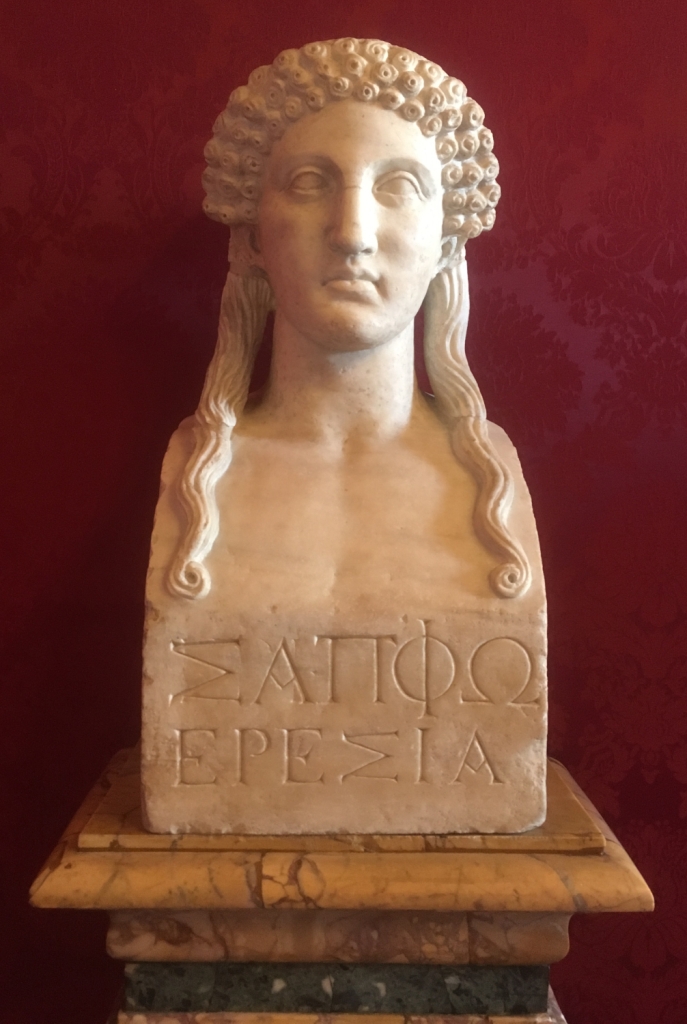
In the wake of the controversy over the “Newest Sappho” papyrus in the last few years , I’ve read more about the Greek poetess Sappho than I ever thought I would. In doing so, I realized that I have a pretty firm mental image of Sappho, and it’s the marble bust in the Capitoline Museum in Rome.
Portrait of “Sappho” in the Capitoline Museum, Musei Capitolini, Inventario Sculture, S 1164; image source: Brent Nongbri 2018
But of course, this is not a portrait of Sappho. In his catalog of the sculptures in the Palazzo dei Conservatori (1926), H. Stuart Jones unenthusiastically described it as follows:
“Dull Roman work from an original of the early fifth century B.C. sometimes combined with the bearded Dionysus and therefore perhaps Ariadne” (p. 60).
Jones goes on to note that the inscription below the head and the base on which the herm sits are modern.
So, when did this anonymous head become Sappho? Around 1564. Maybe.
The inscription below the head (ΣΑΠΦΩ | ΕΡΕΣΙΑ), Sappho Eresia, has been published multiple times. It was published in 1844 and apparently regarded as an ancient inscription (CIG 6106). It was published again in 1890, but this time it was taken to be a clearly modern inscription (IG XIV 253*). It was described as suspect already in 1845 (“eine weibliche Herme mit Namen Sappho in einer sehr verdächtigen griechischen Inschrift,”) by Platner and Urlichs, Beschreibung Roms, p. 237. The most informative publication is Huelsen 1901, which notes that the inscription shows evidence of erasure of letters under the letters ΣΑΠ. And indeed, this can be seen quite clearly:
Detail of erasure under “Sappho” inscription in the Capitoline Museum, Musei Capitolini, Inventario Sculture, S 1164; image source: Brent Nongbri 2018
But none of these publications offer a guess at when the inscription was added.
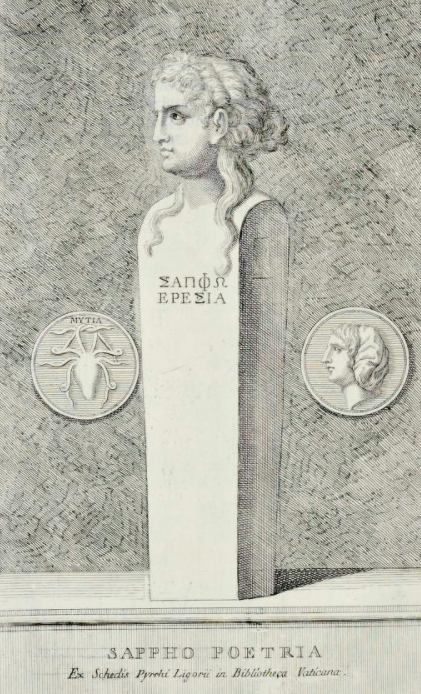
Jones notes that a drawing of the herm was published by by Jacob Gronow (1645-1716) in his Thesaurus Græcarum antiquitatum (1698):
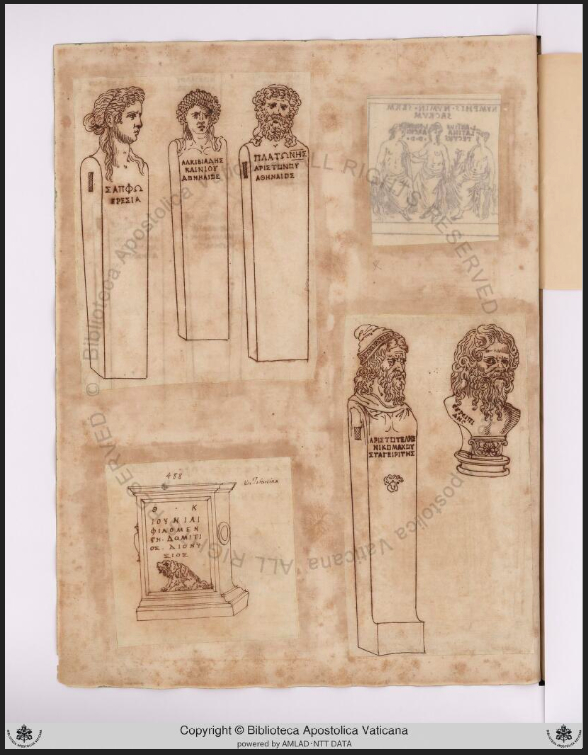
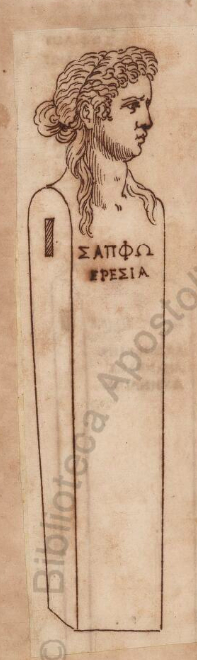
The ultimate source for these images is indeed a manuscript at the Vatican Library, BAV Vat Lat 3439, an album of drawings on sheets that have been repaired and rebound. The drawings were prepared at some point in the 16th century (probably before 1570) and are based on drawings by Pirro Ligorio (1513-1583).
Here is a closer look at the Sappho herm in the Vatican codex:
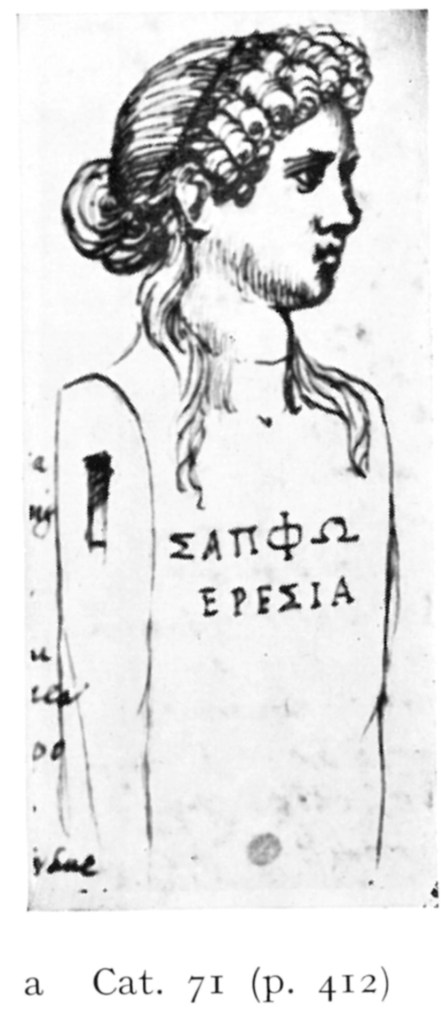
The images in the Vatican manuscript are isolated and without context. The source for these deptictions is generally agreed to be a drawing in one of Ligorio’s manuscripts in the National Library at Naples, Codex XIII.B.7, p. 412. Here is the relevant image of the Sappho:
Image source: E. Mandowsky and C. Mitchell, Pirro Ligorio’s Roman Antiquities (Warburg Institute, 1963), plate 40a
The drawing is accompanied by a short note. Mandowsky and Mitchell point out that “the drawing and commentary are late insertions into the manuscript” (probably between 1564 and 1570), but it nevertheless seems that Ligorio’s drawing in this manuscript is the earliest record of this sculpture with this inscription. Unfortunately, the note does not provide much help with the history of the artifact itself:
“Sappho Eresia è quella poetessa che scrisse gli Enigmi jambi, et epigrammi et oltre opere, fu contemporanea all’ altra Sappho Mytilenea, viveano ambedue sotto il regno di Tarquinio Prisco in Roma. La Sappho Mytilenea trovò la poesia lyrica [ms.: illyrica], et si precipitò in mare per amore di phaone, furono ambedue dell’ isola di lesbo l’una di Ereso città, l’altra di Mytilene. La Eresia hebbe il borbozzo ò vero mento grossotto.”
So, Ligorio was under the impression that there were two women from Lesbos named Sappho. One (Sappho of Eresos) was a writer of enigmas and epigrams and the other (Sappho of Mytilene) was the lyric poet. Here, then, we get no details about the sculpture itself. For that, it seems we have to look to one of Ligorio’s manuscripts in Turin (Cod. a.II.10.J.23, p. 76). In the course of describing a herm of “Philemon,” Ligorio writes that it
“fu portato in Roma nella villa di papa Julio terzo, et dindi è stata tolto come molti altri ritratti, et posto nel palazzo Vaticano dà papa Pio quarto, et parte egli ne donò et parte ne dedicò nell’ hemicyclo dell’ atrio di Belvedere, dove erano queste effigie di Platone, Isocrate, di Aristide Smyrneo, di Diogene, di Socrate, di Ierone, de Alcibiade, due testa della celeste Vergine, due di Ariadne, l’effigie di Sappho Eresia, et una testa di Serapide; delle quali nella sedia vacante alcune ne furono tolte, altre portate in Capitolio, et quel ritratto che fù più raro fù di Minicio Cippo tolto dalla villa di Horatio.”
So from this note, it would appear that “l’effigie di Sappho Eresia” was among those pieces that Ligorio sourced to decorate the Cortile del Belvedere at the Vatican (1564-1565) when he was papal architect under Popes Paul IV and Pius IV. These sculptures decorated the area only briefly, before they were given to the people of Rome (that is, sent to the Capitoline and other locations) in 1566 by Pope Pius V, who was less of a fan of pagan statuary.
I assume that this quotation is also the source of the association sometimes made between the Capitoline Sappho and the Villa Giulia, but I’ve been unable to find any other connection between this piece and the Villa (I would be grateful to learn if anyone does know other sources that make that attribution explicit). But the sculptures that decorated the Cortile were acquired from all over Rome and the surrounding regions. How can we really know if this piece came from the Villa Giulia?
Mandowsky and Mitchell have an alternative theory. They point out the similarity of a number of the pieces that decorated the Cortile del Belvedere. Herms of Socrates and Alcibiades that stood with the Sappho also consist of ancient heads on modern shoulders. In all three cases, Mandowsky and Mitchell suggest that “the concoction” is probably the work of Ligorio himself.
In addition, the three herms, which have all ended up in the Capitoline Museum, have inscriptions bearing very similar lettering:
Inscriptions beneath portraits of “Alcibiades,” “Sappho,” and “Socrates” in the Capitoline Museum, Musei Capitolini, Inventario Sculture, S 1160, S 1164, and S 1163
Mandowsky and Mitchell reach a similar conclusion regarding these inscriptions: “All three of these inscriptions seem to have been cut by the same hand–very likely Ligorio’s own” (p. 95).
This all seems plausible, but it’s not the only possible story of this Sappho. According to some scholars, Ligorio’s Sappho is not the one in the Capitoline. Gisela Richter (The Portraits of the Greeks, 1965, p. 70) described Ligorio’s Sappho as follows:
“A herm inscribed Σαπφω Ερεσια is illustrated in Bellori, Imag. 63, and in Gronov, Thes. 11, 34, but has now disappeared. She wears a headdress consisting of a sakkos bound twice round her head, and thick shoulder supports. Apparently not ancient.”
This opinion was followed by David A. Campbell’s 1982 Loeb edition of Sappho (p. 13, note 1). So, if they are right, then the origin of the Capitoline Sappho is still a mystery.
Sources:
Huelsen, Ch. “Die Hermeninschriften beruehmter Griechen und die ikonographischen Sammlungen des XVI. Jahrhunderts.” Mitteilungen des Deutschen Archaeologischen Instituts, Romische Abteilung. Bullettino dell’Istituto archeologico germanico, Sezione romana 16 (1901), 123-208 (at p. 199)
Jones, H. Stuart. A Catalogue of the Ancient Sculptures Preserved in the Municipal Collections of Rome: The Sculptures of the Palazzo dei Conservatori. Oxford: Clarendon, 1926.
Mandowsky, Erna and Charles Mitchell. Pirro Ligorio’s Roman Antiquities: The Drawings in MS XIII. B 7 in the National Library of Naples. London: Warburg Institute, 1963.
Ernst Platner, Ernst and Ludwig Erlichs, Beschreibung Roms: Ein Auszug Beschreibung der Stadt Rom. J.G. Cotta’scher Verlag, 1845.
Online record on the website in the Capitoline Museum
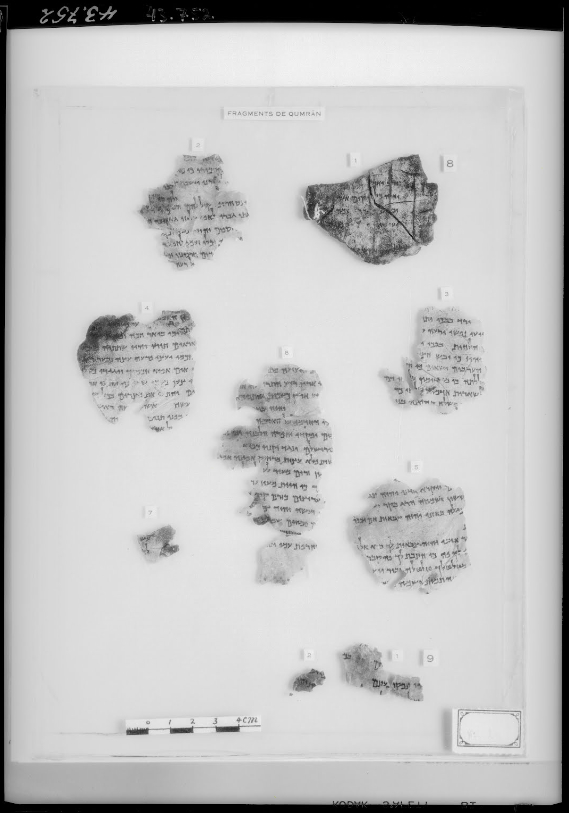
1Q5 is a collection of dozens of fragments reassembled into 20 or so more substantial fragments representing one of two copies of the book of Deuteronomy associated with Cave 1 (1QDeutb). The fragments of 1Q5 were edited in DJD 1 in 1955. My interest is with the piece the editors labelled fragment 13. Its history is a little complicated.
The editors make the following remarks about the provenance(s) of the different parts of fragment 13: “The fragments published in the Appendix as well as the central part of f. 5 13 are the remains of the clandestine prospecting of the Syrians (les restes de la prospection clandestine des Syriens)” (p. 43). So, the “central part” of fragment 13 of 1Q5 belonged to a purchase that the editors here associate with the items published in the Appendix to DJD 1 (1Q71, 1Q72, 1Q19bis, 1Q34bis, 1Q70bis), which are the pieces that were at that time in the possession of Mar Samuel in the United States. Those pieces were said to have been acquired by George Isha’ya around August 1948. The editors add in a footnote that two small parts of fragment 13 of 1Q5 were excavated at Cave 1 by de Vaux’s team: “The fact that f. 5 13 could be completed by two small fragments from the excavation of February-March 1949 provides an additional argument for the identical origin for the various lots (Le fait que le f. 5 13 ait pu être complété par deux petits fragments provenant de la fouille de février-mars 1949 apporte un argument de plus à l’identité d’origine de ces divers lots).” This all seems straightforward, but there are a couple problems.
First, the Mar Samuel items in DJD 1 were published without photographs (because the pieces were in the US), but DJD 1 does include a photograph of 1Q5 fragment 13. Second, John Trever, who later published photos of the Mar Samuel fragments, doesn’t mention any bits of Deuteronomy in that context. In his popular account of the discovery of the Scrolls, however, Trever does provide some information on this topic, but it complicates the picture. Trever twice mentions the purchased Cave 1 Deuteronomy fragment. The first time he does so, he associates it with a different purchase, the 1950 lot bought by the Palestine Archaeological Museum from Kando that included 1Q8, 1Q20, and 1Q28:
“The story of [director of the Palestine Archeological Museum Yusuf] Saad’s efforts to make the acquaintance of Kando, and finally (in 1950) to secure the mass of fragments which the cobbler and his associates had dug from the cave, reads like a Sherlock Holmes detective adventure. It was then that fragments of the Hebrew University Isaiah Scroll (1QIsb), some from the “Genesis Apocryphon” (1Q20, now 1QApoc), several large pieces (including two almost-complete columns) from the Manual of Discipline (1QS) and some fragments of a scroll of Deuteronomy (1QDeutb) were secured for the Department of Antiquities, but only after payment of the large sum of £P1,000 ($2,800)” (Trever, The Untold Story, p. 146)
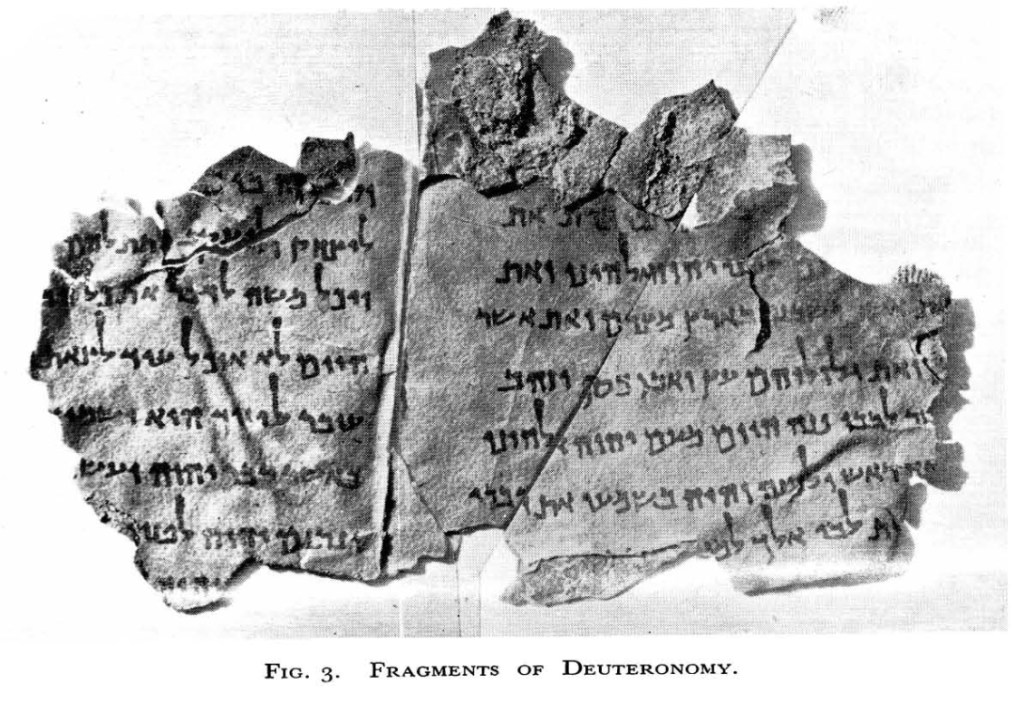
So, here the fragment is part of the 1950 purchase. But again, there is a problem. Harding had already written about the purchased fragment in an article in the Palestine Exploration Quarterly that was published in 1949. He wrote, “Some other fragments in the square script, which have been acquired from an outside source, are of the book of Deuteronomy.” That he is referring to our piece seems clear from the accompanying photograph (which is reproduced below). So what is going on? Trever’s second statement about the Deuteronomy fragment might provide a clue:
“The excavators…also found small pieces of the larger Deuteronomy fragment, part of which was reported to have come from Isha’ya and part from Kando” (Trever, The Untold Story, p. 203, note 2).
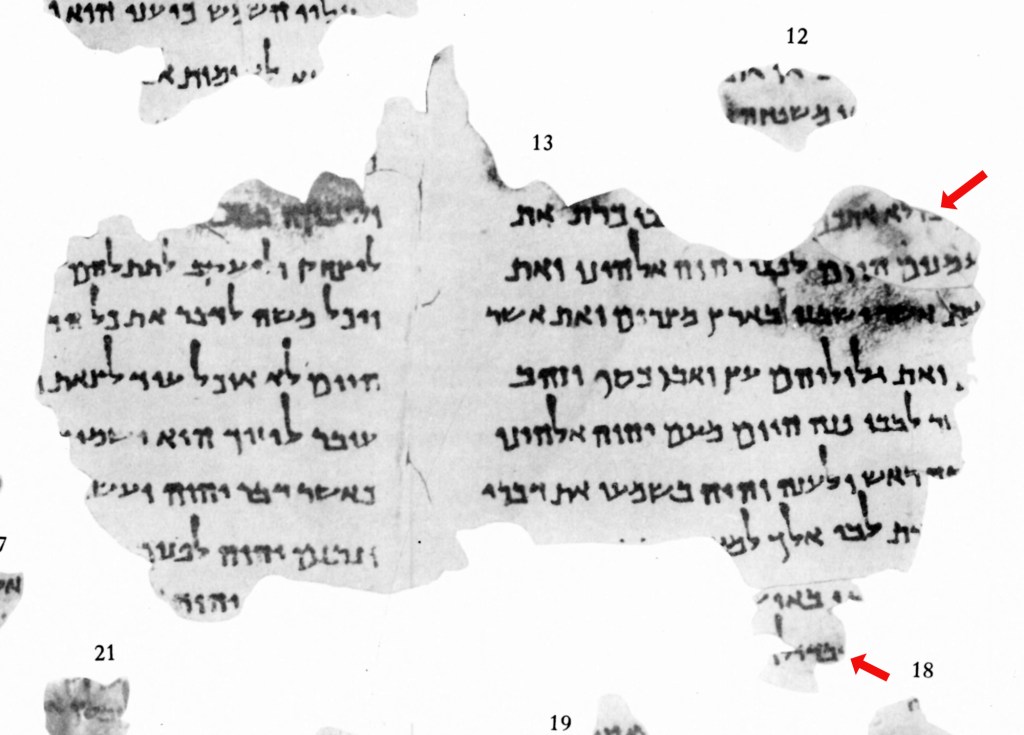
So, here it seems like we have three sources for the fragment: de Vaux’s excavation, and two separate purchases, one from George Isha’ya and one from Kando. It may be possible to get a better sense of things by comparing photographs. We can begin with the fragment as published in DJD 1, plate X (published in 1955):
DJD 1, plate X
The image looks composite, with a couple pieces added in (identified here with small red arrows). Might these be the pieces excavated by de Vaux? Compare this image to PAM 40.531 taken in 1953, in which our piece is framed together with 1Q5 fragment 8 (top left) and 1Q33 (top right), the fragment of Sukenik’s War Scroll found by the excavators in Cave 1.
Notice the absence of the two smaller fragments that are present in the published plate and the clearly different (lighter) color of the large fragment on the right. Now compare both these photos with the image Harding published in 1949, which again has something of a composite look about it.
Image source: Gerald Lankester Harding, “The Dead Sea Scrolls,” PEQ 81 (1949), 112-116, figure 3
To me, this image looks like it has three main pieces, left (made of several fragments), center, and right (again, a slightly different color). So, is it the case that this whole piece was bought in 1949? Or was only the “central part” bought and the other parts excavated? (in which case, where did the small “extra” fragments in plate published in DJD 1 come from? excavation? another purchase?) But to confuse matters more, the editors of DJD 1 make it seem as if this image was one of Harding’s photographs of excavated fragments: “During the excavation, Mr. Harding took photos of all the finds (de tout le lot trouvé). That of f. 5 13 was published in the Palestine Exploration Quarterly (lxxxi, 1949, pl. XX. 3).” So, it is unclear whether this image is showing an excavated piece, a purchased piece, or some combination of the two. If anyone knows the full story of this fragment, I would be grateful to learn it.
In any event, it is interesting to see that the Museum was already purchasing fragments in 1949 and apparently in the early part of the year.
Before diving in to this post, a quick note: The conference that was the proximate cause for me trying to organize my thoughts on the topic of the Dead Sea Scrolls said to come from Cave 1 took place a couple weeks ago (“On the Origin of the Pieces: The Provenance of the Dead Sea Scrolls”). My presentation is now available online at the Lying Pen website, along with all the other presentations. If you do watch my paper, please keep in mind that I view talks like this as an opportunity to raise questions and think through issues, and not necessarily as presenting final conclusions to any particular problem.
Now, back to the questions. In this series of posts (see part 1, part 2, and part 3), one of the questions I have been trying to answer is: Which of the purchased scrolls that we call “Cave 1” pieces can actually be connected with the material recovered from Cave 1 in controlled excavations by de Vaux and his team? Today I want to look again the scroll of Isaiah bought by Eleazar Sukenik (1QIsab).
The scroll was one of three purchased by Eleazar Sukenik from the dealer Faidi Salahi in 1947. It was published in 1955. Seven additional small pieces of the scroll were published in DJD 1 as 1Q8. These pieces are sometimes described as having been excavated by de Vaux’s team. For instance, the editors of DJD 32, the re-edition of the Cave 1 Isaiah scrolls, made the following claim in 2010:
“While Sukenik was working on the main part of 1QIsab, those seven additional fragments were found during excavations in Cave 1 by Lancaster Harding and Roland de Vaux, under the auspices of the Jordanian Department of Antiquities. They were published in the first volume in the DJD series in 1955.” (p. 22)
But the editors of DJD 1 are quite clear that these fragments, collectively published as 1Q8, were not excavated. They were purchased in 1950:
“…parmi les fragments édités ci-après, les ensembles nos. 8 (Isaïe), 20 (Apocalypse de Lamech), et 28 (Annexes à la Règle de la Communauté) ont été achetés à un marchand d’antiquités de Bethléem.” (p. 43)
The Bethlehem dealer would no doubt be Kando, to whom this purchase is attributed by John Trever.
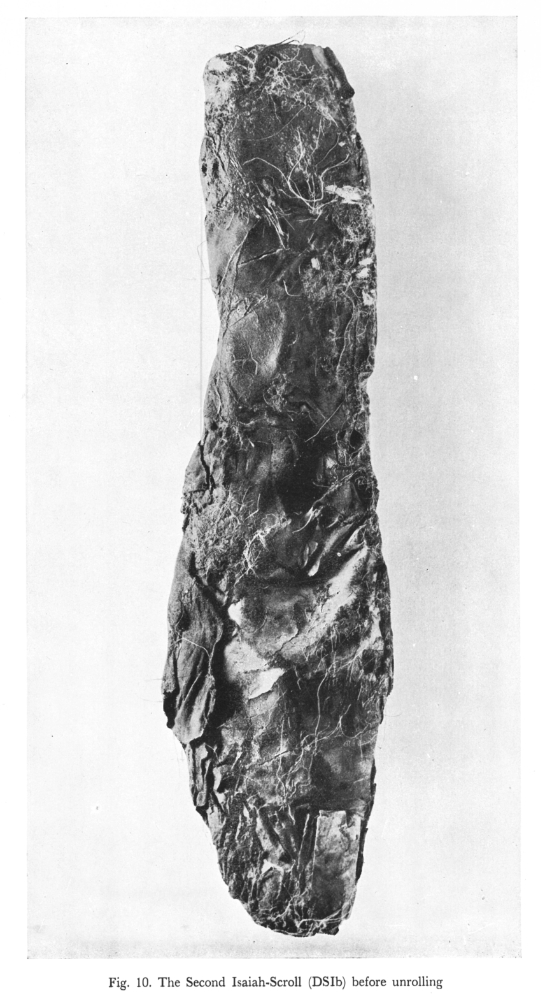
Sukenik’s Isaiah scroll (1QIsab) before unrolling; image source: E.L. Sukenik, The Dead Sea Scrolls of the Hebrew University (Magness Press, 1955), fig. 10
In more recent times, other fragments of 1QIsab have been identified in photographs from the Shrine of the Book (identified as “SHR” in these discussions). In 1988, Emile Puech identified a small portion of Isaiah 44 from Sukenik’s scroll among these photographs. In 2002, Eva Jain made a new reconstruction of Sukenik’s Isaiah scroll and identified several more fragments from the scroll among the pieces recorded in photos in the “SHR” series. So now a couple questions: First, I assume that the pieces in the “SHR” frames were part of the batches of material obtained by Sukenik in November and December of 1947, meaning that this “new” material was also purchased and not excavated. Is this correct? And second: Are these SHR series photos available anywhere online?
In 2009 Peter Flint and Nathaniel Dykstra identified several more such “SHR” fragments and placed them in position in the roll as reconstructed by Jain. These authors also placed one PAM fragment from the frame 40.543. But this piece had already been published (but not placed) as fragment 7 of 1Q8, and thus was also part of the 1950 purchase from Kando. So, again, unless I am missing something, there is no connection between Sukenik’s Isaiah scroll and the material excavated by de Vaux’s team.
Sources:
Barthélemy, DominiqueandJózef T. Milik, Qumran Cave I, DJD I (Oxford: Clarendon, 1955).
Flint, Peter W. and Nathaniel N. Dykstra, “Newly Identified Fragments of 1QIsab, Journal of Jewish Studies 60 (2009), 80-89.
Jain, Eva. “Die materielle Rekonstruktion von 1QJesb (1Q8) und einige bisher nicht edierte Fragmente dieser Handschrift,” Revue de Qumrân 20 (2002), 389-409.
Puech, Emile. “Quelques aspects de la restauration du Rouleau des Hymnes (1QH),” Journal of Jewish Studies 39 (1988), 38-55, at 55, note 40.
Ulrich, Eugene and Peter W. Flint, Qumran Cave 1, II: The Isaiah Scrolls, Part 2: Introductions, Commentary, and Textual Variants, DJD XXXII (Oxford: Clarendon, 2010).











 Variant Readings