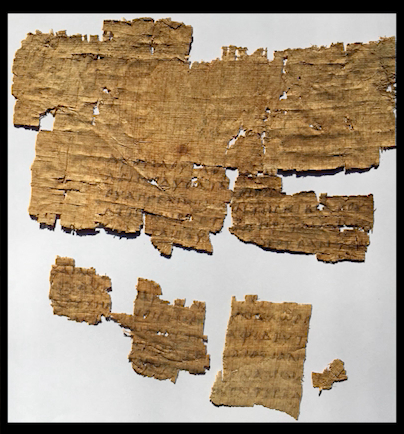
I’ve added a couple more pieces to the list of manuscripts of dubious origins. These are more pieces that have shown up in Scott Carroll’s talks in recent years, and both of these items may also be connected to the manuscripts stolen from the Egypt Exploration Society. The first is a collection of papyrus fragments identified only as “a patristic text.” I am also posting an image here:
This particular image comes from a talk given by Carroll in 2016 that is not freely available online (this is yet another instance in which I need to thank David Bradnick for digging up the evidence).
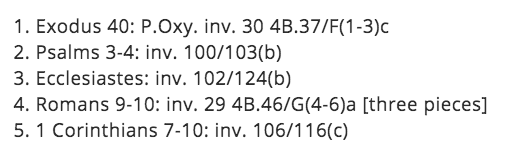
The Egypt Exploration Society has posted an update to last week’s announcement regarding papyri stolen from the EES and allegedly sold to Hobby Lobby by Professor Dirk Obbink. The updates discuss the EES manuscripts that have made their way to the collection of Andrew Stimer. These include the following, which Mr. Stimer intends to return to the EES:
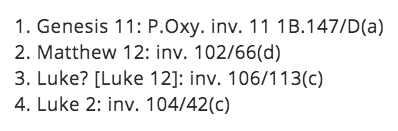
The EES also notes that a couple of manuscripts on the list of papyri with dubious origins are actually safe and sound in EES holdings and have been assigned to editors:
It seems that Scott Carroll had only gotten hold of images of these unpublished papyri and not the manuscripts themselves. I will update the list accordingly. See the full EES announcement here:
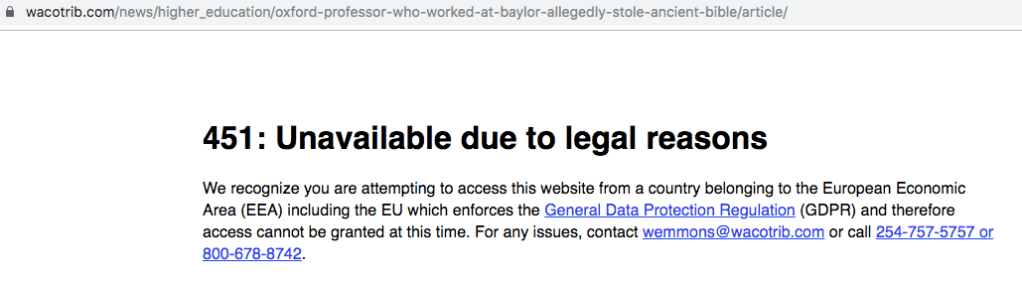
Professor Dirk Obbink has issued a public statement emphatically denying the accusations that he sold Oxyrhynchus papyri to Hobby Lobby. The local Texas newspaper to which Prof. Obbink chose to communicate his statement (the Waco Tribune-Herald) is not available online in Europe:
But Geoffrey Smith of the University of Texas at Austin broke the news on twitter:
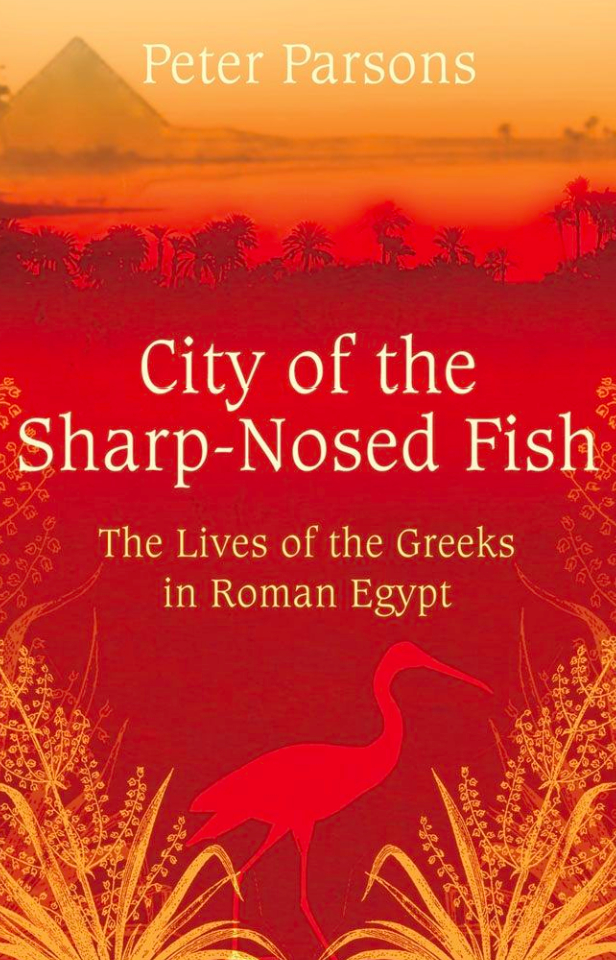
The recent discussions surrounding the theft of 13 unpublished Oxyrhynchus papyri from the Egypt Exploration Society raises the question of just how much material that was excavated from Oxyrhynchus still remains unpublished. Bernard Grenfell and Arthur Hunt led excavations at Oxyrhynchus for six winters between 1896 and 1907. Some of the material they collected was kept in Cairo, but the vast majority was sent back to Oxford. So, how much material did they collect? This is actually a more complicated question than it first appears. In terms of raw numbers, credible estimates differ. According to an article that used to be on the official website of the Oxyrhynchus Papyri Project, the number was 400,000. No source for the estimate is provided. Peter Parsons, who actually worked on the sorting project, puts the number somewhat higher in his excellent book, City of the Sharp-nosed Fish (2007), at p. 17:
“The six seasons had yielded, at a cost of some £4000, 700 boxes of papyri, which might be estimated at 500,000 pieces and scraps…”
But of course the question is what is meant by “pieces and scraps.” I dug into it a little bit in my book, God’s Library:
“The most reliable reports suggest that Grenfell and Hunt recovered a total of about half a million papyrus and parchment items, ranging from small fragments to substantial portions of long rolls. It is difficult to know how this figure translates into numbers of actual independent texts. In many cases, a single fragment represents all that remains of a manuscript. Yet, Hunt at one point mentioned spending several weeks flattening and sorting “some thirty thousand pieces of various sizes” …which was eventually consolidated into about thirty-five different papyrus rolls. In any event, for a full accounting of the Oxyrhynchus materials, we must also consider the manuscripts unearthed during later excavations at the site undertaken by Flinders Petrie in the 1920s, Italian teams between 1910 and 1914, and again between late 1927 and 1934, as well as finds from more recent excavations. It is thus hard to state firmly what proportion of the total number of excavated texts have been published.” (God’s Library, pp. 227-228)
For the Italian excavations, at least, we do have some exact numbers:
“Of the material from the Italian excavations, 572 pieces from Oxyrhynchus have been published so far in the Papiri della Società Italiana (PSI) series, 55 have been published elsewhere, and 602 are unedited (I am indebted to Guido Bastianini for supplying me with this information in a personal communication in May 2016).” (God’s Library, p. 341, note 35)
So, the Italian portion seems to be very small in comparison to the mass of material collected by Grenfell and Hunt. As of the 2019 installment (volume 84), The Oxyrhynchus Papyri series has published 5,476 items. So, on any account, this is just a fraction of what was recovered. This should make us cautious about conclusions reached from surveys (even my own!) based only on published material from Oxyrhynchus.
[[Update 8 December 2019: In this video from 2016 (at about the 5:50 mark), Dirk Obbink puts the number of Oxyrhynchus fragments at Oxford at “over a million fragments of varying sizes from a postage stamp up to the size of a long continuously unrolling scroll” and at the 6:10 mark: “5,100 items published [in the first 82 volumes of The Oxyrhynchus Papyri] out of a million fragments that remain to be catalogued, sorted, and transcribed.”]]
In recent days, the Egypt Exploration Society has disclosed that 11 manuscripts from their Oxyrhynchus collection were allegedly illegally sold by Professor Dirk Obbink to the Hobby Lobby organization. Two further fragments of pieces from the Oxyrhynchus collection have surfaced in a different American collection. I’ve been quoted in several news outlets as saying that we don’t yet know the scope of this problem. What I mean by this is that in the decade since Professor Obbink first connected with the Scott Carroll and the Green family’s Hobby Lobby organization, ancient manuscripts of surprising quantity and quality have appeared on the antiquities market. Many of these pieces appeared with no provenance information or with very problematic or dubious provenance stories. I began to compile this list some time ago, taking inspiration from the very useful collection of data on post-2002 “Dead Sea Scrolls” at the blog of the Lying Pen of Scribes project and a list of known Green Collection manuscripts posted to Twitter by David Bradnick. In light of recent developments, it seems like a good idea to make this list “live” now, even in an incomplete state. I’m focusing here on literary manuscripts in Greek and Latin that have shown up since about 2010. I’m starting with some classical papyri (this is not just a “Bible” thing; this mess affects you too, classicists) and early Christian pieces that did not appear on the list of items already known to have been stolen from the Egypt Exploration Society, which can be found here.
Scott Carroll has provided a written account of the building of the Van Kampen Collection of books and manuscripts, a task he carried out before he helped to build the Green Collection. Carroll offered up the following brief anecdote in the course of a somewhat confused discussion of Coptic manuscripts he had acquired on behalf of the Van Kampen Collection from a “London dealer”:
“The only clue regarding the manuscripts’ immediate provenance was a lone letter-sized envelope holding a small fragment with the following printed as a return address: Harold H. Von Maker, Stone Eagles, Montclair, NJ. I have asked the London dealer repeatedly about where he had acquired them, but he never revealed his source.” (Scott Carroll, “Biblical Treasures in Private Holdings: The Van Kampen Collection,” pp. 235-293 in John D. Wineland, The Light of Discovery: Studies in Honor of Edwin M. Yamauchi, Pickwick, 2007)
Now, Stone Eagles is an impressive historic home in Montclair. And who is Harold H. Von Maker? There is a Harold Maker of Irvington, New Jersey (about a 20-minute drive from Stone Eagles) who is sometimes mentioned as a collector and dealer of rare books and manuscripts in the 1950s and early 1960s. For instance, the name shows up in the records of Yale’s Beinecke Library as the source of a 15th century Italian manuscript and in the records of the New York State Library as a previous owner of a set of dismembered pages of rare books. The American manuscript collector John M. Lawrence has described this Harold Maker as “legendary and almost mythical.” And, indeed, I find very little online about him. But what about that “Von”? Now things get interesting. There is a figure who shows up in property law textbooks in relation to the case of Porter vs. Wertz (Court of Appeals, State of New York, 3 March 1981). The case centers on a certain Harold Von Maker (a.k.a. Harold Maker, a.k.a. Peter Wertz) who sold a valuable painting he didn’t actually own (sounds like a vaguely familiar scenario. . .).
An FBI agent involved in the arrest of Harold Von Maker wrote a book that includes a full chapter on the Von Maker episode. After his retirement from the FBI in 1994, Thomas McShane became a lawyer and in 2006 published Stolen Masterpiece Tracker, an autobiographical account of his days as an FBI investigator of art crimes. The prose of the book is almost a parody of mid-20th century TV detective talk (“the bad guy had a .357 Magnum with a massive slug that could blow the gams clear off a bony French chick with a single shot”–an actual quote from the book). Nevertheless, McShane’s account of Von Maker is a fascinating tale of fraud and deception in the art world. McShane first encountered Von Maker in the latter’s alias of Prince Harold von Hohenloe, but he also seems to have been known at different times as Dr. Harold J. Maker, Peter Wertz, and David Patterson. Here is McShane’s description of Von Maker:
“The 5-foot-9-inch, balding, pudgy, 42-year-old grifter leased various mansions, which he resided in for only a few months, rarely paying the high rent. Sometimes, he’d do nothing more than gain temporary access to one under the guise of buying it, and would hang around just long enough to have someone photograph him on the grounds. To complete the picture, he usually wore a royal blue jacket with an Ivy League family crest stitched on it. He’d then show prospective marks the photos to support his claims of wealth and power. It didn’t take long to discover his real name, the equally impressive sounding Harold von Maker. Instead of a castle in Austria, however, the 42-year-old hailed from the decidedly unimpressive city of Newark, New Jersey.”
Using these luxury homes as a way of establishing his financial credentials, Von Maker ran a business called Antique Investors, Inc. that specialized in the market for high-end art. But all was not as it seemed. Here again is McShane’s description:
“He had acquired art catalogues from the major auction houses and galleries, and went down the list of great masterpieces for sale around the country. He then contacted the sales agents, gave them his celebrity spiel and nifty address, and somehow convinced a few of them to send him the paintings on consignment in return for full payment within 30 days. Once he gained possession of a valuable painting, he used it in various ways, often as the centerpiece to pawn dozens of fakes he had in inventory. In this sense, he was ‘art kiting,’ stealing the concept of ‘check kiting’ which follows one good check with dozens of bad ones.”
Eventually, the FBI ran a sting operation that resulted in the arrest of Von Maker and the seizure of his inventory.
Image source: Thomas McShane, Stolen Masterpiece Tracker (Barricade Books, 2006)
Von Maker, however, posted bail, fled, and was never seen again. What caught my attention in the story of Von Maker’s arrest and the confiscation of his assets was this statement by McShane:
“We took everything I thought was good, and left the obvious junk fakes. We had to summon a truck to haul them out of there. Among the ‘treasures’ I did take was an ancient Bible manuscript that turned out to be phony. Von Maker was probably marketing it as being written in God’s own hand.”
Obviously, it would be nice to know more about this fake biblical manuscript. I tried to contact McShane a little over a year ago at an e-mail address I found online, but I never got a response.
If I understand McShane’s chronology correctly, Von Maker was 42 years old in 1973. So he would have been in his 20s in the 1950s. Is he the same Harold Maker whose name pops up in the Beinecke records and elsewhere? It seems plausible (it would be quite a coincidence to have two people called Harold Maker selling rare books and manuscripts). The New Jersey connection strengthens the probability (I note that the house in the background of the photo above closely resembles Stone Eagles in Montclair).
Earlier this year, I filed a Freedom of Information Act request to review the FBI records for Harold Von Maker. The request was denied. I appealed to the Department of Justice, but they’re otherwise occupied at the moment.
But, to bring it back to Scott Carroll: Some of Von Maker’s wares made their way into the Van Kampen Collection. And according to Mr. Stimer’s provenance statement released today, he has “another manuscript in [his] collection that also came through Harold Maker, and with it are copies of sales materials he issued in the early 1950s.” It would be interesting to learn more about these manuscripts and how they made their way into the Van Kampen and Stimer collections.
Fortunately, the papyrologist Graham Claytor has been looking into the Von Maker collection (which did in fact include papyri), so more light will be shed on Mr. Von Maker, an intriguing figure (and, for the purposes of these Oxyrhynchus fragments, an ideal distraction).
Now that the Egypt Exploration Society (EES) has found that Oxford Professor Dirk Obbink has clandestinely sold papyri from the Oxyrhynchus collection to Hobby Lobby, several questions arise. It will take a while to process this. But let’s make a start. Here is a brief excerpt from the longer announcement made earlier today the EES:
“With the help of photographs provided by the MOTB [Museum of the Bible], the EES has so far identified thirteen texts from its collection, twelve on papyrus and one on parchment, all with biblical or related content, which are currently held by the MOTB (see the attached list). These texts were taken without authorisation from the EES, and in most of the thirteen cases the catalogue card and photograph are also missing. Fortunately, the EES has back-up records which enable us to identify missing unpublished texts…The MOTB has informed the EES that 11 of these pieces came into its care after being sold to Hobby Lobby Stores by Professor Obbink.”
There is so much to unpack here. The sale of the manuscripts and the attempt to cover it up by removing records is almost unbelievable. But the first thing to note are the words “so far.” We don’t yet know the full extent of this. More items may well have been sold to Hobby Lobby.
The Egypt Exploration Society has just released a statement regarding manuscripts owned by the EES but sold to Hobby Lobby. So, 13 such manuscripts have been identified. 11 of these 13 manuscripts are said to have been sold by Professor Dirk Obbink. The Museum of the Bible has agreed to return the items. The list is here:
Read the full EES statement here. More to come. Thanks to Mike Holmes for the tip.
When it comes to the question of assigning palaeographic dates to Greek literary manuscripts of the Roman period, British papyrologists in late nineteenth and early twentieth centuries seem to show some different tendencies. One of the most respected of the early palaeographers, Arthur S. Hunt (1871-1934) tended to favor relatively wide date ranges and often allowed for somewhat later dates for particular manuscripts than did his contemporaries. The equally esteemed Harold Idris Bell (1879-1967) and Frederic Kenyon (1863-1952) tended to approve of narrower ranges and earlier dates (a related point is discussed with regard to a particular cluster of early Christian manuscripts in Roger Bagnall’s Early Christian Books in Egypt, pp. 10-16).
This usual difference between Hunt and Bell makes their evaluations of the writing of Codex Sinaiticus all the more interesting.

 The recent discussions surrounding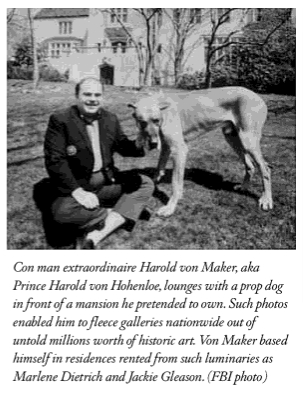


 Variant Readings