Palaeography, Codicology, and Assigning Dates to Early Christian Codices: A Review of God’s Library

Over at The Textual Mechanic blog, Timothy Mitchell has posted a review of God’s Library. I’m happy to say that the review is mostly positive, although Mitchell does mention some “glaring problems,” “contradictions,” and “circular argumentation” that he detects in the book. I’d like to take this opportunity to try to clarify a couple points he raises. Continue reading

Posted in Codices, Palaeography | 2 Comments

The “Qarara” Exodus Codex

I’ve recently posted about papyrus fragments of the Psalms in Greek and the book of Job in Coptic from Karanis that I wasn’t able to treat in God’s Library. Another set of ancient Christian manuscripts that I didn’t have the space to treat thoroughly in my book are the so-called “Qarara codices.” They are best known because one of them contained the Gospel of Judas, which was published with a good bit of fanfare in 2006. Three other books were said to have been found together with that codex. One of them was a papyrus codex that contained a copy of the book of Exodus in Greek that has been scattered on the antiquities market. I’ve now written a little article about this codex for Ancient Jew Review. You can check it out here. Also, a side note: I wanted to link to the full set of digital images of the Gospel of Judas that used to be online at the website of National Geographic. I can’t seem to find them now. Am I missing something? Or have they disappeared from the web?

Update 5 September 2018: Thanks to Stephen Goranson for pointing out that the images of the Judas leaves are available here.

Gospel of Judas and Qarara Exodus

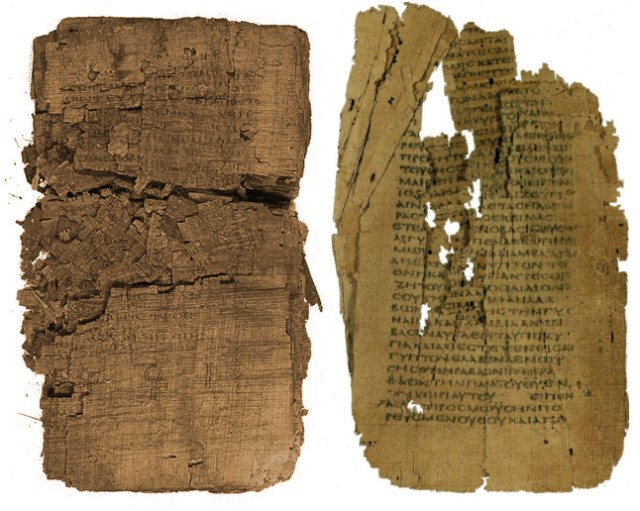
The “Tchacos” codex containing the Gospel of Judas and the Exodus codex allegedly from the same find (not to scale); images sources: tertullian.org and The Schøyen Collection

Posted in Antiquities Market, Codices, Schøyen Collection, Tchacos-Ferrini Codices, Tchacos-Ferrini Exodus Codex | 4 Comments

God’s Library: Publication Day

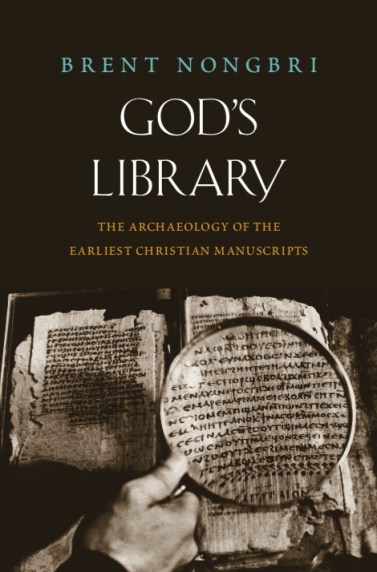
Nongbri Gods Library Cover

So, it’s August 21. This is the official publication date for God’s Library (I’m not entirely sure what that means, because the book has been shipping from the publisher for a couple weeks now already). Thanks again to everyone involved in the production of the book. Amazon has quite a few preview pages available, and the preview at Google Books features what I believe is the Kindle version of the book (I’m happy to see that the graphics look good in that format as well). Amazon seems to be low on hard copies, but the book can also be bought through the Yale Press website, which has links to other sellers, too. The great cover image comes courtesy of the Coptic Museum in Cairo and the very useful collection of photos at the Nag Hammadi Archive, a part of the Claremont Colleges Digital Library. Thanks to Stephen Emmel for pointing out that the photo was probably taken in 1956 when Pahor Labib was preparing to make plates for his facsimile volume.

Posted in Antiquities Dealers and Collectors, Antiquities Market, Archaeological context, Book binding, Book covers, Codices, Find Stories, Manuscript Collections, Palaeography, Radiocarbon analysis | 7 Comments

The Nag Hammadi Discovery Story

Over on his blog, Bart Ehrman is answering questions about the Gospel of Thomas. He has started out by re-telling a version of the traditional find story of the Nag Hammadi codices. This is a topic that I treat in my new book and that I’ve also addressed in a recent article.

The traditional story of the discovery has been a point of contention in the last few years. Continue reading

Posted in Codices, Find Stories, Nag Hammadi, Videos | 6 Comments

A Manuscript of Job in Coptic from Karanis

PMich inv 5421 Coptic Job verso

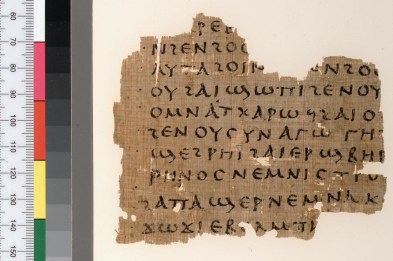
Leaf of a papyrus codex containing Job in Coptic (P.Mich. inv. 5421); image source: APIS, University of Michigan

In my previous post, I discussed a fragment of the Psalms in Greek excavated during the University of Michigan’s campaigns in Karanis. The Michigan excavators also found some Coptic literary material at the site. In 1979, Gerald M. Browne published a volume of Coptic texts in the University of Michigan collection (thanks to Alin Suciu for helping me consult this surprisingly-hard-to-find publication). Among these pieces was one that Browne noted was excavated at Karanis in the 1928/1929 season, P.Mich inv. 5421. It was a fragment of a papyrus leaf from a codex containing Job 30:21-30 in Coptic that Browne described as being characterized by “dialectical fluidity.” Continue reading

Posted in Archaeological context, Codices, Michigan Papyri | 5 Comments

A Manuscript of the Psalms in Greek from Karanis

One of the things I try to do in my book on early Christian manuscripts is survey some of the contexts in which ancient Christian books have been discovered. A set of examples that I wasn’t able to treat in detail in the book is the small group of Christian manuscripts found at the Egyptian town of Karanis. One of these pieces is a fragmentary leaf of a codex that contained the Psalms 32-33 in Greek (P.Mich. inv. 5475c, LDAB 128586) that was found in the courtyard of a house. Continue reading

Posted in Archaeological context, Codices, Michigan Papyri | 2 Comments

God’s Library

So, it has been about a year since I started this blog. At that time, I was in the midst of finishing my last revisions to the manuscript of my book, and in my first posting, I described the blog as an outgrowth of this book project:

“I’ve just completed a book on that topic (God’s Library: The Archaeology of the Earliest Christian Manuscripts), which is due out next year. This was a really fun book to write. While researching it over the last few years, I encountered so many fascinating stories about Christian manuscripts (and the people who study them!). So, I’m planning on using this site primarily to share some of these interesting, entertaining, and just plain strange stories.”

I’ve still got lots of stories to tell, so the blog will go on. But in the meantime, but I’m happy to report that I received my author copies of the book today:

Nongbri Books

Continue reading

Posted in Codices, Nag Hammadi | 10 Comments

E. C. Colwell on P52

E C Colwell

Ernest Cadman Colwell (1901-1974)

Back in 2005, I wrote an article on P.Ryl. 3.457, or “P52,” the small papyrus fragment of chapter 18 of the Gospel According to John kept at the Rylands Library in Manchester. I argued that the date generally assigned to the fragment on the basis of its handwriting (“first half of the second century,” or “circa 125 CE”) was overly narrow and that reasonably good palaeographic comparanda could be found among documents securely dated to the later second century and into the third century. As a result of this, I argued that P.Ryl. 3.457 should not be a factor in historical arguments about the date of the composition of John’s gospel.

At a conference in Manchester in 2014 I gave a paper that collected some new archival evidence on both the acquisition of this papyrus and the establishing of its date. The paper remains in a publication queue, but I was reminded today of an item of bibliography that had somehow escaped my notice when I was preparing that original 2005 article but that I luckily stumbled upon before the 2014 talk: E. C. Colwell’s review of the original edition of P.Ryl. 3.457 by C. H. Roberts in The Journal of Religion 16 (1936), 368-369. I thought I would highlight some of its salient lines: Continue reading

Posted in Antiquities Market, Codices, Colin H. Roberts, P.Ryl. 3.457, Palaeography, Rylands Papyri | 11 Comments

“Ink & Blood” Back? (but with less ink?)

I’ve recently been doing some research on a few early Christian books that were on the antiquities market about a decade ago. There are a lot of interesting stories here. We’re all pretty familiar with the collection now known as the Museum of the Bible, which really got going in 2009. Part of its public debut was the traveling “Passages” exhibition, which I have discussed earlier on this blog. The “Passages” exhibition itself seems in some ways to have been built in the mold of an earlier road show of biblical antiquities, “Ink & Blood: Dead Sea Scrolls to the English Bible.” Continue reading

Posted in Antiquities Dealers and Collectors, Antiquities Market, Bruce Ferrini, Fakes and Forgeries, Oxyrhynchus Papyri | 14 Comments

The Moschos Ioudaios Inscription

One of the most interesting early Greek inscriptions involving a Jew/Judaean is the so-called “Moschos inscription” (or “Moschus inscription”), a record of a manumission found in 1952 during excavations at Oropos north of Athens. The inscription was recovered from the Amphiareion, a shrine to the hero Amphiaraos.  The inscription itself bears no date but is generally assigned to the first half of the third century BCE, which would make it among the earliest Greek inscriptions to mention an ΙΟΥΔΑΙΟΣ in the singular. I was having a hard time locating an image of the inscription online, but I recalled having scanned the publication some time ago. I was able to find the scan and have posted it here: Continue reading

Posted in Inscriptions | 3 Comments