
In a previous post, I discussed the phenomenon of papyrus codices made from reused documents. Among this group is a very interesting item in the John Rylands Library at the University of Manchester. In fact, it was the first piece published in the first volume of Greek papyri from the Rylands collection edited by Arthur S. Hunt in 1911, P.Ryl. 1.1 (LDAB 3169). Continue reading
Codices Made from Reused Documents
Typically, ancient papyrus codices were made by cutting off sheets from a long roll of blank papyrus, stacking the sheets, and folding them into quires. There is, however, a small group of somewhat odd papyrus codices that were made in a different way. A number of papyrus codices, some of which can be associated with the Egyptian city of Panopolis, were made by reusing the blank sides of documentary rolls. Continue reading
Posted in Chester Beatty Papyri, Codices, Reuse of manuscripts
4 Comments
The Yale Genesis
Among the ancient Greek manuscripts in the Beinecke Library at Yale University is a fragment of a leaf of a papyrus codex containing the book of Genesis. It constitutes another interesting case of palaeographic analysis, both for the variety of opinions among experts and the changing of opinions by individual palaeographers. Yale purchased the piece (P.CtYBR inv. 419, LDAB 3081) as part of a lot of a few hundred papyri in February of 1931 from the Cairo dealer Maurice Nahman, but it was not published until the 1960s. Continue reading
Symposium on Early Codices
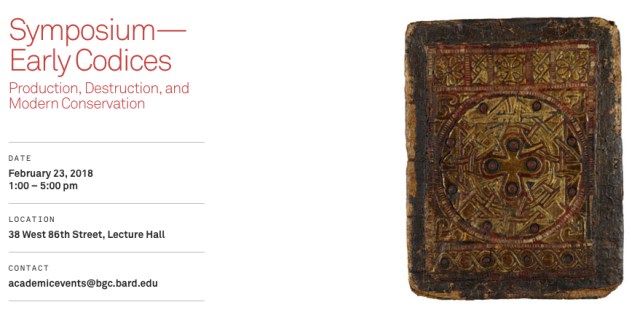
If you’re going to be in the New York area a month from now (23 February) and have an interest in early codices, you may want to be aware of an afternoon symposium at the Bard Graduate Center that promises to be illuminating: Early Codices: Production, Destruction, and Modern Conservation. I’ll be speaking on “The Emergence of the Codex in the Roman Empire.” The symposium is taking place in conjunction with an exhibition that also opens on the 23rd of February and runs through the beginning of July, The Codex and Crafts in Late Antiquity.
Posted in Codices
3 Comments
Palaeography and the Hawara Homer: Part 3, A Christian Example of the “Rounded Majuscule”
PSI 11.1200 is a collection of fragments of a papyrus roll that contained Plato’s Gorgias (LDAB 3770). Framed together in the Biblioteca Medicea Laurenziana in Florence, the fragments were excavated at Oxyrhynchus by a team led by Evaristo Breccia in the spring of 1932. Along with the fragments of Plato, the frame also contained another fragment from a different roll. This fragment also came from a papyrus roll and was written in a script that was similar to, but clearly distinct from, the the writing of the Plato fragments. Its text was not part of the Gorgias. In fact, it was not part of of any known text. More curious still, it contained abbreviations: ⲑⲥ (=θεος) and ⲑⲱ (=θεω), so-called nomina sacra, abbreviations for certain words that appear in Christian manuscripts. Continue reading
Posted in Guglielmo Cavallo, Hawara Homer, Oxyrhynchus Papyri, Palaeography
1 Comment
Palaeography and the Hawara Homer: Part 2
After looking at the account of the discovery of the Hawara Homer, I left off the story of the palaeographic dating of this manuscript with Edward Maunde Thompson’s 1912 introductory book, in which the Hawara Homer was assigned with confidence to the second century. This became the standard view of the dating of the papyrus. It was not until the 1960s that a full-scale study of this type of handwriting (now known as the “Rounded Majuscule” or “Roman Uncial”) appeared. This is the classic article of Guglielmo Cavallo, “Osservazioni paleografiche sul canone e la cronologia della cosiddetta «Onciale romana»” (1967). Continue reading
Posted in Ambrosian Iliad, Guglielmo Cavallo, Hawara Homer, Palaeography
7 Comments
Palaeographic Vocabulary: (In)appropriate
Thanks to Peter Malik for helpfully clarifying what is meant by the judgment that some palaeographic comparisons are “inappropriate.” As illustrations, he cites a couple examples from my work—my claims for graphic similarities between P.Bodmer XX and P.Bodmer II and my claims for graphic similarity between P.Herm. 4 and 5 and P.Bodmer XIV-XV. Those two arguments that I made are a little different from one another, and I think there are two separate issues at stake relative to the label “inappropriate.” Continue reading
Posted in Bodmer Papyri, Palaeography
1 Comment
Palaeographic Methodology
Peter Malik on the ETC blog has initiated a useful discussion of palaeographic method that invokes a bit of my own work. In general, he writes in favor of coming to terms with the fact that the analysis of handwriting of early Christian manuscripts cannot provide the very precise dates that we might like to have for these manuscripts. I am definitely on board with that contention. In the course of his post and in the comments, he notes his disagreement with a couple of my arguments, and I’d like to push him for some clarity on those critiques. Continue reading
Posted in Bodmer Papyri, Palaeography
7 Comments
Hurtado’s List of Early Christian Manuscripts
Over on his blog, Larry Hurtado has posted a link to his list of “Christian Literary Texts in Manuscripts of Second & Third Centuries.” When he first published a version of this list in his 2006 book, The Earliest Christian Artifacts, it provided a much needed succinct listing of the earliest surviving Christian texts and made it a lot easier to think about this entire corpus of material. That said, there are some features of the list that are worth pondering further. Continue reading
Posted in Palaeography
20 Comments
Palaeography and the Hawara Homer: Part 1
In an earlier post, I talked about the archaeology of the Hawara Homer (LDAB 1695), a papyrus roll containing the second book of the Iliad found with an unadorned mummy during Flinders Petrie’s excavations in Hawara in 1888. In this post, I want to talk a bit about the dating of the manuscript, which provides a nice illustration of how things functioned in the early days of palaeographic dating of ancient Greek handwriting. The handwriting of the papyrus is striking in the regularity of the letters, which were clearly executed by a skilled copyist.
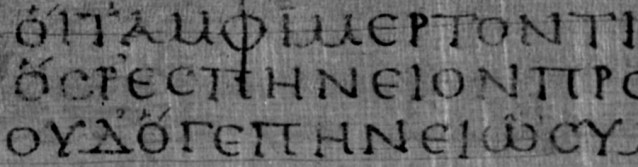
Sample of writing from the Hawara Homer (Bodleian MS Gr. Class A.1 (P); Image from the Centre for the Study of Ancient Documents


