
During the “Passages” Speaker Series in Charlotte, North Carolina in 2012 and 2013, it was customary for Jerry Pattengale to host the evening talks and to provide updates on the development of the Green Collection. In one of these updates, Pattengale briefly described some of the circumstances surrounding the Green Collection’s purchase of a particular book. What he said helps us to understand what it can mean for the Green Collection to “own” some of its artifacts. Continue reading
The Green Collection’s “Block Book” and What It Means to Own a Cultural Heritage Item
Posted in Antiquities Market, Green Collection
1 Comment
Burning Papyri
 As I compiled stories of discoveries of early Christian manuscripts for my book, God’s Library, one of the recurring tropes I encountered was the claim (usually by European and American scholars and collectors) that native Egyptians burned manuscripts. Such stories circulated about the Beatty Biblical Papyri, the Bodmer Papyri, the Nag Hammadi Codices, Codex Sinaiticus, and the Tura Papyri (for further details and references, see the entry for “burning of manuscripts” in the index of God’s Library).
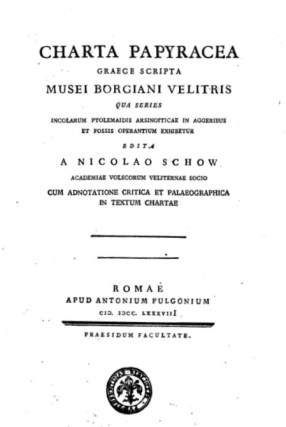
The idea that “the natives burned” manuscripts is a trope that goes back to the very beginning of European encounters with Egyptian papyri. The earliest such report known to me is Nicolao Schow, Charta papyracea graece scripta musei Borgiani Velitris (Rome: A. Fulgonium, 1788), iii–iv: “diripiebant Turcae, earumque fumo (nam odorem fumi aromaticum esse dicunt) sese oblectabant” (the Turks tear them up; they are delighted by the smoke, for they say its smell is aromatic). Continue reading
Posted in Antiquities Market
4 Comments
P129: Some Questions about a Papyrus of 1 Corinthians
[[Update: The papyrus fragments of Romans and 1 Corinthians discussed in this post were among those stolen from the Egypt Exploration Society. See details here.]]
On a few occasions, I’ve mentioned a fragmentary papyrus leaf containing 1 Corinthians in the Green Collection, GC.PAP.000120 (which has been assigned the number P129 in the INTF Liste). In one of Scott Carroll’s videos from 2018, this papyrus was featured along with an additional fragment said to be from the same manuscript. The “new” fragment is on the right side of the slide shown here, while the Green Collection portion is on the left:
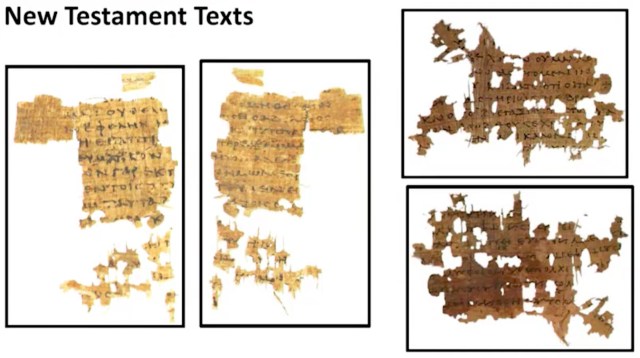
Slide from a talk by Scott Carroll showing fragments of a papyrus of 1 Corinthians (P129); image source: “Stones and Scriptures”
Now, thanks to some clever detective work by David Bradnick, we have some more information about this new fragment. But first, here is what Carroll had to say in the 2018 video: Continue reading
The Tchacos-Ferrini Codex of the Pauline Epistles in Coptic
While working through Scott Carroll’s videos, I’ve mentioned what I’m calling the Tchacos-Ferrini Codex of the Pauline epistles in Coptic (LDAB 108582). Little is currently known about this papyrus codex aside from an article in the journal Early Christianity by Hans-Gebhard Bethge from 2013. Through this article we learn that this is the codex that was allegedly found together with three other codices (supposedly in Qarara in Egypt): one containing the Gospel of Judas and other texts (LDAB 108481), one containing Exodus in Greek (LDAB 66871), and one containing mathematical material in Greek (LDAB 10719). These books first surfaced on the antiquities market in the early 1980s. Coptologist Stephen Emmel saw them in Geneva hotel room in 1983 and reported as follows on the codex of Paul’s letters: Continue reading
Newsreel Footage of Codex Sinaiticus from 1933
The major portions of Codex Sinaiticus that now reside in the British Library were bound into a volume by Douglas Cockerell after the leaves were closely studied by H.J.M. Milne and T.C. Skeat in their classic book, Scribes and Correctors of the Codex Sinaiticus (1938). So, if you visit the codex on display now, you will be looking at this handsome modern binding:
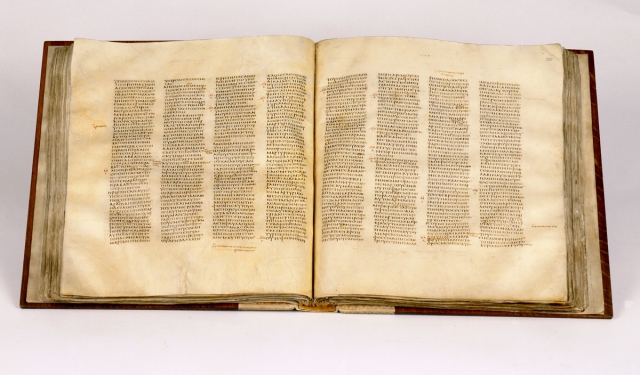
An opening of Codex Sinaiticus in its present binding; image source: codexsinaiticus.org
Posted in British Museum, Codex Sinaiticus, Codices, Videos
5 Comments
Scott Carroll’s Christian Manuscripts
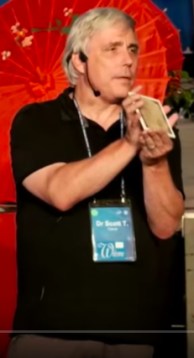
Scott Carroll and the Hobby Lobby / Museum of the Bible organization cut ties in May of 2012. Yet, his public presentations after that time continued to include images of manuscripts, such as the Bodmer Psalms codex, that are known to have been part of the Green Collection and/or the Museum of the Bible collection. So, it can sometimes be hard to tell which of the manuscripts that Carroll displays are actually owned by him. One way to begin to sort this out is to examine the actual manuscripts that remained in his possession after May of 2012. I think it’s safe to assume such pieces probably belonged to someone other than the Hobby Lobby / Museum of the Bible organization (either to Carroll himself or to other parties). This would seem to be the case with a set of classical papyri that Carroll passed around at a talk in California perhaps in early 2015. With this it mind, it may be helpful to revisit some older, reasonably well known videos of Carroll’s talks and reassess the manuscripts he displays. Continue reading
The Green Collection Mummy Masks: A Possible Source
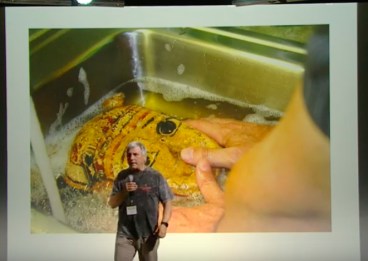 For some time now, I’ve been trying to make progress in ascertaining the previous ownership of both the manuscripts and the cartonnage (from mummies and other sources) that ended up in the Green Collection. This post will focus on the mummy masks. For the record, there are several mummy masks that have been associated with the Green Collection over the years. Continue reading
Sources and Destinations of Scott Carroll’s Papyri?
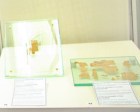 Thanks to Alin Suciu and Tommy Wasserman for pointing out that some of the manuscripts and facsimiles that Scott Carroll has been displaying over the last couple of years were part of an exhibition organized by Carroll’s Manuscript Research Group at the National Library of Belarus in 2018, complete with placards containing details that apparently relate to the current owners of some of these manuscripts: Continue reading
Still More Greek and Coptic Papyri from Scott Carroll
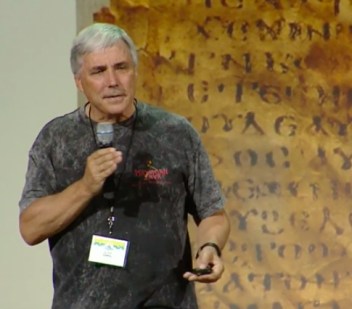
Thanks again to the resourcefulness of David Bradnick, here is still another video of Scott Carroll displaying still more papyrus and parchment manuscripts, including some Greek and Coptic manuscripts that have not appeared in the other videos I have surveyed. This video was filmed in Kansas City on 7 September 2016 during a meeting of the group Youth With a Mission.
Scott Carroll’s portion of what seems to have been a quite long evening begins at about the 32:50 mark and is notable for the number of Coptic manuscripts included in the presentation. Around the 38 minute Mark, Carroll gives an overall description of the material he will discuss: “recently discovered. . .all new material. . .some of these things are as recent as this past week.” One of Carroll’s slides describes this material as “Buried Treasures”: Continue reading
More of Scott Carroll’s Papyri?
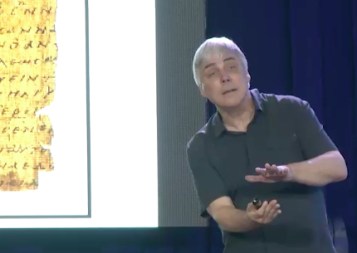
Thanks to David Bradnick for uncovering this relatively recent video of Scott Carroll that was recorded February 23, 2018 (Update: Thanks to Peter Gurry and Susanna Kinzig for pointing out the website for the original event). In this talk, “Stones and Scriptures,” Carroll presents slides with images of several of the same manuscripts that he discussed in a 2016 talk, as well as images of several other manuscripts. At about the 11:05 mark, Carroll begins going through some slides of the manuscripts that he describes in the following way:
“These texts are just a couple of examples of things recently that we have, ah, discovered or identified.” Continue reading


