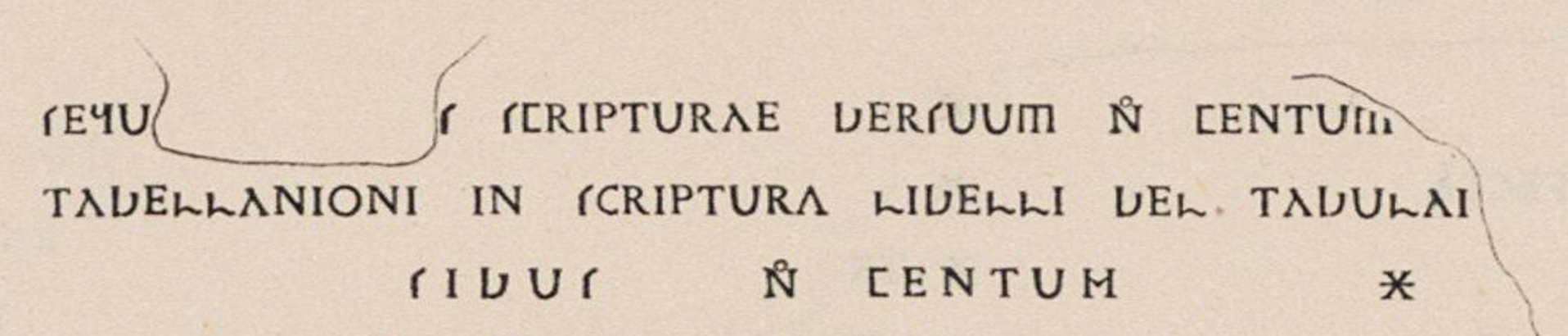
In an earlier post, I reviewed the evidence for a stichos or versus being equal (in theory) to 16 prose syllables. The count of stichoi in a work provided a standardized way of describing its length. A stichometric count could also be used as a means of calculating the cost of writing or copying a text. An important piece of evidence for this is the so-called Edict on Maximum Prices of Diocletian issued in the year 301. The complete text of the edict does not survive, but epigraphic remains, some quite substantial, preserve much of it.
Drawing of the Corone fragment of the Edict on Maximum Prices, including the Greek text of the lines on the cost of writing; image source: M.N. Tod, “A New Fragment of the Edictum Diocletiani,” Journal of Hellenic Studies 24 (1904) 195-202.
Both Greek and Latin versions survive for the portion of the edict that is relevant to the discussion of stichometry.
CIL edition of the lines concerning prices of writing from the Stratonikeia inscription of the Edict on Maximum Prices
There are a few lacunae, but between the two versions, the sense is reasonably clear. The text given here is that of Lauffer.1
39 scriptori in sc<ri>ptura optima versus n. centum D̸ XXV 40 sequ[enti]s scripturae bersuum no. centum D̸ XX 41 tabellanioni in scriptura libelli bel tabularum [in ver]sibus no. centum [D̸] X
After a word about payment for the parchment maker, the inscription gives maximum prices to be paid to a scriptor or καλλιγράφος (copyist) for two types of writing, “the best writing” and “second quality writing.” In each case the basis for price is the sum of στίχων ρʹ, versus centum, 100 stichoi. A third type of writing is attributed to a different type of writer. The ἀγοραῖος or tabellio,2 figures who execute the writing used in different kinds of documents (the terms libelli and tabulae cover a variety of documentary texts). Again, the unit for determining pay is 100 stichoi.
So accuracy of stichometric counts would seem to be important not just for knowing the length of texts but also for paying those who copied texts of all kinds. One would thus expect that stichometric counts for a given text would be basically stable, but this doesn’t really seem to be the case.3 I will explore this issue a bit in another post.
Siegfried Lauffer, Diokletians Preisedikt (Berlin: de Gruyter, 1971). ↩︎
Presuming that tabellanioni is synonymous with (or an error for) tabellioni. ↩︎
The statement in the Cheltenham List mentioned in an earlier post already suggested that getting such a count might not be an entirely straightforward matter: “Because the index of verses (indiculum versuum) in Rome is not clearly given, and because in other places too, as a result of greed, they do not preserve it in full, I have gone through the books one by one, counting sixteen syllables per line, and have appended to each book the number of Virgilian hexameters it contains.” Edition and translation of Rouse and McNelis, “North African Literary Activity: A Cyprian Fragment, the Stichometric Lists and a Donatist Compendium,” Revue d’histoire des textes 30 (2000) 189-238: Quoniam indiculum versuum in urbe Roma non ad liquidum sed et alibi avariciae causa non habent integrum per singulos libros computatis syllabis posui numero XVI versum Virgilianum omnibus libris numerum adscribsi. ↩︎
I’ve been thinking a bit about stichometry lately. As some of the primary sources did not seem to be easily accessible online, I’ve decided to write up a couple posts on the topic. We can begin with the opening of the entry for “stichometry” in the Oxford Classical Dictionary (2012):
“stichometry, the modern name for an ancient system of numbering lines in literary texts. In Greek papyri, this numbering takes two forms. (1) Marginal: each hundredth line marked with a letter of the alphabet (A = 100 up to Ω = 2400, then again from A). (2) Final: the sum total of lines in the work (roll) stated at the end, often introduced by ἀριθμός, ‘number,’ and most often in acrophonic numerals. Any individual copy may exhibit both, one, or neither; a few copies show lines checked off in fives, tens, or twenties. In verse, the ‘line’ defines itself. In prose, the numbering assumes a notional or standard line (the actual lines would differ in length from copy to copy): apparently15-16 syllables.”
At present, I am mostly interested in stichometric counts of prose texts. The basis for this standard length of a prose line is an incidental remark in Galen (On the Doctrines of Hippocrates and Plato 8.1.22-25). While engaged in a lively medical dispute, Galen repeatedly apologizes for writing so much when the matter at hand is actually, in his view, quite simple. In the course of one of these apologies, he provides some interesting equivalences. I provide the reference here in full in the translation of Phillip De Lacy.1
“Thus the true account is as short as I shall demonstrate to you; it reaches its conclusion in a few syllables (δι᾽ ὀλίγων συλλαβῶν), as follows: ‘Where the beginning of the nerves is, there is the governing part. The beginning of the nerves is in the brain. Therefore, the governing part is there.’ This one argument has thirty-nine syllables (ἐννέα καὶ τριάκοντα συλλαβῶν), equivalent to two and one-half hexameters (δυοῖν καὶ ἡμίσεος ἐπῶν ἑξαμέτρων). A second argument is in all five lines long (πέντε τῶν πάντων ἐπῶν): ‘Where the affections of the soul more visibly move the parts of the body, there the affective part of the soul is. The heart is observed to undergo a great change of motion in anger and fear. Therefore, the affective part of the soul is in the heart.’ If you thus join these two arguments together, the combined total will be no more than eight hexameter lines (ἐπῶν ἑξαμέτρων ὀκτώ). Who, then, is to blame for my having written five books dealing with these matters that could have been scientifically demonstrated in eight heroic lines (διὰ ὀκτὼ στίχων ἡρωϊκῶν)?”2
On Galen’s reckoning, then, two and a half hexameters lines is 39 syllables of prose. If we do the math: 39/2.5=15.6 At the same time, eight ἡρωϊκοὶ στίχοι (or ἑξάμετρα ἔπη) are greater than 122 syllables. If we again do the math: 122/8=15.25
So, it seems then that an epos or a stichos in prose writing is 16 syllables. This finds support in (later) Latin tradition, in which a versus was also equivalent to 16 prose syllables. A Latin Christian sitchometric list generally called the Cheltenham List is preserved in two medieval manuscripts.3 The maker of the list appended the following note (given here in the text and translation of Rouse and McNelis):4
“Because the index of verses (indiculum versuum) in Rome is not clearly given, and because in other places too, as a result of greed, they do not preserve it in full, I have gone through the books one by one, counting sixteen syllables per line, and have appended to each book the number of Virgilian hexameters it contains.”5
The point of stichometric counts (or at least one of the points) seems to be to provide a standard way of measuring the length of a work. But as the statement above from the Cheltenham List indicates, it could be challenging to get an accurate stichometric count for a book. And in fact surviving lists and stichometric notations for biblical books often disagree with each other, sometimes significantly. But that will be the topic of another post.
St. Gallen Stiftsbibliothek Cod. Sang. 133, p. 490; image source: e-codices
Phillip De Lacy, Galen: On the Doctrines of Hippocrates and Plato. Second Part: Books VI-IX, 2nd ed. (Berlin: Akademie Verlag, 2005). ↩︎
The list itself is usually assigned to the second half of the fourth century, but the manuscripts that preserve them are later Biblioteca Nazionale Centrale di Roma, Vitt.Em.1325 (tenth or early eleventh century) and St. Gallen Stiftsbibliothek Cod. Sang. 133 (late eighth or early ninth century). ↩︎
Richard Rouse and Charles McNelis, “North African Literary Activity: A Cyprian Fragment, the Stichometric Lists and a Donatist Compendium,” Revue d’histoire des textes 30 (2000) 189-238. It’s not totally clear whether this statement goes with the material that precedes it (a list of the stichoi of biblical books) or the material that follows it (a list of the stichoi of the works of Cyprian). ↩︎
Rouse and McNelis’s edition of the Latin: Quoniam indiculum versuum in urbe Roma non ad liquidum sed et alibi avariciae causa non habent integrum per singulos libros computatis syllabis posui numero XVI versum Virgilianum omnibus libris numerum adscribsi. ↩︎
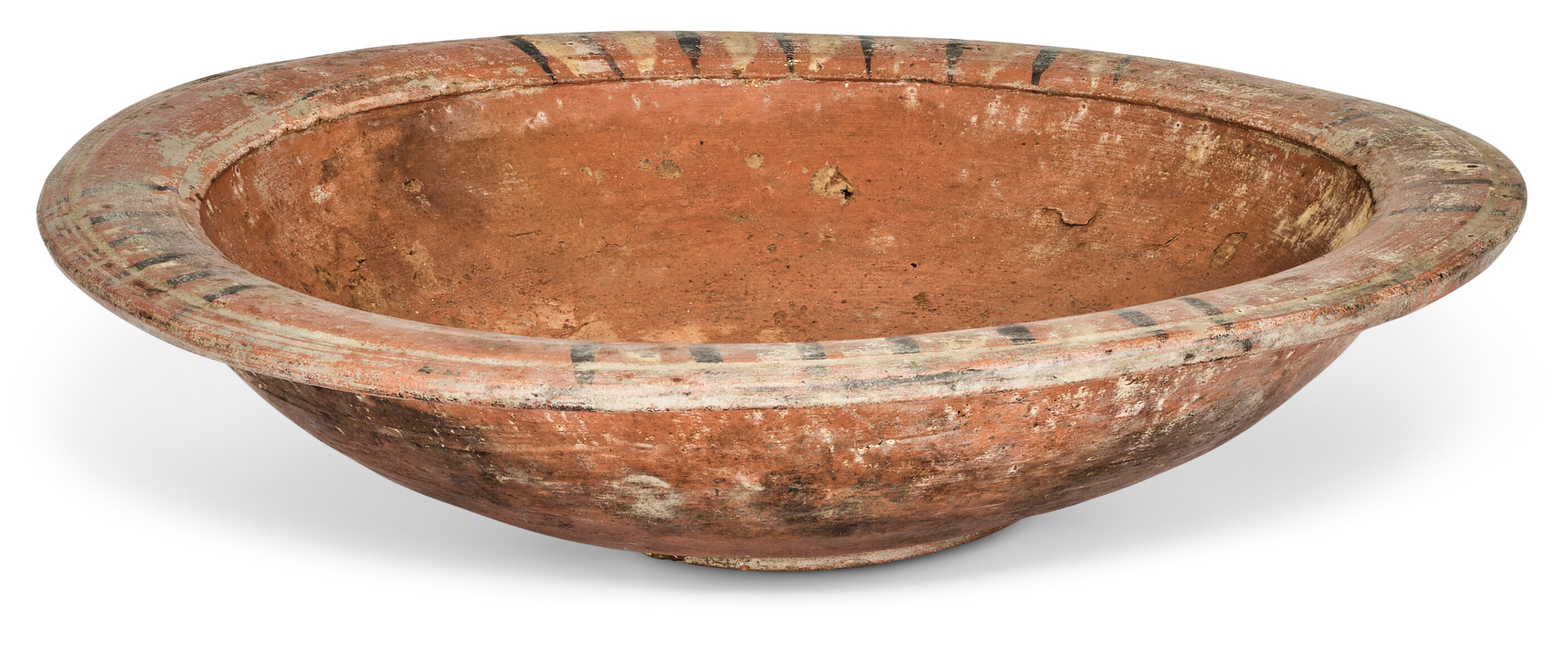
After being down for several days due to a cyber attack, the Christie’s website appears to be back up and running. A more detailed description of the items being auctioned from the Schøyen Collection is now available. Among them is the leather cover of Nag Hammadi Codex I along with the separately framed waste papyrus extracted from the cover.
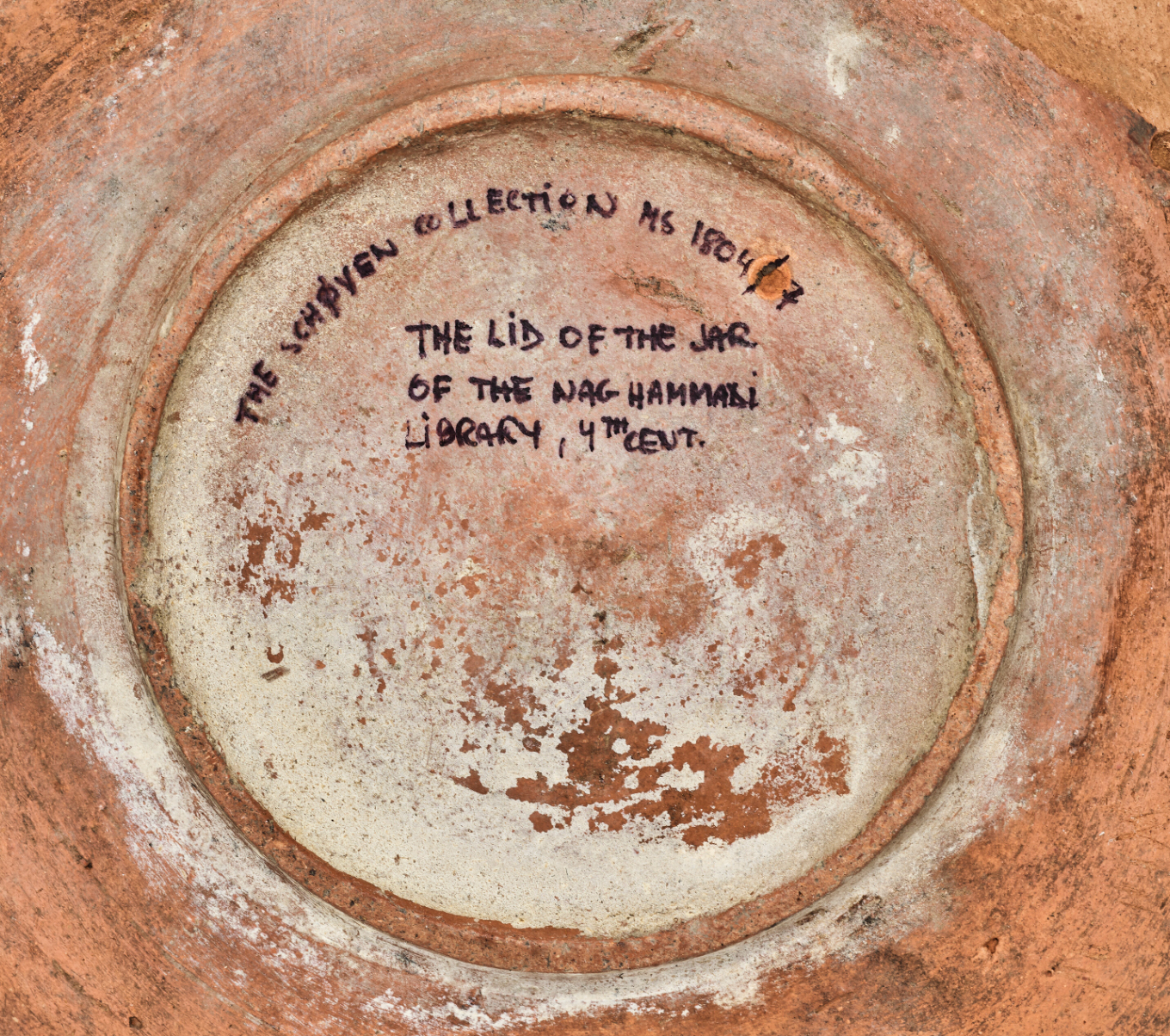
One observation about the catalog entry for this lot: The buyer will also get the bowl that James Robinson often claimed was used to seal the jar in which the Nag Hammadi codices were said to have been found. I want to point out that this bowl has a provenance history that differs from that of the leather cover (and cartonnage) of Codex I. While the quires and leather cover of Codex I took different paths to their current repositories (the quires to Cairo and the cover eventually to the Schøyen Collection), the bowl had a more direct path: an Egyptian family to James Robinson (in 1976) and then to the Schøyen Collection in 1994.
Now, was this in fact “the” bowl used to seal the jar with the codices? For reasons I have outlined in detail elsewhere, I regard the find story or–more accurately–the multiple, conflicting find stories of the Nag Hammadi codices as unreliable. Nevertheless, it’s worth teasing out the tale of the bowl a bit. To the best of my knowledge, Robinson’s fullest account of the bowl is in his book, The Nag Hammadi Story (2014). While summarizing his story of the discovery of the codices, Robinson gave a detailed description of the jar in which the books were said to have been found (a jar that had allegedly been smashed and that Robinson had never seen). He eventually moved on to describe the way this jar had allegedly been sealed and what happened to the bowl used to seal the jar:
“The jar had been closed by laying into its mouth a pottery bowl, which Khalīfah took with him to al-Qaṣr. There he was employed as a servant and camel driver for a Copt, Sami ʿAbd al-Malāk, who took the bowl as a talisman that would bring a blessing. Through the mediation of his wife Umm Nadya, a relative Salib ʿAbd al-Masīḥ, for a modest consideration, made it available for study.”1
In other words, Robinson bought the bowl and took it back to Claremont. What is interesting about the story is that the connection of the bowl to the alleged discovery of the books is the figure of Khalīfah, that is, the brother of Muhammad ʿAli al-Samman, the man most closely associated with the discovery of the codices, whose story (or rather, stories) Robinson spent years investigating. One part of Muhammad ʿAli’s story was a denial that Khalīfah was present at the time of the discovery of the codices.2 Robinson did not believe this part of Muhammad ʿAli’s story.
James Robinson’s Egyptian bowl, now MS1804/1 (3) in the Schøyen Collection; image source: Christie’s
Another account of Robinson’s purchase of the bowl is provided in James Goehring’s publication of a similar bowl found during excavations of a church at Pbow. Goehring says the following about the bowl Robinson bought:
“Robinson notes that Khalifah took it [the bowl] to the home of the Coptic family of Sami Abd al-Malak and his wife Umm Nadia. When Robinson located the bowl, it was Salib Abd al-Masih, Sami’s nephew, who sold it to him. While Robinson did not know for sure the whereabouts of Sami at that time, one may assume, since Umm Nadia was still present and Salib acted as the one with authority to sell the bowl, that Sami had passed away. Robinson concurred with this assessment.”3
I think it’s important to emphasize that this bowl took a path in the antiquities trade that is different from that of the cover of Nag Hammadi Codex I. We might assume that they had a common origin, but that really is just an assumption. The first time the bowl and the cover of the codex actually have a documented history together is in Claremont, California in 1976 (the cover of Codex I had arrived in Claremont in 1972).4 Treating the cover and the bowl as a unit tends to create the impression of unity and coherence in a “find story” that is actually quite messy when we focus on the details.
Inscription on the bottom of the bowl, MS1804/1 (3) in the Schøyen Collection; image source: Christie’s
James M. Robinson, The Nag Hammadi Story (Leiden: Brill, 2014), 1.35-36. ↩︎
James E. Goehring, “An Early Roman Bowl from the Monastery of Pachomius at Pbow and the Milieu of the Nag Hammadi Codices,” in L. Painchaud and P.-H. Poirier (eds.), Coptica – Gnostica – Manichaica: Mélanges offerts à Wolf-Peter Funk (Louvain: Peeters, 2006), 57-371, quotation at 361, n. 15. ↩︎
See the account in Robinson, The Nag Hammadi Story, 1.383-390. ↩︎
The upcoming auction of the Crosby-Schøyen Codex prompted me to revisit the edition of the codex and think a bit about the book’s construction. One datum that didn’t really register with me before I started making papyrus rolls is the length of the kollēmata, the individual sheets of papyrus pasted together to make up a papyrus roll. Pliny the Elder provides descriptions of different classes of these sheets, and the largest that he mentions is the macrocolum, which is 1 cubit long (about 44.4 cm).
Papyrus codices that are sufficiently well preserved sometimes allow us to reconstruct the rolls from which their bifolia were cut. The kollēmata of the rolls reconstructed from some codices do fall below the maximum width reported by Pliny. For example, in 1956 Jean Scherer reconstructed the rolls from which the bifolia of one of the Tura codices of Origen (TM 62347) were cut.
Reconstruction of the kollēmata of the Tura codex of Origen’s Contra Celsum; images sources: CSAD and J. Scherer, Extraits des Livres I et II du Contre Celse d’Origène (Cairo: IFAO, 1956), p. 3
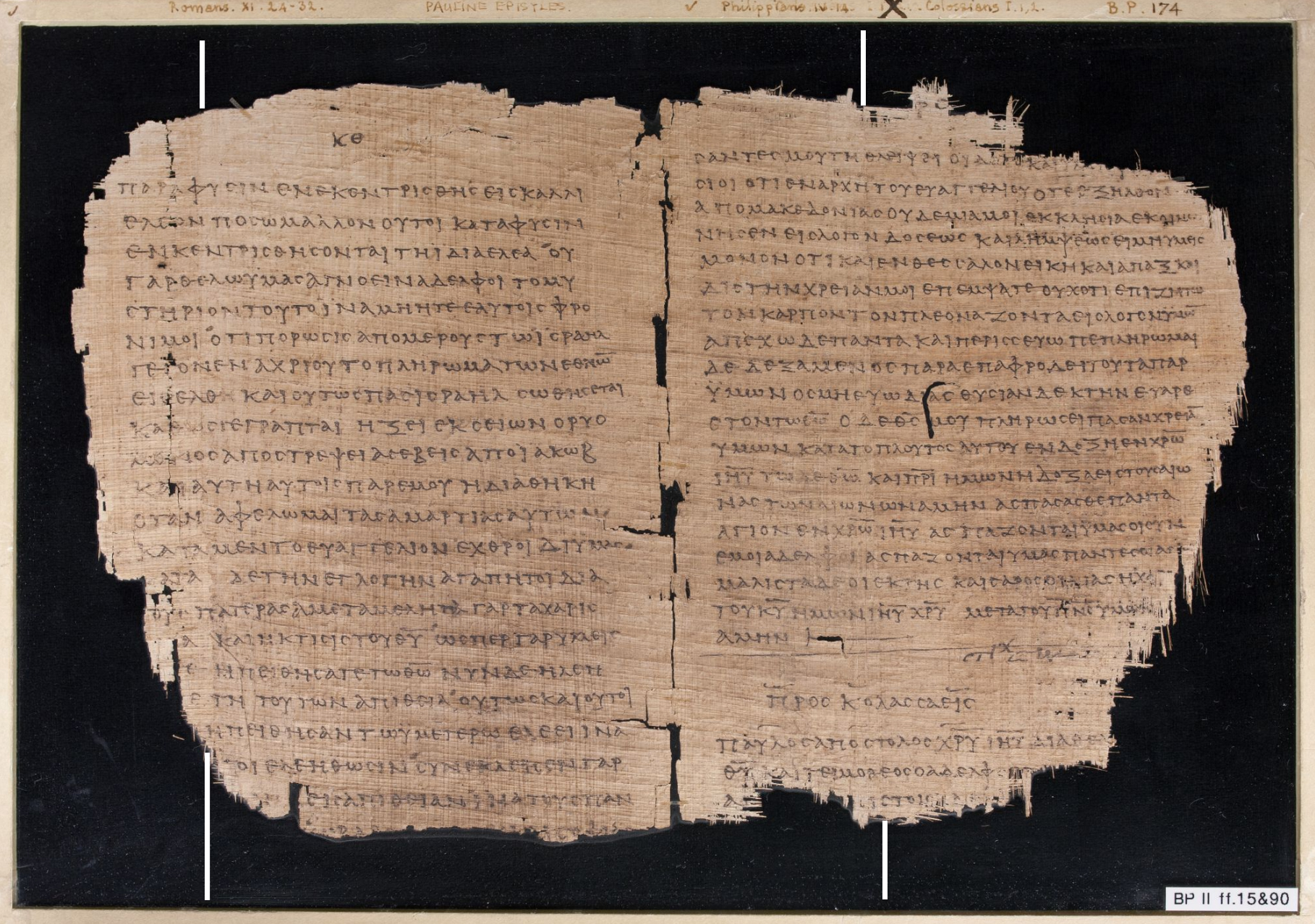
Each individual kollēma was about 20 cm long. The Beatty-Michigan codex of the Pauline epistles (P46, TM 61855) has kollēmata that average about 20 cm long (though they range in length from about 10 cm long to about 33 cm).1 There are usually two kollēseis (pasted joins) on each surviving bifolium.
A bifolium of the Beatty-Michigan codex of the Pauline epistles (P46) with two kollēseis indicated by white lines; image source: Chester Beatty Online Collections
But a number of codices were constructed from rolls that have much longer kollēmata. The conservator Hugo Ibscher (1874-1943) reported that some of the kollēmata used to make the rolls used for the Berlin “Gnostic” codex (P.Berol. 8502, TM 107765) were over 1.6 meters long. Rodolphe Kasser reported that the Bodmer Menander codex (TM 61594) was made up of cut from a single very long kollēma measuring at least 4.20 meters!2 [[Correction 28 Sept. 2025: Kasser claimed the length of the roll was 4.20 meters, but he points out the roll had two kolleseis, so the individual kollemata were shorter, but still quite long.]] This seems implausible given the usable length of a stalk of papyrus. I have not been able to verify or refute Kasser’s claim, but from the digital images now available online, one can reconstruct quite long kollēmata. Here is a set of bifolia certainly from a single kollēma that was at least 75 cm long:
Bifolia of the Bodmer Menander Codex showing a single long kollēma stretching across three bifolia, white arrows highlight especially prominent horizontal fiber patterns; image composed from material from the Bodmer Lab
When the rolls used to make the Nag Hammadi codices were reconstructed, it was found that these kollēmata were also quite long, with lengths of up to 1.62 meters.3 So, there is good evidence for rolls composed of kollēmata much longer than Pliny’s macrocollum. This suggests that the mode of manufacturing papyrus must have undergone a change from Pliny’s day. Eric Turner drew out the implications:
“A roll without kolleseis of a length of about 2 m. would have been constructed using the full height (about seven feet) of the papyrus stem. If such rolls were made, they would appear to be a novelty designed to meet the requirements of codex-makers. It is to be noted that most of these supposed rolls with kollemata 2 m. wide are of very coarse, thick papyrus.”4
Turner located this shift in the fourth century. It is thus possible that the presence of these long kollēmata may be an indicator that a codex was produced no earlier than the fourth century.
The kollēmata of the Crosby-Schøyen codex fall into this later, longer group. The editors of the codex reported kollēma lengths between 1 and 1.5 meters.5 Radiocarbon analysis of the papyrus of this codex would allow for a date anywhere from the middle of the third century to the middle of the fourth century. It may be that the presence of the long kollēmata in the Crosby-Schøyen codex suggest a date in the later part of that range. But some caution is necessary. The number of samples we have is small. And the existence of the relatively short kollēmata in the Tura Origen papyrus noted above (which is assigned to the sixth or seventh century) suggest that shorter kollēmata continued to be used throughout late antiquity. So, shorter kollēmata may not necessarily be indicative of an earlier date, but longer kollēmata (over about 45 cm) may perhaps be an indicator of production in the fourth century or later.
See the data gathered in E.B. Ebojo, A Scribe and his Manuscript: An Investigation into the Scribal Habits of Papyrus 46 (P.Chester Beatty II – P.Mich. inv. 6238) (Ph.D. diss., University of Birmingham, 2014), 79-86. ↩︎
R. Kasser, Papyrus Bodmer XXV, Ménandre: La Samienne (Bibliotheca Bodmeriana, 1969), at 11-12: “En effet, un examen attentif des pages du P. Bodmer XXV-IV-XXVI nous a convaincu du fait suivant: tous les folios de ce codex ont été découpés dans un même rouleau. …Ce volumen devait avoir une longueur de 4,20 m au moins.” ↩︎
J.M. Robinson, The Facsimile Edition of the Nag Hammadi Codices: Introduction (Brill, 1984), 67-70. ↩︎
E.G. Turner, The Typology of the Early Codex (University of Pennsylvania Press, 1977), 53. ↩︎
J.M. Robinson, “The Manuscript’s History and Codicology,” in James E. Goehring (ed.), The Crosby-Schøyen Codex Ms 193 in the Schøyen Collection (Peeters, 1990), xix-xlvii, at xlv-xlvi. ↩︎
In 2022, I published a short paper on the construction of the Beatty-Michigan codex of the Pauline epistles (P46, TM 61855). I suggested that the surviving page numbers in the codex might not be an entirely reliable guide to the original size of the single quire that makes up the codex (I had noticed that some other better preserved single-quire papyrus codices were not symmetrical in terms of numbered pages in the two halves of the codex).
I realized after publication that I had not noted an additional fact relevant to the discussion: Early codices, even single-quire codices, can have multiple sequences of page numbers. I pointed to the Crosby-Schøyen codex (TM 107771) as an example in a subsequent post.
Now, I follow up with another addendum. In the original article I used the Berlin Akhmimic Proverbs codex (TM 107968) as an example of a single-quire codex in which the outer folia of the quire were incorporated into the cover, relying upon the conservator Hugo Ibscher’s description of the book:
The original cover of Berlin Ms. or. oct. 987, now on a paper quire; image source: Paola Buzi, The Manuscripts of the Staatsbibliothek zu Berlin preussischer Kulturbesitz, Part 4 (Steiner, 2014), plate 5
“The Berlin Akhmimic Proverbs codex presents further interesting evidence. Hugo Ibscher noted that the outermost folia of this single-quire codex were incorporated into the leather cover of the codex along with waste papyrus to help stiffen the cover.”
I added a footnote to this sentence expressing some caution about this interpretation of Ibscher:
This is at least how I understand Ibscher’s somewhat confusing description: “The cover of the book consists of 6 to 8 layers of papyrus, which, when glued on top of each other, resulted in a strong cardboard. The outer sheets of this cardboard contain remains of Greek writing, while the inner ones are apparently blank. It fits well with this that from the first papyrus roll, before the surviving sheet 1 of the codex, four more sheets have been taken from the first papyrus roll [from which the bifolia were cut] that are not found in the codex and were probably used to strengthen the book cover and were bound through at the same time” (Hugo Ibscher, “Von der Papyrusrolle zum Kodex,” Archiv für Buchbinderei 20 [1920] 21–40, at 39: “Der Buchdeckel besteht aus 6 bis 8 Papyruslagen, die übereinandergeklebt eine starke Pappe ergaben. Die äußeren Blattlagen dieser Pappe enthalten griechische Schriftreste, während die inneren anscheinend unbeschrieben sind. Hierzu paßt es gut, daß aus der ersten Papyrusrolle, vor dem erhaltenen Blatt 1 des Codex, noch vier Blätter entnommen sind, die sich im Kodex nicht vorfinden und wahrscheinlich zur Verstärkung des Buchdeckels verwendet und gleich mit durchgeheftet wurden”). I take heart from the fact that Theodore C. Petersen showed a similar understanding: “The papyrus boards of the binding were found by Dr. Ibscher to have been built up of six to eight papyrus leaves pasted one over the other. Several of the innermost of these were found to have been sewn as part of the original codex, i.e., as its outermost sheets.” See Theodore C. Petersen, Coptic Bookbindings in the Pierpont Morgan Library (ed. Francisco H. Trujillo; Ann Arbor: Legacy, 2021) 430. It is unclear how common this type of construction was among single-quire codices. I know of no other documented examples. J.A. Szirmai, citing Ibscher’s “Der Kodex,” mentions another alleged example of this phenomenon, but he has misread Ibscher’s reference, which is almost certainly to the Berlin Proverbs codex (Szirmai, The Archaeology of Medieval Bookbinding [Aldershot: Ashgate, 1999] 12).
I was a little unclear on what Ibscher meant by “und gleich mit durchgeheftet wurden.” And I probably should have given Ibscher’s reference from “Der Kodex” in full. The context there is a discussion of single-quire codices. Ibscher does not specifically name the Proverbs codex (which is why Szirmai, I think, misinterpreted him), but it must be the Proverbs codex that Ibscher had in view:
“In one of these early codices I was able to make the interesting observation that the six outer bifolia were left blank. They were firmly attached to the quire by stitching, then glued together and now also served as a book cover, which was covered with leather.”
“Bei einem dieser frühen Kodizes konnte ich noch die interessante Beobachtung machen, daß die sechs äußeren Doppelblätter unbeschrieben gelassen wurden. Sie wurden mit der Lage durch die Heftung fest verbunden, dann zusammengeklebt und dienten nun zugleich als Buchdeckel, der mit Leder überzogen war.”
Now, I am happy to report that another passage by Ibscher confirms this understanding of the construction of the Proverbs codex in no uncertain terms. While looking up some information about the Medinet Madi codices, I came across this note by Ibscher specifically in reference to the Proverbs codex (Ms. or. oct. 987):
“The Coptic papyrus codex of the Berliner Staatsbibliothek, which was still bound when I received it for conservation, consists of 40 bifolia and some stubbed bifolia, while the 6 outermost bifolia were glued together to form the book cover.”
“[D]er koptische Papyruskodex der Berliner Staatsbibliothek, der noch im Einband saß, als ich ihn zur Konservierung erhielt, umfaßt 40 Doppelblätter und einige Einzelblätter, während die äußeren 6 Doppelblätter zusammengeklebt den Buchdeckel ergaben.”
It’s good to have Ibscher’s view of this matter fully clarified.
Bibliography:
Ibscher, Hugo. “Die Handschrift.” Pages v–xiv in Hans Jakob Polotsky and Alexander Böhlig, Manichäische Handschriften der Staatlichen Museen Berlin: Kephalaia, 1. Hälfte (Lieferung 1–10). Stuttgart: Kohlhammer, 1940.
Ibscher, Hugo. “Der Kodex.” Jahrbuch der Einbandkunst 4 (1937) 3-15.
Nongbri, Brent. “The Construction and Contents of the Beatty-Michigan Pauline Epistles Codex (P46).” Novum Testamentum 64 (2022) 388-407.
After reading these articles, I recognized that I was not going to be able to approach early Christian literature (or indeed, ancient Roman literature more generally) in quite the same way again. Gaining a greater appreciation of the the ubiquity of enslaved labor in the Roman world, and especially the role of shorthand specialists in the production of writing, casts all of early Christian literature in a different light.
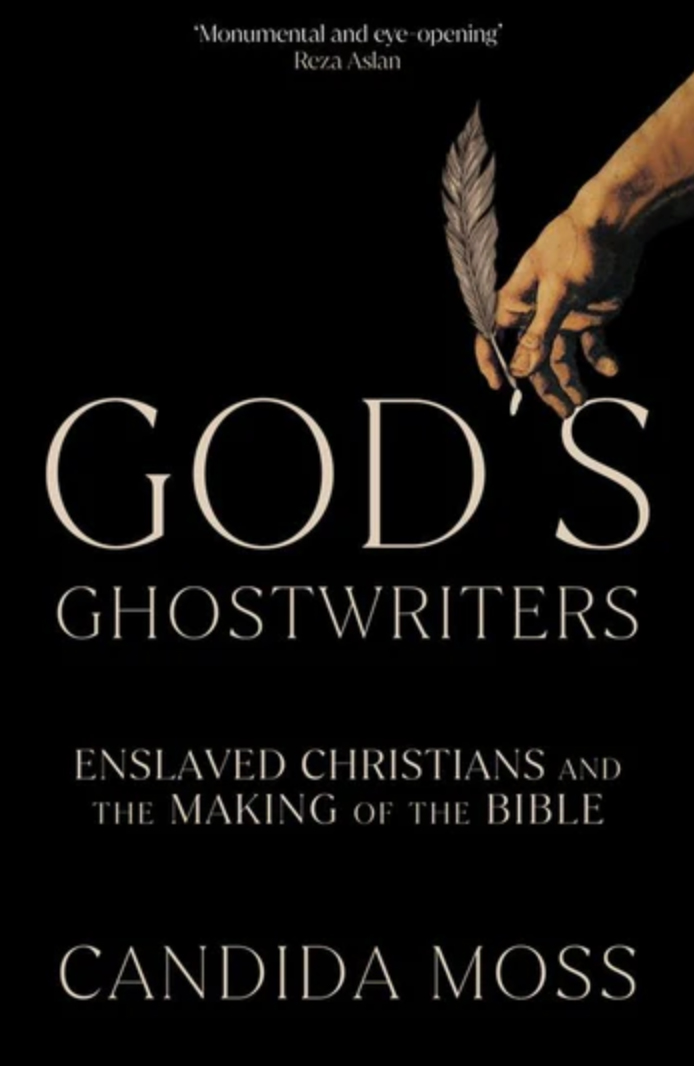
Now Moss has synthesized her findings and produced what is probably the most important book in New Testament studies written in the last half century. God’s Ghostwriters: Enslaved Christians and the Making of the Bible manages to touch upon and reframe nearly every “classic” question of critical New Testament scholarship–issues of authorship and pseudepigraphy, sources and editing, transmission and textual variation, reading and reception, and even theology. And it’s written in a way that will be readable to those outside specialist circles (for scholars, a companion website provides amplified footnotes and a set of additional resources, and the articles mentioned above offer further documentation and nuance).
The topic of slavery in the New Testament is of course not new. There are many studies about what early Christian writers had to say on the topic of slavery and also about the metaphorical use of the language of slavery and freedom in early Christian writings. But in the last twenty years or so, scholarship has begun to focus more on actual enslaved people in the Roman world, including early Christians. Moss is meticulous in noting her debts to the work of predecessors and contemporary colleagues working on ancient slavery. Yet, she has pushed this conversation in interesting new directions by focusing especially on the role of literate enslaved laborers in the production, transmission, and consumption of literature in the Roman world.
Sarcophagus of Valerius Petronianus, side relief showing an elite figure reclining while an assistant holds writing tablets, Museo archeologico di Milano; image source: Wikimedia Commons
Part of what makes the book intriguing is the complication of the idea of authorship. When we talk about things like “Paul’s letters,” we’re actually talking about the letters of Paul and his co-authors. Several of the letters are clear about this in their opening lines: Paul and Sosthenes (1 Corinthians); Paul and Timothy (2 Corinthians, Philippians, and Philemon); Paul, Silvanus, and Timothy (1 Thessalonians). But Moss pushes further to highlight the different kinds of labor that went into composing writing in the Roman world. There are places in our sources where such labor flashes into view and then disappears just as quickly, such as Romans 16:22: “I, Tertius, the writer of this letter, greet you in the Lord.” We only see Tertius for a moment, but he has been there the whole time, “writing” the entire letter to the Romans. And acknowledging this fact feels different after reading Moss’s discussion of shorthand notation, a complicated set of signs memorized by literate workers, who were often enslaved, in order to quickly take dictation. The notary who took the dictation would later expand the shorthand copy to produce a copy in normal writing. It’s difficult to escape the conclusion that, much as we might like to imagine these letters as a direct conduit to “Paul’s beliefs,” what we are seeing here is more probably a situation of co-authorship. And it’s likely that Paul’s other letters, and most literary works in Roman antiquity, were written in a similar way. The praise of the shorthand writer attributed to the professor, poet, and statesman Ausonius evokes a partnership (albeit an unequal one): “No teaching ever gave you this gift, nor was ever any hand so quick at swift stenography: Nature endowed you so, and God gave you this gift to know beforehand what I would speak, and to intend the same that I intend” (Ephemeris 7).
Wax tablet with a student’s practice in shorthand symbols; British Library Add. MS 33270; image source: H.J.M. Milne, Greek Shorthand Manuals (Egypt Exploration Society, 1934)
Was Tertius enslaved? Moss demonstrates that people who performed secretarial work in Roman antiquity often were. And names like “Tertius” (literally, “the third one”) were common for slaves. But more elite Romans also had such “numerical” names. At the end of the day, we don’t know the status of Tertius with certainty; we simply don’t have enough data. Indeed, one of the themes that runs through the book is the problem of invisibility. Had Tertius not decided to add his ten words of greeting, we wouldn’t know he had ever existed. A similar situation applies with almost all literate enslaved labor in the ancient Roman world. We have to work with a small corpus of surviving evidence, because when these kinds of workers did their jobs well, they became invisible. Moss highlights the irony: “They performed their work so perfectly that they wrote themselves into nonexistence.”
P.Oxy. 44.3197, a contract for dividing up the slaves of the estate of Tiberius Julius Theon. Among the slaves are Heron the γραμματεύς (scribe), Ammonas the νοτάριος (shorthand writer), and Demas the προχειροφόρος (amanuensis); image source: University of Oxford Sustainable Digital Scholarship
One tactic Moss uses to address this problem of invisibility is to present historical reconstructions that are avowedly imaginative. This decision will no doubt invite some criticism. Yet, by explicitly and repeatedly highlighting the imaginative elements in her own account, Moss invites fellow historians to consider the imaginative work that lies behind many of our own easy assumptions about Roman literary culture.
The question really is: What should our “default” assumptions about the composition of early Christian literature be? Having read Moss’s work, I don’t think it’s historically responsible to picture Paul or the writers behind the gospels as lone theological geniuses. The realities of ancient practices of composition, at least to the extent that we can reconstruct and imagine them on the basis of limited and fragmentary sources, suggest that a rethinking of ancient authorship is going to be necessary.
And it’s not just the composition of early Christian literature that involved this often invisible labor. The copying of texts, the movement of books from place to place, and the reading of books all frequently involved enslaved or formerly enslaved workers. If Paul and co-authors wrote letters together, those who delivered letters also had a role in creating and conveying the meaning of the text. Cicero comments in a letter to a friend, “Your freedman Cilix was not well known to me before, but ever since he delivered me your letter, so full as it was of affection and kindness, he has himself by his own words followed up in a wonderful way the courtesy with which you wrote. It was a delight to me to hear him holding forth…” (Ad. fam. 3.1). Moss’s chapters detail the ways in which reading the ancient evidence with enslaved laborers in view can inform and transform the way we understand these aspects of early Christianity.
Clever and insightful observations abound. Throughout the book, Moss places various early Christian texts in dialogue with literature that depicts different aspects of ancient enslaved life. To take just one of many examples, Moss pairs Paul’s language–or perhaps better, the language of Paul, Sosthenes, and the others involved in the writing of 1 Corinthians–about the body (“Christ is the head of every man…You all are the body of Christ, and individually its limbs”) with the fascinating but neglected treatise on household management by Bryson, who theorized slavery for elite Romans: “Slaves resemble the limbs of the body…”
Excerpts from Bryson, Oikonomikos logos, Bibliothèque nationale de France, Grec 1984, fol 165 verso; image source: Gallica
The comparison prompts reflections on how early followers of Jesus may have understood their relationship with the man they called their κύριος, dominus, master. It adds a dimension to the self-designation of some followers of Jesus as δοῦλοι Χριστοῦ, “slaves of Christ” (Romans 1:1, Philippians 1:1, Titus 1:1, James 1:1, 2 Peter 1:1, Jude 1). And for all the ink spilled on the meaning of πίστις/fides in early Christian writings, Moss’s emphasis on Roman elites’ use of the term to describe the proper attitude of the enslaved to the enslaver (“loyalty”) is striking and suggestive.
Overall, this book has an effect that is similar to that of E.P. Sanders’s Paul and Palestinian Judaism (1977). Even if you don’t agree with every interpretive move the author makes, the collective force of the book’s examples leaves you with what can only be described as a new perspective. In other words, if the field takes God’s Ghostwriters seriously (and it should), then there is no going back. And the way forward will involve greater effort to pay attention to the enslaved people who played important parts in producing, promulgating, and preserving the writing of the Roman world.
Metal tag, likely from the collar of an enslaved person; the inscription reads: tene me ne fugia(m) et revoca me ad dom(i)num Viventium in ar(e)a Callisti Inscription translation: Capture me, lest I escape, and return me to my master Viventius on the estate of Callistus; image source: The British Museum, 1975,0902.6
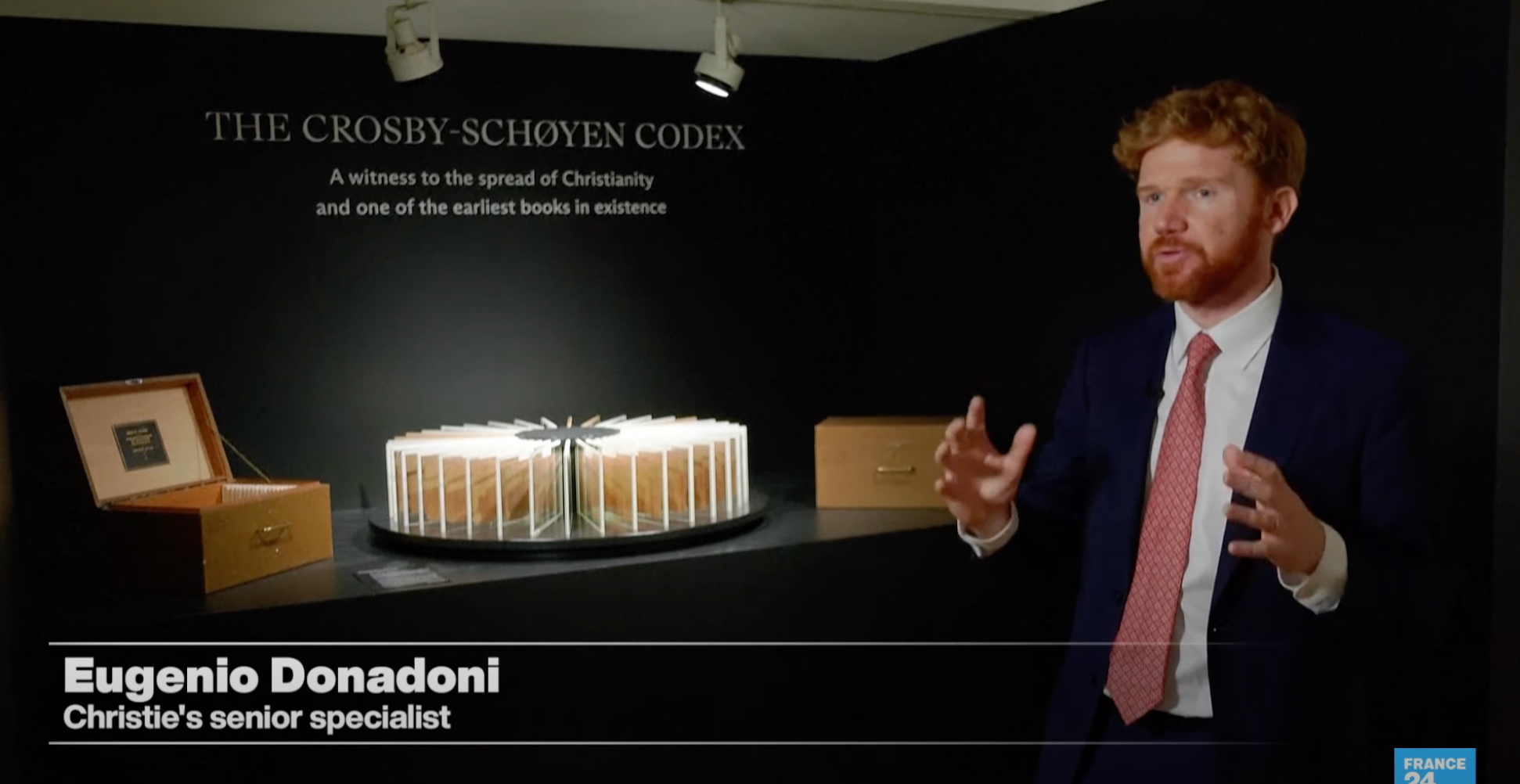
It has been an unusually busy news week for Coptic codices. I posted a few days ago about the Mudil Psalms codex, and then yesterday several news outlets reported that Christie’s will be auctioning off the Crosby-Schøyen codex, a papyrus codex containing an eclectic mix of early Christian texts in Coptic (Melito’s On Passover, 2 Macc. 5:27–7:41, 1 Peter, Jonah, and a liturgical exhortation).
Eugenio Donadoni displaying the Crosby-Schøyen Codex for Christie’s; image source: France24
The codex is currently part of the collection of Martin Schøyen, a Norwegian collector who holds a number of early papyrus and parchment manuscripts. There is a brief posting at Christie’s website with highlights of what will be on sale in June. It’s not clear which, if any, of Schøyen’s other papyrological holdings might be up for sale.
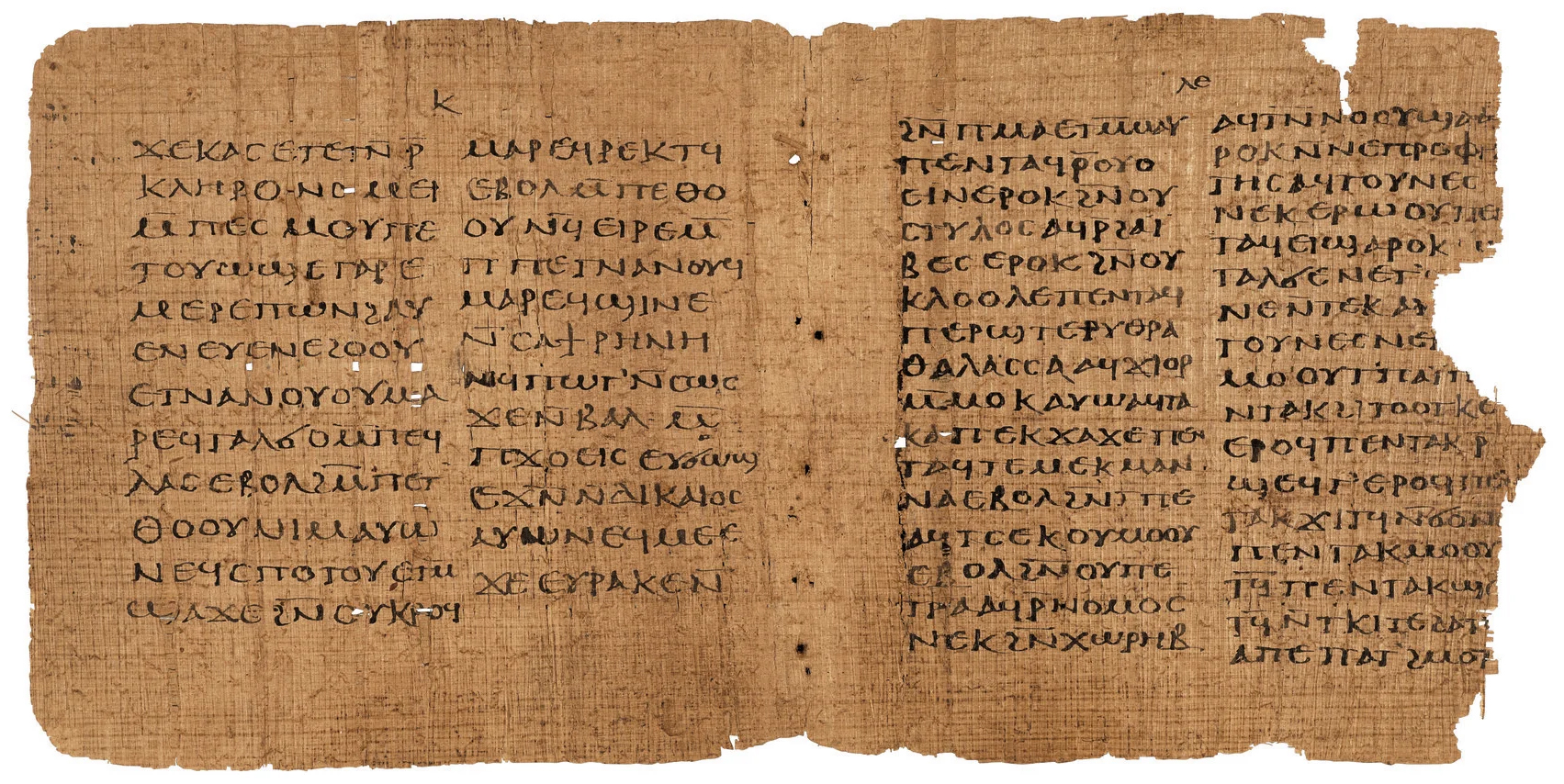
A nearly complete bifolium of the Crosby-Schøyen codex; image source: CNN
As some of the various news articles note, the Crosby-Schøyen codex first came to the notice of scholars in the 1950s when it was bought by the University of Mississippi. I noted some months ago that a recent article by Dan Sharp makes a deep dive into the history of this purchase and other related transactions.
In the news reports, the date of the codex is given as “around 250-350 AD.” This is a reasonable date range, but it’s not quite the whole story (see below). This is one of the few papyrus codices that has actually been subject to radiocarbon analysis, the results of which were published in 2020 by Hugo Lundhaug (available here open access).
“A single scribe is said to have written the codex, which is made up of 52 leaves – or 104 pages – over a period of 40 years at a monastery in upper Egypt.”
There’s a lot to unpack here.
“A single scribe is said to have written the codex”: Yes, it is generally thought that one copyist executed the whole codex.
“made up of 52 leaves – or 104 pages.” That may be the number of leaves in the Schøyen portion of the codex, but to the best of my knowledge, the most reliable analyses suggest that the original book when whole had 68 folia and two stubs, so 136 pages with two uninscribed partial leaves. Some of these folia are lost, but there are fragmentary remains of some folia in other collections (the Chester Beatty collection in Dublin and the Fondation Martin Bodmer in Cologny).
“over a period of 40 years”: I have no idea what this claim even means. Writing an ancient script is a difficult skill to master, but it doesn’t take 40 years to copy a codex.
“at a monastery in upper Egypt.” Yes, this is a widely accepted theory for the production of this codex. But if this theory is true, that fact would really narrow down the range of possible dates for the production of the codex. The specific theory is that this book was produced in one of the Pachomian monasteries in Egypt, and these monasteries were only formed in the second quarter of the fourth century. This would mean that the date of the codex would actually be more like 330-350. That is to say, the radiocarbon analysis gives us a rough terminus ante quem (latest possible date of production), and the monastic production theory gives us a terminus post quem (earliest possible date of production).
So, if this is accurate, then the sales claims about this codex containing “the two earliest complete texts of two books of the Bible, 1 Peter and Jonah” may not be strictly correct. P.Bodmer 8 also has a reasonable claim to being the earliest complete copy of 1 Peter. We can’t say for sure, as we just don’t know the dates of these manuscripts with high degrees of precision.
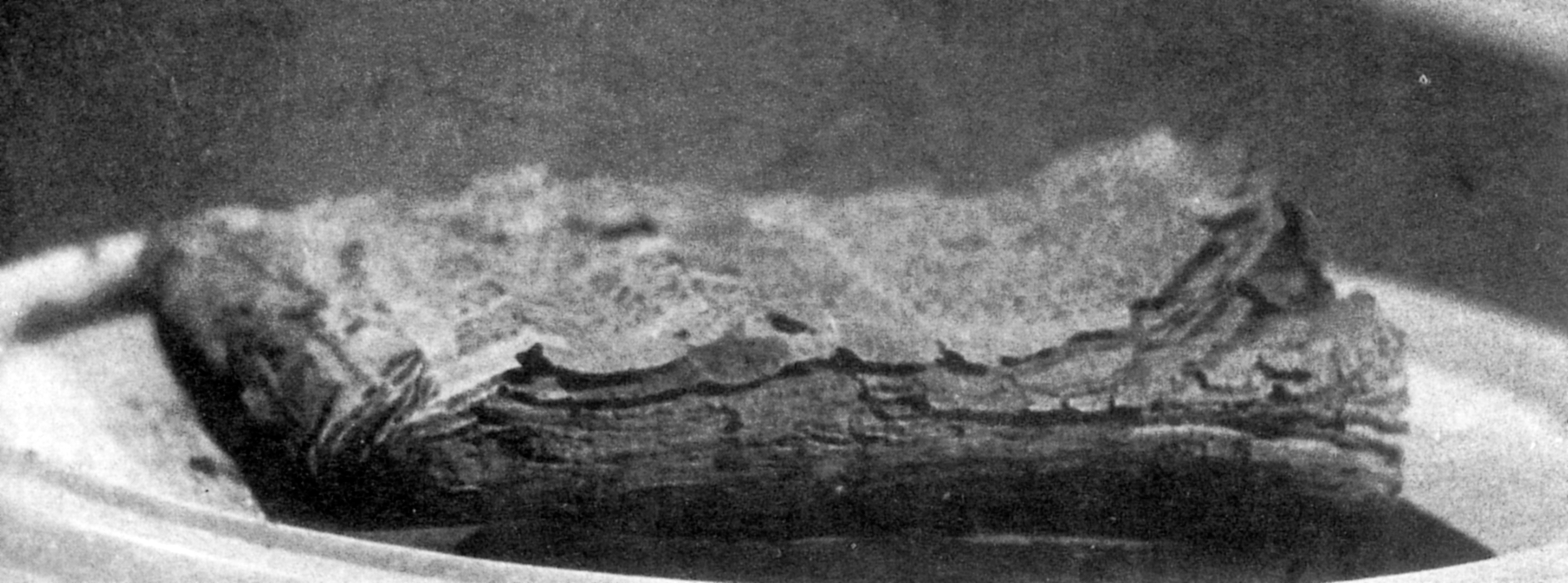
What we can say with confidence is that this is an early and well preserved specimen of the codex format. When the codex first arrived in Mississippi, it was still in a relatively intact state:
The Crosby-Schøyen codex before it was taken apart, view of the quire showing the broken remains of the outer folia surviving at the spine; image source: William H. Willis, “The New Collections of Papyri at the University of Mississippi,” in Leiv Amundsen and Vegard Skånland (eds.), Proceedings of the IX International Congress of Papyrology (Oslo: Norwegian Universities Press, 1961), 381-392, plate V.
It is a single-quire codex (a single large stack of papyrus sheets that was folded and tacketed through the central fold). The outer folia had broken away by the time the codex arrived in Mississippi. But the papyrus seems to have been pliable enough to handle the codex just as one would handle a modern book:
The Crosby-Schøyen codex before it was taken apart, opened to the end of 2 Macc. 5:27-7:41, page numbered ⲝⲋ (= 66) and the beginning of 1 Peter, page numbered with a new sequence beginning with ⲁ (= 1); image source: William H. Willis, “The New Collections of Papyri at the University of Mississippi,” in Leiv Amundsen and Vegard Skånland (eds.), Proceedings of the IX International Congress of Papyrology (Oslo: Norwegian Universities Press, 1961), 381-392, plate V.
The codex was disassembled, and the individual folia were mounted between glass plates, which is how they are now seen in Christie’s sales video.
The Corsby-Schøyen codex is a very interesting artifact in terms of the history of the book, for what it can tell us about early book construction and codicology (one example is its curious scheme of pagination).
It is also interesting from a legal and ethical point of view. Because it was removed from Egypt before 1970, it sits on the “happy” side of the UNESCO Convention on the Means of Prohibiting and Preventing the Illicit Import, Export and Transfer of Ownership of Cultural Property. Yet, it is one of many ancient manuscripts that exited Egypt before 1970 but after the passage of Egypt’s Law no. 215 of 1951. Sharp’s research demonstrates that the codex probably left Egypt in 1954 or 1955, was moved to Switzerland, and then brought to the US in the summer of 1955. Law no. 215 stipulated that certain antiquities could leave Egypt but only with explicit written government approval. I believe the Egyptian dealer who sold this codex, Maguid Sameda, held an official antiquities license issued by the government, so, in theory at least, some paperwork should exist that documents that the legal export of the codex from Egypt (although I have never seen it).
News services in Egypt have announced that the Mudil Psalter is back on display after undergoing conservation treatment. This was a very well preserved Coptic codex that was excavated in 1984.
It was found buried together with the body of a young girl, but, frustratingly, we don’t know the exact relationship between the book and the body. Here is what I wrote about the codex in God’s Library (2018) in the context of discussing stories about bodies buried with books in late antique Egypt:
“A more recent discovery is less open to doubt but still frustratingly vague. In 1984, during excavations in a cemetery about forty-five kilometers north of Oxyrhynchus, a small but thick parchment codex of the Psalms in Coptic was reportedly discovered. The so-called Mudil Psalter (LDAB 107731) was likely copied in the fourth or fifth century. It is said to have been found either ‘under the head of a young girl’ or simply ‘near the head of a young girl’ in a tomb, or, most elaborately, ‘placed open as a pillow beneath the head of an adolescent girl in a humble cemetery.’1 The codex was found during work supervised by the Egyptian Antiquities Organization, but no analysis was undertaken on the human remains or other material in the tomb. Nor is there any photograph or drawing of this discovery showing either the corpse or the book in situ before removal. Thus we are left to wonder what was the exact relationship between the book and the corpse and what the date of the burial might have been.”
Perhaps unsurprisingly, it is the most elaborate description of the find that has stuck, and this codex is sometimes thus called “the Pillow Psalter,” even though we don’t actually know how the codex was positioned in relation to the body. In any event, although the photo is a bit blurry, it looks like the book has undergone extensive treatment. Earlier images of the codex show the folia in a very cockled state:
The Mudil Codex in 1993; image source: G. Gabra, Cairo: The Coptic Museum and Old Churches (Cairo: Egypt International, 1993), p. 111
It would be interesting to learn exactly what conservation procedures the codex has undergone.
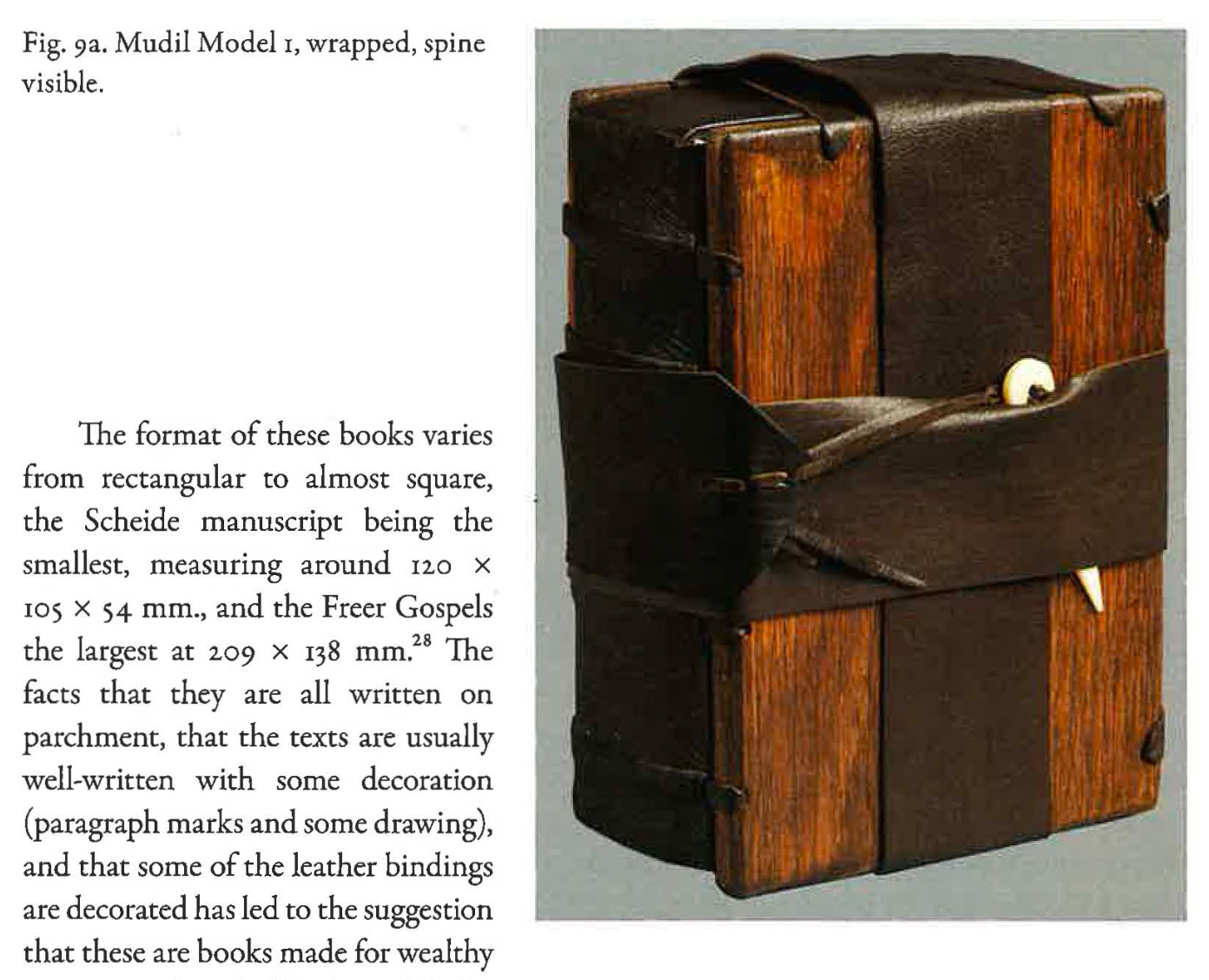
The binding of the Mudil Psalter was the subject of an in-depth study published in 2020 by Julia Miller:
Julia Miller, “Modeling Ambiguity: The al-Mudil Codex (David Psalter),” in Julia Miller (ed.), Suave Mechanicals: Essays on the History of Bookbinding, vol. 6 (Ann Arbor: The Legacy Press, 2020), 305-362.
Miller’s study is full of excellent images of the codex and also Miller’s incredible models:
It’s nice to see the codex in the news and good to know that it is back on display at the Coptic Museum in Cairo.
For the first description, see Gawdat Gabra, “Zur Bedeutung des koptischen Psalmenbuches im oxyrhynchitischen Dialekt,” Göttinger Miszellen 93 (1986): 37–42, at 37. For the second, see Gawdat Gabra, Der Psalter im oxyrhynchitischen (mesokemischen/mittelägyptischen) Dialekt (Heidelberg: Heidelberger Orientverlag, 1995), 23. For the third, see Michelle P. Brown (ed.), In the Beginning: Bibles Before the Year 1000 (Washington, D.C.: Freer Gallery of Art and Arthur M. Sackler Gallery, 2006), 74. Brown’s source for this more elaborate description is unclear. She cites Gawdat Gabra, Cairo: The Coptic Museum and Old Churches (Cairo: Egypt International, 1993), but Gabra here describes the book again only as having been found “in a shallow grave under a young girl’s head” (110). ↩︎
In 2023, the civil case of Hobby Lobby Stores, Inc. v. Dirk D. Obbink switched venues from New York to Oklahoma City. The Oklahoma court has now found a default judgement in favor of Hobby Lobby, with the result that Professor Obbink is now obligated to pay Hobby Lobby “$7,085,100.00, together with prejudgment interest from February 5, 2013, at the rate of 6% per annum, as specified in 15 Okla. Stat. § 266, postjudgment interest at the rate provided in 28 U.S.C § 1961 until the judgment is satisfied, and attorney’s fees and costs.”
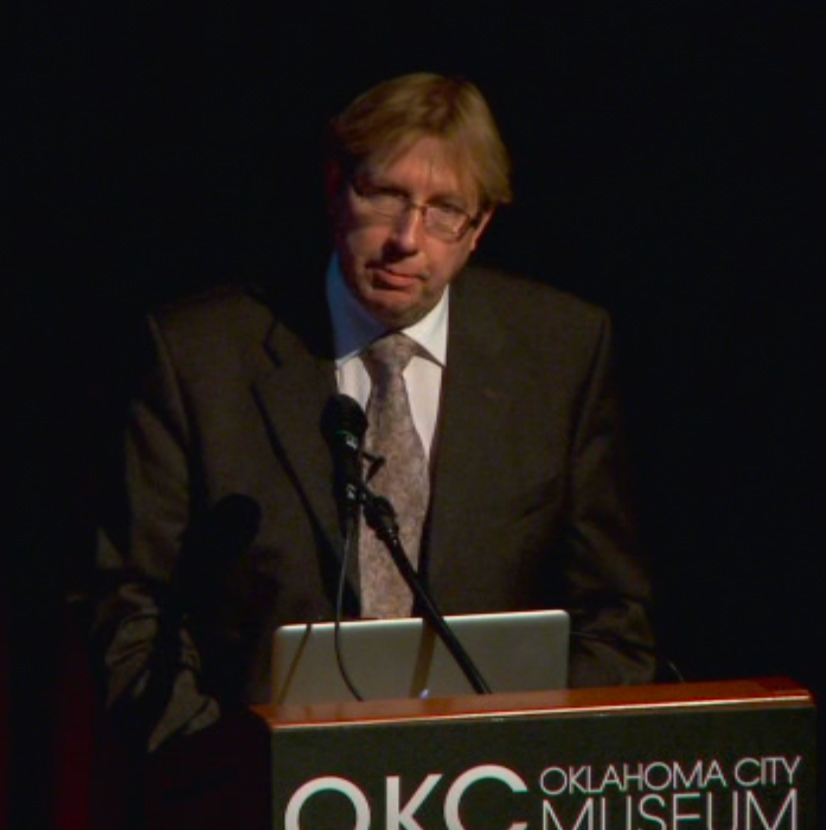
Dirk Obbink presenting for the Passages Speakers Series in Oklahoma City in 2011
The complaint alleges that Professor Obbink sold Hobby Lobby 32 papyri that turned out to have been stolen from the collection of the Egypt Exploration Society. The original complaint contains a list of seven purchases Hobby Lobby made from Professor Obbink between 2010 and 2013, outlined by Lynda Albertson in a post yesterday (which also has a nice summary of the whole affair).
There are a couple interesting statements in the complaint document, which is often identical with the original New York filing. This statement was in the original filing, but I breezed right by it:
“Obbink, one of the world’s leading scholars of ancient papyri, also acted throughout his career as a private dealer of papyri fragments and other antiquities to the world’s greatest museums and private collectors.”
Is this actually accurate? I wonder if Hobby Lobby has evidence to back up the statement about sales to other museums. Did Professor Obbink in fact sell to others outside the community of wealthy Christian collectors in the US? If so, might there be more missing EES pieces in other collections?
I think it’s also worth emphasizing a statement that I highlighted before when the New York complaint was filed:
“The fact that some unknown number of the Fragments were stolen renders all the Fragments unsalable and worthless to Hobby Lobby, which stands to lose both the Fragments and the entire value of the Purchase Price it paid to Obbink.”
If Professor Obbink has acted as Hobby Lobby alleges, he should of course be held accountable. But it’s worthwhile to reflect on how “worthless” the stolen fragments actually were to Hobby Lobby. One of the aspects of the Hobby Lobby and Museum of the Bible relationship that was amply documented by Candida Moss and Joel Baden was that Hobby Lobby would buy manuscripts and other artifacts, have them appraised at higher values than they paid, donate them to the Museum of the Bible, and then take a tax write-off for the higher amount. As Baden and Moss write (Bible Nation, p. 25):
“The financial incentive to donate items, and reap the substantial tax write-off, is commonplace among serious art and antiquities collectors; this is how many museums have traditionally acquired much of their holdings. Part of what sets the Greens apart from other collectors, however, is that when they donate pieces from their collection, they give them to their own nonprofit organization. When, in 2015, we asked Steve Green how the family decides what artifacts to donate to the Museum of the Bible, he candidly responded that the decision was financial: “I don’t know that there’s a lot of rhyme and reason to it. . . . We want to donate X amount and we can do it with this, and that’s easy so we’ll do it.” Once donated to the Museum, however, the items never truly leave the Greens’ control. The charitable organization known as Museum of the Bible, Inc. (MOTB) is also based at Hobby Lobby, Inc., in Oklahoma City. Once the bricks-and-mortar museum opens in D.C. the artifacts will be transferred there, but the museum, as we will see later in this book, effectively remains under Green control.”
Items bought from Professor Obbink do seem to have been among those that Hobby Lobby donated to the Museum of the Bible, as the Museum records for some of the Distribution Papyri indicate. This is the provenance information associated with P.Oxy. 1353:
Now, the model that Moss and Baden describe, and which Scott Carroll used in his own business, Ancient Asset Investment, refers to a minimum 3-to-1 return for people who buy antiquities and then donate them to non-profit organizations. One of the videos in which Carroll promoted this plan in 2014 is very explicit on this point. The host of the event, Marshall Foster, says “So a person who wants a tax write-off that’s major, I mean, so that you don’t pay taxes for the next year and a half, two years, uh you buy one of these treasures, and it’s, it’s a legal, uh, way to do it.”
The Hobby Lobby v. Obbink complaint notes that aside from the seventh purchase from Professor Obbink (which involved the four gospel fragments), the other six purchases were all delivered: “Obbink sent the Fragments at issue in the Action from the United Kingdom to Hobby Lobby in Oklahoma City, where Hobby Lobby is headquartered.” So, if Hobby Lobby did appraise these items, donate them to the Museum of the Bible, and take the tax deduction, it would seem that Hobby Lobby may have managed to extract considerable value out of these “worthless” papyrus and parchment fragments after all.
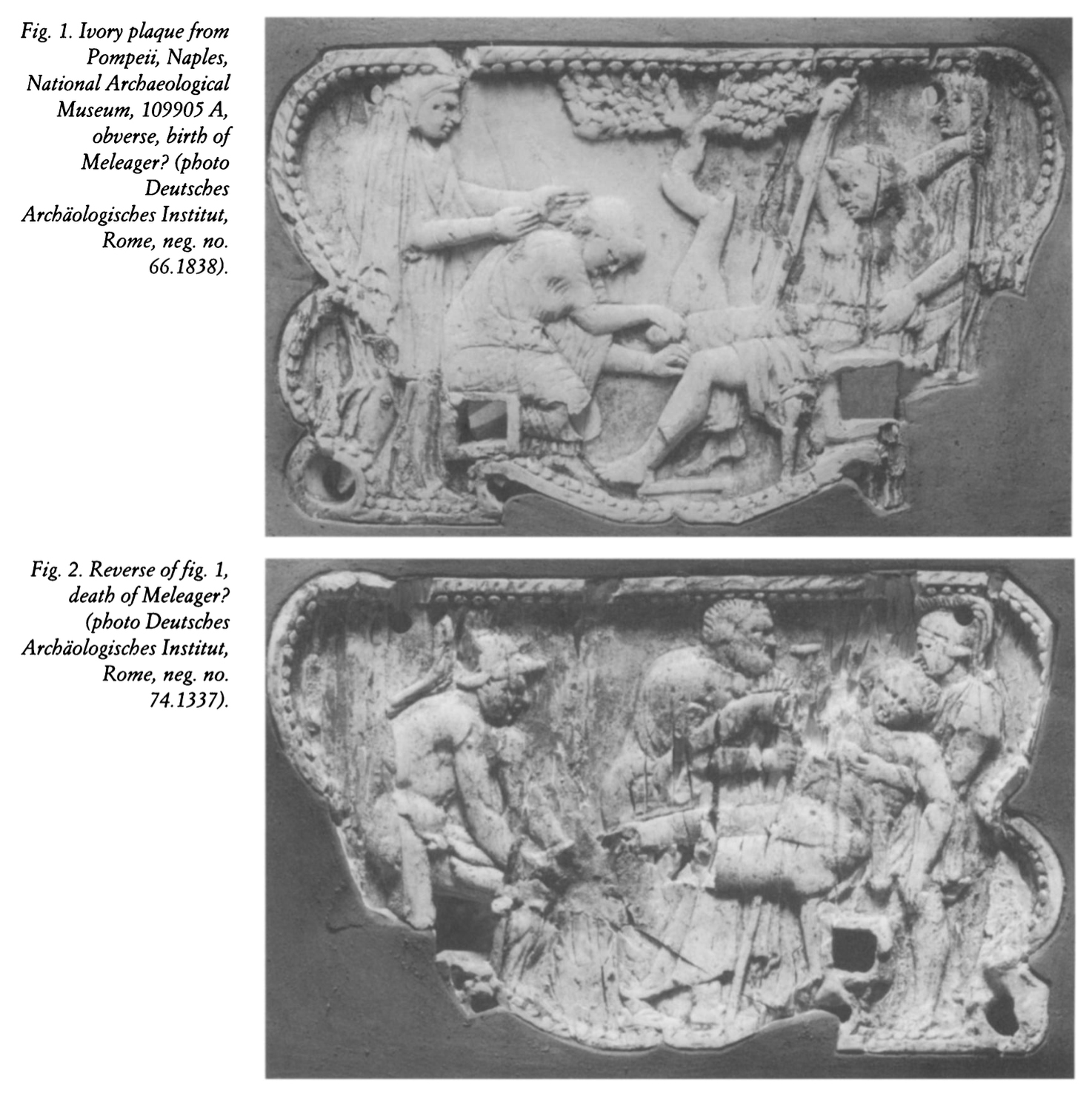
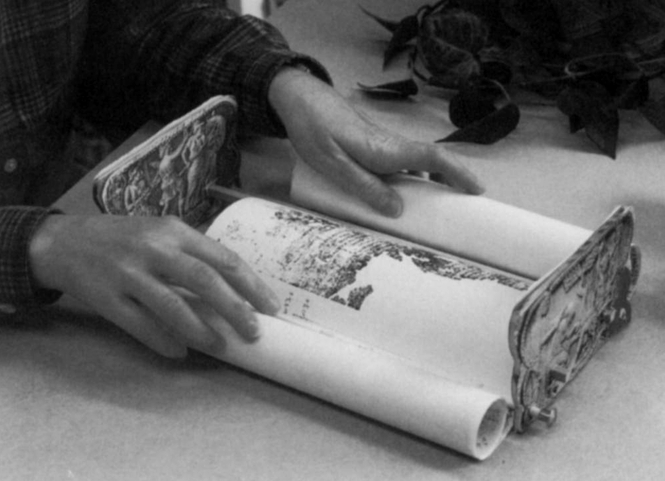
In a post back in 2021, I highlighted some interesting artifacts discussed in a 2001 article by Susan Wood. It’s a fascinating piece that focuses on two decorated ivory plaques with curious sets of holes found at Pompeii. The image below from her article reproduces the front and back of one of these plaques:
Ivory plaque from Pompeii, Naples Archaeological Museum 109905 A; image source: Susan Wood, “Literacy and Luxury in the Early Empire: A Papyrus-Roll Winder from Pompeii,” Memoirs of the American Academy in Rome 46 (2001), p. 24, figures 1 and 2
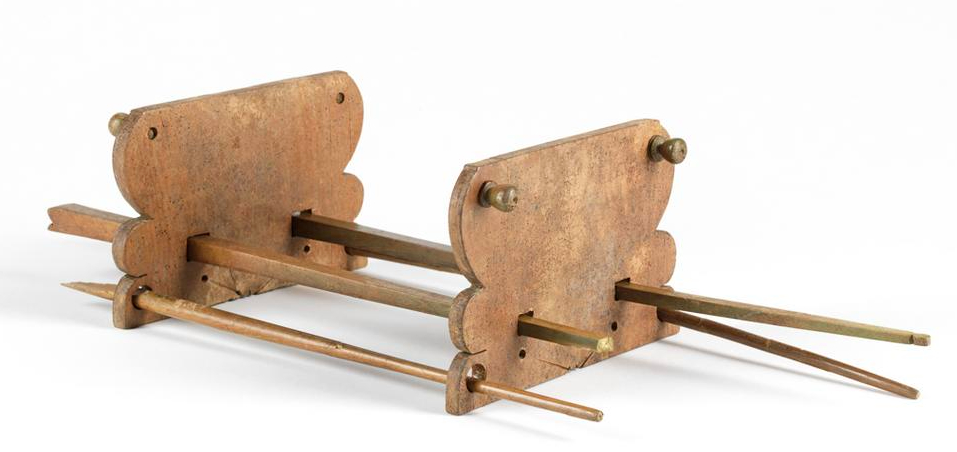
Wood makes a plausible case that these pieces were parts of a device for holding open papyrus rolls. She pointed to plaques of similar shapes and sizes in Cambridge and Nîmes, which are preserved together with sets of rods that fit through the various holes in the plaques:
Ivory plaque and rods (papyrus roll holder?) from Nîmes, Musée de la Romanité; image source: Moose and Hobbes
I recently had a chance to see the Pompeiian examples in person. Only one of them was in Naples, tucked away in a nondescript case in a corner. The other one, however, was part of a traveling exhibition at the Capitoline Museums in Rome. This one was in a case that you could actually walk beside and around, and it was interesting to see just how curved these plaques are. This is something that Wood noted in her article, describing the pieces as having convex and concave surfaces. I think that, when I saw the images above, I failed to register just how pronounced this curvature is. It’s a a bit difficult to see when viewing these objects from the front:
Ivory plaque from Pompeii, Naples Archaeological Museum 109905 A; image source: Brent Nongbri 2023
But looking at them from the side gives a better impression of the way that they curve.
Ivory plaque from Pompeii, Naples Archaeological Museum 109905 A; image source: Brent Nongbri 2023
I’m not sure how this curving surface would affect the way that these objects might function as the ends of devices that would have held papyrus rolls. One of the arguments Wood makes in favor of this interpretation is the idea that the ends of the papyrus rolls would rub against the plaques: “The more abraded concave surfaces must have been the inner sides of the plaques, which came in contact with the edges of papyri” (p. 32). But, if the plaques were curved, would the edges of papyrus rolls actually have much contact with the plaques? I note that the replica model pictured in Wood’s article seems to have been made with flat plaques like the Fitzwilliam example, and at least in the image provided, the mock-up roll only seems to be touching one of the two plaques:
If these plaques were curved, the roll would seemingly just touch the outer edges of the plaque. I wonder whether such a scenario would be consistent with the abrasion patterns that Wood mentions on the inner surfaces of the plaques? I didn’t get a sufficiently good look at the insides of the plaques to tell. I would be interested to see a replica of one of these devices in action.